
By the EradiTatt team · Laser tattoo removal specialists in Tampa Bay and Orlando since 2015
Short answer: the best time of year to get a tattoo removed in Tampa is fall or winter, ideally starting in October or November. Laser tattoo removal works best on skin that isn’t tanned. Treated skin also has to be kept out of strong sun while it heals. Tampa’s sun is at its mildest from late fall through winter, and that’s when it’s easiest to keep treated skin covered and out of the water. Starting in the fall also lets you finish four or five sessions before Clearwater Beach and boat-day season comes back.
Key takeaways
- Fall and winter are the easiest seasons for laser tattoo removal in Tampa because UV is lower and treated skin is easier to cover.
- Most tattoos need 8 to 12 sessions spaced 4 to 8 weeks apart, so full removal usually takes a year or more.
- Starting in October puts about five sessions behind you by Memorial Day.
- Summer treatment is possible with strict sun protection and no swimming until the skin heals.
- If you have a deadline, count back 6 to 8 weeks per session, plus two weeks of healing.
That doesn’t mean you have to wait. People start tattoo removal in Tampa every month of the year, and a good provider can work with any season. This guide explains why timing matters, what each Tampa season is like for someone in the middle of treatment, how to plan backward from a deadline such as a wedding or a new job, and what you can do to get the best results whenever you start.
Why the time of year matters for laser tattoo removal
To understand why the season matters, it helps to know what the laser is actually doing. Tattoo ink sits in the dermis, the layer of skin under the surface. The ink particles are too large for your body to remove on its own, which is why tattoos are permanent. A tattoo removal laser sends very short pulses of light energy into the skin. The ink absorbs that energy and breaks into much smaller fragments. Over the following weeks, your immune system gradually carries those fragments away through the lymphatic system, and the tattoo fades.
Three things about that process make timing important.
1. A tan gets in the way of the laser
The laser targets pigment. Ink is pigment, and so is melanin, the natural pigment that darkens your skin when you tan. When skin is freshly tanned, there’s more melanin between the laser and the ink. That raises the risk of side effects such as lighter patches (hypopigmentation) or darker patches (hyperpigmentation), and it can mean your provider has to use more conservative settings. That’s why Eraditatt asks clients to avoid sun and tanning for at least four weeks before treatment, and why we can’t treat skin that’s red from recent sun exposure.
2. Healing skin needs to stay out of the sun
Right after a session, the treated area is inflamed, much like a mild sunburn. It’s normal to see redness, swelling, a white “frosting” effect, and sometimes blisters or scabs over the next few days. Skin in that state reacts strongly to UV light. Sun exposure while it heals is one of the most common reasons people end up with lasting color changes around a removed tattoo. After each session, the area needs SPF 50+ or clothing over it, and it should stay out of pools and open water until any blisters or scabs have fully healed.
3. Sessions are spaced weeks apart
Your body needs time between sessions to clear the broken-up ink and for the skin to recover. At Eraditatt, sessions are usually spaced 4 to 8 weeks apart, most often 6 to 8. Most clients need between 8 and 12 sessions for full removal. So a complete removal usually takes a year or more, and each season you’re in treatment brings its own sun and lifestyle challenges. Choosing when to start decides which seasons your early, most reactive sessions fall in.
Tampa’s seasons for tattoo removal, compared
Tampa gets strong sun all year, but the difference between January and July is big. Here’s how each season tends to go for someone in the middle of a treatment plan.
| Season | Sun and UV | Lifestyle factors | How easy it is to be mid-treatment |
|---|---|---|---|
| Fall (Oct–Nov) | UV starts to ease off; summer tans fade | Fewer beach days, cooler evenings, long sleeves become comfortable | Best time to start |
| Winter (Dec–Feb) | Lowest UV of the year | Easiest time to keep the area covered; Gasparilla in late January | Excellent |
| Spring (Mar–May) | UV climbs quickly | Spring break, outdoor events, boating picks up | Good, with careful sun protection |
| Summer (Jun–Sep) | UV regularly very high; heat and humidity | Pools, Gulf beaches, boat days, outdoor work, lots of sweating | Possible, but takes the most discipline |
Fall: why October and November are ideal
By October, most people’s summer tans have started to fade. Your skin is in a better state for the laser, and your first few sessions heal during the coolest, least sunny months of the year. Many people find that their first two or three sessions bring the most visible change, especially with dark black ink. Getting those sessions done in fall means you’ll see real progress before you’re back in shorts and swimsuits.
Fall is also a practical time to start for another reason: the holidays. A lot of our Tampa clients start in the fall so a tattoo is noticeably lighter by spring events, weddings or a summer vacation. If you start in mid-October, your second session will usually land in early December.
There’s a scheduling benefit too. Interest in tattoo removal jumps in January with New Year’s resolutions and again in spring as people think about summer. Starting in the fall means more choice of appointment times, so it’s easier to keep sessions on schedule.
Winter: the easiest season to heal
Winter in Tampa is mild, but the sun is at its gentlest, and it’s comfortable to wear sleeves, pants and layers that keep a treated area covered. If your tattoo is somewhere usually exposed, like a forearm, hand, neck or ankle, winter is the easiest time to protect it. Starting in December or January works just as well as starting in the fall. You’ll just have fewer sessions done before summer.
One local note: if you’re planning to be out at Gasparilla in late January, try to schedule your session so the area has a week or two to heal first. Long days outside are hard on freshly treated skin, even in winter.
Spring: still a good time, with more care
Spring is a perfectly good time to start, and many people do because they’re thinking about summer. The difference is that UV rises quickly from March onward, and spring break, festivals and boating season all mean more time outside. If you start in spring, plan on wearing SPF 50+ over the treated area every day and covering it when you’re outdoors for long. Don’t book a session the week before a beach trip. Give your skin at least two weeks to heal before a big outdoor weekend.
Summer: possible, but the hardest season
You can absolutely get laser tattoo removal in a Tampa summer, but it takes the most discipline. After each session, the area needs to stay out of pools, the Gulf and freshwater springs until it has completely healed. Heat and humidity mean more sweating, which can irritate healing skin, and Eraditatt recommends no exercise for the first 24 hours after a session. Afternoon storms and humidity can make bandages and clothing over the area less comfortable. If you work outdoors, or spend most weekends on the water at places like Ben T. Davis Beach or Clearwater Beach, summer is when it’s hardest to protect your results.
For more detail, see our guide to laser tattoo removal in summer. If summer is the only time that works, that’s okay. Be honest with your provider about your plans. We may suggest spacing sessions a little further apart, timing them around trips, or treating at more conservative settings if your skin has any tan.
Your tattoo may look worse before it looks better
Here’s something many people don’t expect: a tattoo in the middle of removal doesn’t fade evenly like a photo dimming. After early sessions it can look patchy, blurry or “ghosted”, with some lines lighter than others. That’s normal, and it keeps improving with each session. It’s also one more practical reason to start in the cooler months. In a Tampa winter, a long sleeve or pants hide an in-progress tattoo without anyone thinking twice. In July, most people are in shorts and tank tops.
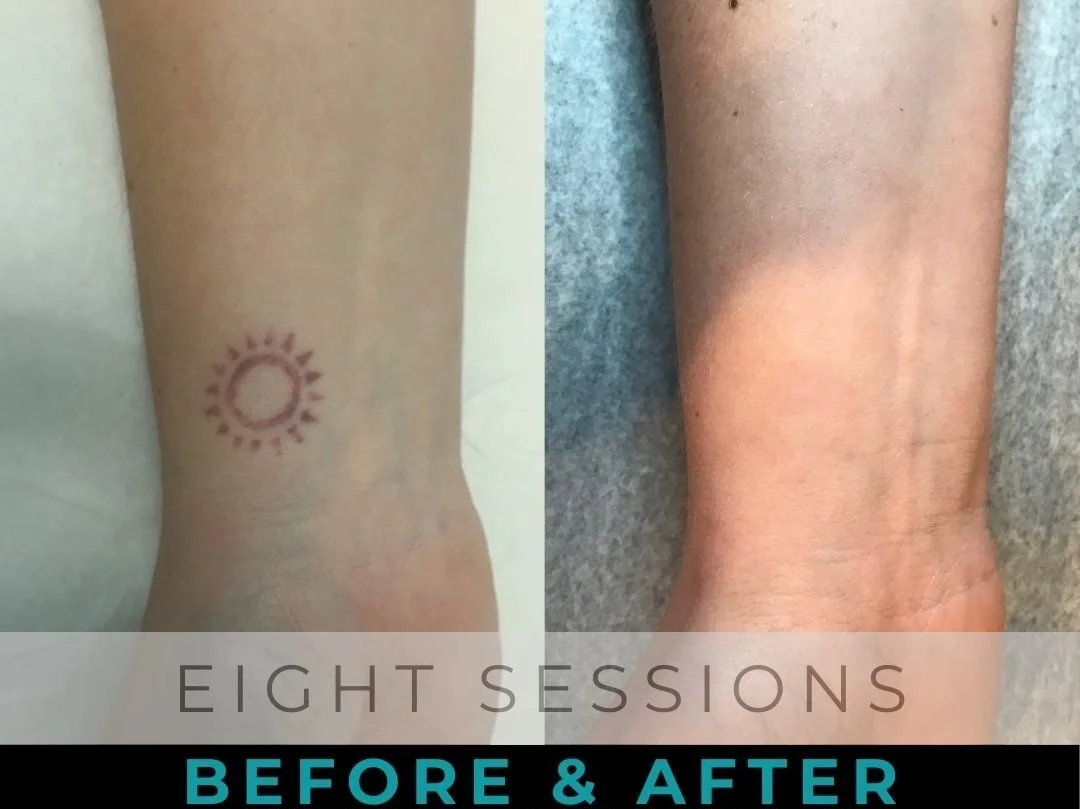
See more real client photos on our results and reviews page.
Sample timeline if you start in fall
Here’s roughly how a treatment plan looks if you start in mid-October and come in about every 6 to 8 weeks. Your schedule will depend on your tattoo and how your skin heals, so treat this as an example, not a promise.
| Session | Approximate timing | What’s typically happening |
|---|---|---|
| Free consultation | Early October | Tattoo assessment, skin type review, session estimate and pricing |
| 1 | Mid-October | First treatment; frosting and redness are normal for a few days |
| 2 | Early December | Many dark-ink tattoos look visibly lighter |
| 3 | Late January | Outline and shading start breaking up |
| 4 | Mid-March | Spring break season; keep the area covered or use SPF 50+ |
| 5 | Late April / early May | Healed in time for Memorial Day weekend |
| 6+ | Summer and the following fall | Continue as needed for full removal, timing sessions around trips |
Five sessions by late spring is often enough to fade a tattoo for a cover-up, or to lighten a small, dark tattoo a great deal. Full removal of larger, older-style or colorful tattoos usually continues through the next fall and winter. You can read more in our guide to how many laser tattoo removal sessions you’ll need.
How to plan backward from a deadline
Many people searching for the best time to get a tattoo removed have a specific date in mind: a wedding, a military enlistment, a job interview, a professional photo shoot or a cover-up appointment with a tattoo artist. If you have a deadline, work backward from it.
- Allow about two weeks after your final session for the skin to fully settle before the big day.
- Count back 6 to 8 weeks for each session you expect to need. Your provider can estimate this at your consultation.
- Add a buffer. Some tattoos need longer between sessions, especially colorful pieces and tattoos on the ankles, feet and hands, where circulation is slower and healing takes longer.
Example: a June wedding
Say you want a wrist or shoulder tattoo noticeably faded for a June wedding, and you expect to fit five sessions in first. Counting back roughly 7 weeks per session, plus two weeks of healing, puts your first session around late October or early November. Start in February instead and you’d likely get only two or three sessions in.
Example: fading for a cover-up
If your goal is a cover-up rather than full removal, you usually need fewer sessions, often 2 to 5. That’s enough to lighten the old design so your tattoo artist has a cleaner canvas. Start in the fall and you can often be ready for your artist by spring. Learn more about fading a tattoo for a cover-up.
Example: military or a new career
If you’re enlisting or starting a job with a visible-tattoo policy, ask your recruiter or employer exactly what’s required. Sometimes a tattoo only needs to be significantly faded, and sometimes it has to be gone. Tell us your deadline at your consultation so we can be honest about what’s realistic. Eraditatt offers a 15% discount for active-duty military and veterans. Read more about tattoo removal for military service.
What affects how many sessions you’ll need
The season you start in affects how easy treatment is. How long removal takes depends mostly on your tattoo and your body. These are the biggest factors:
- Ink color. Black and dark blue usually fade fastest. Colors like green, light blue, yellow and white can take more sessions. Eraditatt uses the PiQo4 laser, which has four wavelengths and both picosecond and nanosecond modes, so different colors can be targeted with the right wavelength. Learn more in our guide to the PiQo4 laser.
- Ink density and depth. Heavily saturated professional tattoos and layered cover-ups usually take longer than light, thin linework.
- Age of the tattoo. Older tattoos have often faded a bit naturally and may respond faster.
- Location on the body. Areas closer to the heart with good circulation, like the chest, upper arm and back, tend to clear faster than hands, ankles and feet.
- Your immune system and health. Your body does the work of clearing the ink. Smoking slows healing and can slow results, so cutting back helps.
- Skin type. Your provider will adjust the wavelength and settings for your skin tone to keep treatment safe. Read more about tattoo removal on darker skin.
For a broader look, see our guide on how long tattoo removal takes.
How to prepare for your first session
Whatever time of year you start, a little preparation makes treatment safer and more effective. Our full guide on how to prepare for tattoo removal goes into more detail, but here are the essentials:
- Avoid tanning and heavy sun for at least four weeks before. That includes tanning beds and self-tanner on the area.
- Use SPF 30 or higher on the tattoo every day, even when it’s cloudy. Tampa’s UV is strong enough to matter in winter too.
- Cut back on smoking if you smoke. It helps your skin heal between sessions.
- Ask about numbing cream if you’re nervous about discomfort. If you use it, apply it about an hour before your appointment. Most people describe the laser as feeling like a rubber band snapping against the skin, and Eraditatt uses a Zimmer Cryo 6 cold-air chiller during treatment for comfort.
- Shave carefully, or not at all. If the area is hairy, your provider may ask you to shave it before your appointment. Afterward, avoid shaving or waxing over treated skin until it has fully healed.
- Wear loose clothing over the area so nothing rubs on it afterward.
- Tell your provider about medications and health conditions. Some, such as isotretinoin (Accutane) or blood thinners, affect whether and when you can be treated.
Most appointments are quick, often just 5 to 15 minutes depending on the size of the tattoo. Your first visit takes a little longer to allow for your consultation and photos. You can see each step in our laser tattoo removal process.
Aftercare in Tampa’s climate
Good aftercare matters in any season, but Tampa’s heat, humidity and outdoor lifestyle add a few extra things to watch:
- Keep it clean and covered at first. Follow the bandaging instructions you’re given for the first few days, then let the skin breathe.
- No exercise for 24 hours, then ease back in slowly. Heavy sweating and friction from gym clothes or straps can irritate the area.
- Stay out of pools, hot tubs, the Gulf and springs until any blisters or scabs have fully healed. Open skin plus water raises the risk of infection.
- Don’t pick or scratch. Blisters and scabs are part of healing. Picking can lead to scarring or uneven fading.
- Protect it from the sun for weeks, not days. Use SPF 50+ or cover the area with clothing whenever you’re outside, including on boat days, at outdoor games and during your commute.
See our full tattoo removal aftercare guide for day-by-day instructions, and the most common mistakes to avoid after treatment.
What tattoo removal costs in Tampa
Eraditatt prices treatment by tattoo size, the same at every location. You can pay session by session or buy a package of four sessions at 20% off.
| Tattoo size | Per session | Package of 4 (20% off) |
|---|---|---|
| XX-Small (smaller than a quarter) | $100 | $320 |
| X-Small (smaller than a credit card) | $175 | $560 |
| Small (smaller than a dollar bill) | $225 | $720 |
| Medium (smaller than a CD) | $300 | $960 |
| Large (smaller than a DVD case) | $400 | $1,280 |
| X-Large (smaller than a sheet of paper) | $600 | $1,920 |
Active-duty military and veterans get 15% off, and when you refer a friend who starts treatment, you get $50 off your next session. Prices can change, so check our laser tattoo removal cost page for current pricing, or send a photo for a free quote.
Laser tattoo removal in Tampa: where to go
Our Tampa clinic is at 1715 N. Westshore Blvd, Suite 100, Tampa, FL 33607, near International Plaza and Tampa International Airport. We’re open Monday to Friday 10 am to 6 pm and Saturday 10 am to 3 pm. Patients come to us from South Tampa, Westshore, Brandon, Riverview, Valrico, Temple Terrace, Lutz, Wesley Chapel, Plant City and across Tampa Bay.
Every treatment is performed by Melissa Hoperich, FNP, our owner and nurse practitioner, who has completed thousands of laser tattoo removal sessions. We treat black and multicolored body tattoos, fade tattoos for cover-ups, and remove cosmetic eyebrow tattoos, microblading and powder brows. Learn more about laser tattoo removal in Tampa, or call us at (813) 235-4111.
Choose your provider before you choose your start date
The season matters, but who treats you matters more. Before you book, ask a few questions. Who actually operates the laser, and what training do they have? Which laser do they use, and can it treat your ink colors? How many sessions do they honestly expect for your tattoo? What’s the total cost, including packages? A good clinic will give you a realistic answer, including telling you if you should wait for a tan to fade or plan around an upcoming trip. At EradiTatt, tattoo removal is all we do. Every consultation is free, and there’s no pressure to commit.
Frequently asked questions
Is it better to get a tattoo removed in summer or winter?
Winter is generally better. Your skin is less likely to be tanned, the sun is gentler, and it’s easier to keep treated skin covered and out of the water while it heals. Summer treatment is possible but takes more care with sun protection and avoiding pools and the Gulf.
Can my tattoo be completely gone by summer if I start in the fall?
Some small, dark tattoos can get close. Most tattoos need 8 to 12 sessions, though, and at 6 to 8 weeks apart, fall to summer fits about five. For most people, a fall start means significant fading by summer, with full removal finishing later.
Can I get laser tattoo removal if I’m still tan from summer?
Usually not right away. Treating tanned skin raises the risk of lighter or darker patches. Your provider may recommend waiting a few weeks for your tan to fade. That’s one more reason October and November are such good months to start.
Can I go to the beach between sessions?
Yes, once the treated area has completely healed, as long as you keep it covered or protected with SPF 50+. Stay out of the water entirely while there are any blisters, scabs or open skin.
Is January a good time to start tattoo removal?
Yes. In Tampa, January has some of the lowest UV of the year, and it’s easy to keep a treated area covered. Your early sessions will heal during the gentlest months. The only drawback compared with a fall start is that you’ll have fewer sessions done before summer.
Does the season change how many sessions I need?
Not directly. Your session count depends mostly on your tattoo’s colors, density, age and placement and on your immune system. The season can make a difference indirectly, though: a tan or sun damage can force delays or more conservative settings, which can stretch out your timeline.
How soon after getting a tattoo can I start removal?
A new tattoo needs to be fully healed before laser treatment, which usually takes several weeks at minimum. Your provider will confirm the skin is ready at your consultation. Have more questions? Visit our tattoo removal FAQ.
How do I know how many sessions my tattoo needs?
Book a free consultation or send us a photo. We’ll look at the size, colors, age and placement of your tattoo along with your skin type, and give you a realistic session range and price before you commit to anything.
Ready to start?
If you’ve been thinking about removing a tattoo, this fall is a great time to start. You’ll be well into your fade plan by the time summer comes around. Send us a photo of your tattoo for a free quote, or book your free consultation at our Tampa office. Not close to Westshore? We also treat patients at our St. Petersburg, Palm Harbor, Bradenton/Sarasota and Orlando locations.