
You notice the dark patch while checking the tattoo in ordinary light. The tattoo itself looks lighter, but a slate-gray or brown shadow now seems to sit beneath the skin. It's easy to assume the laser pushed the ink deeper or failed to remove it. In many cases, the answer is more specific, and identifying the cause determines what should happen next.
Tattoo removal hyperpigmentation can describe several different changes. The dark area may be residual ink, post-inflammatory hyperpigmentation, or paradoxical darkening caused by a reaction within certain cosmetic pigments. These conditions can look similar at first, but they differ in timing, texture, color, and treatment. A calm assessment is more useful than immediately adding stronger creams or scheduling another laser session.
Table of Contents
- When Dark Spots Show Up After Laser Tattoo Removal
- What Hyperpigmentation Actually Means in This Context
- Why the Laser Sometimes Triggers Excess Pigment
- How Skin Tone and Tattoo Color Shape Your Risk
- Practical Ways to Prevent Darkening Before and Between Sessions
- Treatment Options That Help Hyperpigmentation Fade
- When to Stop Waiting and See a Specialist
When Dark Spots Show Up After Laser Tattoo Removal
Mira was three weeks past her fourth laser session when she noticed the change. The rose tattoo on her ankle had been fading gradually, yet a slate-gray shadow now mirrored the old design. She worried that the treatment had made the tattoo darker.
Her concern was reasonable. Darkening after laser tattoo removal can come from three different sources:
- Residual ink: Tattoo particles remain in the dermis and continue to appear as part of the original design. The color usually follows the tattoo's shape and may fade gradually as the immune system clears fragmented pigment.
- Post-inflammatory hyperpigmentation: The laser has irritated the skin, and melanocytes have produced excess melanin. This usually appears as a flat brown, gray-brown, or ashy patch around or over the treated area.
- Paradoxical darkening: Certain cosmetic or flesh-toned pigments, especially those containing titanium dioxide, can oxidize after laser exposure and turn black-gray rather than becoming lighter.
The distinction matters because each cause needs a different lever. Residual ink may call for a carefully selected tattoo-removal wavelength and more healing time. Post-inflammatory hyperpigmentation usually calls for inflammation control, strict sun protection, and patience. Paradoxical darkening may require reassessment of the pigment chemistry and laser approach instead of repeated treatment with the same settings.
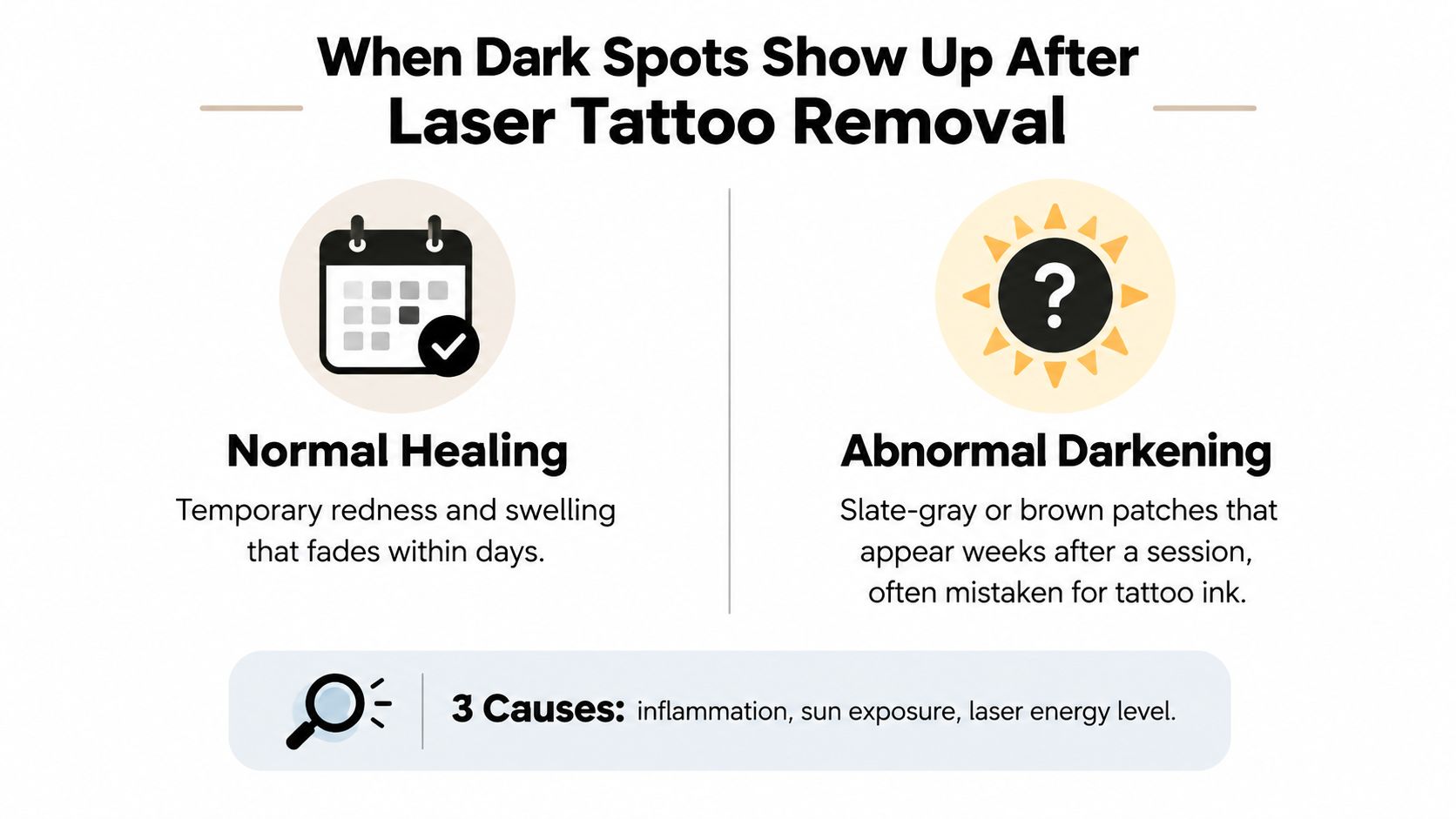
Normal early healing commonly includes redness, swelling, tenderness, and crusting. Darkening that appears later, especially as a brown or slate-gray patch after the surface has settled, deserves closer observation rather than an automatic assumption that more ink remains.
First question: Does the dark area behave like the tattoo, or does it look like a flat stain extending around the treated skin?
A photograph taken under consistent lighting can help you and your provider compare the area over time. Don't scratch, scrub, or resume treatment because the color is worrying. The next step is to sort the appearance into the correct lane.
What Hyperpigmentation Actually Means in This Context
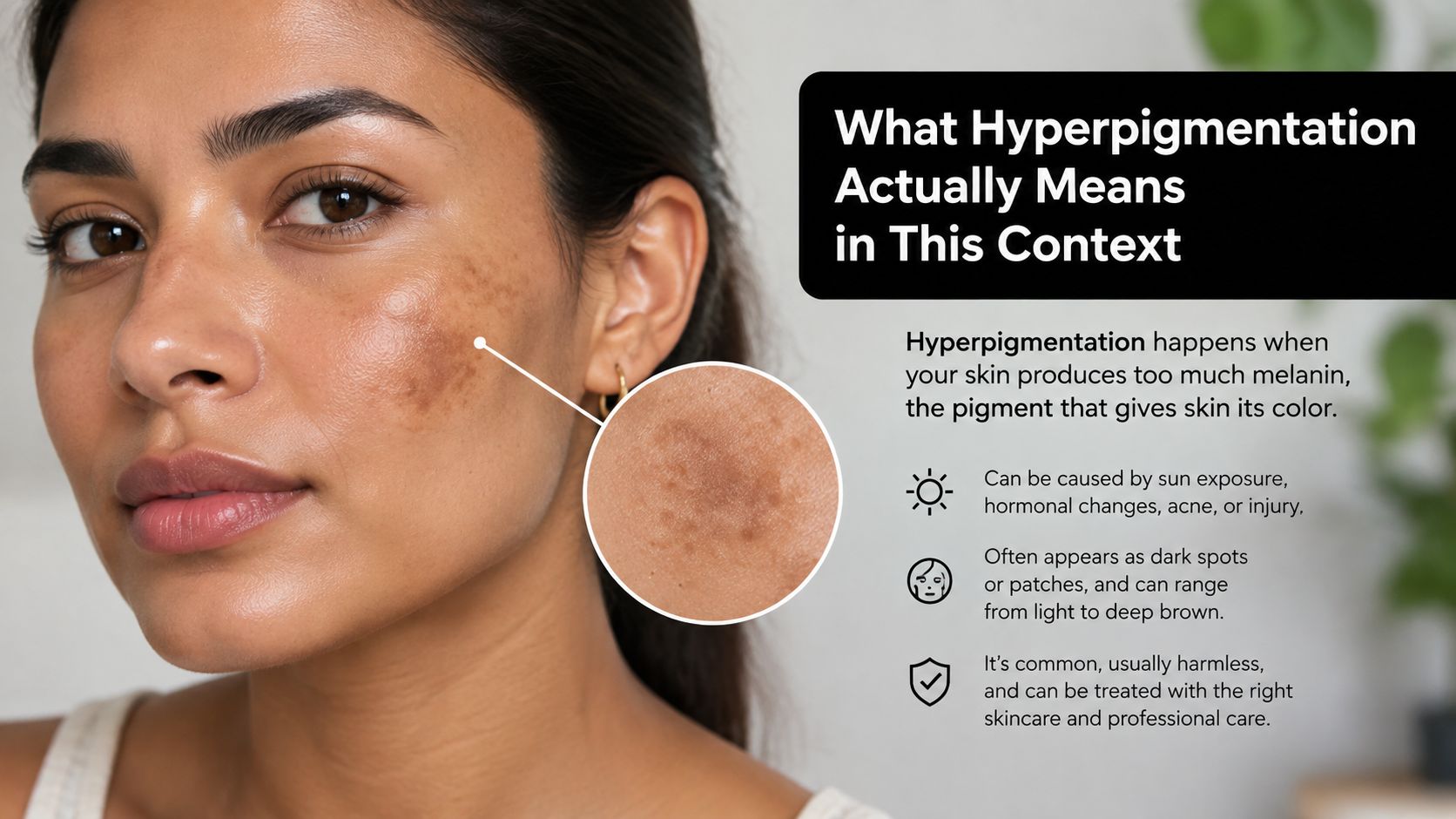
Post-inflammatory hyperpigmentation, or PIH, is excess melanin left behind after inflammation or injury. The skin may look completely closed and calm on the surface while pigment cells continue to leave a brown or gray-brown mark underneath.
A useful analogy is a sunburn without the peeling. After ultraviolet exposure, skin can produce more pigment as a protective response. With laser tattoo removal, the trigger isn't necessarily sunlight. The laser creates a controlled injury through rapid energy delivery, pigment fragmentation, and local heat. That irritation can signal melanocytes in much the same way that a scrape, burn, or inflamed blemish can.
The sequence is straightforward:
- Laser energy reaches the tattoo and surrounding tissue.
- The energy produces a rapid photothermal or photomechanical response.
- Local inflammation sends chemical signals through the skin.
- Melanocytes respond by producing or distributing additional melanin.
- The extra pigment remains after redness and swelling have faded.
That's why PIH can be mistaken for leftover tattoo ink. Both changes can follow the original design, and both may look darker before they look lighter. PIH is usually flat rather than raised, and it isn't the same thing as a scar. It's a biologically reversible pigment response, although the fading process can be slow and varies with skin tone, sun exposure, treatment settings, and the intensity of inflammation.
The distinction also explains why aggressive exfoliation can backfire. If the skin is still irritated, adding acids, scrubs, heat, or friction may create another inflammatory signal and encourage additional pigment production. Gentle care is often more appropriate while the area is recovering.
For a broader overview of ways clinicians and skincare professionals approach uneven pigmentation, review these hyperpigmentation treatment options. That information can help you understand the difference between supporting gradual fading and irritating recently treated skin.
Why the Laser Sometimes Triggers Excess Pigment
Laser settings don't affect only the tattoo. They also determine how much energy the surrounding skin receives and how much inflammation follows. The main variables are wavelength, fluence, pulse duration, skin phototype, and aftercare.
A 1064 nm wavelength generally penetrates more readily and is considered more melanin-sparing than shorter wavelengths. Wavelengths such as 532 nm are absorbed more readily by epidermal pigment, so the provider has to account carefully for skin tone and ink color. Fluence, the energy delivered over an area, and pulse duration also shape the balance between breaking ink and heating nearby tissue.
| Driver | How It Raises Risk | Safer Setting |
|---|---|---|
| Wavelength | A wavelength that interacts strongly with epidermal melanin can increase pigment stimulation, particularly in medium-to-deep skin tones. | Match the wavelength to the ink color, depth, and Fitzpatrick phototype. |
| Fluence | Excessive energy can increase thermal injury and inflammation around the tattoo. | Begin conservatively and calibrate energy to the treatment response. |
| Pulse duration | Poorly matched pulse characteristics can deliver more collateral heat than the ink requires. | Use a pulse duration and platform suited to the pigment and treatment goal. |
| Skin phototype | Higher baseline melanin creates more competing pigment for the laser to interact with. | Use test spots, cautious escalation, and longer observation between sessions. |
| Aftercare | Sun, picking, friction, heat, and sweat can add inflammation after the laser response. | Protect the area, keep care gentle, and follow the provider's recovery plan. |
A 2022 randomized clinical trial reported hyperpigmentation in 2 of 30 tattoos treated with a nonselective laser, 4 of 30 treated with a picosecond 1064 nm laser, and 0 of 30 treated with a picosecond 532 nm laser. Hypopigmentation occurred only in the nonselective-laser group, affecting 3 of 30 tattoos. These findings don't mean one wavelength is universally safe or unsafe. They show that wavelength and platform choice materially influence pigmentary outcomes. (Randomized clinical trial)
Skin tone raises the baseline sensitivity of the decision. Fitzpatrick IV to VI skin types carry a higher risk of PIH because more melanin is present in the epidermis and melanocytes can respond strongly to inflammation. A literature review places post-laser hyperpigmentation at about 5% to 15% of treated cases, with higher risk in Fitzpatrick IV to VI skin types. (Clinical literature review)
Sun exposure, picking scabs, and unnecessary heat or sweat can add a second inflammatory hit. The biology behind that process is described clearly in this resource on PIH biological triggers explained. The risk usually comes from several factors stacking together, not from one isolated mistake.
How Skin Tone and Tattoo Color Shape Your Risk
Skin tone and ink color create different risk profiles. Fitzpatrick typing isn't a judgment about complexion. It's a clinical framework that helps a provider estimate how much natural melanin may compete with the tattoo pigment for laser energy.
| Fitzpatrick Type | Skin Description | PIH Risk Level | Highest-Risk Ink Colors |
|---|---|---|---|
| I | Very light skin that burns easily | Lower baseline risk, though inflammation can still cause pigment change | White, flesh-toned, yellow, and cosmetic pigments |
| II | Light skin with limited tanning response | Lower to moderate risk | White, yellow, red, and cosmetic pigments |
| III | Light to medium skin that may tan | Moderate risk | Red, yellow, white, and flesh-toned inks |
| IV | Medium to olive or light brown skin | Higher risk of PIH | Red, yellow, white titanium dioxide, and flesh-toned inks |
| V | Brown skin with substantial baseline melanin | Higher risk of pigmentary change | White titanium dioxide, flesh-toned, red, and yellow inks |
| VI | Deep brown to very deep skin | Higher risk of both pigmentary complications and cautious treatment limits | White, flesh-toned, cosmetic pigments, red, and yellow inks |
A large review of tattoo-removal complications documented hypopigmentation in 8% of patients with darker skin and hyperpigmentation in 22%. (Review of tattoo-removal complications) These figures show why deeper skin tones need individualized settings, not a one-size-fits-all protocol.
Ink chemistry adds another layer. Red, yellow, white, and flesh-toned pigments can behave differently from uncomplicated black ink. Titanium dioxide in some cosmetic pigments may oxidize during laser exposure and create a black-gray appearance. That's paradoxical darkening, not a darker layer of ordinary tattoo ink.
Placement matters, too. Hands, forearms, and the chest receive more incidental sunlight than covered areas, and repeated exposure can keep melanocytes active. If you're assessing your own situation, compare your Fitzpatrick type, ink colors, and daily sun exposure rather than judging risk from tattoo color alone. Guidance on tattoo removal on dark skin can provide additional context before you discuss settings with a qualified provider.
Practical Ways to Prevent Darkening Before and Between Sessions
Prevention starts before the appointment. The objective is to reduce competing melanin activity, avoid unnecessary irritation, and give the skin enough time to settle after each session.
Protect the treated area from ultraviolet exposure
Apply broad-spectrum SPF 50+ to exposed treated skin every morning, and reapply every two hours when you're outdoors. Avoid deliberate tanning for at least four weeks before and after a session. Medical guidance identifies UVA and UVB exposure as contributors to both hyperpigmentation and hypopigmentation after treatment. (Medical guidance on sun avoidance)
Covering the area with clothing or seeking shade adds protection sunscreen can't provide by itself. If the skin is blistered, crusted, or open, follow your provider's instructions about when topical sunscreen is appropriate.
Leave enough recovery time
Many providers use an interval of eight to twelve weeks when pigmentary risk is a concern. The correct timing depends on how the skin healed, whether darkening is still changing, and which laser and wavelength were used. Treating again while the area remains inflamed can prolong the pigment response.
Before treatment, ask whether you should pause retinoids and exfoliating acids five to seven days beforehand. Ask which wavelength is planned, whether a test spot is appropriate for your skin tone, and how fluence will be calibrated if the test area reacts strongly.
Keep recovery boring
Use cool compresses for comfort, but don't apply ice directly to the skin. Leave micro-crusts alone, avoid picking, and reduce friction from tight clothing or rubbing. A provider-approved, silicone-based healing balm may help limit irritation while the barrier recovers.
Gentle, fragrance-free moisturization can support comfort, but it shouldn't replace the removal clinic's wound-care instructions. The post-laser tattoo removal guidance offers another practical reference for organizing care between appointments.
Treatment Options That Help Hyperpigmentation Fade
Treatment should match the diagnosis and the skin's recovery stage. A flat brown patch caused by PIH is managed differently from oxidized cosmetic ink, and recently treated skin may worsen if brightening products are introduced too aggressively.
Start with protection and low-irritation support
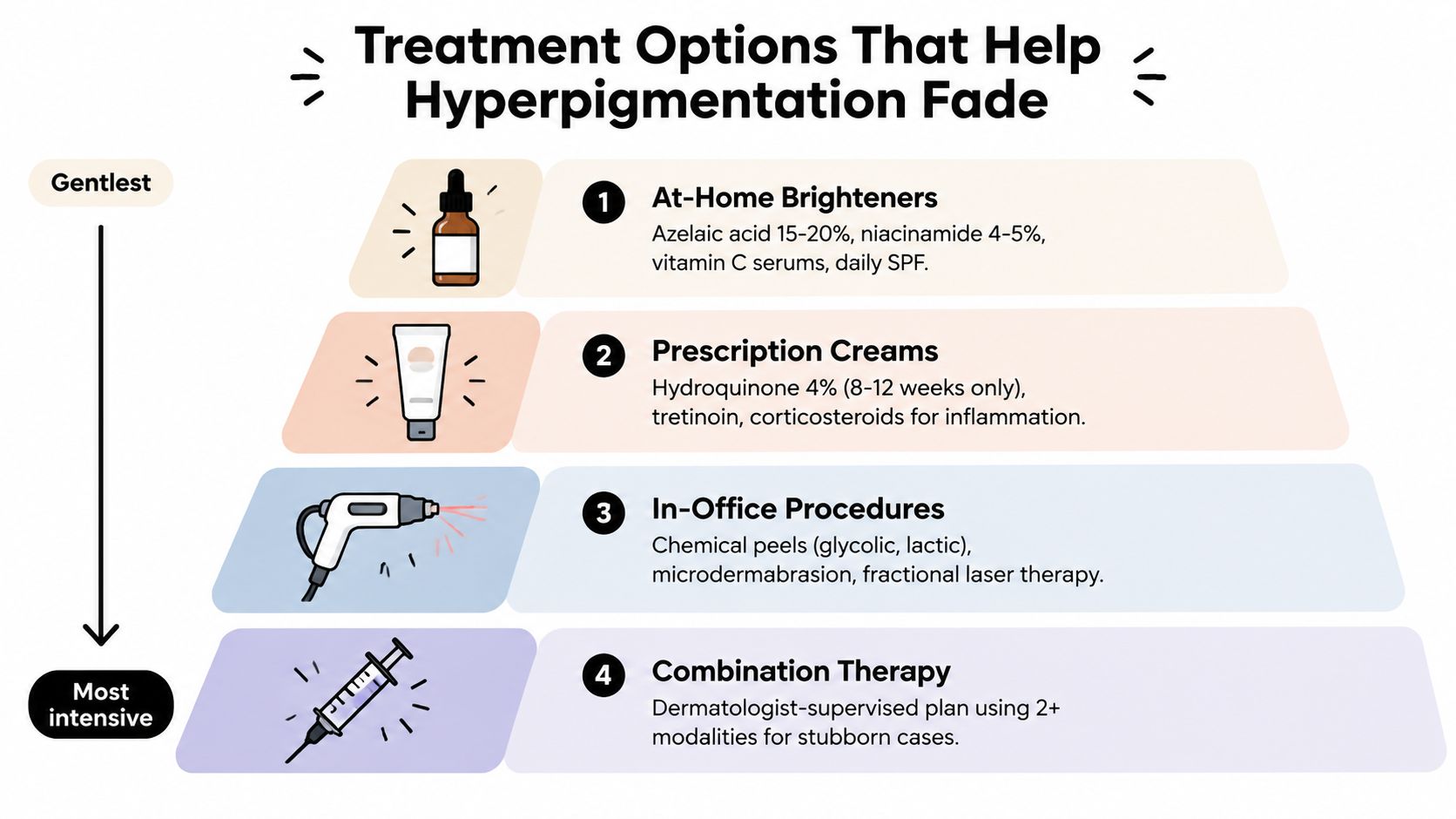
Daily sunscreen is the foundation because ultraviolet exposure can deepen existing pigment. Once the skin has fully closed and your provider confirms that active products are appropriate, gentler options may include:
- Azelaic acid: Commonly used at 15% to 20% concentrations for uneven pigmentation and inflammation.
- Niacinamide: Often formulated at 4% to 5% to support a more even appearance with relatively low irritation potential.
- Vitamin C: A topical antioxidant option that may support brightness when the skin barrier tolerates it.
The numbers above describe common formulation ranges, not a universal prescription. Recently lasered skin can react differently from untreated skin, so introduce one product at a time and stop if burning, worsening redness, or scaling develops.
For people who prefer a simpler botanical-focused routine, this guide to a plant-powered routine for even tone may help with product-selection ideas. It shouldn't replace an assessment when the color change could be residual ink or paradoxical darkening.
Move to clinician-directed options when needed
A dermatologist may consider prescription hydroquinone 4%, kojic acid, or arbutin combinations for selected cases. Hydroquinone is commonly used in defined cycles of eight to twelve weeks, followed by a break or reassessment. A clinician should decide whether it's appropriate, especially if the treated area remains sensitive.
Chemical peels using glycolic, lactic, or mandelic acid can increase turnover, but a peel is still an intentional injury. Microneedling also creates controlled trauma, so it may aggravate PIH if performed before the skin has stabilized. These treatments require careful timing and conservative technique.
Reserve intensive approaches for confirmed, persistent pigment
For stubborn PIH, a qualified clinician may discuss low-fluence Q-switched laser passes aimed at melanin rather than residual tattoo ink. Tranexamic acid protocols, topical or oral, may also be considered under medical supervision. Neither approach should be used to guess at the cause of a gray patch.
The systematic review of tattoo-removal outcomes found that 69% to 100% of tattoos achieved more than 70% pigment clearance after one to ten sessions, while adverse effects commonly included hyperpigmentation. (Systematic review of laser tattoo removal) The finding reinforces an important point: fading the tattoo and correcting a pigment complication are separate treatment goals. If the concern is a light patch instead of a dark one, read about hypopigmentation after tattoo removal before choosing any brightening treatment.
When to Stop Waiting and See a Specialist
Not every dark mark needs urgent intervention, but waiting indefinitely can make the situation harder to interpret. A clinician should assess hyperpigmentation that hasn't visibly improved after eight to twelve weeks of consistent sunscreen, gentle care, and appropriate brightening products.
Book an evaluation sooner if the pigment spreads beyond the tattoo borders, develops uneven edges, or changes into a deeper brown, blue-gray, or ashy tone that doesn't match the surrounding skin. A color shift that mirrors the ink may point toward residual or paradoxically darkened pigment rather than ordinary PIH.
Watch for symptoms beyond color
Pigment alone is usually a cosmetic concern. Pigment accompanied by other changes needs closer attention:
- Persistent itching or stinging: Ongoing discomfort may indicate continuing inflammation or sensitivity.
- Raised texture: A thickened, firm, or raised area can suggest scarring rather than flat PIH.
- Unresolved blistering: Blisters that don't heal as expected require professional review.
- Light patches: Hypopigmentation can occur alongside tattoo-removal treatment and needs a different assessment.
- Possible infection: Increasing pain, warmth, drainage, or spreading redness should be evaluated promptly.
The distinction between PIH and paradoxical darkening is especially important. PIH reflects melanocyte activity in response to inflammation. Paradoxical darkening may reflect pigment chemistry, including oxidation of titanium dioxide in cosmetic ink. Topical brighteners may not correct that problem, and the provider may need to reconsider the laser wavelength or treatment strategy. Clinical literature also emphasizes that IPL is discouraged for tattoo treatment because it can interact unpredictably with tattoo pigments. (Clinical discussion of pigment changes and tattoo-removal complications)
A board-certified dermatologist, experienced laser specialist, or the original removal technician can be a useful first point of contact. When booking, say: “I had tattoo removal with [laser type], I have Fitzpatrick skin type [type], I've completed [number of sessions], and my current aftercare routine is [routine]. The treated area has developed [color and symptoms], and it has changed over [time].”
That information helps the provider distinguish healing pigment from remaining ink, identify unsafe timing, and decide whether treatment should pause.
EradiTatt Tattoo Removal provides consultations and progressive laser-removal plans across Central and West Florida, including Orlando, Bradenton/Sarasota, St. Petersburg, Palm Harbor, and Tampa. If darkening has appeared after a session, visit EradiTatt Tattoo Removal to discuss your skin type, ink colors, laser history, and a safer next step with the team.
2 Responses