
You notice a pale outline where your tattoo used to be. The ink looks lighter, but the surrounding skin also seems lighter, almost as though the design has left a ghost behind. That change can be unsettling, especially when you started laser treatment expecting the skin beneath the tattoo to return to its natural color.
This is called hypopigmentation after tattoo removal. It often improves as the skin recovers, but the outcome depends on factors such as your skin phototype, the laser wavelength, treatment intensity, and how much time your skin has between sessions. Understanding those variables can help you recognize a normal recovery pattern, avoid preventable irritation, and ask better questions before another treatment.
Table of Contents
- What Hypopigmentation Means After Tattoo Removal
- Why Hypopigmentation Happens During Laser Removal
- Risk Factors That Raise Hypopigmentation Odds
- How to Reduce Hypopigmentation Risk Before and After Sessions
- Treatment Options When Hypopigmentation Persists
- Recovery Timelines and What to Ask at Your Consultation
- Next Steps With EradiTatt Across Florida
What Hypopigmentation Means After Tattoo Removal
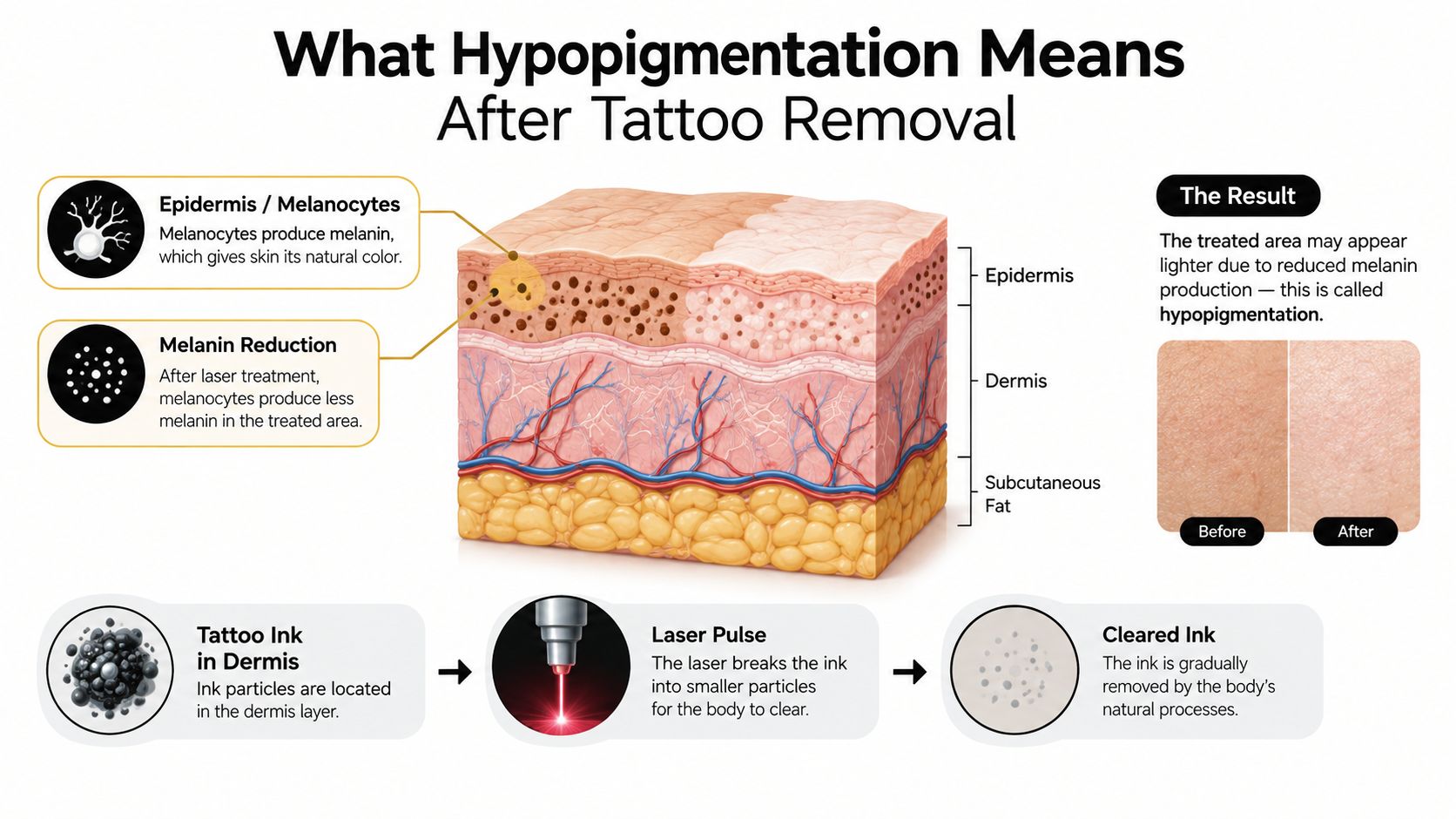
Hypopigmentation means the treated skin has less natural melanin than the surrounding area. Melanin is the pigment that gives your skin its baseline color. After laser tattoo removal, hypopigmentation may appear as a lighter patch that follows the former tattoo's shape. A mild case can look like soft fading, while a more noticeable case creates a pale, almost ghost-like outline.
That appearance isn't the same as tattoo ink fading. Ink removal means the laser has fragmented tattoo pigment and the body is clearing those particles. Hypopigmentation means the skin's own pigment has been reduced or temporarily suppressed during treatment. You can have one without the other, although both may appear in the same area.
Where the pigment changes occur
Tattoo ink sits in the dermis, a deeper layer of skin beneath the epidermis. The ink particles become surrounded by connective tissue and are gradually handled by immune cells called macrophages. Those cells can transport and process fragmented pigment over time, which is part of why tattoo removal requires multiple treatments rather than one pass.
The epidermis, meanwhile, contains melanocytes. These are the pigment-producing cells responsible for making melanin that colors the skin above the tattoo. Laser energy aimed at tattoo pigment can also interact with melanin or create enough local stress to temporarily reduce melanocyte activity.
A simple way to understand the process is:
- Tattoo ink occupies the dermis.
- The laser breaks the ink into smaller fragments.
- The immune system helps clear those fragments.
- Nearby melanocytes may become temporarily less active or may be injured.
- The surface then looks lighter until pigment production resumes, if the cells recover.
Temporary suppression versus lasting damage
Temporary hypopigmentation occurs when melanocytes are stunned by inflammation or treatment stress but remain capable of producing pigment. The patch may gradually blend back into the surrounding skin as those cells resume normal activity. More lasting lightening can occur when melanocytes have been seriously injured or destroyed.
A clinical review notes that hypopigmentation is generally less common than hyperpigmentation but may be more likely to persist, particularly in darker or recently tanned skin types (medical review of post-inflammatory pigment changes). That doesn't mean every pale patch is permanent. It means the appearance should be monitored rather than dismissed.
If you're also researching the broader role of automation in direct-to-consumer businesses, Faint for DTC lead generation offers useful background. For the skin itself, the practical point is simple: protect the treated area from additional irritation and let a qualified provider assess whether the lightening is still evolving.
Why Hypopigmentation Happens During Laser Removal
Laser tattoo removal works by directing concentrated energy toward ink particles. The pulse creates photoacoustic and photothermal effects that fracture the pigment so the body can clear it. The challenge is that the laser doesn't interact with ink in complete isolation. Melanin can also absorb energy, especially when the selected wavelength and treatment settings deliver more heat or energy to the epidermis.
The role of pulse duration
Older Q-switched nanosecond lasers were an important part of modern tattoo removal, but their treatment dynamics could create more thermal stress in surrounding tissue. A landmark 1994 Arch Dermatol study reported greater than 95% pigment removal after an average of 8.9 treatment sessions, while transient hypopigmentation occurred in approximately 50% of patients (1994 Arch Dermatol study). The same study documented transient textural surface changes in 12% of patients, establishing that pigmentary and surface reactions were recognized complications of early laser treatment.
Picosecond devices use shorter pulses, which can create a stronger mechanical effect on pigment with less reliance on prolonged heating. That can reduce collateral thermal exposure, but it doesn't eliminate risk. A comparative clinical report observed hypopigmentation in 3 of 30 tattoos treated with a nanosecond laser, while it wasn't observed in the picosecond arm in that series (clinical comparison of nanosecond and picosecond treatment).
| Laser Era | Pulse Duration | Reported Hypopigmentation Rate | Mechanism |
|---|---|---|---|
| Early modern laser era | Nanosecond | Approximately 50% transient hypopigmentation in the 1994 study | Greater thermal contribution alongside pigment fragmentation |
| Contemporary comparison | Nanosecond | 3 of 30 tattoos in one 2022 series | Ink disruption with observed pigmentary injury |
| Contemporary comparison | Picosecond | Not observed in the picosecond arm of that series | Shorter pulse structure with a more mechanical emphasis |
Why modern devices still carry risk
The remaining risk comes from the fact that melanin still competes with tattoo ink for laser absorption. This matters more when the skin contains more baseline melanin, when the area is tanned, or when treatment intensity is increased to address dense or resistant pigment.
There's also a difference between post-inflammatory pigment suppression and true melanocyte loss. In the first situation, healed skin temporarily pauses pigment production. In the second, melanocyte injury may create a longer-lasting deficit. A case of Q-switched Nd:YAG-induced hypopigmentation remained unchanged for more than 4 years before partial repigmentation was induced with 308-nm excimer phototherapy over 40 sessions in 14 months (published case and review). That example is unusual, but it explains why persistent lightening deserves a proper assessment.
Risk Factors That Raise Hypopigmentation Odds
The risk of hypopigmentation tattoo removal isn't identical for every patient or every tattoo. Three variables deserve the most attention: skin phototype, wavelength, and treatment intensity. Your provider should evaluate them together rather than choosing settings based only on the ink color.
Skin phototype
Fitzpatrick types IV through VI have more baseline melanin, so the epidermis can absorb more laser energy. That creates a narrower margin between breaking up ink and protecting natural pigment. Recently tanned skin carries a similar concern because the skin's pigment load has increased, even if your usual phototype is lighter.
One source summarized hypopigmentation in 8% of patients with darker skin, showing that phototype can materially affect risk (clinical review of laser tattoo removal complications). The result shouldn't be treated as a personal prediction. It's a reason to ask how your own skin type changes the wavelength, fluence, and timing plan.
Wavelength choice
The 1064 nm Nd:YAG wavelength penetrates more and has the least risk of pigmentary alteration according to a dermatology review. It's considered the safer choice for darker skin types. By contrast, 532 nm acts closer to the surface and can cause short-lived hypopigmentation in any skin type because of its shallower penetration (review of undesired pigmentary alterations).
| Fitzpatrick Type | 1064 nm Risk | 532 nm Risk | Clinical Note |
|---|---|---|---|
| I to III | Lower relative pigment concern | Greater surface pigment concern | Settings still need to match the ink and skin response |
| IV to VI | Preferred wavelength for darker skin | Higher concern because of shallow penetration | Test spots and conservative settings are particularly important |
Intensity and timing
Fluence, spot size, pulse stacking, and the number of sessions all influence how much stress reaches melanocytes. A 2022 case-based review reported hypopigmentation rates of 8.1% with a 1064 nm nanosecond laser versus 2.7% with a 1064 nm picosecond laser, and one patient developed slight hypopigmentation after 11 sessions (case-based review).
Intervals matter too. A published Nd:YAG case series states that at least one month between sessions is required for optimal ink removal and wound healing, while shorter intervals can contribute to fibrosis and visible textural change (Nd:YAG tattoo removal case series). Patients with darker or recently tanned skin may need an even more cautious schedule, depending on the clinical response.
For additional technical context on newer approaches, you can review new technology in tattoo removal, then ask a clinician to explain how the technology applies to your specific skin and ink.
How to Reduce Hypopigmentation Risk Before and After Sessions
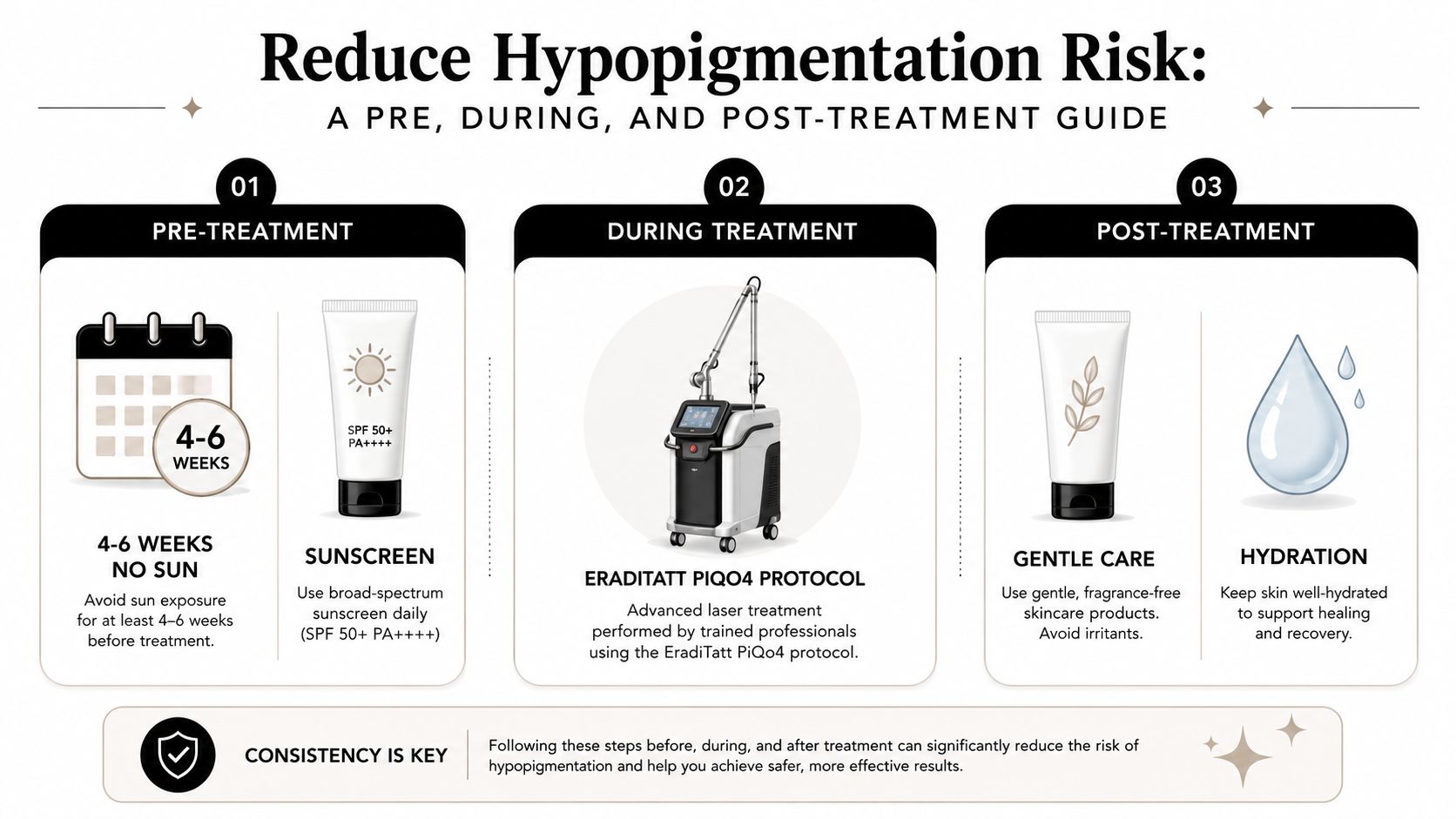
Risk reduction starts before the laser touches your skin. The aim is to keep the epidermis calm, avoid excess melanin stimulation, and give your provider an accurate view of your natural skin tone. A protocol using the PiQo4 system may include conservative planning, test spots, and adjustments for darker skin, but the exact settings still need to be individualized.
Before treatment
- Limit sun exposure: Avoid direct sun on the tattoo for 4 to 6 weeks before treatment. Tanned skin can increase the chance that melanin absorbs treatment energy.
- Pause irritating products: Ask your clinician when to stop retinoids, exfoliating acids, and other products that may increase sensitivity.
- Record your baseline: Take clear photographs in consistent lighting. Baseline images help distinguish a true pigment change from normal differences in camera exposure.
- Confirm your phototype: Make sure the provider documents your Fitzpatrick type and explains how it affects wavelength and fluence selection.
During treatment
A test spot can be particularly useful for darker skin types. It gives the clinician a chance to observe how your skin responds before treating the entire tattoo. When possible, a picosecond pulse may be favored over a nanosecond pulse to reduce thermal exposure, although the wavelength, ink color, tattoo depth, and prior response still matter.
Avoid asking for the strongest possible setting to speed up removal. High fluence or repeated pulses over an already lightened area can increase stress on melanocytes. Treatment intervals should also allow proper wound healing and pigment recovery. EradiTatt's guidance on tattoo removal on dark skin discusses why skin tone and laser planning need to be considered together.
After treatment
Cool compresses can ease discomfort during the early healing period. Use the aftercare products recommended by your clinician, protect the area with mineral SPF 50 once appropriate, and consider an occlusive healing ointment for the first 48 hours if instructed.
Don't pick at blisters, crusting, or frosting. Once the surface has fully re-epithelialized, a clinician may recommend silicone gel for texture support. Don't treat the tattoo again while the skin remains red, tender, blistered, crusted, or visibly changing. Melanocytes need quiet time to recover.
Treatment Options When Hypopigmentation Persists
A persistent light patch doesn't have one universal treatment. The right choice depends on whether the area is faint or sharply contrasted, whether the skin texture is normal, how long the change has been present, and whether the original tattoo is still being treated.
| Option | Best For | Typical Timeline | Key Trade-off |
|---|---|---|---|
| Watchful waiting | Faint, stable patches without scarring | Often monitored over months | No procedure risk, but improvement is gradual and not guaranteed |
| Prescription topicals | Selected cases with apparently suppressed melanocyte activity | May require several months | Evidence and response vary, and medical supervision is needed |
| Excimer phototherapy | Localized, stubborn patches | Often requires repeated treatments | Can stimulate pigment, but over-treatment may worsen contrast or irritation |
| Narrowband UVB | Broader or treatment-suitable pigment loss | Requires a supervised course | Less localized than excimer treatment and carries light-treatment risks |
| Micropigmentation | Patients seeking cosmetic blending | Cosmetic change can be faster | Color matching is difficult and the procedure adds pigment to the skin |
| Cover-up tattoo | People replacing the original design | Depends on the new tattoo plan | Conceals the contrast rather than restoring natural melanin |
Observation can be the safest first move
If the patch is faint, stable, and free of textural change, observation may allow melanocytes to resume activity without adding another source of inflammation. Don't judge progress from a single photograph. Use consistent lighting and compare images over time.
A medical review notes that pigment changes often appear 4 to 6 weeks after treatment and are commonly transient, while longer-lasting alterations are more likely in darker or tanned skin (medical reference on laser-related pigment changes). A clinician can help determine whether the patch is still evolving.
Medical and cosmetic approaches
Topical prostaglandin analogs, tacrolimus, or targeted photoprotective strategies may be discussed in selected cases, but they should be prescribed or recommended by a qualified clinician. Excimer phototherapy and narrowband UVB can stimulate repigmentation in some persistent cases. The published case described earlier used 308 nm excimer phototherapy over 40 sessions in 14 months, with partial repigmentation after a prolonged period (published case and review).
Micropigmentation or a cover-up can improve appearance when natural repigmentation is incomplete. Neither option repairs melanocytes. They camouflage the difference, and both require careful color matching to avoid making the patch more noticeable.
Recovery Timelines and What to Ask at Your Consultation
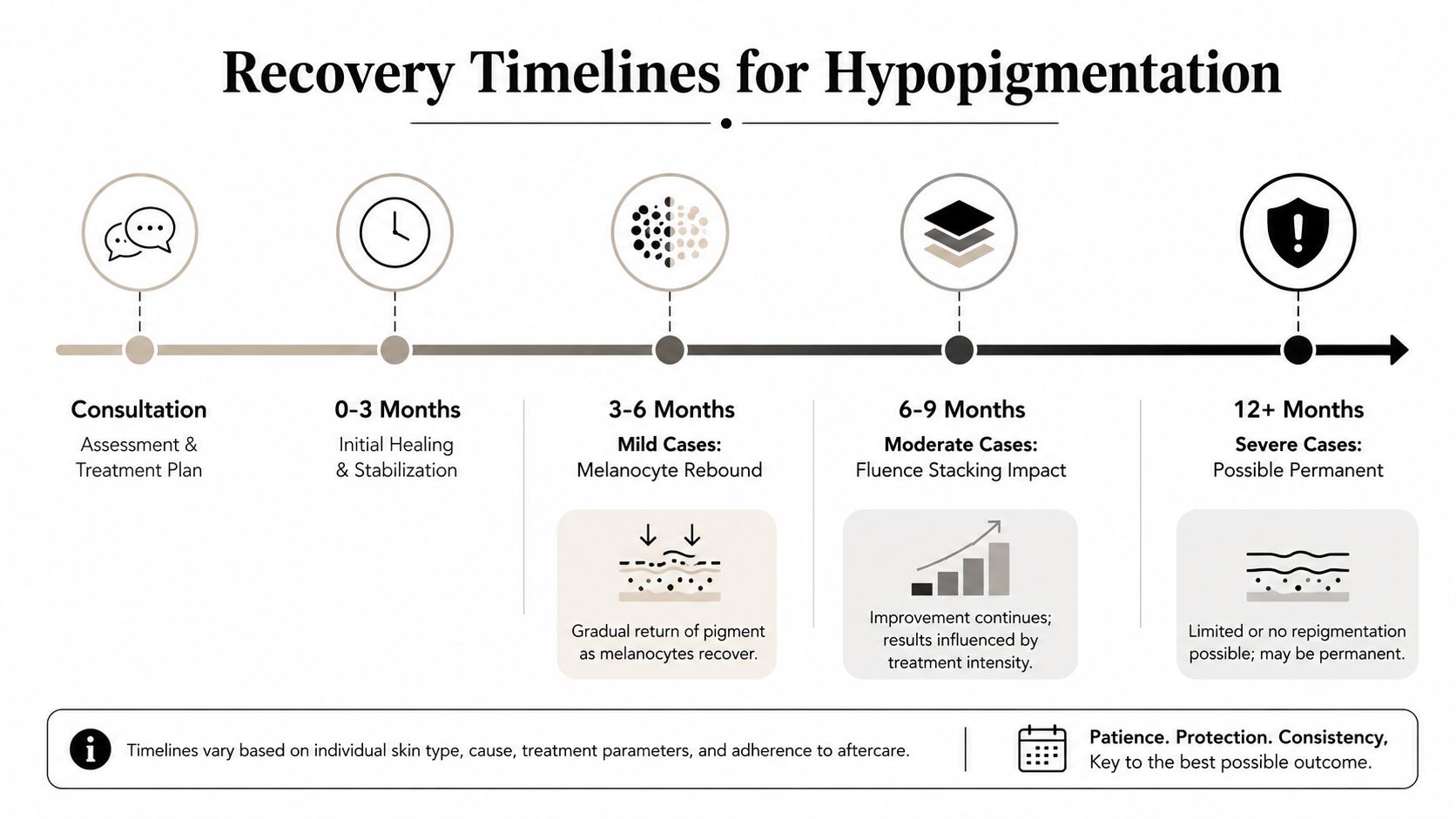
Recovery depends on what caused the lightening. A temporary post-inflammatory change may blend gradually as melanocyte function returns. A deeper injury, repeated high-intensity treatment, or visible scarring can produce a more persistent result.
Treat those time ranges as clinical patterns, not promises. A faint patch may improve over 3 to 6 months, while a more pronounced or repeatedly irritated area may take 6 to 12 months or longer. Severe changes associated with dermal scarring can remain partly hypopigmented without intervention.
Use the skin's behavior as a guide
A patch that is slowly becoming less distinct is generally more encouraging than one that remains sharply defined and unchanged. Redness, tenderness, crusting, or texture changes should be evaluated before another laser session. Continuing treatment over visibly altered skin can make it harder to tell whether the pigment is recovering.
Practical rule: Don't schedule the next treatment because the calendar says it's time. Schedule it when the skin has healed and your clinician has assessed the pigment response.
Questions worth bringing with you
Write these down before your consultation:
- Which wavelength will you use? Ask why it suits the ink colors and your skin phototype.
- Will you perform a test spot? This is especially relevant if you have darker skin, a tan, or a history of pigment changes.
- What interval do you recommend? Ask what signs show that the epidermis and melanocytes are ready.
- How will you modify settings? Have the provider explain how fluence, spot size, and pulse structure will be adjusted.
- What happens if lightening persists? Ask when they would stop laser treatment and consider dermatology referral or repigmentation options.
- Can I see comparable results? Request before-and-after photographs involving a similar skin tone and tattoo color profile.
Use consistent lighting for your own photographs at every visit. This makes subtle changes easier to evaluate than memory does. For more practical guidance on monitoring the treated area, see skin after tattoo removal.
Next Steps With EradiTatt Across Florida
Arrive at a consultation with information that affects pigment risk, not just a photograph of the tattoo. Your treatment history can change how cautiously the next session should be planned.
Printable consultation checklist
- Current ink colors: List the colors still visible and identify any areas that have already faded.
- Tattoo age: Note approximately when the tattoo was applied.
- Previous removal: Record the laser type, treatment dates, settings if available, and any blistering, scarring, darkening, or lightening.
- Skin phototype: Note whether you tan easily, burn easily, or have recently tanned.
- Sun exposure: Describe outdoor exposure and whether the tattoo can remain covered.
- Medications and products: Bring a list of prescriptions, retinoids, exfoliants, and supplements.
- Repigmentation concerns: Mark any pale areas and explain whether they're stable, expanding, or changing.
- Photos: Bring consistent, well-lit images from before and after earlier sessions.
- Records: Bring photo ID and any prior medical or treatment records that relate to the tattoo.
EradiTatt has clinics serving multiple Florida communities, including Orlando, Bradenton and Sarasota, St. Petersburg, Palm Harbor, and Tampa. Because exact landmarks, cross streets, parking arrangements, and hours can change, confirm those details with the clinic before traveling.
| City | Nearest Landmark | Parking Notes | Typical Hours |
|---|---|---|---|
| Orlando | Confirm with the clinic when booking | Ask about the location's current parking instructions | Confirm current availability directly |
| Bradenton and Sarasota | Confirm with the clinic when booking | Ask about nearby and on-site parking | Confirm current availability directly |
| St. Petersburg | Confirm with the clinic when booking | Ask which parking option is most convenient | Confirm current availability directly |
| Palm Harbor | Confirm with the clinic when booking | Request current parking guidance | Confirm current availability directly |
| Tampa | Confirm with the clinic when booking | Ask about parking before your appointment | Confirm current availability directly |
When you call or schedule online, request a PiQo4 hypopigmentation consultation if pigment lightening is your concern. Tell the team whether you want complete removal or fading for a cover-up, and mention any previous laser treatment. Ask what documents and photographs they want before the appointment.
The first visit should give you a clearer risk picture, not pressure you into immediate treatment. Expect a skin and tattoo assessment, discussion of your Fitzpatrick type, an offer of a patch test where appropriate, and a written explanation of how the plan addresses pigment changes.
EradiTatt Tattoo Removal offers personalized tattoo removal and fading consultations across Florida, with treatment planning that considers ink complexity, skin type, and concerns such as hypopigmentation. Visit EradiTatt Tattoo Removal to find a convenient clinic and request a consultation focused on safe, progressive treatment.
2 Responses