
TL;DR: Complete tattoo removal typically takes 6 to 12 sessions spaced 6 to 8 weeks apart, so the full process often lasts 9 months to 2 years. The exact timeline depends on your tattoo’s color, size, age, placement, and how your body clears fragmented ink between treatments.
You’re probably here because you look at a tattoo and want a straight answer. Not a vague “it depends,” and not a promise that everything will be gone in a couple of visits.
That’s fair. People usually start this process because something has changed. A job requirement, a relationship, a style that no longer fits, or a design that doesn’t feel like them anymore. The goal is clear skin, or at least enough fading to move forward with a cover-up. The harder part is knowing what the road looks like.
Your Tattoo Removal Journey Starts with a Simple Question
The same question is often asked first. How long does tattoo removal take?
The practical answer is that removal is a process, not a one-day fix. You come in for a session, the laser breaks up ink, your body clears what it can, your skin heals, and then you repeat the cycle until you reach your goal.
That goal matters. Some people want complete removal. Others only want enough fading so a tattoo artist can cover the old piece cleanly. Those are two different timelines, and a good consultation should separate them right away.
Why the timeline matters
If you’re planning around a wedding, enlistment, a new job, or a future cover-up, timing matters more than generally anticipated. The laser session itself is the short part. The waiting between sessions is what takes time.
A lot of frustration in tattoo removal comes from bad expectations, not bad treatment. If someone thinks one or two sessions should erase years of dense professional ink, they’re going to feel disappointed. If they understand from the beginning that progress is gradual, they usually handle the journey much better.
What works: thinking of removal as a treatment plan.
What doesn’t: chasing instant results or booking sessions too close together.
What a realistic starting point looks like
A consultation should answer a few basic questions:
- What’s the goal: Full removal or fading for a cover-up.
- What’s in the tattoo: Black-only ink behaves differently than a bright multicolor piece.
- Where is it located: Placement affects how quickly the body clears shattered pigment.
- How dense is it: Professional, saturated tattoos usually take longer than lighter amateur work.
In Florida, where people stay active and spend a lot of time in the sun, planning also needs to account for healing habits and skin care. That part is often overlooked, but it matters. Good scheduling, realistic spacing, and careful aftercare usually make the experience smoother and safer.
Fresh starts are possible. They just happen session by session.
The Full Tattoo Removal Timeline Explained
A client books a consultation in January and hopes to be clear by summer. Sometimes that happens for a small, older tattoo. Often, it does not. The laser visit is the fast part. The full timeline is built around healing, immune clearance, and how stubborn the ink is.
Laser removal works in stages. During treatment, the laser energy breaks pigment into smaller particles. Over the following weeks, the body clears part of that fragmented ink. That is why the tattoo usually keeps fading after you leave the clinic, not just during the appointment.
According to Divine Laser’s tattoo removal fading process overview, many tattoos need 6 to 12 sessions spaced 6 to 8 weeks apart, which can put the total process at 6 months to over 1 year. In practice, that range is a starting point, not a promise. A lightly applied black tattoo may move faster. A dense, colorful professional piece can take longer.
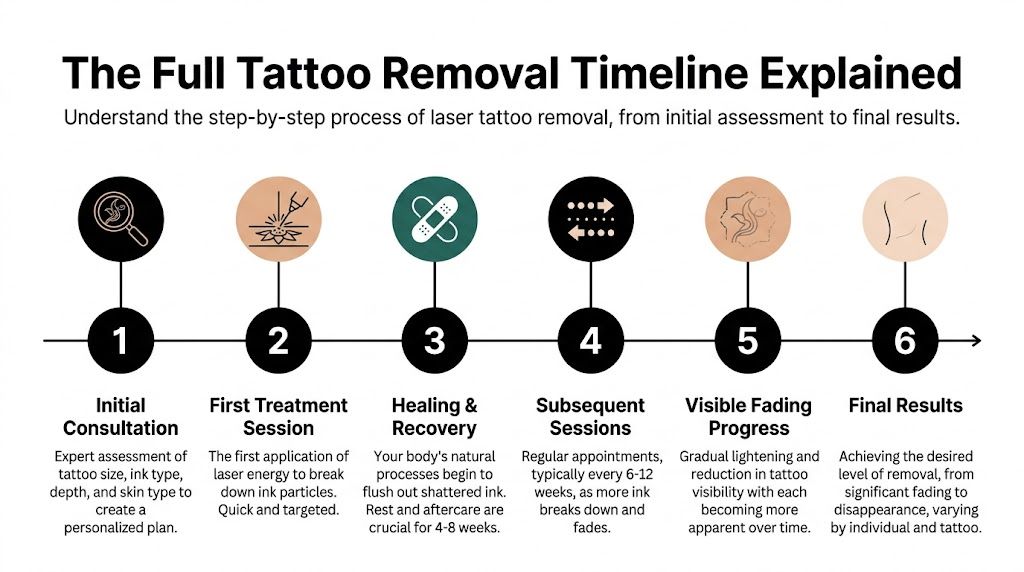
Removal happens in rounds, not all at once
The process is similar to removing layers of embedded pigment a little at a time. The ink is sitting below the surface, and each session only treats part of the total load your body needs to clear.
That is why the change is usually gradual:
- After 1 to 3 sessions: fading often begins, but the tattoo is still clearly visible.
- After 4 to 7 sessions: outlines, shading, and packed areas usually look lighter.
- After 8 to 12 sessions: some tattoos are very faint or close to clear, while others still need more work.
Progress is rarely perfectly even. One color can fade faster than another. One edge can lighten before the center. That does not automatically mean the treatment is off track.
Why waiting is part of the treatment plan
Good removal plans leave enough time between sessions for the skin to recover and for the immune system to do its part. Treating too soon can increase irritation without giving you much extra fading.
At EradiTatt, we set expectations around that reality early because timing affects results. Clients who understand the factors that affect tattoo removal progress usually make better scheduling decisions and have a smoother overall experience.
The appointment is quick. The calendar is not.
The treatment itself is usually short. Small tattoos can be treated in minutes, and the actual laser pass may be over very quickly. The longer part is what happens afterward. Healing, fading, and reassessment take time.
That is the full timeline in plain terms. Session one starts the breakup of the ink. The weeks after session one start the clearing. Then the cycle repeats until the tattoo is light enough for your goal, whether that means full removal or enough fading for a cover-up.
Key Factors That Adjust Your Removal Timeline
Two people can start removal in the same month and finish on very different schedules. I see that often in clinic. A small black tattoo on an upper arm usually behaves very differently from a dense, colorful piece on the ankle, even if both were done by a professional artist.
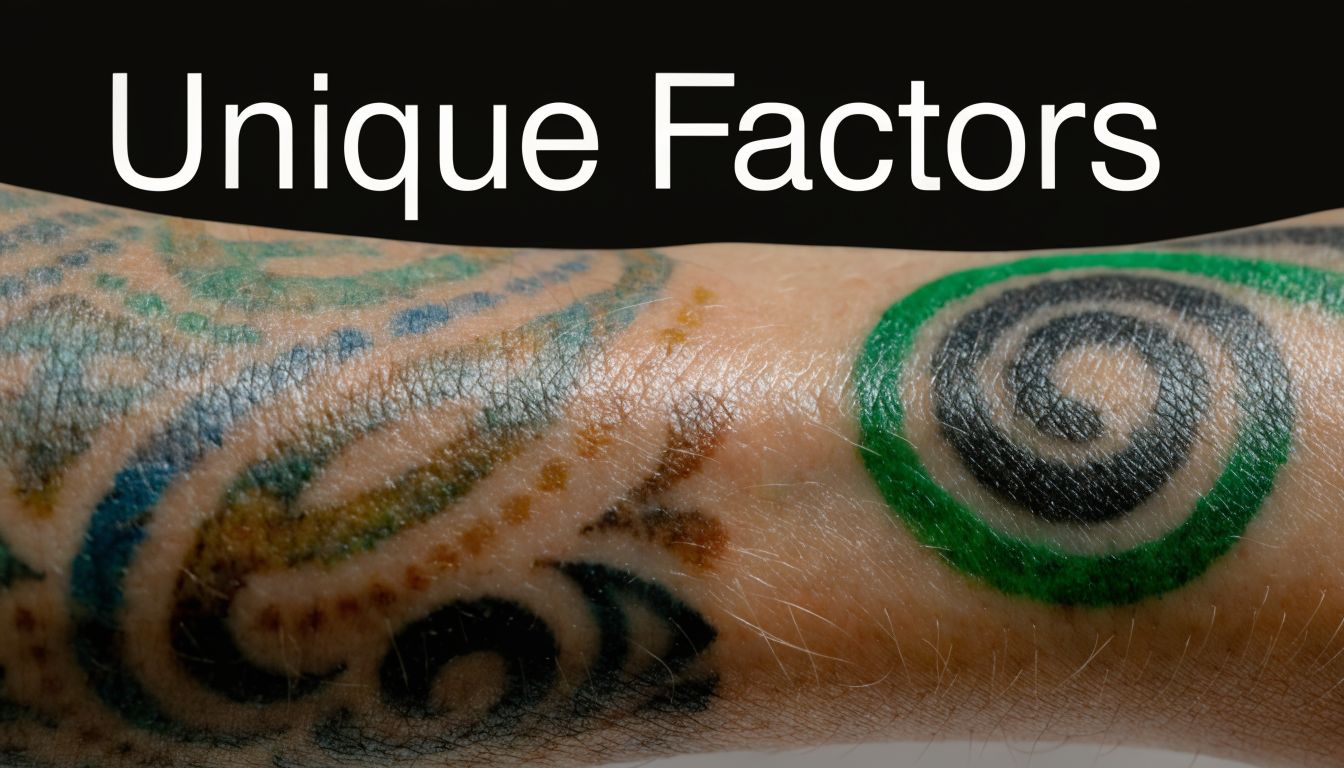
Ink color can shorten or stretch the plan
Color is one of the first things I assess because it changes how the laser energy is absorbed. As explained in Aesthetic Lab’s tattoo removal session guide, black ink usually responds faster, while shades like green, teal, and yellow can be more stubborn and may need more targeted treatment over a longer period.
That does not mean bright tattoos cannot clear. It means the timeline is often less predictable. One color may fade well early on while another hangs on longer, so multicolored tattoos usually require more patience than mostly black designs.
Placement affects how efficiently the body clears ink
The laser breaks pigment apart, but your body still has to carry away those smaller ink particles. Areas with better circulation, such as the chest, back, or upper arms, often fade more steadily than tattoos on the hands, ankles, or feet.
This is one of the most common real-world trade-offs. A small tattoo in a lower-circulation area can take longer than clients expect, while a larger tattoo on the torso may progress more smoothly.
Age, layering, and ink load change the estimate
Older tattoos often have a head start because some natural fading has already happened over time. Newer tattoos usually look sharper and more saturated, which can mean more work.
Layering matters too. Cover-ups, touch-ups, and heavily packed professional tattoos often contain more pigment than they appear to at first glance. More pigment usually means more sessions, not because the treatment is failing, but because there is more material to break apart and clear.
Your healing response matters between sessions
Removal is not just about what happens during the appointment. Healing quality, immune response, smoking status, sun exposure, and aftercare habits all influence how the process moves from one session to the next.
That is why copying a friend’s timeline rarely helps. Their skin, tattoo location, ink depth, and healing pattern are not yours. For a closer look at those variables, EradiTatt’s guide to factors that affect tattoo removal progress breaks them down clearly.
Practical rule: Tattoos usually move faster when the ink is darker, the pigment load is lighter, and the placement has better circulation. Timelines usually stretch out with bright colors, dense packing, cover-up layers, and lower-extremity placement.
A quick way to judge your own case
Before a consultation, use this checklist to get a rough sense of where your tattoo may land:
- Mostly black or mixed with bright colors
- Older and already softened, or newer and heavily saturated
- Located on the torso or upper arm, or on the wrist, ankle, hand, or foot
- Single-pass design, or reworked, touched up, or covered over
- Aiming for full clearance, or enough fading for a cover-up
Those answers will not give an exact finish date, but they do help explain why one Florida client may be on a 6 to 8 session plan while another needs a longer, more staged approach.
Sample Removal Timelines for Common Tattoos
General ranges help, but people usually want to know where they fit. The easiest way to answer that is with common real-world scenarios.
These aren’t guarantees. They’re planning examples based on the factors that usually speed things up or slow them down.
Estimated Tattoo Removal Timelines by Scenario
| Tattoo Scenario | Estimated Sessions | Estimated Total Timeline |
|---|---|---|
| Small black tattoo on the wrist | 6 to 8 sessions | About 9 to 16 months |
| Older medium tattoo on the upper arm | 6 to 10 sessions | About 9 months to 20 months |
| Large dense multicolored tattoo on the leg | 10 to 12 sessions or more | About 15 months to 2 years or longer |
| Tattoo faded for a cover-up | 3 to 7 sessions | About 4.5 to 14 months |
Four common examples
A small black wrist tattoo often falls on the more manageable end of the range. The ink color helps, and the tattoo itself may not contain a huge amount of pigment. The wrist location can still slow things down compared with the torso, so even “small and simple” doesn’t mean immediate.
An older medium tattoo on the upper arm often behaves more predictably. Age can work in your favor, and upper-arm placement usually gives the body a better environment for clearing fragmented ink. These are the tattoos that often show steady fading without as many surprises.
A large multicolored leg tattoo is where patience really matters. There’s more pigment, more complexity, and often more stubborn colors. Lower-body placement can also be slower. This type of tattoo usually needs the clearest long-term plan.
A cover-up fade is a different goal entirely. You don’t always need full removal. If a tattoo artist only needs the old design softened enough to work over it, that can shorten the process. The exact stopping point depends on how dark the original tattoo is and what the new design requires.
Why examples matter
People often compare themselves to a friend who “got theirs removed fast.” That comparison usually misses the details. Ink color, saturation, body placement, and goal all change the timeline.
The better question isn’t “How long did theirs take?” It’s “What kind of tattoo did they have, and what result were they trying to reach?”
That’s how a realistic plan starts.
What Happens During and After Each Session
A lot of anxiety disappears once you know what a session looks like. Most visits are straightforward. The unknown is usually worse than the treatment itself.
Modern picosecond lasers, including the PiQo4 system, use ultra-short pulses to shatter ink into very small particles. According to this explanation of how picosecond tattoo removal works, that photoacoustic effect helps the body clear ink more efficiently and causes less thermal damage than older nanosecond systems, which can reduce the total number of sessions needed.
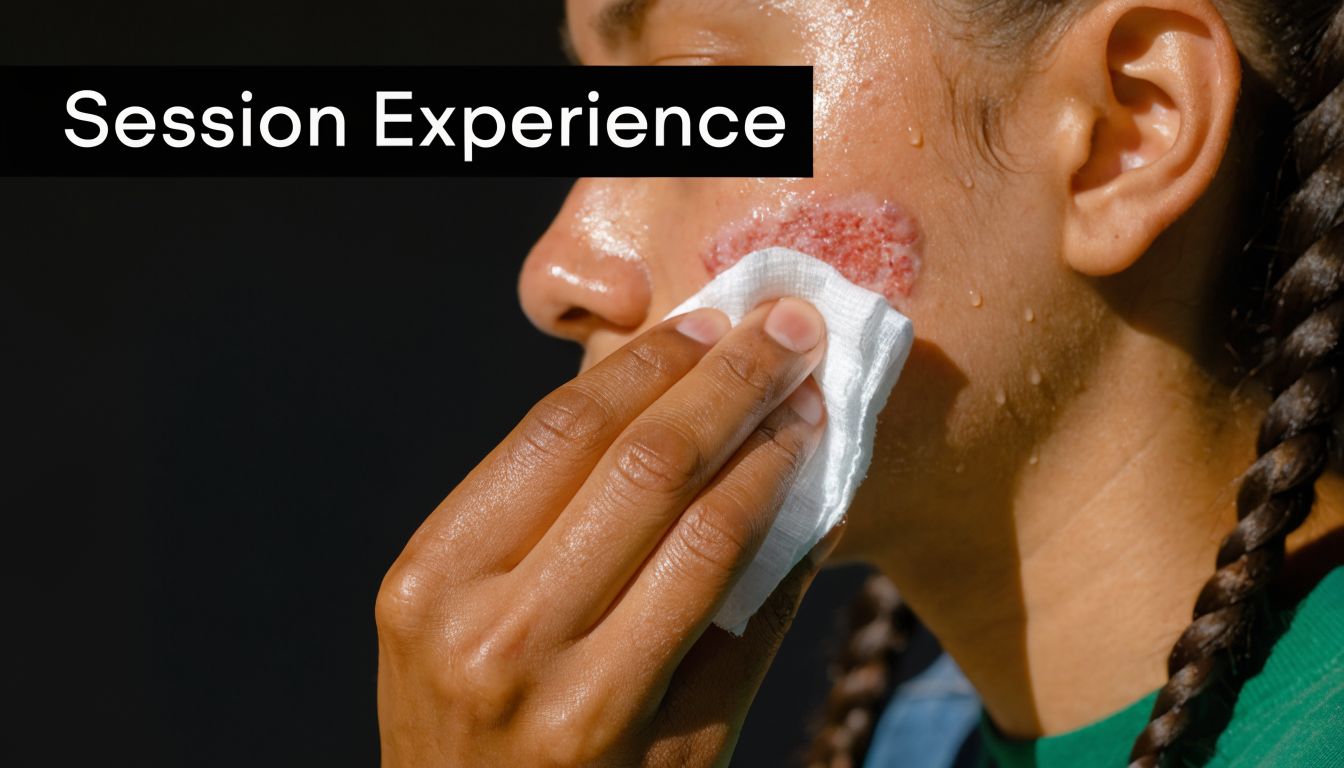
During the appointment
The treatment area is assessed, cleaned, and prepared. Protective eyewear is used. Then the laser is applied in short, targeted passes over the tattoo.
The actual laser portion is often quick. Many people spend more time checking in, getting positioned, and reviewing aftercare than they do under the laser.
Some immediate skin reactions are normal. One common one is frosting, which looks like a temporary white cast over the treated area. That happens as the laser interacts with ink and skin tissue. Redness and mild swelling are also common.
In the hours and days after treatment
The first phase is all about calming the skin and protecting the area. You may feel warmth, sensitivity, or irritation similar to a superficial skin injury.
At this point, people help or hurt their own results.
- Keep the area clean: Gentle hygiene lowers the chance of irritation.
- Leave blisters or scabs alone: Picking slows healing and raises the risk of texture changes.
- Limit friction: Tight clothing over the area can make healing harder.
- Be careful with sun exposure: Freshly treated skin doesn’t handle sun well.
If you want a detailed refresher, EradiTatt’s article on why aftercare matters after laser tattoo removal covers the basics clearly.
Treated skin doesn’t need constant interference. It needs time, protection, and consistency.
What’s happening under the surface
After the visible irritation settles, the slower phase begins. Your immune system starts clearing away the shattered ink particles. That’s why fading continues after you leave the office.
This delayed progress confuses some people. They expect the tattoo to vanish right after treatment. In reality, the visible change often develops gradually over the following weeks.
What helps and what doesn’t
Helpful habits are boring, but effective. Show up on schedule. Follow aftercare. Give the skin enough time before the next session. Stay generally healthy.
What usually doesn’t help is pushing for treatment too early, over-handling the area, or assuming a stronger immediate reaction means a better result. Good removal is controlled, progressive, and repeatable.
Your Removal Journey with EradiTatt
Starting tattoo removal shouldn’t feel confusing. The process works best when the steps are simple and the expectations are clear.
For many clients, the first move is just reaching out and talking through the tattoo, the goal, and the timeline they’re working with. That matters if you’re balancing work, travel, family obligations, or a target date for a cover-up.

How the process typically begins
A consultation should cover the tattoo’s size, color mix, placement, density, and your end goal. If you only want fading for new artwork, the plan can look very different from a full-removal plan.
This is also when scheduling becomes practical. Busy clinics and busy clients both benefit from organized booking tools. If you’re curious how modern booking systems help businesses manage treatment calendars and reminders, this overview of spa appointment scheduling software gives useful context.
What clients in Florida usually want to know
People often want three things answered early:
- How many sessions might I need
- How far apart will visits be
- What should I plan around for healing
Those answers are easier to trust when they’re tied to your actual tattoo instead of a generic online estimate.
EradiTatt serves clients across Florida, including Orlando, Bradenton/Sarasota, St. Petersburg, Palm Harbor, and Tampa. That local access makes it easier to stay consistent with scheduling, which matters more than people think once the process is underway.
The treatment plan should be personal
A realistic provider won’t promise the same timeline for every tattoo. They’ll explain the trade-offs. A small black design may move one way. A dense multicolor piece may move another.
For readers who want more detail on the technology side, this guide to PiQo4 laser tattoo removal explains how that system fits into modern treatment planning.
The important part is that your plan should match your skin, your tattoo, and your reason for removal. That’s what keeps expectations realistic from the first appointment to the final fading stage.
Frequently Asked Questions About Tattoo Removal Time
Can I speed up tattoo removal?
You can help the process along, but you cannot make your immune system clear shattered ink faster than your skin can safely recover.
The clients who stay on schedule, follow aftercare, avoid picking at the area, and protect the tattoo from sun exposure usually get the steadiest progress. The clients who try to stack sessions too close together often end up with more irritation, longer healing, and no real time saved.
Healing time counts.
Will my tattoo be 100 percent gone?
Sometimes yes. Sometimes no.
A better expectation is major fading, with the final result depending on the ink colors, how heavily the tattoo was packed, where it sits on the body, and how your skin responds over a full course of treatment. Black ink on an area with strong circulation often clears better than dense multicolor work on the hands or feet.
I tell clients to plan for improvement first and perfection second. That keeps the process realistic and makes the endpoint easier to judge session by session.
How long does removal take if I only want a cover-up?
Usually less time than full removal.
For a cover-up, the goal is to break up enough existing pigment that a tattoo artist can work over it cleanly. In many cases, that means a few sessions instead of a full removal plan, but the number still depends on how dark the current tattoo is and how much room the new design needs.
Good cover-up fading is a coordination job. The laser plan should match the artist’s design, placement, and color strategy.
Why does one part of my tattoo fade faster than another?
Because tattoos are rarely uniform, even when they look that way at first glance.
Linework is often more saturated than shading. One section may sit deeper in the skin. One color may respond well while another holds on longer. That uneven fading is normal, and it does not mean the treatment failed. It means different parts of the tattoo are clearing at different rates.
Does each session take a long time?
Usually no. The treatment visit itself is often quick, especially for small tattoos.
The longer commitment is the full calendar. You come in for a session, then your body does the slower part over the following weeks as it clears fragmented ink and your skin settles down. That is why tattoo removal feels longer as a process than it does as an appointment.
Your Path to Clear Skin Starts Today
Tattoo removal takes patience, but it isn’t mysterious. When you understand the process, the timeline starts to make sense.
The key is working from your tattoo, not from someone else’s story. Ink color, placement, age, density, and your final goal all shape the plan. Some tattoos are straightforward. Some take longer. Both can be handled with a steady approach and realistic expectations.
If you’re asking how long does tattoo removal take, the honest answer is that it takes time. It also takes a plan. Once you know what you’re treating and what result you want, the process becomes much easier to manage.
A consultation gives you that clarity. You’ll know whether you’re looking at full removal or fade-for-cover-up, what your likely schedule will be, and what kind of healing rhythm to expect.
If you’re ready to take the first step, schedule a consultation with EradiTatt Tattoo Removal and get a treatment plan built around your tattoo, your skin, and your timeline.
3 Responses