
A 1064 nm Q-switched Nd:YAG laser remains an established first-line option for black ink. In clinical literature, it produced more than 75% ink removal in 77% of black tattoos after four sessions, while 28% achieved more than 95% clearance at higher treatment fluence levels, as reported in the controlled study summarized by Mayo Clinic.
Wavelength alone does not determine the best treatment. Clinicians tune wavelength, fluence, spot size, pulse duration, ink density, tattoo depth, and skin type as one system. The settings work like a recipe: changing one ingredient affects how much energy reaches the pigment and how much heat the surrounding skin receives. For many patients, a carefully configured 1064 nm laser offers safer, more predictable treatment than a newer device used with unsuitable settings.
Table of Contents
- Why Black Ink Is the Benchmark Case for Laser Removal
- How Lasers Break Apart Black Ink
- Comparing the Main Laser Technologies
- Realistic Timelines and Session Counts
- Safety, Side Effects, and Skin Type Considerations
- Choosing a Clinic and Preparing for Treatment
- Frequently Asked Questions About Black Ink Removal
Why Black Ink Is the Benchmark Case for Laser Removal
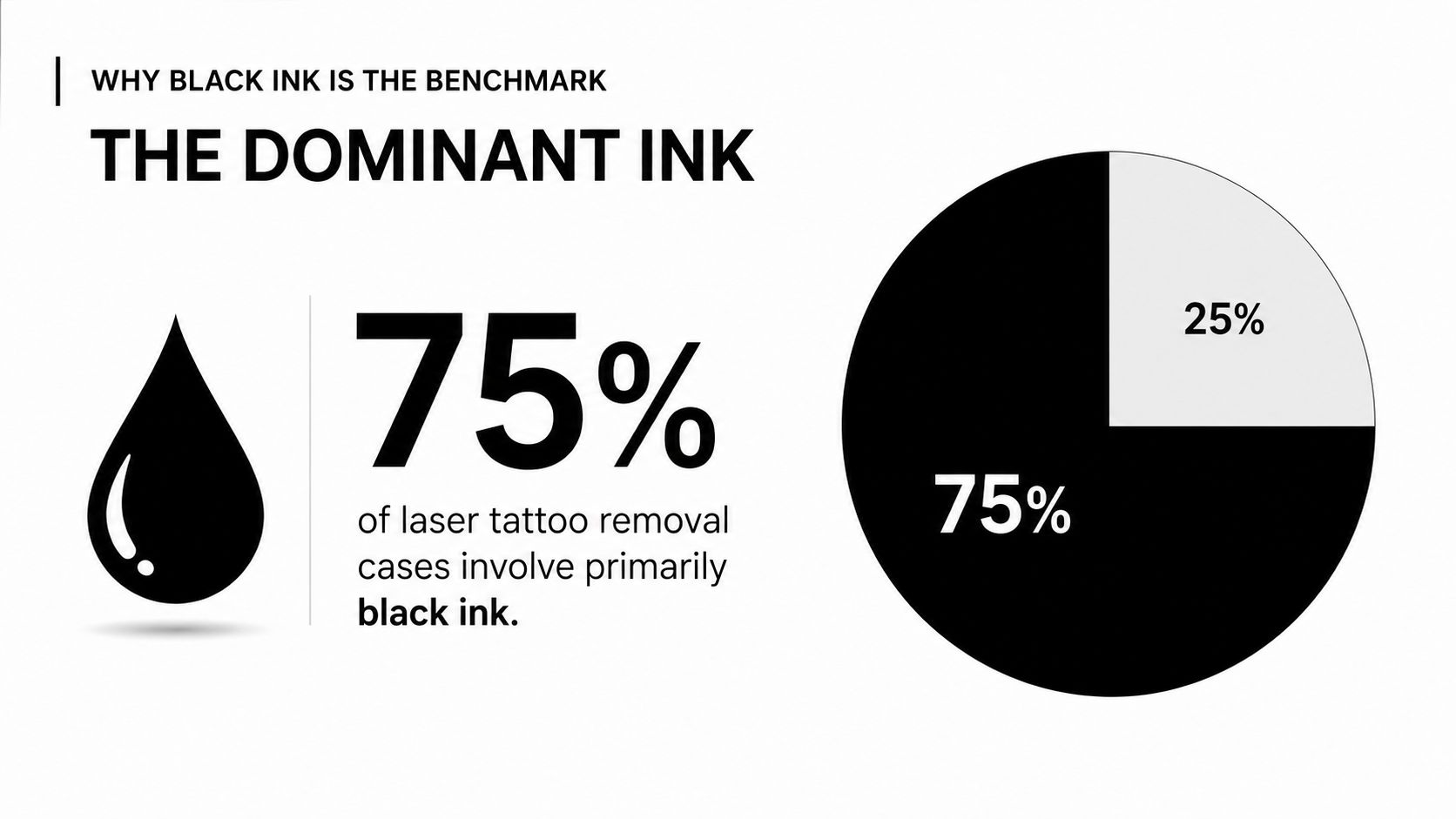
Black ink is the reference point for tattoo-removal technology because it dominates real-world treatment. A 2025 global analysis of 560,042 tattoos found that black ink accounted for 75% of treated tattoos, making it the most common pigment clinicians see in removal practice. The global analysis summarized by Modern Aesthetics
Black pigment absorbs laser energy efficiently, which gives clinicians a strong target. Dark colors such as black, brown, and purple respond well to the 1064 nm wavelength, while other wavelengths are more closely associated with colors such as blue-green ink. The pigment's absorption lets the laser focus energy on the tattoo rather than heating a broad area of surrounding skin. A review of Q-switched Nd:YAG tattoo treatment
That doesn't mean every black tattoo behaves the same way. Professional tattoos may contain dense, deposited pigment, layered passes, or mixed formulations. Amateur tattoos can be shallower and less uniform. Age, location, immune response, and skin pigmentation also affect how quickly fragmented ink leaves the body.
Why easy-to-target ink can still be difficult
Black ink is often the easiest color to remove, but it can also be easy to over-treat. Too little energy may leave dense pigment largely intact. Too much energy can increase blistering, prolonged inflammation, and unwanted pigment changes. The clinician has to create enough mechanical disruption without transferring excessive heat to the skin.
This is why black ink serves as a benchmark. A clinic should be able to explain not only which laser it uses, but also how it adjusts treatment for pigment density and skin type. Wavelength identifies the target, but treatment parameters determine how safely that target is reached.
Practical rule: Ask how the clinic will adjust fluence, spot size, and pulse duration for your tattoo instead of accepting a device name as proof of suitability.
The modern approach grew from Q-switched ruby, alexandrite, and Nd:YAG lasers, which established selective photothermolysis for tattoo removal. These systems made it possible to target pigment colors more selectively instead of broadly damaging the skin. For black ink, 1064 nm Q-switched Nd:YAG remains the safest first pick for many patients, particularly when the clinician is experienced with darker skin.
How Lasers Break Apart Black Ink
A tattoo laser does not dissolve ink like a chemical solvent. It delivers an extremely brief pulse that creates a mechanical shock inside each pigment particle. The process resembles striking a bell: the particle vibrates intensely, stress builds, and the pigment fractures into smaller pieces that the body's immune and lymphatic systems can gradually clear.
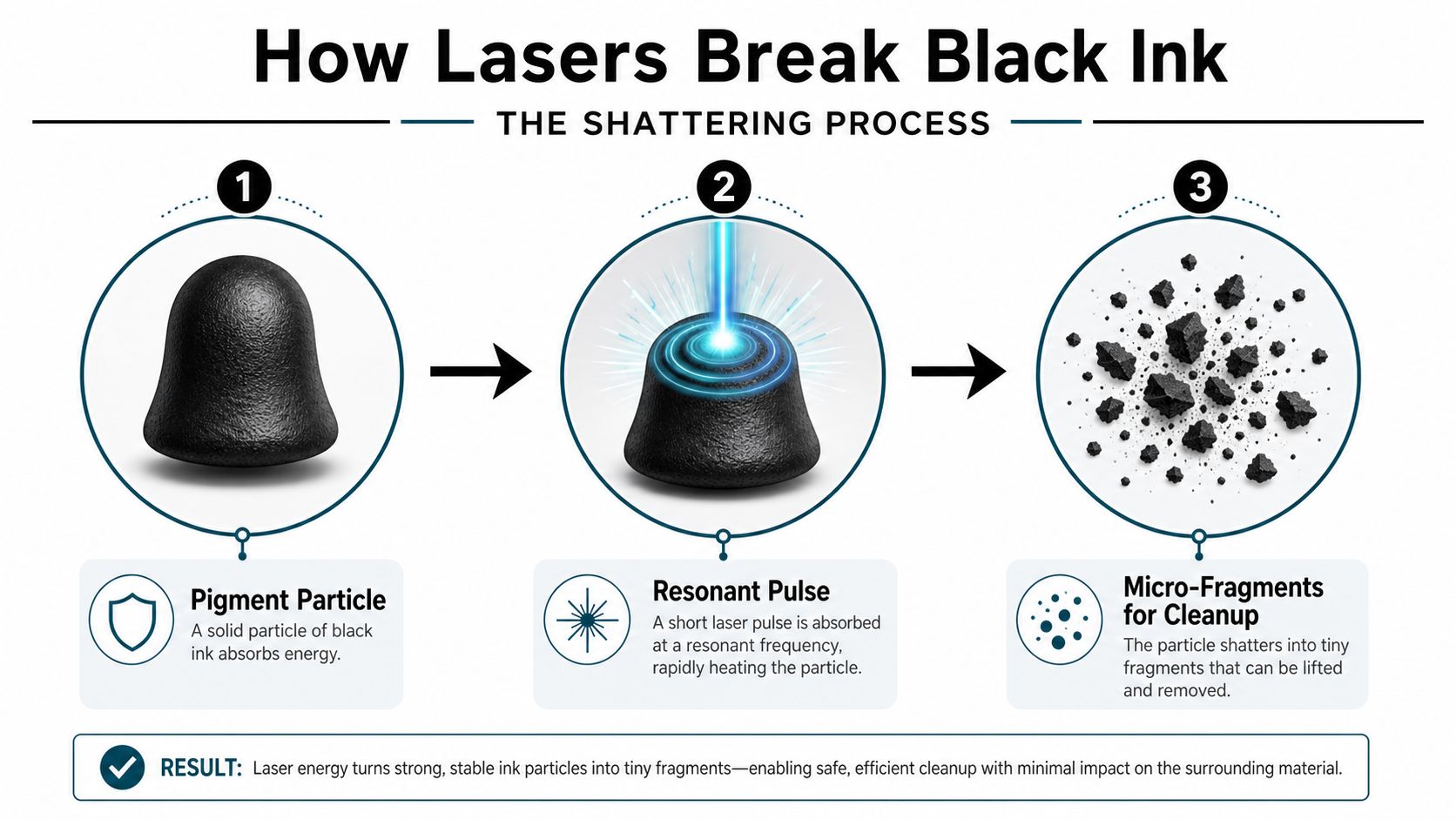
The outcome depends on several settings working together:
- Wavelength selects the pigment target. A 1064 nm wavelength is absorbed well by dark colors and can reach particles in the dermis. It also interacts less with epidermal melanin than shorter wavelengths, which can improve the safety margin for more heavily pigmented skin. Clinical evidence on 1064 nm Q-switched Nd:YAG treatment
- Pulse duration controls the type of impact. Nanosecond pulses can create photomechanical disruption while limiting heat spread. Picosecond systems use even shorter pulses, which may strengthen the photoacoustic effect and fragment pigment efficiently in selected cases.
- Fluence sets the energy delivered per area. The level must be sufficient to fracture the ink without causing unnecessary thermal injury. It is not a universal setting. The clinician adjusts it for pigment density, depth, spot size, device behavior, and the patient's skin response.
Spot size also changes the treatment calculation. A larger spot can reach deeper with the same device, while a smaller spot may concentrate energy more locally. Pulse duration and fluence must be adjusted with it, rather than treated as independent controls.
Why 1064 nm is the workhorse
The 1064 nm Q-switched Nd:YAG wavelength offers two practical advantages for black ink. It penetrates sufficiently to interact with pigment below the surface, and epidermal melanin absorbs it less than shorter wavelengths. That lower interaction can reduce pigmentary side effects compared with ruby or alexandrite options in darker skin.
Research on a 150 ps Nd:YAG platform reported a 76.46% clearance rate for black tattoos under its highest-performing conditions, using a 2 mm spot size and 155 mJ pulse energy. The analysis identified an effective fluence of approximately 3.02 J/cm² for black tattoo treatment with 1064 nm energy. The 2023 Nd:YAG analysis in PMC
Those figures apply to specific equipment and study conditions, not every patient. Older clinical literature also used 6 to 12 J/cm², a 2.5 mm spot size, and 10 ns pulses for resistant tattoos. The contrast shows why parameter tuning matters. A clinician cannot safely copy a published setting without accounting for the device, tattoo, and skin being treated.
Comparing the Main Laser Technologies
The main technologies differ less in their marketing labels than in how their wavelength and pulse behavior fit the patient. For black ink, 1064 nm Q-switched Nd:YAG is the established default. A picosecond Nd:YAG may offer more efficient fragmentation, but current evidence doesn't show that it is universally superior in every black tattoo case. A 2026 systematic review of laser tattoo removal
| Laser Type | Wavelength | Best For Skin Types | Avg. Sessions for Black Ink | Key Trade-off |
|---|---|---|---|---|
| Q-switched Nd:YAG | 1064 nm | Broad range, especially darker phototypes | Multiple sessions, commonly 4 to 8 for at least 75% clearance in reviewed studies | Proven, accessible, and comparatively melanin-sparing, but may require persistence |
| Picosecond Nd:YAG | 1064 nm, with 532 nm on some systems | Broad range when selected and operated appropriately | May reduce visits in some cases, but consistent superiority isn't established | Shorter pulses can fragment pigment efficiently, while equipment and treatment costs may be higher |
| Q-switched ruby | 694.3 nm | Lighter skin types with suitable pigment | Multiple sessions | Historically important and useful for selected colors, but greater melanin absorption raises concern for darker skin |
| Q-switched alexandrite | 755 nm | Mainly lighter skin types when clinically appropriate | Multiple sessions | Can treat selected dark pigments, but its shorter wavelength creates more melanin-related risk than 1064 nm |
Q-switched Nd:YAG lasers established the modern selective photothermolysis approach alongside ruby and alexandrite systems. Their long clinical history remains important, especially for patients who want a treatment plan based on established black-ink performance rather than a premium device label.
Picosecond systems shorten the pulse duration, which can create a stronger mechanical effect with less heat spread. That can be meaningful for resistant or densely packed pigment, but the result still depends on wavelength, fluence, spot size, operator technique, and session spacing. A 1064 nm picosecond Nd:YAG is a more logical comparison for black ink than a picosecond device operating at a wavelength chosen primarily for another color.
For readers comparing technical approaches, this overview of picosecond laser treatment offers additional context. The decision should ultimately reflect ink depth, skin type, tattoo density, treatment goal, and budget, not brand marketing.
Realistic Timelines and Session Counts
Black ink typically fades through a series of treatments rather than one appointment. Clinical guidance places the overall average at about 6 sessions, with reported courses ranging from 2 to 20 sessions. Appointments are commonly spaced 6 to 8 weeks apart, as described in clinical guidance on black tattoo removal treatment intervals.
The interval is part of the treatment plan, not empty time. The skin needs to recover, while immune cells and lymphatic drainage gradually clear fragmented pigment. Treating too soon can add inflammation before the previous session has produced its full visible effect. A tattoo may look almost unchanged immediately afterward, then lighten gradually as the body processes the fragments.
| Tattoo Type | Typical Sessions | Spacing Interval |
|---|---|---|
| Black tattoo with lower pigment density | Fewer visits within the overall treatment range | 6 to 8 weeks |
| Dense professional black tattoo | More visits within the overall treatment range | 6 to 8 weeks |
| Resistant or heavily layered tattoo | May approach the longer end of the overall range | 6 to 8 weeks |
A systematic review found that black and blue pigments generally needed 4 to 8 sessions to reach at least 75% clearance in most studies. Another model reported average needs rising from 3.2 sessions for low-density tattoos to 9.0 sessions for high-density tattoos. Density, depth, and layering can therefore matter more than the color label alone. Evidence summarized in the global tattoo-removal analysis
What shifts the schedule
Older, faded, shallow, and less saturated tattoos may respond more readily. Dense professional work, cover-ups, implanted pigment, and locations with slower healing can require more time. Skin type influences wavelength and energy choices, so a conservative plan may be appropriate. Smoking, general health, and aftercare can also affect recovery and clearance.
A cover-up requires sufficient fading, not necessarily perfectly ink-free skin. The clinician and tattoo artist can judge when the remaining contrast is low enough for a new design. A fixed short course promised without examining the tattoo is not a dependable timeline.
Before booking, review this detailed guide to how long tattoo removal takes and ask how the clinic will adjust wavelength, fluence, spot size, pulse duration, and session spacing for your tattoo and skin type.
Safety, Side Effects, and Skin Type Considerations
Laser removal is controlled injury. The clinician wants the pulse to disrupt ink while preserving the surrounding skin, so every setting becomes a risk lever. Fluence, spot size, and pulse duration must be adjusted together, particularly when treating Fitzpatrick IV to VI skin.
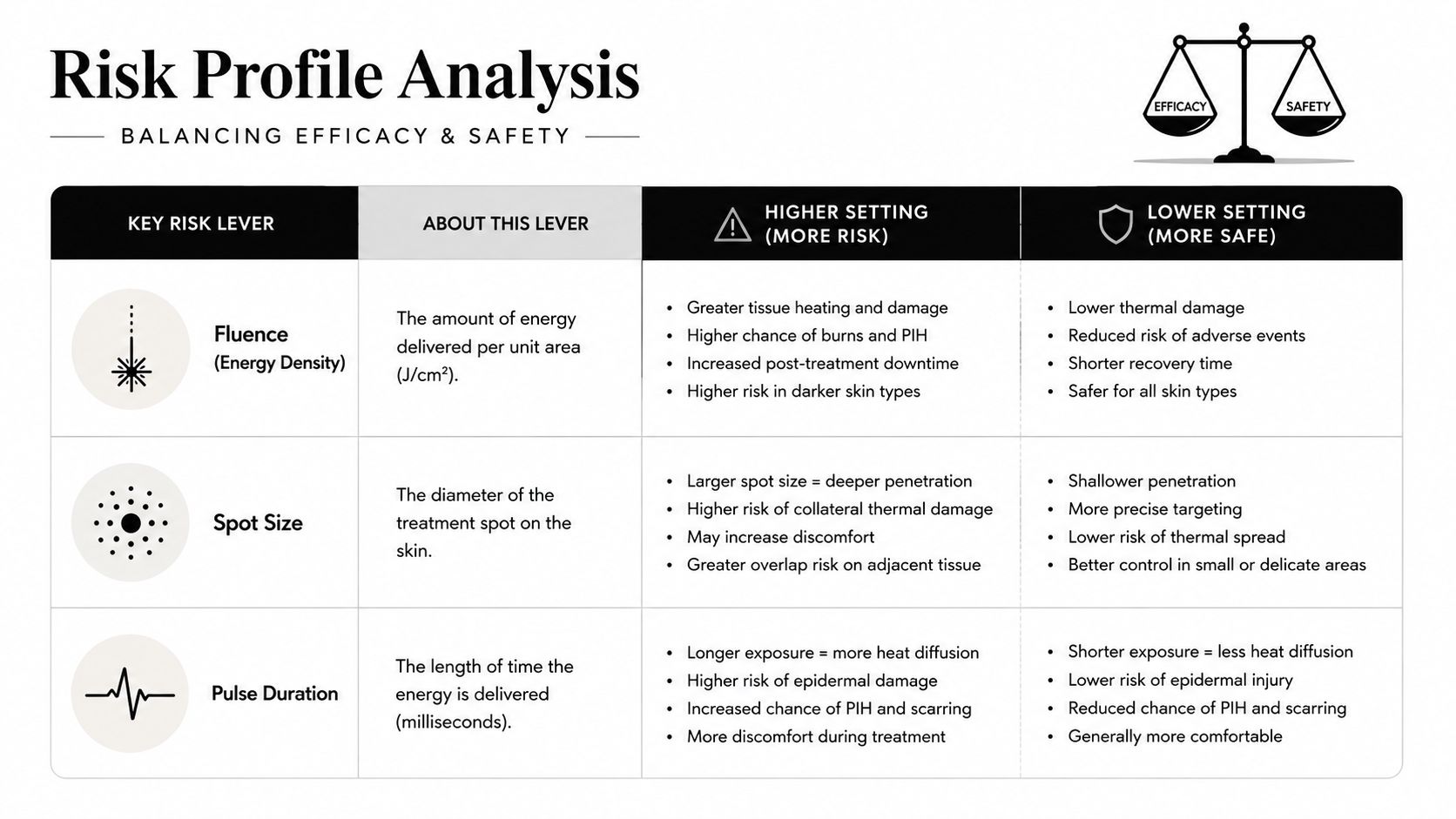
A high fluence may improve fragmentation when pigment is dense, but it can also increase blistering, pinpoint bleeding, and pigmentary change. A smaller spot concentrates energy into a tighter area, while a larger spot distributes energy differently and may be useful for broader treatment. Short nanosecond or picosecond pulses reduce heat diffusion, but a short pulse doesn't make an unsuitable wavelength safe.
Skin-of-color safety
The 1064 nm Q-switched Nd:YAG is favored for darker phototypes because it targets black pigment while interacting less with epidermal melanin. That lower melanin absorption is why clinicians often use it as the first-line wavelength for black ink on darker skin. Ruby at 694.3 nm and alexandrite at 755 nm are absorbed more readily by melanin, so they can carry greater risk of hypopigmentation or other pigmentary changes in darker tones. Dermatology evidence on laser tattoo removal in skin of color
Common treatment reactions include redness, swelling, frosting, pinpoint bleeding, blistering, and temporary hyperpigmentation or hypopigmentation. Scarring and lasting textural change are less common but remain possible, especially after excessive energy, infection, picking, or unsuitable treatment choices.
Stop and ask questions: Severe or worsening pain, spreading redness, pus, fever, extensive blistering, or a reaction that doesn't follow the clinic's expected healing pattern warrants prompt clinical review.
A responsible provider should explain the expected reaction, photograph the area, discuss sun protection, and consider a test spot when skin pigmentation or tattoo behavior creates uncertainty. Faster treatment isn't automatically safer treatment.
Choosing a Clinic and Preparing for Treatment
A consultation should function like a technical assessment, not a sales presentation. The practitioner should examine the tattoo's ink density, depth, colors, location, age, and previous removal attempts before choosing a wavelength or outlining a session plan. Settings should be adjusted like a treatment recipe, balancing wavelength, fluence, spot size, pulse duration, and skin type rather than relying on one preset.
Use these checks during your appointment:
- Verify the device. Ask whether the clinic uses a Q-switched Nd:YAG at 1064 nm for black ink and whether a picosecond Nd:YAG is available for selected cases. Ask which regulatory clearance applies in your location.
- Assess the operator. Request information about laser training, certification, and medical oversight. Higher fluence and darker skin types demand careful clinical judgment, with settings adjusted to the individual.
- Request a test spot when appropriate. A patch test can show how your skin responds, particularly with a darker phototype, a history of pigment changes, or uncertainty about the ink.
- Review comparable results. Look for before-and-after photographs showing similar skin tones, tattoo density, body location, and treatment goals. Images without treatment details offer limited guidance.
- Get pricing in writing. Ask whether charges are per session or packaged, what happens if additional visits are needed, and whether aftercare support is included.

Prepare the skin
Avoid sun exposure and self-tanner before treatment. Recently darkened skin can raise the chance of unwanted pigment changes. Tell the clinic about retinoids, antibiotics, active skin conditions, previous scarring, and medications before the appointment. Do not arrive with makeup or numbing cream unless the clinic specifically prescribed or approved it.
Keep the area clean and follow the provider's aftercare instructions. Do not pick blisters or scabs, and protect the site from added irritation while it heals. This tattoo-removal preparation guide can help you prepare questions for the consultation.
A multi-location provider may offer appointments across Florida, with a central booking line and direct numbers for nearby offices. Convenience helps only when the clinical team can explain its devices, individualize settings, and provide accessible follow-up.
Frequently Asked Questions About Black Ink Removal
Is a picosecond laser better than a Q-switched Nd:YAG for black ink?
Not universally. Picosecond pulses may fragment pigment efficiently and can reduce the number of visits in some cases, but a 1064 nm Q-switched Nd:YAG remains a proven first-line option for black ink. A 2026 systematic review found that picosecond Nd:YAG systems had not demonstrated consistent superiority over nanosecond Q-switched Nd:YAG across the evidence. The systematic review in PMC
The most meaningful comparison is often 1064 nm versus another wavelength, not “old” versus “new.” A picosecond device operating at the right wavelength may offer an advantage for dense or resistant pigment, while an experienced clinician using Q-switched 1064 nm may achieve excellent results with a more established platform.
How many sessions will I need before a cover-up?
Many patients need multiple treatments before a cover-up artist can work over the remaining pigment. The reviewed clinical literature commonly places meaningful black-ink clearance within 4 to 8 sessions for at least 75% clearance, but tattoo density can shift the course from 3.2 sessions for low-density ink to 9.0 for high-density ink in one predictive model. The evidence summary from Modern Aesthetics
A cover-up doesn't always require complete removal. Your laser clinician and tattoo artist should coordinate around the desired design and the amount of contrast that can remain safely.
Is black really the easiest color to remove?
Generally, yes. Black is commonly treated and responds well because it absorbs the 1064 nm wavelength efficiently. Other colors may require different wavelengths and can behave less predictably, so “black is easiest” is a useful starting point, not a guarantee.
Can the tattoo become completely invisible?
Some tattoos can fade dramatically or become difficult to see, but no responsible clinician should promise identical results for every tattoo. Ink formulation, density, depth, skin response, prior treatments, and pigmentary changes all affect the final appearance. A realistic plan distinguishes between complete removal, substantial fading, and fading for a cover-up.
How much does each session cost?
Pricing varies by tattoo size, location, clinic, laser platform, and treatment complexity. Ask for a written estimate based on your specific tattoo rather than relying on a universal price or an advertised package. The lowest per-session price may not represent the lowest total cost if the treatment plan lacks appropriate settings or follow-up.
What should I ask at the consultation?
Ask which wavelength will target your black ink, how the practitioner will select fluence and spot size, how your skin type changes the plan, how long appointments will be spaced apart, and what side effects require a call. You should leave knowing whether the goal is complete removal or cover-up fading, along with the uncertainty around the number of visits.
EradiTatt Tattoo Removal offers laser tattoo removal for dark inks, including treatment planning for complete removal or fading before a cover-up. Visit EradiTatt Tattoo Removal to discuss your tattoo, skin type, treatment goals, and the most appropriate consultation path.