
You're staring at an old tattoo and thinking about the next big thing in your life, a new job, a wedding, military enlistment, or a cover-up that needs a cleaner canvas. The first question is usually simple, can it come off, and the harder question is what kind of plan will fit your ink, your skin, and your timeline.
Discovery Pico is a picosecond laser platform made to fragment tattoo ink into smaller particles so the body can clear them gradually. It is designed for tattoo removal, but the actual-world answer is never as simple as “one laser, one result,” because wavelength, pulse structure, ink color, and treatment spacing all shape what happens next.
Table of Contents
- What to Know Before Starting
- How Picosecond Laser Technology Works
- Discovery Pico Compared With Other Laser Approaches
- Who Is a Good Candidate
- What Happens During a Treatment Session
- Results Sessions and Cost Considerations
- Safety Side Effects and Common Misconceptions
- Planning Your EradiTatt Consultation
What to Know Before Starting
A lot of people start this process with the same thought, “I just want this tattoo gone before a date on the calendar.” That's understandable, whether the deadline is a job interview, a wedding, or a fresh start after years of living with an image you no longer want. The useful first answer is direct, Discovery Pico is a laser platform intended for tattoo removal, and its picosecond energy helps break tattoo pigment into smaller particles that the body clears over time.
That gradual clearance matters. A tattoo doesn't vanish the moment the laser fires, because the ink has to be fragmented first, then your body has to process those fragments between visits. That's why outcomes vary, not just from one person to the next, but from one tattoo to the next, depending on ink color, depth, location, skin response, and how carefully the treatment plan is followed.
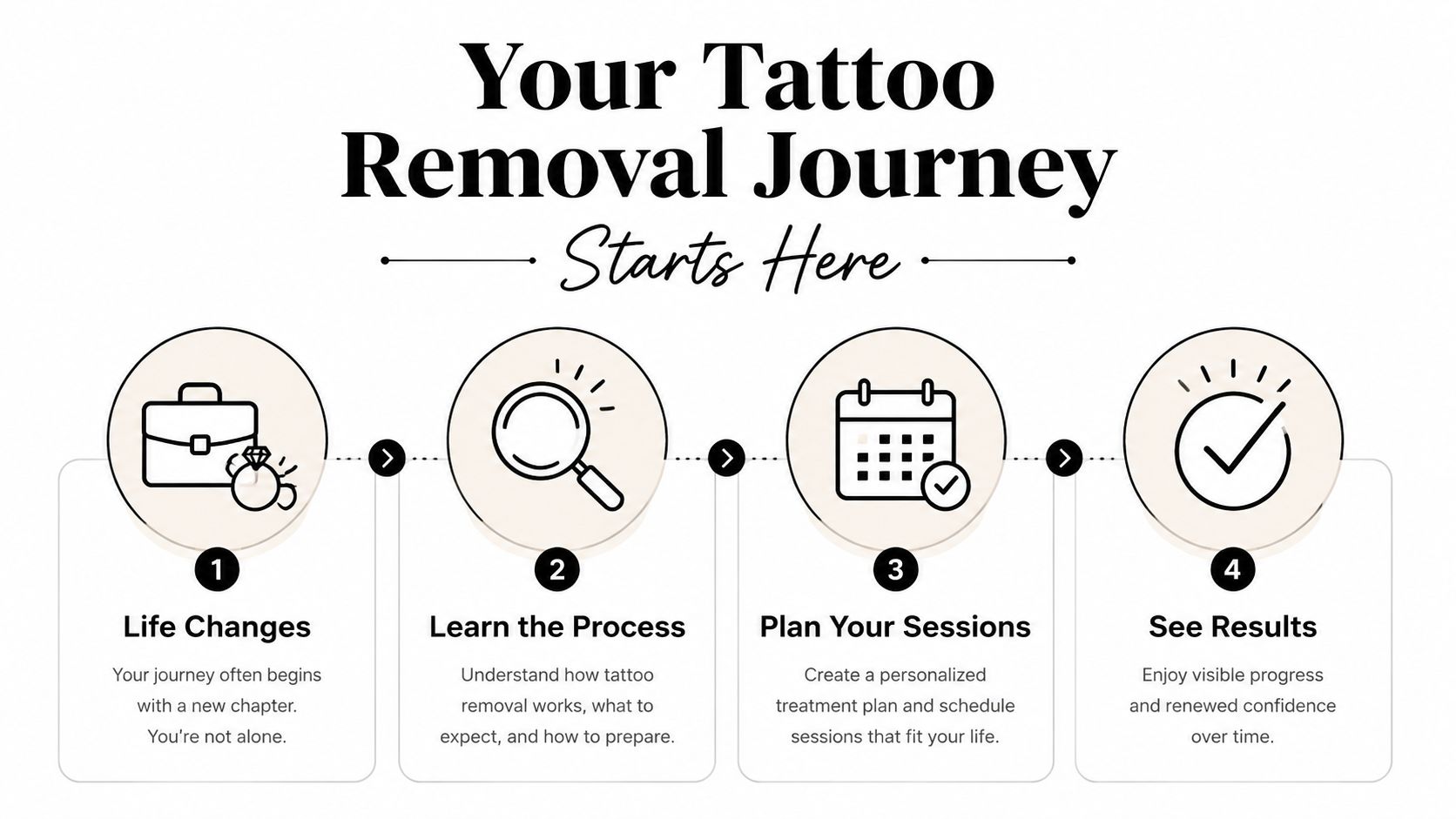
A good consultation should answer the practical questions first, not bury you in jargon. What is the tattoo made of, what goal matters most, and does the design need full removal or just enough fading for a cover-up?
| Question | Direct Answer |
|---|---|
| What is Discovery Pico? | A picosecond laser platform intended for tattoo removal and pigment treatment. |
| How does it work? | It uses ultra-short pulses to fragment ink into smaller particles for gradual clearance. |
| Is the result the same for every tattoo? | No, results vary based on tattoo and skin factors, plus treatment planning. |
| What should I expect first? | A consultation, then a plan based on the tattoo's colors, depth, and location. |
Practical rule: if a provider promises the same result for every tattoo, that's not a treatment plan, it's a shortcut.
A useful way to think about the rest of this guide is simple. The next questions are about how the laser works, what it can and can't do with different colors, who should be cautious, what a treatment session looks like, and why cost is always a consultation issue rather than a universal number.
How Picosecond Laser Technology Works
A tattoo that looked sharp in the chair can still be stubborn under a laser because ink is engineered to stay put. The body does not clear those particles quickly on its own, so removal starts by turning large pigment clusters into smaller pieces that the immune system can gradually clear. Discovery Pico is a second-generation picosecond Nd:YAG platform, and its product materials describe 370 ps at 532 nm and 450 ps at 1064 nm, with maximum pico-mode energy of up to 800 mJ at 1064 nm and 300 mJ at 532 nm Quanta Discovery Pico product page.
A helpful way to picture the process is gravel breaking down into finer gravel. A larger particle resists change, while smaller fragments are easier for the body to handle over time. Picosecond laser energy works on that same principle with pigment, so the first job is fragmentation and the second job is clearance.
Pulse duration, wavelength, and modes are not the same thing
Many treatment discussions get muddled. Picosecond and nanosecond describe pulse duration, which is how long the energy pulse lasts. Wavelength describes which part of the light spectrum is used, and that matters because different tattoo pigments absorb different wavelengths more efficiently. Emission modes describe how the platform delivers energy, which gives the clinician more ways to match treatment to the tattoo and the surrounding tissue.
The FDA-cleared family labeling for the Discovery Pico platform in 2019 included tattoo removal among intended uses, and the U.S. FDA 510(k) documentation also states intended uses for vascular lesions and pigmented lesions FDA 510(k) K191842. The family documentation also identifies wavelength-specific targeting, and the 532 nm setting is part of the device's documented operating logic FDA 510(k) K163222.
Discovery Pico's technical family combines up to three wavelengths, 532 nm, 1064 nm, and 694 nm, with up to 4 emission modes and up to 6 with VarioPulse Quanta Discovery Pico series. That matters because tattoo ink is rarely uniform. One design may mix black outlines, colored fills, older touch-ups, and areas that sit differently in the skin, so the provider needs room to adjust the approach instead of forcing every color through the same setting.
A versatile platform still does not make every tattoo equally predictable. Black ink at a suitable depth usually responds differently from red, green, or mixed pigments, and skin location can change how cautiously a clinician has to work. A tattoo on thick, well-healed skin is not the same as a piece sitting over a thinner or more sensitive area.
The point is not that more settings are always better. The point is that matching the setting to the ink is better than guessing.
The FDA-cleared technical documentation also notes that the wavelengths are fired individually and cannot be fired simultaneously PPS Lasers technical page. That operating rule matters in planning because it means the provider chooses a specific wavelength and delivery approach for a specific goal, rather than treating every pigment the same way at once.
For a broader look at how modern tattoo removal platforms are discussed in practice, see this background on tattoo removal technology.
Discovery Pico Compared With Other Laser Approaches
A useful comparison starts with a real tattoo, not a brochure. The provider has to match wavelength, pulse structure, and emission mode to the ink, the skin, and the treatment goal. Discovery Pico gives that kind of planning flexibility, while standard Q-switched approaches usually work within a narrower pulse framework, so the discussion should stay focused on control and fit rather than on marketing language.
| Decision Factor | Discovery Pico Platform | Standard Q-Switched Approach |
|---|---|---|
| Pulse structure | Includes picosecond, nanosecond, and photo-thermal operation in the family documentation | Uses a more limited Q-switched pulse style |
| Wavelength options | Up to 532 nm, 1064 nm, and 694 nm in the family | Wavelength options vary by device, often with less flexibility |
| Ink targeting | Wavelength choice helps target different pigment colors more specifically | Still useful, but usually with fewer tailoring choices |
| Treatment planning | Multiple modes can help match ink density and tissue response | Planning is typically less adjustable |
| Expectation setting | Still needs an individualized assessment, because versatility helps with planning, but results still depend on the tattoo and the treatment approach | Also needs assessment, especially for mixed colors and layered tattoos |
The FDA-cleared 532 nm Q-switched nanosecond mode is described as suitable for light-ink tattoos such as red, sky blue, green, tan, purple, and orange FDA 510(k) K163222. That matters because it shows the wavelength-to-ink relationship in practical terms. A provider may choose one mode for one part of a tattoo and a different approach for another part, especially when the design mixes colors or has areas that sit differently in the skin.
A multicolor tattoo can behave like a set of different problems inside one image. Black linework, bright fill, older touch-ups, and denser scarred areas do not all respond the same way, even when they sit in the same design. That is why wavelength choice and pulse structure matter together. If the wrong setting is used, the session may be less efficient or the provider may need to work more cautiously than planned.
The more confusing part is what Discovery Pico does not promise. A versatile platform can help the clinician adapt, but it does not make every color equally predictable or create a fixed session count for every tattoo. The 2023 NIH review notes that picosecond and fractional picosecond lasers can improve pigmentation and scars, while also saying more research is still needed to confirm benefits across protocols and outcomes NIH review. That is why a sound consultation talks about likely improvement, what the tattoo is made of, and how the plan may change as the skin responds.
More on the broader picosecond tattoo removal conversation
Who Is a Good Candidate
Candidate suitability depends on the tattoo itself, skin tone, ink colors, size, depth, layering, and the endpoint you want. A dense black line piece, a multicolored sleeve, a cosmetic brow tattoo, and a previously treated design each raise different planning questions, even before the first setting is chosen.
Match the goal before talking about the laser
Complete removal and cover-up fading are different goals, so the treatment plan should reflect that difference from the start. If the goal is to remove the tattoo as much as possible, the work usually focuses on gradual clearance and repeated checks along the way. If the tattoo only needs to fade enough for new artwork, the target changes, and the conversation about how much pigment should remain changes with it.
A few practical examples make this clearer. A black outline on the forearm may respond differently from a rainbow design on the ankle because pigment type and body location matter. A tattoo that has already been treated may also behave differently from one that has never been touched, which is why any prior laser history should be shared during consultation.
Good consultation habit: bring the tattoo's age if you know it, every prior removal detail you remember, and a clear description of whether you want full removal or just fading.
The first questions should focus on planning, not on promises.
- Which wavelengths are you planning to use, and why?
- Do you expect full removal, or is fading for a cover-up more realistic?
- How will you adjust the plan if the tattoo has layered ink or mixed colors?
- What should I tell you about previous treatments or skin sensitivity?
Wavelength choice is not random. The FDA-cleared family documentation shows the platform was built for tattoo removal, vascular lesions, and pigmented lesions, with wavelength-specific use cases tied to the settings used on that platform FDA 510(k) K163222. That is why a good consultation matters so much, because the machine still needs a trained plan that matches the tattoo in front of it.
What Happens During a Treatment Session
A visit usually begins with a close look at the tattoo, the skin around it, and the treatment goal. A provider then chooses the approach based on what is on the skin, because wavelength, ink color, and ink depth all influence how the laser should be used. With Discovery Pico, the wavelengths are selected individually, so the treatment plan can match the tattoo instead of treating every design the same way.
That matters in real-world planning. A black script tattoo may respond differently from a multicolor sleeve, and a tattoo with layered touch-ups can behave differently again. A versatile platform can help a provider adapt, but it does not make every tattoo equally predictable or guarantee the same number of sessions for each person.
After the assessment, the area is prepared and protected according to the clinic's protocol. The laser is then applied in the chosen mode, with settings matched to the tattoo's characteristics and the skin's response. The appointment starts the clearance process, and the body continues the work of clearing fragmented pigment between visits.
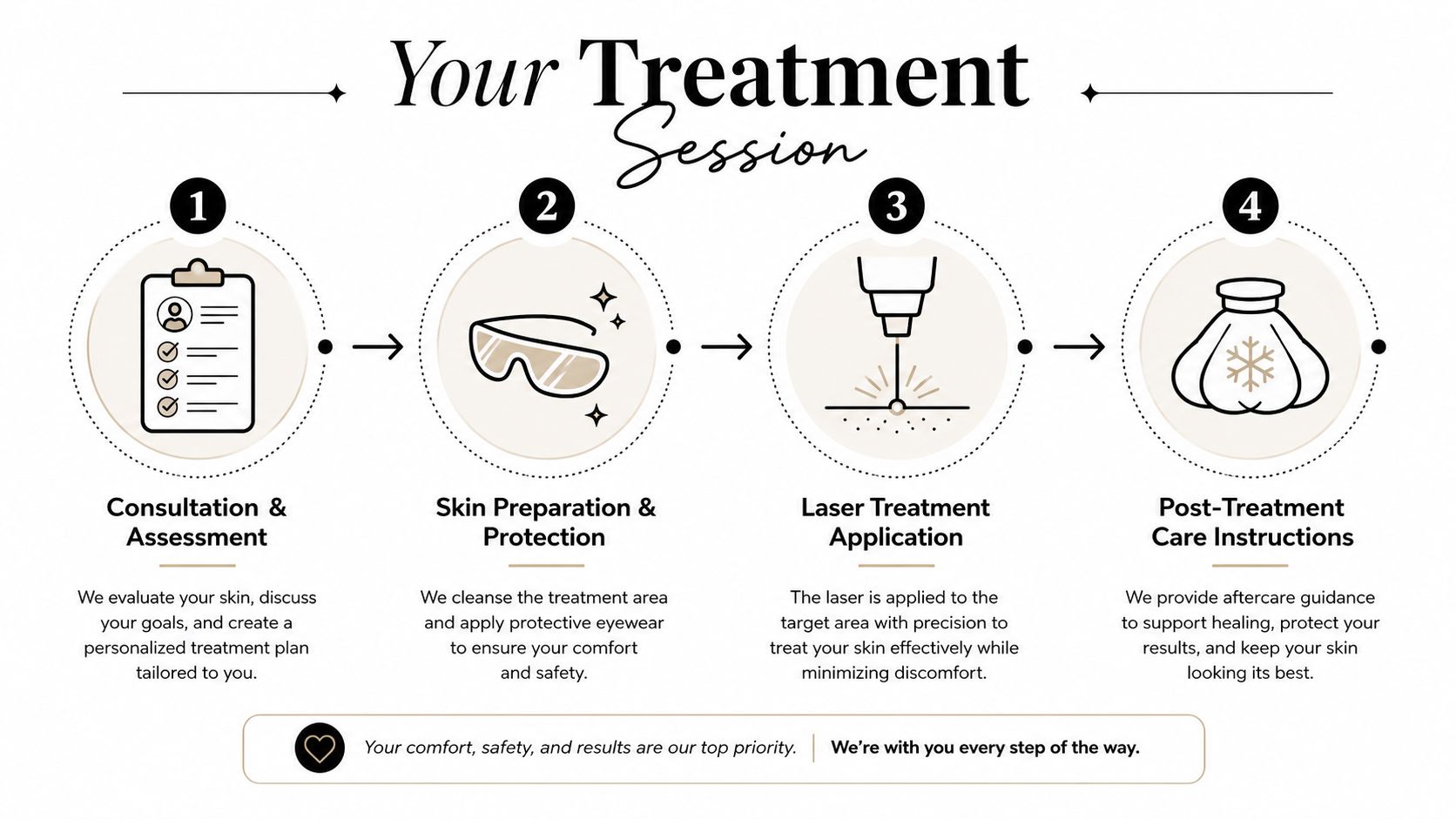
The visit usually follows a simple sequence
- Consultation and assessment. The provider checks the tattoo, the skin, and any treatment history.
- Skin preparation and protection. The area is prepared before energy delivery.
- Laser application. The selected wavelength and mode are used on the tattoo.
- Post-treatment instructions. You leave with care guidance for the healing period.
Aftercare affects how the treated skin settles between sessions. Following the provider's instructions, protecting the area, avoiding unnecessary friction, and asking promptly about anything that seems unusually prolonged or concerning can help keep recovery on track. The appointment is only one part of the process, and the time between visits carries a lot of the practical work.
Early fading after one session can be easy to overread. Some tattoos show visible change quickly, while others move more slowly, and both patterns can still fit the treatment plan. Progress is gradual, and session spacing is part of that plan because the skin and the immune system need time to do their part.
Results Sessions and Cost Considerations
A consultation estimate should start with the tattoo itself. Ink color, density, tattoo depth, location, size, layering, skin response, prior treatment history, and spacing between sessions all shape what a provider can reasonably expect. If the goal is complete removal, the estimate may look different from a cover-up fading plan, because the endpoint changes how much pigment still needs attention.
| Factor | Why It Matters | Question for the Consultation |
|---|---|---|
| Ink color | Different pigments absorb wavelengths differently | Which colors do you expect to fade first? |
| Ink density | Heavier saturation often needs more planning | How dense does this tattoo look to you? |
| Depth | Deeper pigment can be harder to clear | Do you think the ink sits deep or superficial? |
| Location | Body area can affect treatment planning | Does this placement change the plan? |
| Size | Larger tattoos usually need more time and coordination | How will the area size affect scheduling? |
| Previous treatment | Earlier sessions can change how the skin responds | How should past removal work shape this estimate? |
Cost should be discussed as an estimate shaped by your tattoo and your goals, not a fixed guarantee. A lower per-session number does not automatically mean better value if the plan does not match the ink, the skin, or the endpoint you want. A better question is whether the treatment strategy fits the tattoo in front of you.
Wavelength choice also affects how the estimate is built. A platform with several options can help a provider match certain colors more thoughtfully, yet that flexibility does not make every tattoo equally predictable. Black ink, bright colors, mixed pigments, and older layered work can respond very differently, even under the same device settings, because pigment type and pulse structure still matter.
Session count is usually approached as a moving estimate. Providers watch how fading develops between visits, compare one appointment to the next, and decide whether the next pass should stay the same or be adjusted. That is why planning should leave room for change. Two tattoos that look similar at the start may separate quickly once treatment begins, especially if one has deeper saturation or more color variation.
Read about scar-related questions before treatment
Safety Side Effects and Common Misconceptions
A tattoo that fades unevenly or feels different from one visit to the next can raise questions fast. That is normal, and it is one reason safety conversations matter before the first pulse is delivered. Temporary reactions can happen after laser tattoo removal, but the exact experience depends on the person, the ink, and the treatment plan. Aftercare works best when it is customized to the skin in front of the provider, not treated like a one-size-fits-all checklist. If anything seems unusually prolonged, the right move is to contact the treating clinic or a clinician who can evaluate it directly.
The biggest misconception is that a stronger laser erases ink in one pass. Tattoo removal does not work that way, even with Discovery Pico, because the laser has to break pigment into smaller pieces before the body clears it over time. Wavelength choice also matters. A platform may offer several options, but that does not make every tattoo equally predictable. Black ink, bright colors, mixed pigments, and older layered work can respond very differently because pigment type and pulse structure still shape how the ink breaks apart.
The FDA-cleared family documentation shows that the platform includes picosecond, nanosecond, and photo-thermal operation, and that the wavelengths are fired individually PPS Lasers technical page. That detail helps explain why planning is deliberate rather than automatic. A provider has to match the wavelength to the ink and the skin, then watch how the tattoo responds over time. The NIH review on picosecond laser tattoo removal also notes that more research is still needed to confirm benefits across different protocols and outcomes.
A final misconception is that a fixed session package equals a fixed result. It does not. Two tattoos that look similar at the start may separate quickly once treatment begins if one has deeper saturation or more color variation, while another may need a slower pace to protect the skin and keep the plan realistic. If you are also trying to understand what changes can and cannot affect the skin after treatment, this guide on tattoo removal scars gives a useful reference point.
If a plan sounds universal, ask who decided it, and what it is based on.
Planning Your EradiTatt Consultation
If you're in Florida and ready to move from reading to action, EradiTatt offers tattoo removal through locations in Orlando, Bradenton or Sarasota, St. Petersburg, Palm Harbor, and Tampa. Before you call, write down the tattoo's approximate size, colors, age if known, prior removal work, your desired outcome, and any scheduling limits you're working around.
Ask directly whether your goal is complete removal or fading for a cover-up, and ask how skin considerations may shape the plan. A good consultation should leave you with a clearer estimate, a better sense of treatment intervals, and a realistic understanding of how wavelength choices affect your tattoo.
FAQ
Is complete removal the same as cover-up fading? No, those are different goals, and they often need different treatment planning.
Why are wavelengths used individually? Because the device is designed to deliver selected wavelengths one at a time, which helps the provider match treatment to the tattoo.
What should I bring to the consultation? Tattoo size, colors, age if known, prior removal history, and your scheduling constraints.
Does a versatile laser guarantee faster results? No, versatility helps with planning, but results still depend on the tattoo and the treatment approach.
EradiTatt Tattoo Removal helps people in Florida plan tattoo removal with a consultation-first approach, which matters when wavelength, ink color, and treatment goals all affect the outcome. If you're ready to talk through full removal or fading for a cover-up, visit EradiTatt Tattoo Removal and start with a conversation built around your tattoo, not a guess.
2 Responses