
You're looking at a black tattoo and wondering why something so dark, so simple-looking, can feel so stubborn. Maybe it's the design you loved years ago, maybe it's a cover-up that didn't age well, or maybe you just want a clean slate without guessing what happens next. Tattoo removal black ink is usually the easiest place to start, but “easiest” doesn't mean instant, painless, or one-size-fits-all.
Black pigment responds differently because of how it absorbs laser energy, and that basic fact shapes almost everything that follows, from the laser choice to the number of sessions to the risk on darker skin. The good news is that the physics are well understood. The harder truth is that dense blackwork, cover-up goals, and skin tone can change the plan a lot more than many expect.
Table of Contents
- Why Black Ink Removal Is the Easiest Starting Point
- How Lasers Actually Erase Black Ink
- Session Counts and What Happens During Each Visit
- Skin Tone, Risk, and Why Easy Is Not Always Simple
- Side Effects, Healing, and Aftercare Between Sessions
- Fading for a Cover-Up and How to Plan It
- How to Choose the Right Clinic for Black Ink Removal
- Putting It All Together and Next Steps
Why Black Ink Removal Is the Easiest Starting Point
The first thing many people notice is how a black tattoo looks under harsh morning light, flat, dense, and far more permanent than it seemed before. That moment usually leads to the same question: if black is only one color, why does it still take so long to remove? The answer is that black pigment is embedded in the skin, so the laser has to reach it, break it apart, and let the body clear the fragments over time.
Black ink is usually the easiest pigment for laser treatment because it absorbs light very efficiently across a wide range of wavelengths. That makes it the benchmark color in tattoo removal, not because it disappears instantly, but because it gives the laser a cleaner target than most other pigments. A large global analysis summarized by Practical Dermatology found that black ink accounted for most removals, and blackwork and illustrative styles were also common among treated tattoos. Clinics build their standard black-ink protocols around that reality, since they see this pigment constantly.
A black shirt left in direct sun heats up faster than a white one. Black tattoo pigment behaves in a similar way under laser light, it takes in more of the energy instead of reflecting much of it back. That is why black is the easiest color to target, while the ink still has to be shattered into small particles and carried away by the immune system.
Practical rule: black ink is the easiest color to start with, not the easiest tattoo to finish. Dense linework, older scarred skin, cover-up layers, and body location still change the result.
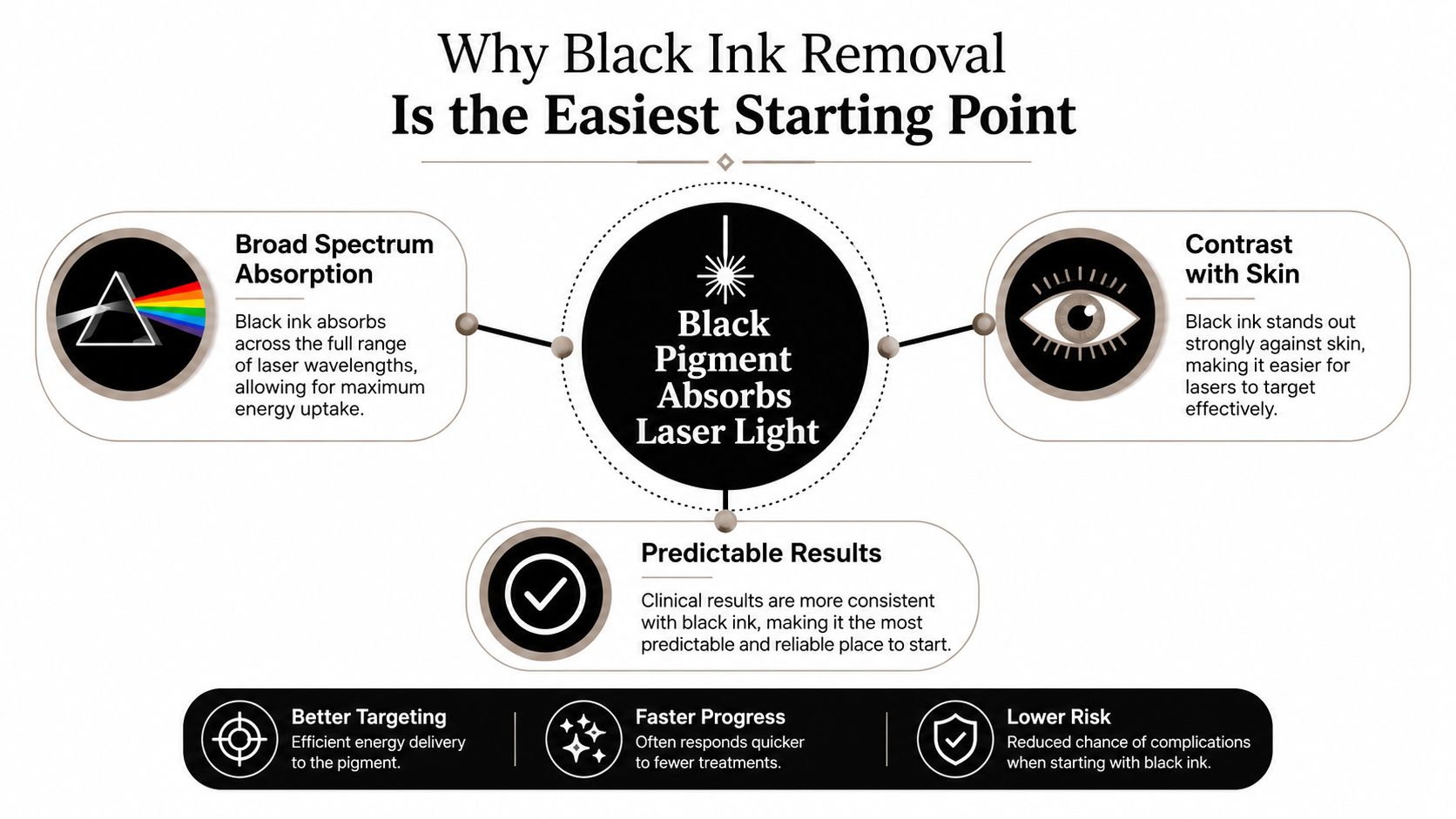
That starting advantage has clear limits. Thick blackwork holds more pigment in a tighter area, so there is more material to clear. Cover-up tattoos can be even trickier because the darkest parts are often layered over older ink, and the visible black on top may hide what sits underneath. Skin tone matters too, because clinics have to separate the energy needed to hit the ink from the energy that could also affect melanin in the surrounding skin.
Some colors still behave very differently under the same laser approach, which is why black often becomes the comparison point for the rest of a treatment plan. If a tattoo also contains other pigments, the black sections usually give the most predictable early progress, while greens and other colors can lag behind. For a related explanation, see why green ink behaves differently under laser removal.
How Lasers Actually Erase Black Ink
A black tattoo does not vanish from the skin in one step. A client walks in with pigment sitting under the surface, and the laser's job is to break that pigment into smaller pieces so the body can clear them over time. That is why black ink removal starts with a physical question, what wavelength reaches the ink most efficiently while leaving the surrounding skin as untouched as possible.
The wavelength choice matters first
Black tattoo ink is usually treated with a Q-switched 1064 nm Nd:YAG laser because that wavelength is well suited to dark pigment while producing relatively low melanin absorption, which helps reduce epidermal injury in darker skin types (laser interaction physics reference). The choice is practical rather than cosmetic. The machine has to reach the ink without putting too much energy into the surface skin.
Q-switched systems typically use pulses in the 6 to 10 nanosecond range, and that timing matters because it favors photoacoustic fragmentation instead of bulk heating. In plain language, the laser delivers energy so quickly that the pigment particles crack apart before the surrounding tissue has time to cook.
What the technician is adjusting
Published technical data for Q-switched Nd:YAG systems report fluence settings roughly in the 2 to 12 J/cm² range with spot sizes around 2 to 8 mm (technical overview). Those settings are not random. They determine whether the beam carries enough energy to fracture the ink, or enough to irritate the skin without clearing much pigment.
A porcine-model study of a 150 ps Nd:YAG laser found the best black-tattoo clearance at 1064 nm, 2 mm spot size, and 155 mJ pulse energy, with 76.46% clearance in that experimental setup (technical overview). That does not mean every clinic should use those exact settings. It shows how sensitive black-ink clearance is to wavelength, spot size, and pulse delivery.
The technician is balancing two targets at once, the ink and the skin. If the energy is too low, the pigment stays intact. If it is too high, the epidermis absorbs more stress than it should, especially in skin that already has more melanin.
The laser does the cracking, but the body does the cleanup. If the fragments do not have time to clear, the next pass will not help much.
Picosecond systems come up often because shorter pulses create a different fragmentation pattern for some ink types. Even so, the 1064 nm Nd:YAG remains the standard reference point for black pigment because it matches the physics of dark ink so well. The useful way to judge a device is not by whether it sounds newer, but by whether the pulse, wavelength, and depth match the tattoo in front of it.
For a fuller explanation of why black ink can still need many visits even when the wavelength is right, see why tattoo removal takes multiple sessions.
Session Counts and What Happens During Each Visit
A first-time client usually wants one clean answer, but black ink removal does not work that way. A lighter tattoo with sparse lines may clear in a handful of sessions, while dense blackwork can keep showing up for much longer because every pass still has to break apart enough pigment for the body to clear. A clinical review and predictive model found an overall average of 6 sessions, with a range of 2 to 20 sessions depending on ink density and other variables (clinical review and predictive model).
A realistic session table
| Tattoo Type | Average Sessions | Range | Notes |
|---|---|---|---|
| Low-density black ink | 3.2 | Fewer sessions than dense work | Lighter linework tends to respond faster (clinical review and predictive model) |
| Typical black ink | About 6 | 2 to 20 | Broad clinical average, varies by depth and skin factors (clinical review and predictive model) |
| High-density blackwork | 9.0 | More sessions than sparse tattoos | Dense pigment takes longer to clear (clinical review and predictive model) |
Ink density was the strongest predictor in that model. Low-density tattoos averaged 3.2 sessions, while high-density tattoos averaged 9.0 sessions (clinical review and predictive model). That gap matters because a small outline and a packed sleeve do not behave the same way under a laser. The first is more like breaking a thin crust, the second is like cracking a thick slab that has pigment layered through it.
A reported study summary of black tattoo removal found that many people need more than a few visits before the result looks complete. In that summary, 77% of black tattoos had an excellent response, defined as more than 75% ink removal, after four treatment sessions, and 11 of 39 black tattoos (28%) cleared more than 95% at the reported settings (Practical Dermatology summary). That is the middle of the process, not the finish line. Early fading can look dramatic, especially on black ink, but “mostly gone” and “fully gone” are different goals.
One client visit is usually short and structured. The clinic checks the tattoo, positions the handpiece, then treats the area in passes while watching for frosting, the white, chalky look that shows the laser has hit the ink. After the session, the job shifts to the body. The fragments do not vanish on the spot, the immune system and lymphatic drainage clear them between appointments, which is why sessions are commonly spaced 6 to 8 weeks apart (technical overview).
Practical rule: if a clinic promises a fast finish on dense blackwork, ask how it is accounting for ink density. That one variable can change the entire timeline.
For a fuller explanation of why the calendar stretches out, see why tattoo removal takes multiple sessions.
Skin Tone, Risk, and Why Easy Is Not Always Simple
A black tattoo on fair skin often looks like the easiest removal case. The same ink on darker skin, dense blackwork, or a piece that needs controlled fading for a cover-up changes the picture fast. Ink density, skin tone, and the goal of treatment all shape the risk profile, which is why online advice can sound simple while the decision is more specific: can the tattoo come off without causing pigment change or unnecessary injury?
The FDA says laser removal is the main professional method, but results and side effects vary, and sun avoidance helps lower the chance of pigment change, so the skin has a better chance to recover with less color shift (FDA consumer guidance). That guidance matters even more in darker skin, where the QS Nd:YAG laser is often favored because it reduces injury to surrounding melanin more effectively than more aggressive approaches. The same black tattoo can be a straightforward target on one person and a much more delicate one on another.
What can go wrong
Hyperpigmentation means the skin darkens after treatment. Hypopigmentation means the skin lightens. Scarring is less common when the procedure is performed correctly, but the risk rises if the skin is overtreated, picked at, or exposed to sun too soon. Those are the reasons the clinician's experience with your skin tone matters more than the simple fact that a clinic owns a laser.
A medium or deeper skin tone does not rule out strong results. It changes the margin for error. A careful provider may choose lower energy, fewer passes, and more time between sessions to protect the epidermis. That slower pace can feel frustrating, but slower often means safer skin recovery.
If you have a history of keloids, skin discoloration, or healing that takes longer than expected, say so before the first pulse, not after the first blister.
The biggest mistake is choosing speed over fit. A clinic can promise fast fading and still be the wrong place if it does not have real experience with your skin type and tattoo density. For a cover-up, that caution matters even more because the target is controlled fading, not aggressive clearing.
Side Effects, Healing, and Aftercare Between Sessions
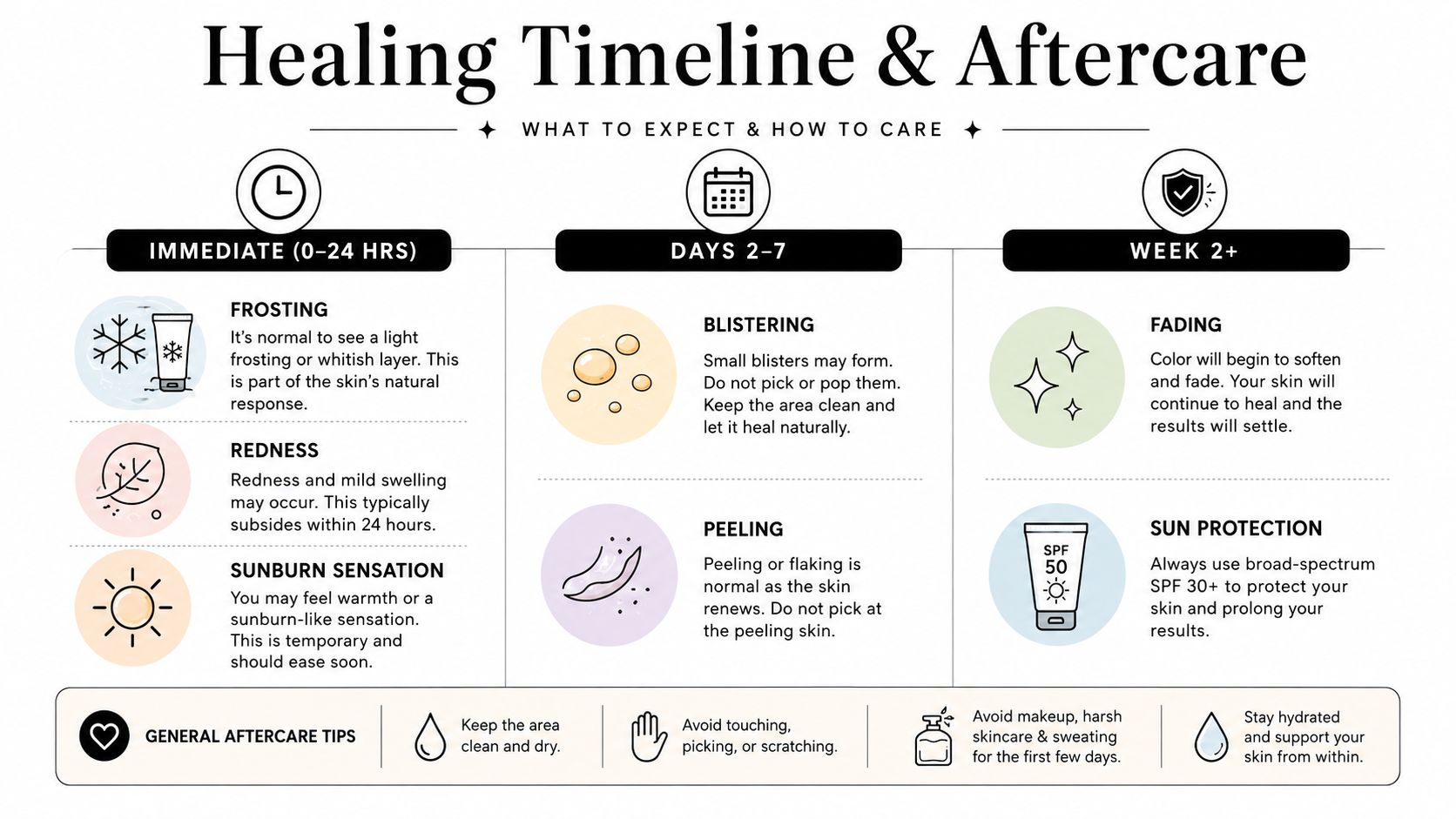
The skin usually reacts right away. Frosting, redness, and a mild sunburn sensation are common after treatment, and some people notice small blisters within 24 hours that may last 1 to 3 days. The first few days are about protecting the surface so it can settle without extra irritation, as explained in aftercare guidance.
What to do and what to avoid
- Keep it clean: wash gently with mild soap and pat dry.
- Skip soaking: no pools, hot tubs, baths, or long water exposure while the skin is healing.
- Don't scratch or exfoliate: the top layer needs time to recover without friction.
- Stay out of direct sun: UV exposure raises the chance of pigment changes on treated skin.
- Use sunscreen later: once the skin has re-epithelialized, consistent SPF helps protect the area.
Visible ink reduction often does not show up until 4 to 6 weeks after a session, because the laser breaks pigment into smaller pieces and the immune system clears them over time. That delay confuses first-timers. They expect the tattoo to look dramatically different a few days later, then worry when the lines still seem obvious.
Healing between visits is part of the treatment plan. If the skin settles well, the next session starts on calmer tissue and usually gives the clinician a better target to work with.
Fading for a Cover-Up and How to Plan It
A lot of people don't want total erasure, they want a cleaner canvas. That changes the whole strategy. For a cover-up, the goal is usually to lighten the existing black lines enough that a new artist can build over them without the old tattoo showing through.
The amount of fading needed is often less than full removal, which means fewer sessions. Light linework may need just 2 to 4 sessions, while dense blackwork can need 5 to 7 before a skilled artist can rework it cleanly, depending on the original density and the new design's coverage needs. Those numbers aren't a promise, they're a planning frame. The denser the old tattoo, the more sessions it usually takes to create usable space.
If you know you want a cover-up, bring the planned design to the consultation. A thick black sleeve and a lighter floral cover-up do not need the same level of fading. The more faded the original, the more creative freedom the artist has, but the less ambitious the new design can be if enough black still shows through.
Practical rule: don't treat cover-up fading like a rush job. The 6 to 8 week spacing still matters, even when you're impatient to get the next piece started.
A useful way to think about it is this. Full removal is about disappearance. Cover-up fading is about reshaping the canvas. Once you know which one you're chasing, the technician can aim the treatment plan at that outcome instead of guessing.
How to Choose the Right Clinic for Black Ink Removal
A good consultation should feel specific, not vague. Ask which laser system they use, at what wavelength, and whether they've treated tattoos with your skin tone and ink density before. Those answers tell you more than a polished website ever will.
The questions that matter most are practical:
- Which wavelength do you use for black ink? You want a clear answer, not a buzzword.
- How do you adjust for darker skin tones? The provider should explain how they reduce melanin injury risk.
- Do you offer a patch test? That matters if you're unsure how your skin will react.
- What session count are you projecting for my tattoo? Ask them to explain the reasoning, not just the number.
- How do you price treatment? Per session and package pricing can lead to very different total costs.
- How do you handle repeat visits? Tattoo removal takes time, so scheduling needs to work over months, not just one day.
A clinic's logistics say a lot too. Clear scheduling, fast responses, and multiple accessible locations make it easier to keep the treatment spaced properly. If you're comparing providers, look at how they handle communication after the first appointment, because follow-up matters just as much as the laser itself.
For practices that also care about their online reputation and patient communication, review management for medical spas is a useful operational reference. It's not about the tattoo itself, but it helps you understand how seriously a clinic treats consistency, responsiveness, and patient feedback.
EradiTatt Tattoo Removal is one option for people seeking laser tattoo removal with multi-location access in Florida, and its PiQo4 platform is described as using picosecond pulses for tattoo work. If a provider can't explain how its settings fit your skin and your ink, keep looking.
Putting It All Together and Next Steps
Black ink is the easy case in tattoo removal, but only in the narrow sense that it absorbs laser energy well and gives clinicians a clearer target. If you want full removal, expect a multi-session process and a timeline that can stretch well beyond a few visits. If you want a cover-up, the goal shifts to controlled fading rather than complete disappearance.
Three profiles usually emerge. The full removal seeker needs patience and a realistic session estimate. The cover-up client needs enough fading to free up design space. The person with darker skin or dense blackwork needs the most careful clinic selection because safety and pigment control matter as much as clearance.
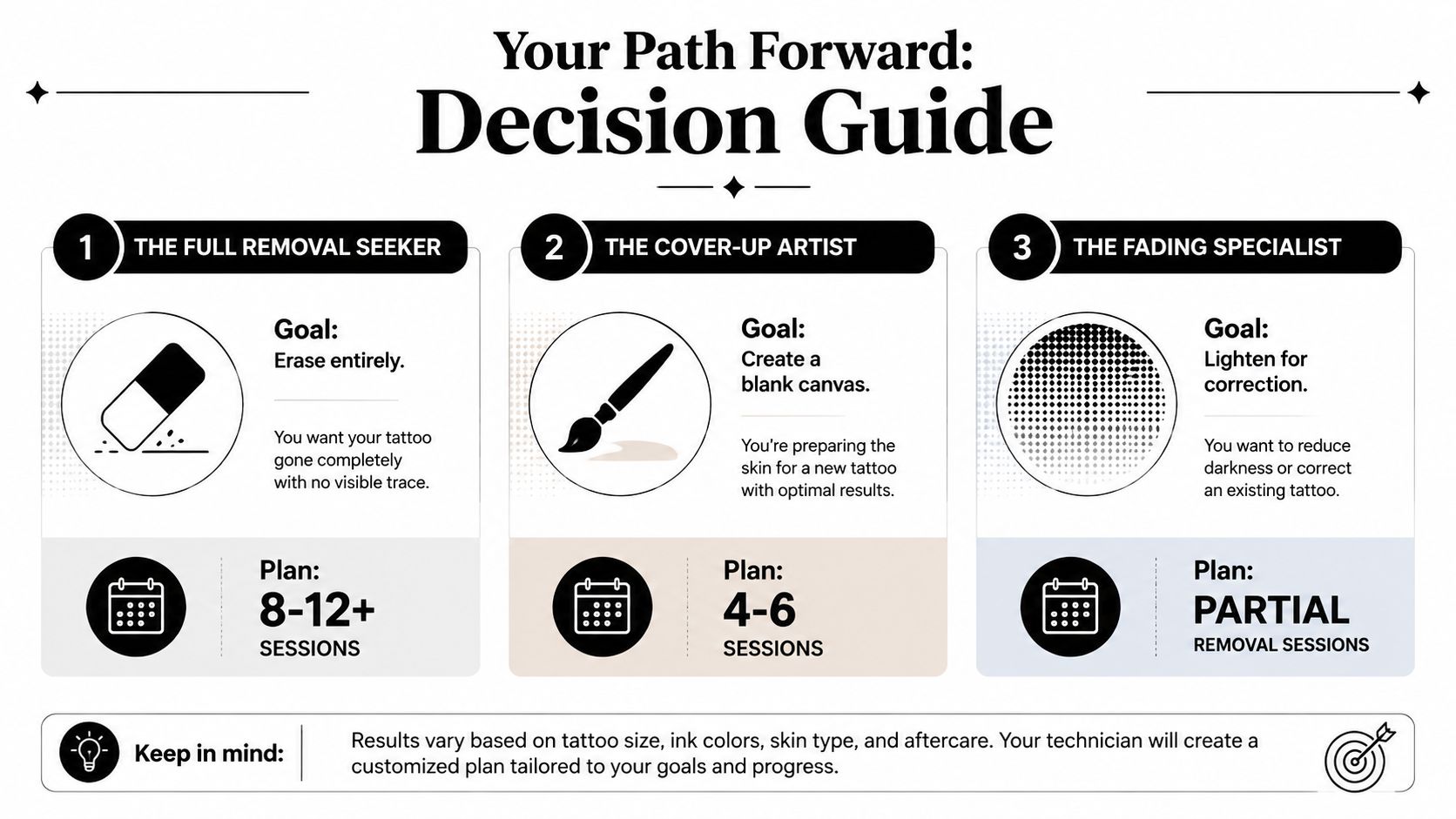
In the next 48 hours, take one clear photo in consistent lighting, write down your goal as full removal or fading for a cover-up, confirm your skin type, and book a consultation that includes a patch test discussion. That small amount of prep makes the first visit far more useful.
If you're ready to compare your options for black ink removal, EradiTatt Tattoo Removal can walk you through a consultation that matches your skin type, tattoo density, and end goal. Visit EradiTatt Tattoo Removal to ask about your next step and start with a plan that fits real-world healing, not guesswork.
One Response