
You're looking at a tattoo that was supposed to fade, but the skin around it now seems darker, lighter, blistered, unusually painful, or raised. That moment can be frightening, especially when you're unsure whether the reaction is part of normal healing or evidence of tattoo removal gone wrong. Most treatments heal without a lasting problem, but complications are real, and the safest response is to understand what happened, protect the skin, and have a qualified professional review it before another session.
Table of Contents
- When a Tattoo Removal Goes Wrong
- How Laser Removal Can Injure the Skin
- The Most Common Complications and How Often They Happen
- Who Is Most at Risk and Why
- How Clinics Prevent and Catch Complications Early
- Corrective Options When the Outcome Is Not What You Expected
- Choosing a Provider You Can Trust With Your Skin
When a Tattoo Removal Goes Wrong
A removal session can appear routine at first. The skin may whiten briefly, then become red, swollen, and tender. Those early reactions often settle as the treated area heals. Concern rises when the pattern changes, such as a blister that continues enlarging, pain that intensifies instead of easing, or redness that spreads beyond the tattoo.
Consider a common clinic scenario. A patient returns several days after treatment because the surface has eroded in one section and a dark outline remains around the design. They've also been applying an at-home acid and picking at the crusted areas. The laser may not have malfunctioned. Excessive energy, overlapping pulses, a poorly matched wavelength, treatment on recently tanned skin, or insufficient healing time can all place more stress on the skin. Picking, soaking, or using irritating products can then turn a difficult recovery into a more serious one.
Expected healing versus a warning sign
Temporary irritation generally stabilizes. A problem that needs prompt medical assessment tends to worsen, spread, or persist.
- Worsening pain deserves attention, particularly when discomfort increases after the initial treatment period.
- Pus, fever, warmth, or expanding redness can indicate infection after the skin barrier has been disrupted.
- Raised or thickened skin may signal abnormal scar formation.
- Persistent darkening or lightening can reflect pigment injury rather than ordinary redness.
- Ink that remains in scattered specks or a ghost-like outline may reflect uneven pigment depth, layering, or an altered cosmetic pigment.
The FDA lists lighter skin, scarring, infection, pinpoint bleeding, redness, and soreness among recognized risks of laser tattoo removal in its consumer guidance on tattoo removal options and results. These effects are expected to be temporary in many cases, but a persistent or worsening change still deserves review.
At-home acids, surgical excision, and treatment by an unqualified operator can also injure skin. Take photographs before and during healing, keep records of treatment dates and settings when available, and avoid starting another treatment until a medical professional has identified the likely cause.
How Laser Removal Can Injure the Skin
Laser removal works by delivering short, intense pulses that tattoo pigment absorbs. The ink receives energy, but nearby skin can absorb some of that energy too. The outcome depends on the ink, its depth and density, the patient's skin phototype, the wavelength, pulse characteristics, spot size, fluence, and the condition of the skin on treatment day.
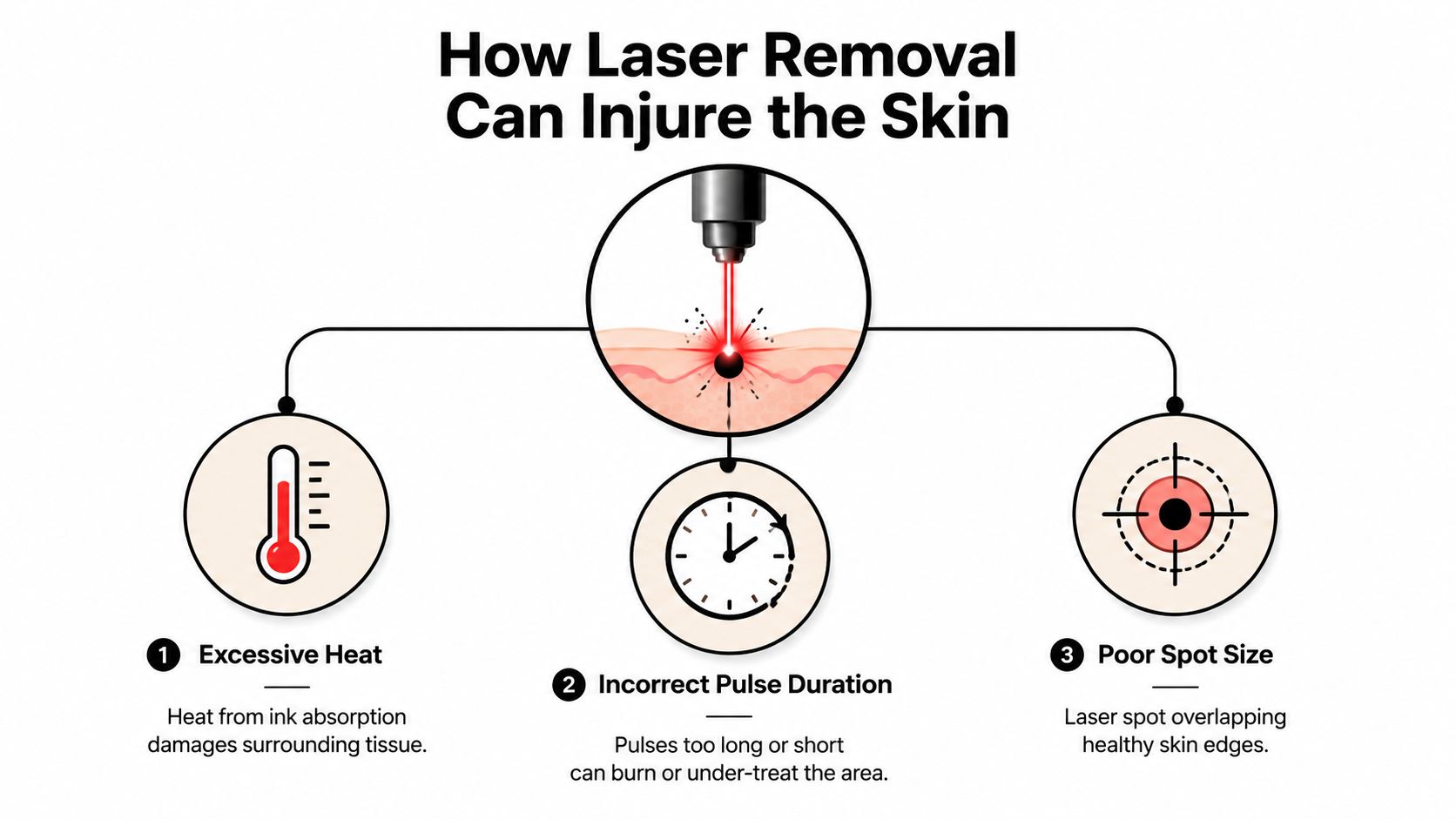
Heat reaches more than the ink
Ink absorbs light and converts it into heat. If the fluence is too high, the epidermis can burn, blister, or lose its surface. Excessive thermal injury may also disturb melanocytes, the cells that produce skin pigment. A review of laser treatment in darker skin reported hypopigmentation in 8% and hyperpigmentation in 22% of darker-skinned patients, as documented in this dermatology review of laser tattoo removal complications.
Melanin competes with tattoo ink for some wavelengths. In darker or recently tanned skin, the laser can affect surrounding pigment more readily, leaving lighter patches when melanocyte activity is suppressed or darker patches when inflammation stimulates pigment production.
Timing and pulse selection matter
Pulse duration affects how energy moves through the target. A poor match can deliver too much heat to surrounding tissue or fail to treat the intended pigment efficiently. Repeated inflammation can interfere with collagen organization in the dermis, which may produce a raised, thickened, or uneven scar.
Treatment intervals matter for the same reason. The skin barrier, inflammatory response, and pigment-clearing process need time to recover. Treating an area that remains irritated can compound injury rather than accelerate removal.
The ink can change its behavior
Not every pigment fragments predictably. Some cosmetic pigments containing iron oxide can darken after laser exposure, creating a black, gray, or more visible appearance instead of immediate fading. Layered or dense ink may also clear unevenly, leaving a persistent outline after the surrounding tattoo has become faint.
Infection usually follows barrier damage rather than causing it at the moment of the pulse. Scratching, soaking, contaminated products, or picking blisters and scabs can introduce bacteria. If you're unsure whether the area is infected, use this guide to signs of infection after tattoo removal as a starting point, then seek direct clinical advice when symptoms are progressing.
A careful provider reduces these mechanisms by matching wavelength, spot size, and fluence to the ink and skin type, using conservative adjustments, protecting surrounding skin, and allowing complete healing before reassessment.
The Most Common Complications and How Often They Happen
The word “complication” covers a wide range of outcomes. Mild redness and swelling are different from infection, a raised scar, or a pigment change that remains after the skin has healed. The timing, severity, and persistence of the reaction matter as much as its appearance.
A 2026 practitioner-reported study estimated complications in 8.1% of laser tattoo removal treatment sessions. The same report recorded edema in 3.0%, blistering in 1.9%, and hematoma in 0.7%. Hypo- and hyperpigmentation appeared in about 0.6% of treatments, while hypertrophic scarring and paradoxical darkening were each reported in 0.2%. Keloid formation, allergic reactions, ink blow-out, and infection were each reported in 0.1% of treatments, according to the published practitioner-reported complication study.
These figures describe treatment sessions, not a guarantee of personal risk. The report also found higher complication reporting with Fitzpatrick skin types III and above, colored tattoos, permanent makeup, previously treated tattoos, and tattoos younger than one year. That pattern reinforces an important point: risk isn't evenly distributed across every tattoo or every patient.
What each complication can mean
Hypopigmentation appears as a lighter patch where melanocyte function has been reduced. It can last for months and may sometimes remain permanent, particularly after aggressive treatment or substantial inflammation.
Hyperpigmentation creates a darker area after inflammation stimulates melanin production. Sun exposure can make the contrast more noticeable. It may stabilize gradually, but persistent change should be assessed rather than repeatedly treated without a diagnosis.
Scarring can be raised, thickened, indented, or associated with altered texture. Historical dermatology data provide useful context. A 2016 chart review of 1,041 patients who received at least five Q-switched Nd:YAG sessions found new hypertrophic scarring in 0.28%, representing three cases, and keloid scarring in 0.00%. However, 5.3% of charts showed some tissue texture change, dyspigmentation, or scar, as summarized in this review of tattoo removal side effects.
Ink persistence isn't automatically an injury. Ink depth, color, density, layering, previous scarring, and the laser's wavelength all influence how much remains. A faded “ghost image” may reflect pigment that sits deeper or responds more slowly.
Paradoxical darkening is different. Cosmetic pigments containing iron oxide can become darker after laser exposure, particularly when the pigment's chemistry reacts to the treatment instead of fragmenting as expected.
| Complication | What it looks like | Why it happens |
|---|---|---|
| Edema | Swelling around the treated design | Short-term inflammatory response |
| Blistering | Fluid-filled raised areas | Epidermal heat injury |
| Hypopigmentation | Lighter patches | Melanocyte disruption |
| Hyperpigmentation | Darker treated skin | Post-inflammatory pigment production |
| Scarring | Raised, thickened, indented, or uneven texture | Excess energy, overlapping treatment, infection, or individual healing tendency |
| Infection | Spreading redness, warmth, pus, increasing pain, or fever | Bacteria entering through damaged skin |
| Ink persistence | Residual specks or a ghost outline | Pigment depth, color, density, layering, or prior scarring |
| Paradoxical darkening | Cosmetic ink becomes black or gray | Chemical reaction in certain pigments |
Published rates vary because studies use different devices, populations, definitions, and follow-up periods. For broader context about adverse outcomes across cosmetic procedures, readers can review what are cosmetic surgery complications, but tattoo removal still requires its own assessment. A consultation should interpret the available evidence alongside your skin type, tattoo characteristics, prior treatment, and healing history, not promise completely scar-free removal.
For an additional overview of laser-specific concerns, see this discussion of laser tattoo removal risks.
Who Is Most at Risk and Why
Risk comes from the interaction between skin, ink, treatment settings, healing biology, and provider judgment. Fitzpatrick skin types III and above had higher complication reporting in the modern practitioner study, and the treatment challenge becomes more pronounced as melanin competes with laser energy intended for tattoo pigment.
Darker skin can develop either lighter or darker patches after treatment. The darker-skin cohort figures cited earlier, 8% for hypopigmentation and 22% for hyperpigmentation, come from a specific review and shouldn't be applied automatically to every person or clinic protocol. They do show why a provider should assess skin tone carefully, avoid recently tanned skin, and use conservative settings.
Patient factors that change the decision
A history of keloids or raised scars matters because the skin may overproduce collagen after injury. Immune suppression, medications that affect healing, pregnancy, recent isotretinoin use, smoking, and active skin disease also need discussion before treatment. These factors don't automatically rule out removal, but they can change timing, supervision, consent, or referral decisions.
Sun exposure deserves special attention. Tanned skin contains more active melanin, which can absorb treatment energy and increase the chance of pigment alteration. Picking scabs or blisters adds mechanical injury and raises the possibility of infection and poor texture.
Tattoo characteristics matter just as much:
- Colored or cosmetic ink may respond unevenly or darken unexpectedly.
- Layered cover-ups can contain pigment at different depths.
- Amateur tattoos may have irregular depth and density.
- Older faded tattoos can be harder to interpret because residual ink is uneven.
- Previously treated tattoos may contain scar tissue or altered pigment behavior.
- Tattoos younger than one year were associated with higher complication reporting in the 2026 practitioner study.
| Risk Factor | Hypopigmentation Risk | Hyperpigmentation Risk | Scarring Risk |
|---|---|---|---|
| Fitzpatrick skin type III or above | Higher reporting in the practitioner study | Higher reporting in the practitioner study | Requires conservative assessment |
| Recently tanned skin | Melanin can absorb more laser energy | Post-inflammatory darkening may be more visible | Thermal injury can increase concern |
| Colored or cosmetic ink | Depends on pigment chemistry | Paradoxical darkening is possible | Aggressive attempts to clear stubborn pigment can injure skin |
| Previous treatment | Altered skin may react unpredictably | Existing pigment change can complicate assessment | Scar tissue may heal differently |
| Keloid history | Not the primary risk | Not the primary risk | Personal tendency raises concern |
| Picking or poor aftercare | Delayed barrier recovery | Inflammation can worsen pigment change | Infection or repeated trauma can impair texture |
Provider-side risks include an unsuitable wavelength, excessive fluence, overlapping pulses, skipped test spots, and treating skin that hasn't recovered. A qualified operator should explain why a particular device and setting fit the tattoo instead of treating every color and skin type with one preset.
How Clinics Prevent and Catch Complications Early
Prevention begins before the laser touches the skin. A responsible clinic reviews medical history, medications, pregnancy status, previous tattoo treatments, sun exposure, skin type, allergy history, and any tendency toward keloids or pigment changes. The assessment should include the tattoo's colors, density, depth, age, cosmetic status, and any existing scar tissue.
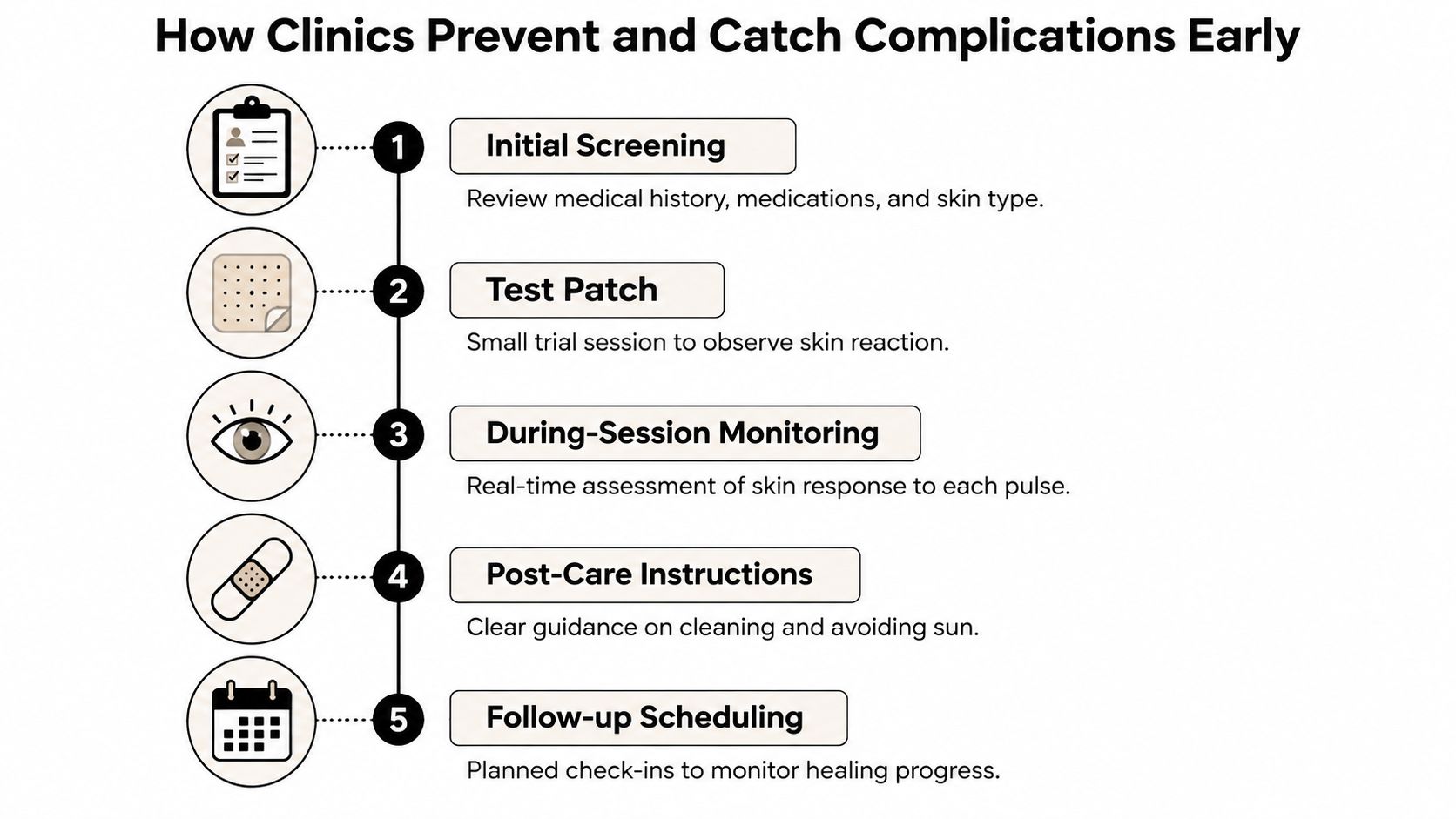
The safeguards that matter most
Photographs create a baseline. Consistent images help distinguish a new pigment change from one that existed before treatment. They also document how the area evolves between sessions.
A test spot provides information. Treating a small area first can reveal an unexpected reaction before the provider exposes the entire tattoo. This is especially important with darker skin, cosmetic pigment, unusual colors, prior treatment, or uncertain ink composition.
Settings should be individualized. Wavelength selection needs to match the pigment. Fluence, pulse characteristics, spot size, and cooling should be adjusted to the tattoo and phototype, with conservative increases only when the skin response supports them.
Healing time is part of treatment. The provider shouldn't use repeated sessions to chase faster fading while the surface remains inflamed, blistered, or pigment-altered. The skin needs to recover before the next assessment can be interpreted accurately.
Florida oversight also matters. State rules commonly involve a physician medical director or direct physician supervision for laser tattoo removal, and a medical-board position statement says these procedures should be performed by a physician or an appropriately trained licensed professional under physician supervision. The Florida laser tattoo removal regulation overview describes supervision and training considerations, including rules that may require hands-on laser operator training.
Aftercare should cover gentle cleaning, dressing when appropriate, sun avoidance, blister protection, and clear instructions about what not to apply. Re-evaluation should be scheduled after the skin has had time to heal, with the plan adjusted if redness, scarring, or pigment shifts appear.
Practical rule: A clinic should be able to explain what it will do if your skin response is stronger than expected, not only describe how the laser works.
Corrective Options When the Outcome Is Not What You Expected
Correction starts with diagnosis, not another laser session. A specialist needs to determine whether the problem is active inflammation, infection, residual ink, paradoxical darkening, pigment alteration, or mature scar tissue. Treating unstable skin too soon can make the original problem harder to evaluate and potentially worsen it.
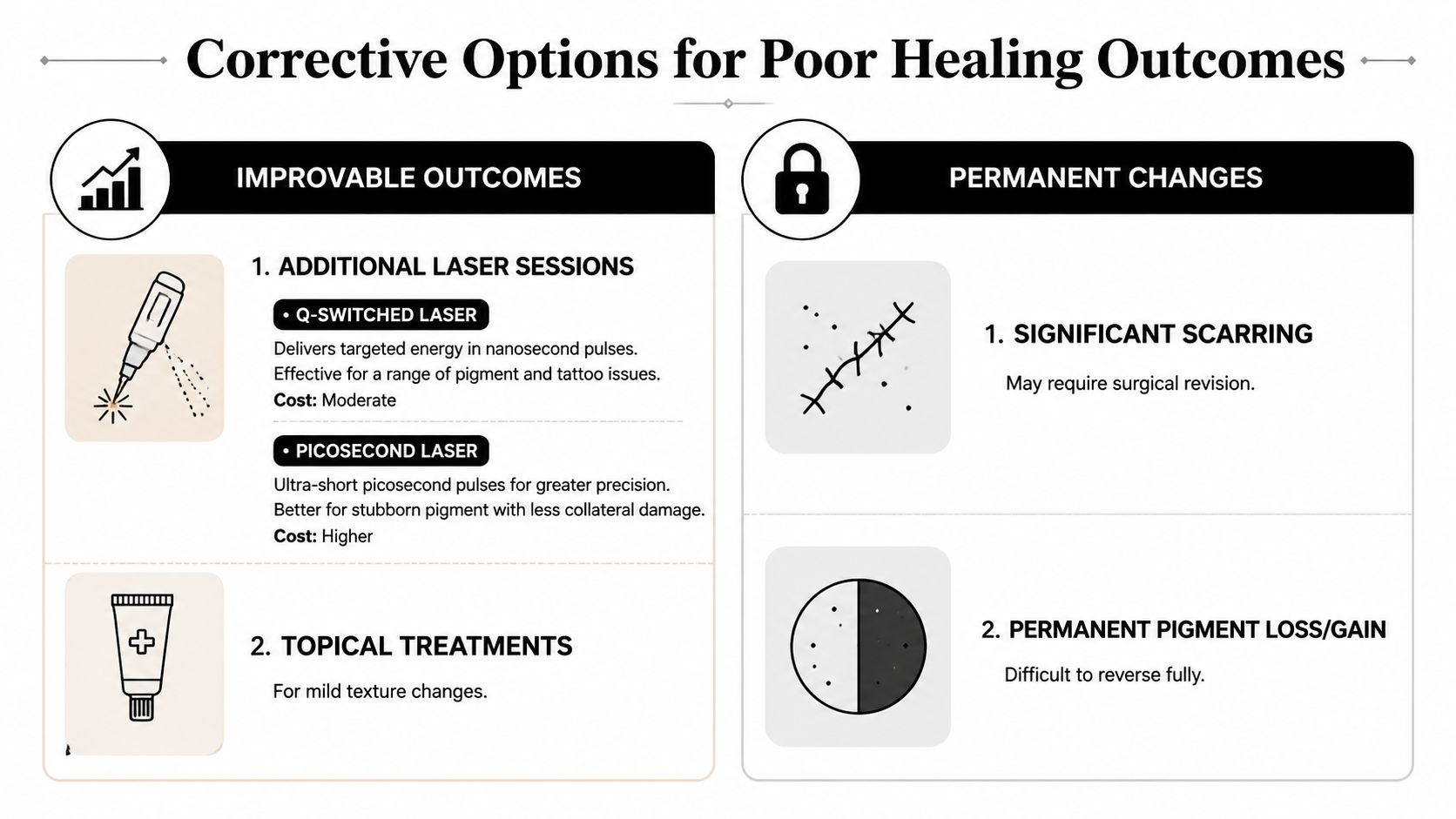
When more laser treatment may help
If the skin has healed and the issue is residual tattoo pigment, a dermatologist or experienced laser provider may consider additional treatment. Q-switched and picosecond devices use different pulse technologies, and the appropriate choice depends on pigment color, depth, density, prior response, and skin type. A change in wavelength or device may make more sense than repeating the same settings.
Cosmetic pigments deserve extra caution. Iron oxide can darken after laser treatment, and titanium dioxide may also behave unpredictably depending on the formulation. A test spot and informed consent are particularly important before treating cosmetic makeup or a previously darkened area.
Observation can be the safest first option for post-inflammatory hyperpigmentation when the skin is stable and no infection or active inflammation is present. A dermatologist may discuss topical lightening agents or other pigment-focused treatment, but self-directed acids and bleaching products can irritate recently treated skin.
Treating pigment loss and scars
Stable hypopigmentation may be evaluated for light-based repigmentation approaches, including narrowband UVB or excimer protocols. Results vary, and pigment restoration may be incomplete. Camouflage tattooing can help some mature, stable light patches or residual outlines, but it introduces new pigment and shouldn't be performed while the area remains inflamed or changing.
Mature scars may respond to silicone therapy, intralesional triamcinolone or 5-FU, microneedling, or fractional resurfacing. Raised scars and keloids need medical supervision because the wrong intervention can stimulate more growth. Small, fibrotic tattoos may sometimes be considered for surgical excision, although excision trades residual ink for a surgical scar and isn't suitable for every location or design.
Significant scarring, infection, rapidly changing pigment, or a reaction involving cosmetic makeup warrants referral to a dermatologist or plastic surgeon. A correction plan may take time because the clinician needs to separate active healing from a permanent change. Cost also varies substantially by the treatment chosen, the size and location of the area, the number of sessions, and whether specialist scar care or surgery is required, so a precise range can't be responsibly promised without an examination.
Choosing a Provider You Can Trust With Your Skin
Use the consultation to test the clinic's process, not just its marketing. Ask how the provider evaluates Fitzpatrick skin types IV through VI, whether a test spot is routine, how treatment settings are documented, and what follow-up looks like if pigmentation or texture changes occur.
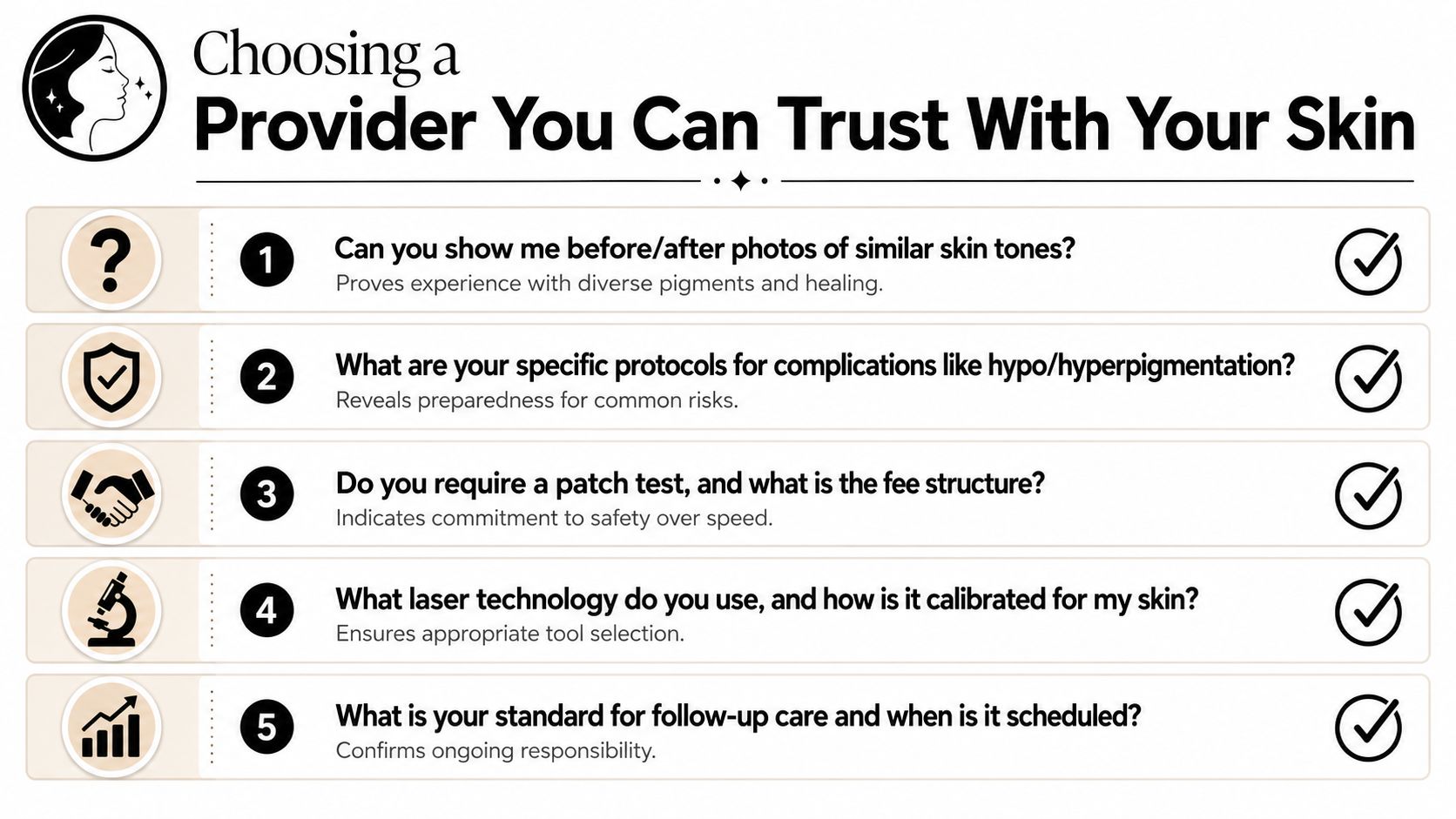
Questions that reveal clinical readiness
- Can you show healed results on similar skin tones? Look for comparable pigmentation, tattoo colors, body locations, and treatment stages, not only dramatic early photographs.
- What's your response plan for hypo- or hyperpigmentation? A prepared clinic should explain monitoring, referral, and treatment changes.
- Do you require a patch test? Pressure to skip a test spot may signal that speed matters more than risk control.
- Which laser technology and wavelengths do you use? Single-wavelength equipment may not suit every ink color or cosmetic pigment.
- Who supervises the procedure? Verify the physician relationship, the operator's training, and how a physician becomes involved when a complication develops.
- How are settings and healing documented? Calibration records, treatment notes, standardized photographs, and follow-up appointments support safer adjustments.
Discount pricing alone doesn't prove poor care, but a clinic that can't explain its safeguards deserves caution. Other warning signs include promises of guaranteed complete removal, no medical director involvement, no discussion of skin type, and treatment of recently tanned or visibly irritated skin.
Reviewing tattoo removal qualifications can help you prepare for a more informed consultation. The strongest provider is the one that can explain how it prevents each complication, recognizes it early, and changes course when the skin needs more time.
EradiTatt Tattoo Removal offers consultation-based assessments for unwanted or stalled tattoo removal, with treatment planning that considers skin type, tattoo size, color complexity, healing, and whether you want complete removal or fading for a cover-up. Visit EradiTatt Tattoo Removal to discuss your skin's current condition, review a safer next step, and arrange a consultation at a convenient Florida location.
One Response