
You're probably looking at a clinic website right now, comparing prices, before-and-after photos, and promises about “fast” removal. One offer looks much cheaper than the rest. Another says the process is simple. A third makes it sound like any laser operator can do the job.
That's the moment when qualifications matter most.
Laser tattoo removal isn't like booking a basic cosmetic service. A tattoo sits at different depths, uses different pigments, and reacts differently based on skin tone, healing history, and the laser being used. The person holding that device needs more than a machine and a short course. They need the right oversight, training, and judgment.
If you're in Florida, the smartest move is to stop asking only “How much does it cost?” and start asking “Who is legally and safely qualified to treat me?” That one shift can protect your skin, your results, and your peace of mind.
Table of Contents
- Why Your Provider's Qualifications Matter Most
- The Core Credentials of a Trusted Provider
- Understanding Florida's Tattoo Removal Regulations
- Red Flags to Spot Before You Book an Appointment
- How to Verify a Provider's Credentials
- Your Pre-Consultation Checklist and Questions
- Frequently Asked Questions About Provider Qualifications
- Can an esthetician perform laser tattoo removal in Florida
- Is a basic online laser certificate enough
- What's the difference between the clinic owner and the medical director
- Should I trust before-and-after photos as proof of qualification
- Is it okay to ask to see credentials before I book
- What answer should make me leave immediately
Why Your Provider's Qualifications Matter Most
A cheap tattoo removal deal can look harmless on a screen. Then the consultation starts, and something feels off. The provider rushes through your medical history, doesn't explain what type of laser they use, and talks more about payment than skin response.
That's not a small concern. It's usually the first sign that the clinic treats tattoo removal like a simple cosmetic add-on instead of a procedure that requires technical judgment.
Clinical outcomes make that clear. Complete tattoo removal success rates reach 94% for black ink when using Q-switched lasers after an average of 10 treatment sessions, according to tattoo removal statistics on Q-switched laser outcomes. That same data also notes why qualifications matter so much. The provider has to select the correct laser modality and protocol to reduce the risk of burns while improving clearance.
What goes wrong with the wrong provider
An unqualified operator may still own a good machine. That doesn't mean they know how to use it well.
Common failures usually come from poor decisions at the consultation stage and the treatment stage:
- Wrong candidate selection: Treating someone who should be delayed, referred, or treated more cautiously.
- Wrong settings: Using energy that's too aggressive for the skin type or tattoo characteristics.
- Wrong expectations: Promising quick clearance when the tattoo's age, density, or location suggests a slower process.
- Wrong aftercare guidance: Giving weak instructions, then blaming the client when healing becomes difficult.
Practical rule: The laser matters, but the operator's judgment matters just as much.
Why this is more than a cosmetic choice
Tattoo removal involves heat, skin response, healing time, and risk management. That's why serious providers don't treat qualifications as a marketing badge. They use them as the basis for every decision they make, from patch testing to timing between sessions.
A qualified provider should be able to explain why one tattoo responds well and another resists, why darker skin may require a different approach, and why rushing sessions can work against the result you want. They should also be comfortable answering direct questions without becoming defensive.
If a clinic can't clearly explain who supervises the treatment, who performs it, and what training backs that up, you're not being overly cautious by walking away. You're making the right call.
The Core Credentials of a Trusted Provider
Trusted tattoo removal qualifications usually fall into three buckets. Medical oversight, technician training, and operational safety. If one of those is weak, the whole clinic becomes harder to trust.
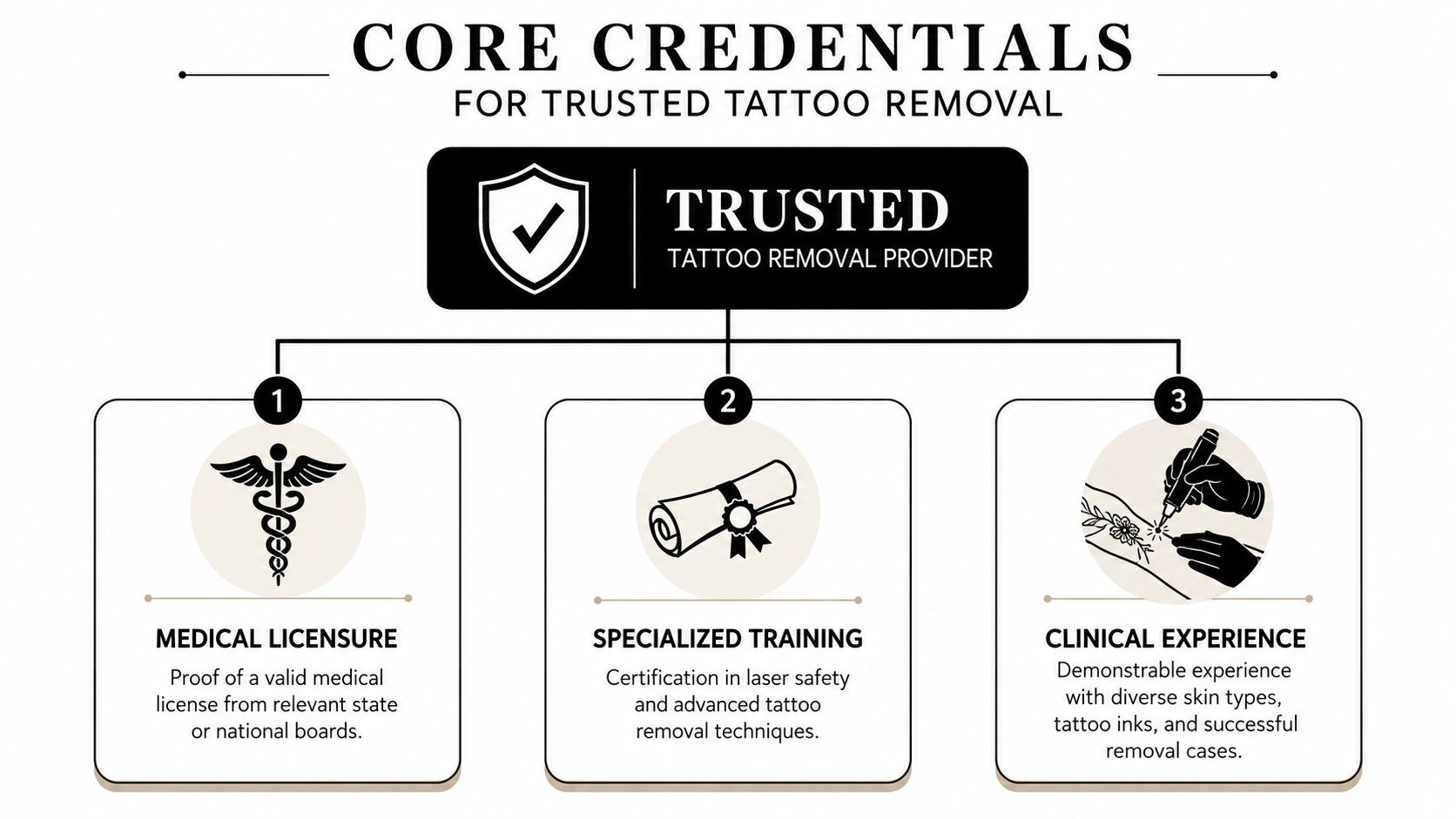
Across much of the United States, the legal baseline can be looser than patients expect. Most US states do not require medical credentials for tattoo removal clinic owners or laser operators, but common regulatory requirements include using an FDA-cleared device, having an affiliated physician medical director, and employing a certified laser operator with at least 16 hours of hands-on training plus laser safety certification, as outlined in state regulations for laser tattoo removal.
Medical oversight
Medical oversight means there's a licensed physician involved in the clinical side of the practice. That doesn't just mean a name on a wall.
You want to know whether the medical director is active, reachable, and responsible for protocols, delegation, contraindication review, and complication response. If the staff can't explain how that oversight works, that's a problem.
A qualified clinic should be able to answer questions like:
- Who is the medical director: Ask for the full name and license type.
- How are protocols set: Find out whether treatment parameters are standardized and medically reviewed.
- What happens if there's a complication: You should hear a clear escalation process, not vague reassurance.
For a patient trying to understand whether a dermatologist-led model is preferable, this explanation of laser tattoo removal with a dermatologist can help frame what medical involvement should look like.
Technician training
A laser operator doesn't need polished sales language. They need real training, documented hands-on experience, and comfort discussing safety.
Certificate titles vary, but the important part is whether the training included actual laser safety education and supervised practical work. A weekend overview or online-only course isn't enough for a procedure that depends on skin assessment, ink response, and complication prevention.
The strongest providers usually have a pattern of ongoing education. If you want a simple analogy for why that matters, tracking rules for continuing education are a useful reminder that credentials only stay meaningful when professionals keep their training current and documented.
A confident technician won't dodge questions about where they trained, what device they use, or how they handle difficult skin and ink combinations.
Operational safety
This is the part patients often overlook because it sounds administrative. It isn't. Operational safety is where clinics prove they're built to treat people responsibly.
Look for these basics:
- FDA-cleared equipment: The clinic should identify the laser platform clearly.
- Insurance coverage: They should carry appropriate professional liability coverage for the service they perform.
- Written consent and aftercare: You should receive both, in plain language.
- A proper consultation process: No reputable provider should jump straight to treatment without assessing your tattoo, skin, goals, and medical history.
Operational discipline often predicts treatment discipline. A clinic that runs a careful front desk, paperwork, consultation, and consent process is usually more careful in the treatment room too.
Understanding Florida's Tattoo Removal Regulations
Florida patients often assume tattoo removal follows one clean statewide rule. In practice, the issue is more nuanced. That's why a checklist-based approach works better than relying on a clinic's marketing language.
The safest mindset in Florida is this: don't assume the state has already screened the provider for you. Verify the people, the supervision, and the process yourself.
Why Florida patients need to verify more actively
Some states spell out laser treatment roles very tightly. Others leave more room for business models that can look professional from the outside while varying a lot in clinical quality.
That gap matters for tattoo removal qualifications because the patient often sees the branding first, not the supervisory structure behind it. Two clinics can both advertise tattoo removal, but one may have clear medical oversight and documented operator training while the other stays vague on both points.
For a Florida patient, practical verification matters more than polished claims. That means asking who performs the treatment, who supervises it, and how those responsibilities are documented. If the answers come back fuzzy, you have your answer already.
A useful comparison with California
California gives patients a useful benchmark because its rules are more explicit. In California, laser tattoo removal can only be performed by a licensed medical doctor or under a physician's direct supervision by approved personnel including Registered Nurses, Nurse Practitioners, or Physician Assistants. Non-medical laser operators are legally prohibited from performing the procedure regardless of training, according to this overview of certifications needed to perform laser tattoo removal.
That comparison doesn't mean Florida clinics are unsafe. It means Florida residents should be more deliberate about checking the details for themselves.
Here's a practical way to consider this:
| Question | Why it matters in Florida |
|---|---|
| Who actually holds the laser? | The person treating you is more important than the brand name on the website. |
| Who supervises the service? | Oversight affects safety protocols and complication response. |
| Can the clinic produce training records? | A good clinic should be ready for that question. |
| Are answers specific or slippery? | Specific answers usually signal real systems behind the scenes. |
If you're comparing providers in your area, a location-specific starting point like tattoo removal options in Boca Raton, FL can help you narrow the field, but don't stop at proximity. Convenience matters less than competence.
The law sets a floor. Your skin deserves a higher standard than the minimum.
Red Flags to Spot Before You Book an Appointment
Most unsafe clinics don't announce themselves. They reveal themselves in little moments. A rushed phone call. A vague answer. A price that makes no sense once you understand what careful treatment requires.
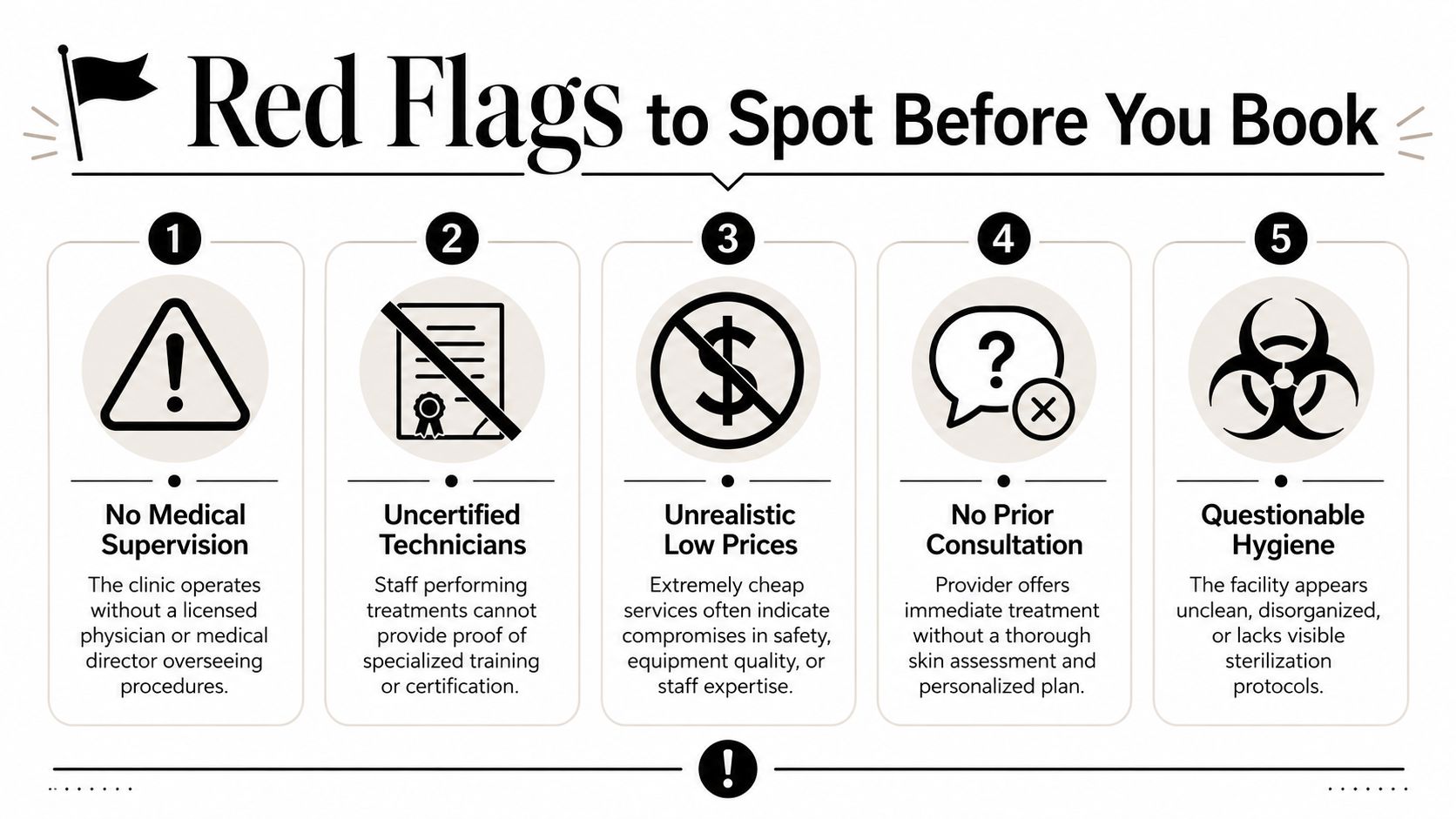
Pricing that doesn't make clinical sense
Low price alone isn't a red flag. Some clinics run legitimate promotions. The problem is pricing that seems disconnected from the cost of qualified staffing, proper consultation, safe equipment, and follow-up care.
If the deal sounds designed to get you in the chair before you ask questions, slow down.
Watch for these signs:
- Extreme discount language: The offer is the headline, while the provider's credentials are hard to find.
- Same-day pressure: They push treatment before you've had time to review qualifications.
- No discussion of suitability: Everyone gets treated as if every tattoo is the same.
Answers that stay vague
A good clinic might not answer every question instantly on the phone, but they should answer them clearly before treatment. Vagueness is one of the clearest warning signs in this field.
Be cautious if you hear statements like:
- “Our team is fully certified” without showing what those certifications are
- “A doctor is involved” without naming the doctor or their role
- “We use the best laser” without stating the platform or why it fits your case
Those phrases sound reassuring, but they don't prove anything.
Promises no ethical provider makes
Tattoo removal is too variable for rigid guarantees. Ink color, density, placement, layering, age of the tattoo, and skin response all affect progress. A qualified provider should speak carefully about expected response, not make sales-style promises.
Walk away if a clinic does any of the following:
- Guarantees full removal in a fixed number of sessions
- Dismisses risk entirely
- Refuses a consultation or skin assessment
- Brushes off aftercare as unimportant
- Acts annoyed when you ask for proof of training or supervision
If a provider treats your safety questions like an inconvenience, they're telling you exactly how they'll treat your care.
The strongest clinics tend to be calm, specific, and comfortable with scrutiny. The weakest ones try to replace proof with confidence.
How to Verify a Provider's Credentials
Verification sounds intimidating until you break it into simple checks. You're not conducting an audit. You're confirming that the clinic's claims match reality.
The easiest way to approach this is the same way homeowners verify licensed trades before work starts. This guide to the understanding contractor verification process is a useful parallel because the logic is the same. Ask for names, confirm records, and compare what's advertised with what's documented.
Step one check the medical side
Start with the medical director or supervising clinician.
Ask for the full name, professional designation, and how they're involved in the clinic. Then verify that information through the appropriate Florida licensing channels. You don't need to be confrontational about it. A normal, well-run clinic should expect this question.
Your checklist:
- Get the full name in writing
- Confirm the license status through the relevant Florida board
- Ask how supervision works in daily practice
- Ask what happens if you have an adverse skin reaction
If the clinic hesitates to identify the supervising clinician, stop there.
Step two check the laser training
Next, ask who will perform your treatment. Not the owner. Not the sales coordinator. The person holding the handpiece.
Ask to see documentation of laser-specific training and safety education. You're looking for clear proof that the operator has been trained to assess skin, use the device appropriately, and work within a supervised clinical structure.
Ask direct questions such as:
- What laser training did you complete
- Was your training hands-on or only classroom-based
- How do you decide whether a tattoo is suitable for treatment
- Who trained you on this specific device
If you want a practical benchmark for what other patients notice when comparing clinics, reading tattoo removal reviews and provider feedback patterns can help you identify the difference between polished marketing and real clinical consistency.
Step three verify the clinic itself
Finally, check whether the clinic behaves like a healthcare setting or a fast-turnover retail service.
Use this mini checklist:
- Documentation: They provide consent forms, aftercare instructions, and a real consultation.
- Equipment clarity: They identify the laser model instead of hiding behind generic phrases.
- Insurance confidence: They don't get evasive when asked whether the service is insured.
- Clean process: The treatment room, eye protection, and hygiene standards look deliberate and organized.
Verification isn't rude. It's what careful patients do before letting someone direct laser energy into their skin.
When a clinic passes these checks, the entire treatment experience usually feels different. The consultation is calmer. The answers are cleaner. The provider talks about suitability, not just selling.
Your Pre-Consultation Checklist and Questions
Bring this list with you or keep it on your phone. If a clinic can't answer these basics, keep looking.
Quick checklist before you agree to treatment
- Confirm medical oversight: Ask who supervises the service and what that role includes.
- Confirm operator identity: Know exactly who will perform your session.
- Confirm laser-specific training: Ask to see proof, not just hear claims.
- Confirm equipment transparency: The clinic should name the laser being used.
- Confirm consultation quality: You should get a proper assessment before treatment.
- Confirm aftercare process: Written guidance should be standard.
- Confirm clinic professionalism: Cleanliness, organization, and communication all matter.
Questions to Ask Your Tattoo Removal Provider
| Category | Question to Ask |
|---|---|
| Supervision | Who is the medical director or supervising clinician for this service? |
| Operator | Who will perform my treatment, and what laser training have they completed? |
| Safety | How do you decide whether my skin type and tattoo are suitable for treatment? |
| Equipment | What laser are you using for my tattoo, and why is that the right fit? |
| Consultation | Will you assess my tattoo and medical history before scheduling treatment? |
| Risk management | What side effects do you watch for, and what is your escalation process if they happen? |
| Aftercare | What written aftercare instructions will I receive? |
| Expectations | How do you set expectations for fading versus complete removal? |
A strong provider won't rush these questions. They'll welcome them.
Frequently Asked Questions About Provider Qualifications
Can an esthetician perform laser tattoo removal in Florida
What matters isn't the job title alone. What matters is whether the person is operating within a lawful, medically supervised structure and has appropriate laser-specific training for the service being offered. If a clinic gives you only a title and avoids explaining supervision or scope, ask more questions.
Is a basic online laser certificate enough
No responsible patient should treat an online-only certificate as enough by itself. Tattoo removal requires hands-on judgment, device familiarity, and safety training that translates into real treatment decisions. A certificate without supervised practical experience should not reassure you.
What's the difference between the clinic owner and the medical director
The owner runs the business. The medical director is responsible for the clinical oversight side. Sometimes those roles are held by the same person, but often they aren't. Patients should never assume ownership equals clinical qualification.
Should I trust before-and-after photos as proof of qualification
Photos can be helpful, but they don't prove training, oversight, or safety standards. Use them as a conversation starter, not as evidence that the clinic is properly qualified.
Is it okay to ask to see credentials before I book
Yes. That's a normal question. A reputable clinic should be able to explain qualifications clearly and show documentation without making you feel difficult for asking.
What answer should make me leave immediately
If the clinic won't identify who performs the treatment or who supervises it, leave. You should never accept mystery staffing for a laser procedure.
If you want tattoo removal from a team focused on safe, progressive treatment across Florida, EradiTatt Tattoo Removal offers consultations designed to answer the exact qualification and safety questions covered here. Whether you want full removal or fading for a cover-up, their clinics can walk you through the process clearly, explain treatment expectations, and help you make an informed next step.
One Response