
You've just looked at the treated tattoo and noticed that the skin seems darker, rougher, or more irritated than you expected. Perhaps a small crust has appeared over the ink, or the area feels tight and itchy beneath a dressing. That reaction can be unsettling, especially if you were hoping to see the tattoo fade immediately.
A laser tattoo removal scab is often part of the skin's short-term repair process, but scabbing doesn't look identical after every treatment. Some people develop little or no crusting, while others see heavier scabbing. Ink density, pigment color, skin characteristics, tattoo location, and the laser settings selected by the technician all influence what happens next. The most useful comparison is your skin's progress against a sensible healing pattern, not another person's experience.
Table of Contents
- Why Scabbing Happens After Laser Tattoo Removal
- The Laser Tattoo Removal Scab Timeline
- What Makes Some People Scab More Than Others
- How to Care for Your Scab and Speed Healing
- Normal Scabbing vs Warning Signs That Need Attention
- When to Contact EradiTatt After Laser Tattoo Removal
Why Scabbing Happens After Laser Tattoo Removal
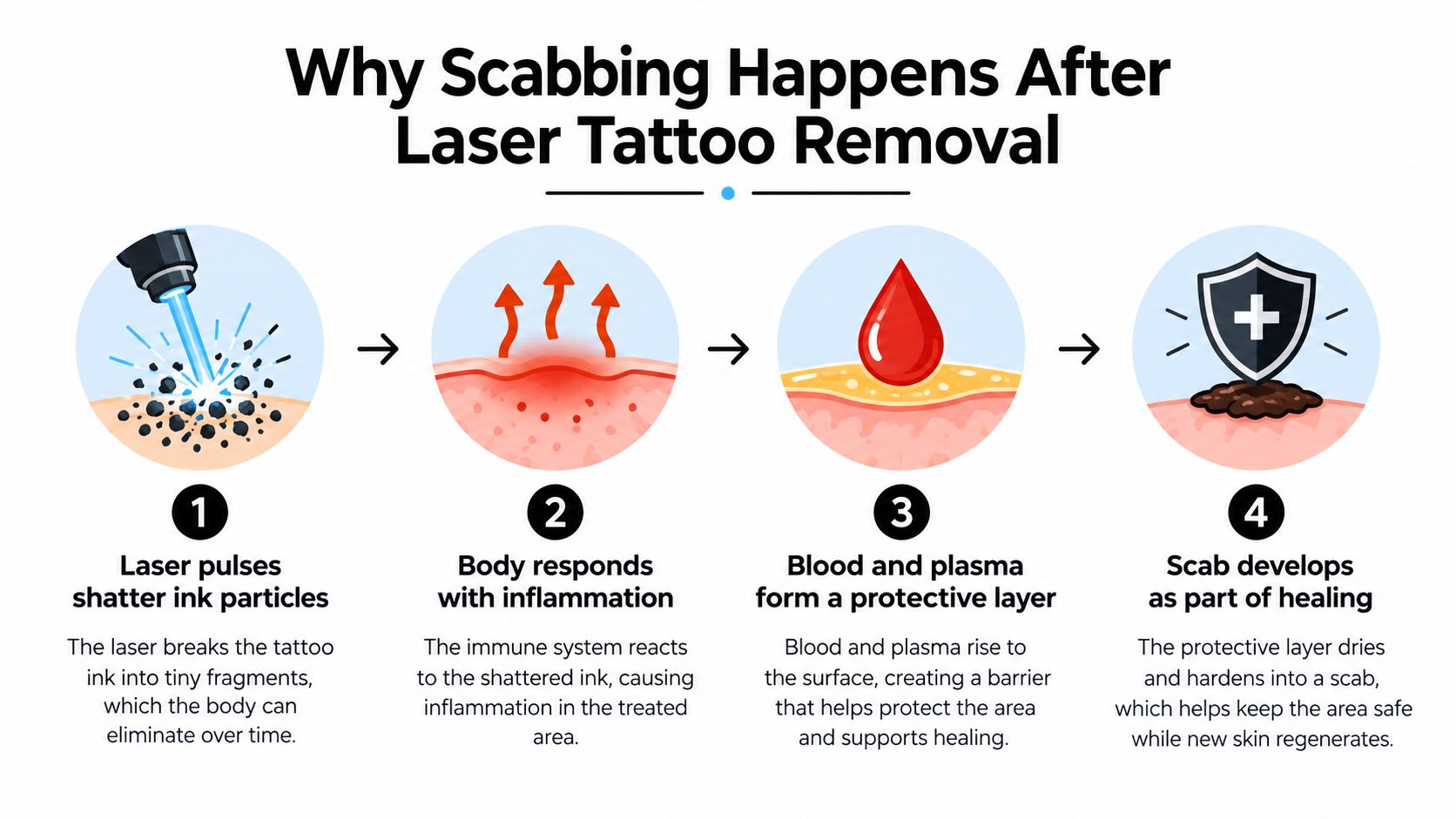
A patient may see the treated area looking raw or frosted shortly after a session and ask whether something went wrong. In most cases, that appearance reflects the intended interaction between laser energy, tattoo pigment, and the skin's inflammatory response. Laser tattoo removal uses very short pulses to break tattoo pigment into smaller fragments, after which the body begins its gradual clearance and repair work.
The skin can respond with redness, swelling, itching, and temporary whitening known as frosting. Clinical guidance from the American Society of Plastic Surgeons' tattoo removal overview describes redness, swelling, and itching during the first day, followed by crusting or blistering that generally settles over 1 to 2 weeks. Those changes don't automatically indicate excessive treatment or a poor result.
What the crust is doing
After the surface becomes inflamed, fluid and blood components can collect at the treated site. As that material dries, it forms a protective layer. The scab helps shield vulnerable skin while the underlying tissue repairs itself, so removing it early exposes tissue that may not yet have rebuilt its surface barrier.
Practical rule: A scab is not a scorecard for treatment success. More crusting doesn't necessarily mean more ink was removed, and little or no crusting doesn't prove the session was ineffective.
The visible scab belongs to the acute healing phase, not the entire tattoo removal process. A hospital aftercare guide says the scab commonly falls away after about 7 to 14 days, while professional guidance also describes the wound itself as sometimes healing in about 5 days. These statements can both be reasonable because surface closure and the skin's complete return to its usual appearance aren't always the same milestone.
Your technician may also recommend leaving approximately 6 weeks between sessions so the skin can heal and the body can continue processing fragmented pigment. The interval is part of safe treatment planning, not wasted time. Treating too soon can mean working on skin that hasn't fully recovered.
The Laser Tattoo Removal Scab Timeline
Healing usually changes in stages rather than all at once. Use the following as a practical guide, while remembering that a dense tattoo may follow a more noticeable course than a lightly pigmented one.
The first 24 hours
Immediately after treatment, the area may look white or frosted, then become red, swollen, warm, or itchy. The initial appearance can resemble a mild sunburn. Avoid rubbing the area to inspect it, because friction adds irritation while the skin is already responding to treatment.
A dressing may be appropriate if the area is open, weeping, or exposed to friction. Follow the specific instructions given by your clinic, particularly if they differ based on the tattoo's location or the reaction seen during treatment.
The next several days
Blistering or scabbing may begin during the next couple of days. The skin can feel tight as the surface dries, and itching may become more noticeable as the repair process continues. Don't interpret that change as a reason to peel the area. The developing crust is still acting as a temporary barrier.
Clean the site gently and avoid soaking it. You can read a practical overview of skin care after tattoo removal for additional guidance on protecting the treated surface during recovery.
Around the first week
The scab may begin to loosen at its edges as the skin beneath it repairs. Some areas may look pink, lighter, or temporarily different in texture after the crust starts lifting. That appearance can be uneven, especially when the tattoo contains concentrated pigment or sits in an area exposed to clothing movement.
Don't help the scab along, even if it seems nearly detached. A piece that comes away naturally is different from one pulled away while it remains attached to healing tissue.
The second week and beyond
The Aesthetic Society says a tattoo removal scab generally falls off after about two weeks, providing a useful recovery benchmark in many cases. Some people reach that point sooner, while others need longer for the surface to settle, particularly after a stronger reaction.
Once the scab is gone, the skin may still look different from the surrounding area. Surface healing doesn't mean all pigment has cleared. The body continues handling the fragmented ink between appointments, so judging the final result while the area is still irritated can lead to unrealistic expectations.
What Makes Some People Scab More Than Others
Two people can receive effective treatment and have very different-looking recoveries. One may see scattered pinpoint crusting, while another develops a more continuous layer over a dense section of ink. That difference alone doesn't establish which treatment worked better.
Ink density and color
Ink density is one of the clearest variables. A heavily packed design contains more pigment in a given area than a faint or partially faded tattoo. When the laser targets a concentrated section, the local skin response may be more visible than it is over lightly shaded areas.
Color also matters because different pigments interact differently with laser wavelengths and energy settings. A technician evaluates the tattoo's colors and concentration rather than assuming the whole design will react uniformly. A black outline, a pale shaded section, and a layered cover-up may not produce the same amount of crusting during one visit.
Tattoo age can influence the starting condition of the pigment, but it isn't a reliable way to predict scabbing by itself. A newer tattoo may be lightly applied, while an older tattoo may contain dense or layered ink. The technician needs to assess what is present in the skin.
Skin type and treatment location
Skin type affects how the surrounding tissue responds to heat and inflammation. The same settings shouldn't be applied automatically to every person, and a cautious technician considers the individual's skin response when selecting an approach.
Body location also changes the practical recovery experience. Areas exposed to rubbing, pressure, sweat, or frequent movement may feel more irritated than a protected site. A tattoo under a tight waistband, for example, has a different friction pattern from one on an area that stays relatively undisturbed.
Energy settings and the treatment plan
Laser energy is adjusted according to pigment, location, skin characteristics, and the response observed during the session. More visible scabbing isn't a target in itself. Effective treatment doesn't require forcing the skin into a heavy crusting response.
Hospital aftercare guidance from Sandwell and West Birmingham NHS notes that blistering or scabbing may appear within the next couple of days, recommends applying Vaseline regularly to keep the skin moist, and says the scab usually falls away after 7 to 14 days. The same NHS laser tattoo removal aftercare guide warns that picking or scratching can contribute to infection or scarring.
A friend's recovery is useful for conversation, not diagnosis. Your tattoo's pigment load and your skin's response are the relevant reference points.
How to Care for Your Scab and Speed Healing
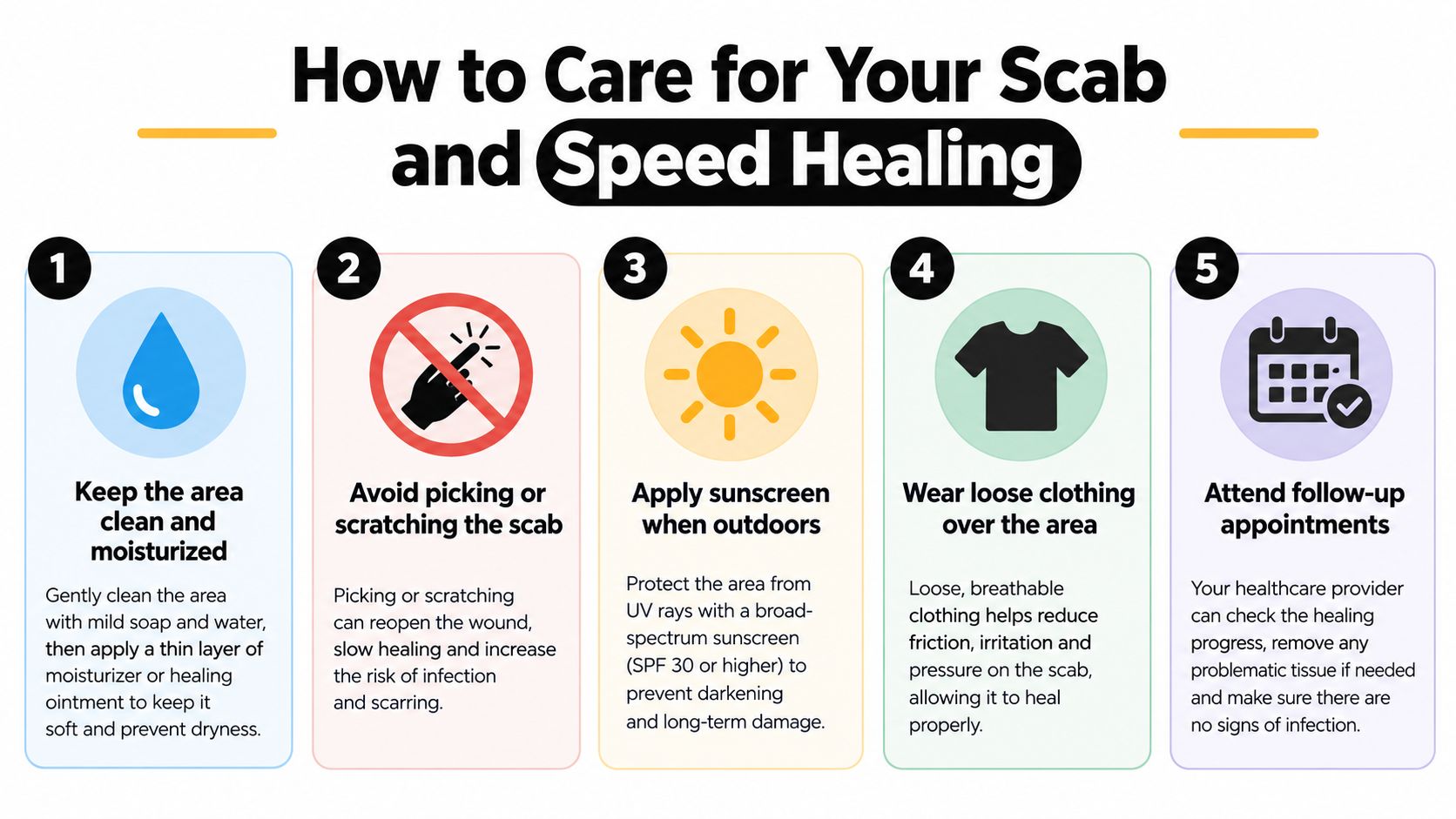
The most effective aftercare is usually simple and consistent. Your aim isn't to make the scab disappear quickly. It's to protect the healing barrier so the crust can separate naturally without unnecessary trauma.
Your daily routine
Clean gently: Wash your hands first, then clean the area with mild soap and water as directed by your clinic. Pat it dry instead of rubbing. WebMD recommends gentle washing without scrubbing or soaking the treated skin.
Keep the surface lightly protected: If the skin is open, blistered, weeping, or rubbing against clothing, use the dressing recommended by your provider. WebMD advises covering the area with a bandage and placing petroleum jelly or an unscented moisturizer beneath it so the dressing doesn't stick to scabs or blisters. Don't apply a thick layer that leaves the area excessively wet.
Leave the scab alone: Don't pick, scratch, peel, or exfoliate it. If itching is distracting, use a cool compress over a clean covering, provided your clinic has approved that approach. Scratching can break the surface and turn a manageable healing phase into an open wound.
Reduce friction: Choose loose clothing over the treatment site and adjust how you sleep if the area is pressed against bedding. Friction can catch a raised edge and pull it away before the skin underneath is ready.
Pause activities that irritate the area: Avoid swimming, saunas, strenuous activity, and other sources of heat, moisture, or rubbing until the skin has recovered according to your clinic's advice. Soaking and maceration can soften the protective crust and delay repair.
What tends to work and what doesn't
A thin layer of petroleum jelly or an unscented moisturizer can help prevent a dressing from sticking and can reduce uncomfortable dryness. Aggressive scrubbing, alcohol-based products, exfoliating acids, and attempts to “clean out” the tattoo don't speed pigment clearance. They can irritate newly treated skin instead.
Protect the area from direct sun while it heals. Once the skin has closed and your provider says it's appropriate, use sun protection outdoors. Treated skin can be more reactive, so sun exposure is a poor trade-off during recovery.
For a clinic-specific checklist, see post-laser tattoo removal aftercare. If your provider gives you different product or dressing instructions, follow those instructions because they may reflect the reaction seen during your appointment.
Normal Scabbing vs Warning Signs That Need Attention
A healthy scab can look unpleasant without being dangerous. Mild redness, manageable itching, tenderness that settles, and a dry crust that gradually loosens are generally more reassuring than symptoms that spread or intensify.
The table below is a quick way to organize what you're seeing. It isn't a diagnosis, and unusual symptoms deserve a conversation with a qualified clinician.
| Usually consistent with healing | Contact your clinic or a medical professional |
|---|---|
| Redness limited to the treated area and gradually settling | Redness or warmth spreading beyond the treatment zone |
| Mild itching or tightness | Pain that keeps increasing instead of easing |
| A dry brown, amber, or lightly colored crust | Pus-like or foul-smelling discharge |
| A scab that begins lifting naturally | Fever, feeling acutely unwell, or rapidly worsening swelling |
| Temporary sensitivity while the surface repairs | A wound that opens repeatedly or shows worsening inflammation |
Why picking changes the risk
The safest approach is to let the scab detach on its own. Pulling it away can reopen the surface, introduce bacteria, and interfere with the repair process. A practitioner-reported study published in 2026 estimated complications in 8.1% of laser tattoo removal sessions, with blistering reported in 1.9% and edema in 3.0%. The figures are reported in the clinical study on laser tattoo removal complications, and they don't mean every scab is a complication.
A hospital patient guide reports that about 3 in 100 patients develop a scar after treatment, also discussed in that clinical source. That's why a patient should resist the temptation to remove a stubborn-looking crust to make the tattoo appear cleaner.
If you're unsure whether drainage, spreading redness, or worsening tenderness could indicate infection, use this guide to infected wound care for general warning signs, then contact your own clinic or a medical professional. You can also review signs of infection after tattoo removal when deciding whether your symptoms need prompt attention.
When to Contact EradiTatt After Laser Tattoo Removal
Contact your clinic if the scab looks unusually extensive for your treatment area, the surrounding redness is spreading, pain is worsening, drainage concerns you, or the skin isn't beginning to settle as expected. It's also reasonable to ask for advice if you're unsure whether a dressing is sticking, whether an activity is safe, or whether the tattoo's fading between sessions appears consistent with the treatment plan.
A technician can review how your skin responded and adjust future guidance for the tattoo's density, colors, location, and your individual skin characteristics. Scabbing alone doesn't measure pigment clearance, so a light reaction shouldn't be treated as proof that the session failed, just as heavy crusting shouldn't be treated as proof that it succeeded more.

The next appointment should be planned around healed skin and the body's ongoing clearance process, not impatience with the tattoo's appearance. Bring photographs or contact the clinic if your recovery doesn't follow the pattern you were given.
EradiTatt Tattoo Removal provides progressive laser tattoo removal for complete removal or cover-up fading, with treatment plans designed to skin type, tattoo size, color complexity, and lifestyle goals. If you're concerned about a scab or want to plan your next safe session, visit EradiTatt Tattoo Removal to arrange a consultation.
One Response