
You've just left the studio with your tattoo wrapped, your skin tender, and your phone open to a search for tattoo aftercare ointment. One product promises healing, another says “natural,” and a familiar antibiotic cream may already be sitting in your bathroom cabinet. The confusing part is that the thickest, most heavily marketed option isn't automatically the safest choice.
A new tattoo needs protection while its outer barrier rebuilds. The most useful approach is usually simple: understand what an ointment does, apply only a thin layer, watch for irritation, and change to a lighter moisturizer as the surface closes. This guide connects those decisions to measurable barrier recovery, allergy risk, and practical aftercare for both fresh tattoos and laser-treated skin.
Table of Contents
- Why Your Fresh Tattoo Needs the Right Ointment
- What Tattoo Aftercare Ointment Actually Does
- Key Ingredients That Shape Healing
- Comparing Popular Ointment Choices
- How to Apply Ointment the Right Way
- Aftercare Ointment for Removal and Cover-Up Prep
- Common Mistakes That Slow Healing
- A Simple Routine You Can Trust
Why Your Fresh Tattoo Needs the Right Ointment
Leaving the studio, you may notice warmth, tenderness, clear fluid, or a small amount of ink mixed with plasma beneath the wrap. The surface looks like artwork, but biologically it's injured skin. Needles have created many tiny channels, and the body must close those channels while managing inflammation, moisture, friction, and exposure to microbes.
That makes the first healing window important, especially the first 48 to 72 hours. A suitable ointment can reduce excessive dryness and friction while the surface begins to seal. Too much product, however, can leave the area overly covered and damp. The practical question isn't, “Which ointment is strongest?” It's, “Which formula gives the skin enough protection without creating a new problem?”
The useful target: a protected wound with a barely visible layer, not a glossy coating that remains wet.
Petroleum-based products have shaped tattoo aftercare for generations. Petroleum jelly was patented in 1859, A&D ointment appeared in the 1930s, and Aquaphor followed in the 1920s, so the petroleum era has lasted for more than a century. Much of that history came from general wound protection rather than research designed specifically for tattooed skin, as explained in this history of tattoo aftercare.
That legacy helps explain why advice differs between artists, dermatology resources, and product labels. Traditional ointments remain familiar and widely available, while newer formulations are assessed with measures such as redness, swelling, discomfort, and transepidermal water loss. For a practical look at how a tattoo can appear to change while it heals, see whether tattoos fade during healing.
The central decision is narrower than many people expect. Use enough ointment to reduce friction and support the closing barrier, but not so much that the skin stays smothered. Then consider whether every added ingredient earns its place, particularly if you have eczema, fragrance sensitivity, or a history of reactions to topical products.
What Tattoo Aftercare Ointment Actually Does
Tattoo aftercare ointment is a semi-occlusive topical product used during the open-wound phase after tattooing or laser treatment. “Occlusive” means it forms a surface layer that slows water loss. “Semi-occlusive” means the product offers protection without necessarily creating an airtight seal.
The basic job is straightforward:
- Reduce water loss. A controlled amount of occlusion helps keep the surface from becoming excessively dry.
- Limit friction. A thin film can reduce rubbing from clothing and bedding.
- Support a moist healing environment. Skin cells can move across a healing surface more effectively when it isn't allowed to crack and form an unnecessarily heavy crust.
- Avoid prolonged sealing. Once weeping has settled and the surface is closing, a heavy ointment becomes less useful.
Tattooed skin differs from an ordinary shallow scrape. Repeated needle trauma creates many small areas of injury, and pigment sits within the skin as the surface recovers. The product therefore needs to protect the area without encouraging prolonged buildup, rubbing, or repeated handling.
Three formulation families
Pure occlusives, such as petrolatum, mainly seal moisture into the skin. They're simple and generally low in allergenic potential, but they don't actively add a barrier-support ingredient. Their greasy feel can also encourage over-application.
Water-in-oil emulsions combine an oily protective phase with water-based ingredients. Formulations containing 5% dexpanthenol have been studied in freshly tattooed skin, with barrier recovery assessed through transepidermal water loss. In one prospective, investigator-blinded intra-individual study, application 4 to 8 times daily over 14 days was associated with virtually complete barrier restoration by day 14, and the products were well tolerated (clinical study details).
Antibiotic-style ointments add agents such as bacitracin or neomycin. Those ingredients may sound protective, but routine use can introduce sensitization risk. In clean tattoo aftercare, an antibiotic is not automatically a better moisturizer or barrier product.
The best choice depends on your skin history, the condition of the tattoo, and the instructions from your tattoo artist or treating clinician. A fresh tattoo generally needs temporary, light protection, not a permanent layer of ointment.
Key Ingredients That Shape Healing
An ointment label is easier to assess as a function-and-risk list than as a contest for the longest ingredient panel. Freshly tattooed skin is temporarily injured, so each ingredient should serve a clear purpose. A shorter formula can also make a reaction easier to identify.
What common ingredients contribute
Petrolatum forms a protective film that slows water loss and reduces friction. It is chemically simple and showed a low allergy rate in a randomized double-blind dermatologic-surgery trial. That evidence found no allergic contact dermatitis cases with petrolatum, compared with four cases involving bacitracin among 922 patients (a trial comparing petrolatum and bacitracin in dermatologic surgery). Petrolatum helps retain moisture, but it does not supply dexpanthenol or another active barrier-support ingredient.
Dexpanthenol, also called pro-vitamin B5, appears in water-in-oil aftercare formulations. Studies of freshly tattooed skin have used 5% dexpanthenol products and assessed recovery through transepidermal water loss. That measure is useful because softer-feeling skin does not always mean the barrier has recovered.
Lanolin softens and conditions dry skin through its emollient action. It is also a recognized contact allergen for some users. A reaction may cause increasing redness, itching, burning, or a rash that extends beyond the tattoo. Anyone with a history of sensitive skin or product reactions should approach it carefully.
Bacitracin and neomycin are antibiotics commonly included in triple-antibiotic ointments. Repeated exposure can trigger allergic contact dermatitis, while routine use adds ingredients that do not directly reduce dryness or friction. An antibiotic ingredient is not automatically a better barrier moisturizer.
Fragrance, dyes, and unnecessary botanical additives may add possible triggers without a demonstrated benefit for barrier closure. “Natural” describes an origin, not a guarantee of low reactivity. For broader ingredient screening, consult this guide to unsafe beauty ingredients, then compare the label with your skin history and aftercare instructions.
| Ingredient | Function in Healing | Allergy or Interference Risk |
|---|---|---|
| Petrolatum | Slows water loss and reduces friction | Usually low allergenic potential, but heavy use can feel overly occlusive |
| Dexpanthenol | Supports a water-in-oil barrier-support formulation | Generally well tolerated in the cited tattoo study |
| Lanolin | Softens and conditions dry skin | Recognized contact allergen for some users |
| Bacitracin | Adds an antibiotic ingredient | Can cause allergic contact dermatitis |
| Neomycin | Adds an antibiotic ingredient | Frequent sensitization concern in topical products |
| Fragrance | Adds scent, not essential barrier support | May irritate freshly injured or sensitive skin |
The practical pattern is clear: simple does not mean ineffective. A focused formula makes its purpose easier to judge and a potential trigger easier to spot.
Comparing Popular Ointment Choices
A product comparison becomes easier when you separate three questions: does it reduce water loss, does it support barrier recovery, and how much allergy or irritation risk does it introduce?
Petroleum jelly provides basic occlusion through petrolatum. It's simple and has a low allergy profile, but many tattoo-care sources advise against using 100% petroleum jelly or original Vaseline during initial healing because heavy occlusion may interfere with the surface healing process. If used at all, some guidance reserves it for extremely dry skin around a fully healed tattoo (guidance on Vaseline and tattoos).
Aquaphor is a more complex ointment format built around a petrolatum base and additional ingredients. That can create a pleasant protective texture for some users, but every additional ingredient creates another possible sensitivity consideration, especially for people who react to lanolin derivatives.
Neosporin-type triple-antibiotic ointments aren't a sound default for a new tattoo. Guidance warns that they can slow healing and contribute to color loss or other healing problems (why Neosporin isn't routine tattoo care). Antibiotic ingredients can also cause allergic contact dermatitis, particularly when used repeatedly.
Lanolin-based balms can help soften dry, irritated skin, but they're not ideal for someone with a known lanolin reaction or a history of unexplained rashes from ointments. A mild, spreading rash is a reason to stop and seek professional advice, not to apply more product.
Panthenol creams offer a different rationale because dexpanthenol formulations have been assessed with barrier measurements. That doesn't make every panthenol product interchangeable. Concentration, base, preservatives, and fragrance still matter.
| Product | Key Ingredients | Healing Support | Allergy Risk |
|---|---|---|---|
| Petroleum jelly | Petrolatum | Basic moisture-loss control | Generally low, but can be too occlusive when over-applied |
| Aquaphor | Petrolatum-based blend with additional ingredients | Protective occlusion and emollience | Depends on the full formula and individual sensitivity |
| Neosporin-type ointment | Antibiotic ingredients such as neomycin and bacitracin | Not a routine barrier-care choice | Higher sensitization concern |
| Lanolin-based balm | Lanolin and emollient ingredients | Softens dry skin | Lanolin can trigger contact allergy |
| Panthenol cream | Dexpanthenol in a cream or emulsion base | Supports barrier-focused care | Depends on the complete ingredient list |
Decision rule: choose the simplest formulation that fits your skin history, not the product with the longest label.
How to Apply Ointment the Right Way
Application technique often matters more than the brand name. A clean hand and a controlled amount reduce avoidable contamination and excessive buildup.
- Wash your hands with soap and water. Don't touch the tattoo first and clean your hands afterward. The fingers spreading ointment should already be clean.
- Clean the tattoo as directed by your artist. Use lukewarm water and a mild, fragrance-free cleanser. Don't scrub, use a loofah, or drag a rough cloth across the area.
- Pat the skin dry. Use a clean disposable towel or a freshly washed, soft towel, then give the surface a moment to finish drying.
- Apply a paper-thin layer. Use a clean fingertip or sterile glove. You're aiming for a faint sheen, not a thick white or glossy mask.
- Spread it evenly. If the product remains visibly wet or pools in the tattoo's texture, you've likely applied too much.
- Repeat two to three times daily during the earliest healing period. As weeping settles and the surface closes, move to a fragrance-free lotion rather than continuing heavy ointment indefinitely.
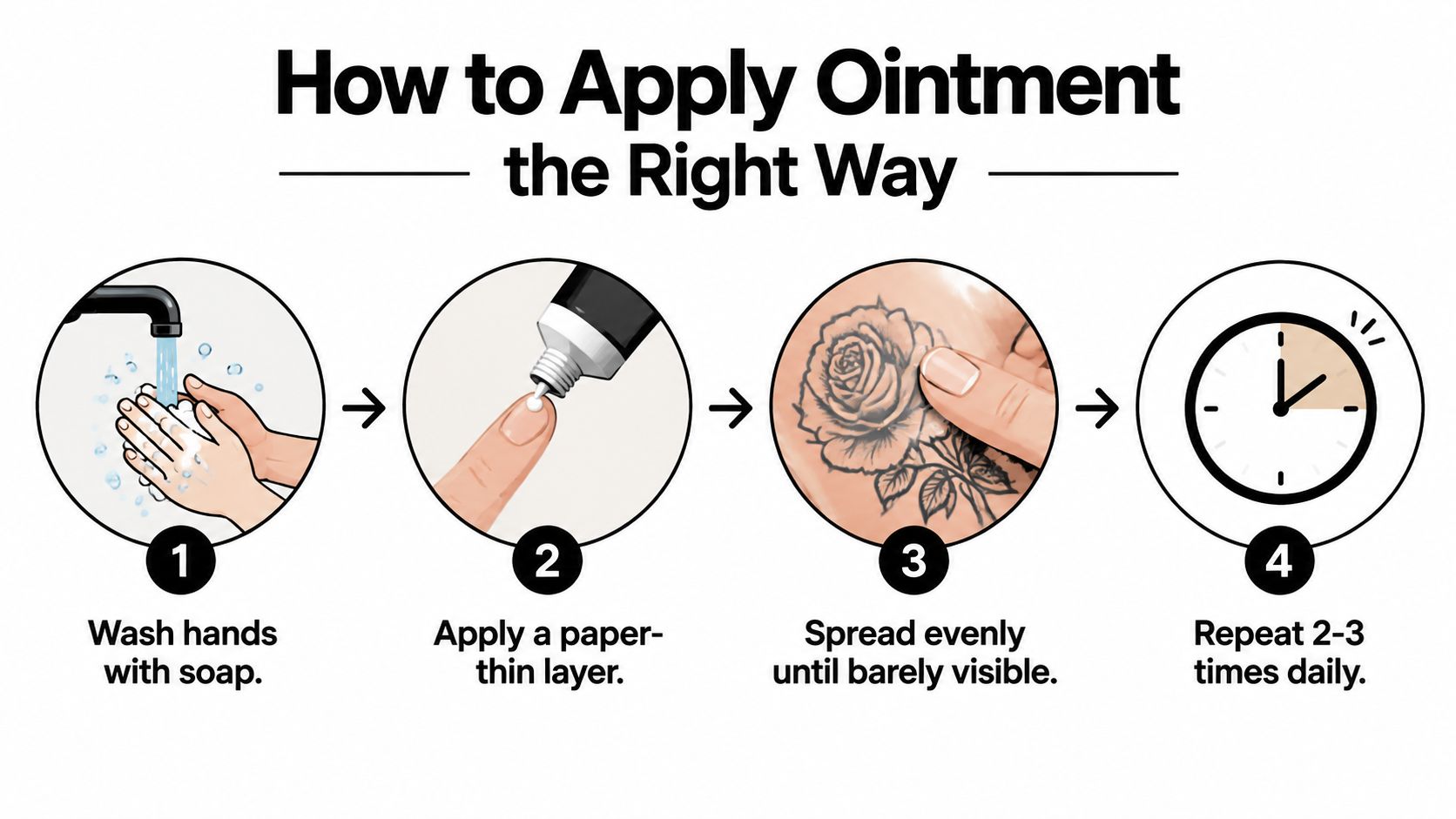
A thin layer helps balance protection with breathability. A thick layer can trap moisture, plasma, heat, and debris against the skin, while repeated rubbing can irritate the tattoo mechanically. Hygiene also matters because opened skin-care bulk packs can become microbially contaminated, potentially introducing bacteria into a fresh tattoo wound (packaging and contamination concerns).
If you're uncertain about how long the dressing should remain in place before this routine begins, follow your artist's specific instructions and review this guide on how long to keep a tattoo covered.
Aftercare Ointment for Removal and Cover-Up Prep
Laser removal changes the appearance of the treatment area, but the aftercare principle remains familiar. After a session, the skin may show temporary frosting, pinpoint bleeding, or small blisters. Those signs reflect treatment-related injury, so the area needs gentle protection rather than aggressive rubbing or a thick product coating.
A person fading an unwanted tattoo for a future cover-up may feel tempted to inspect or touch the treated area repeatedly. That habit can disturb fragile skin and increase friction. Cleanse gently with lukewarm water and mild soap, pat dry, and use the treating clinic's recommended topical product in a very thin layer.
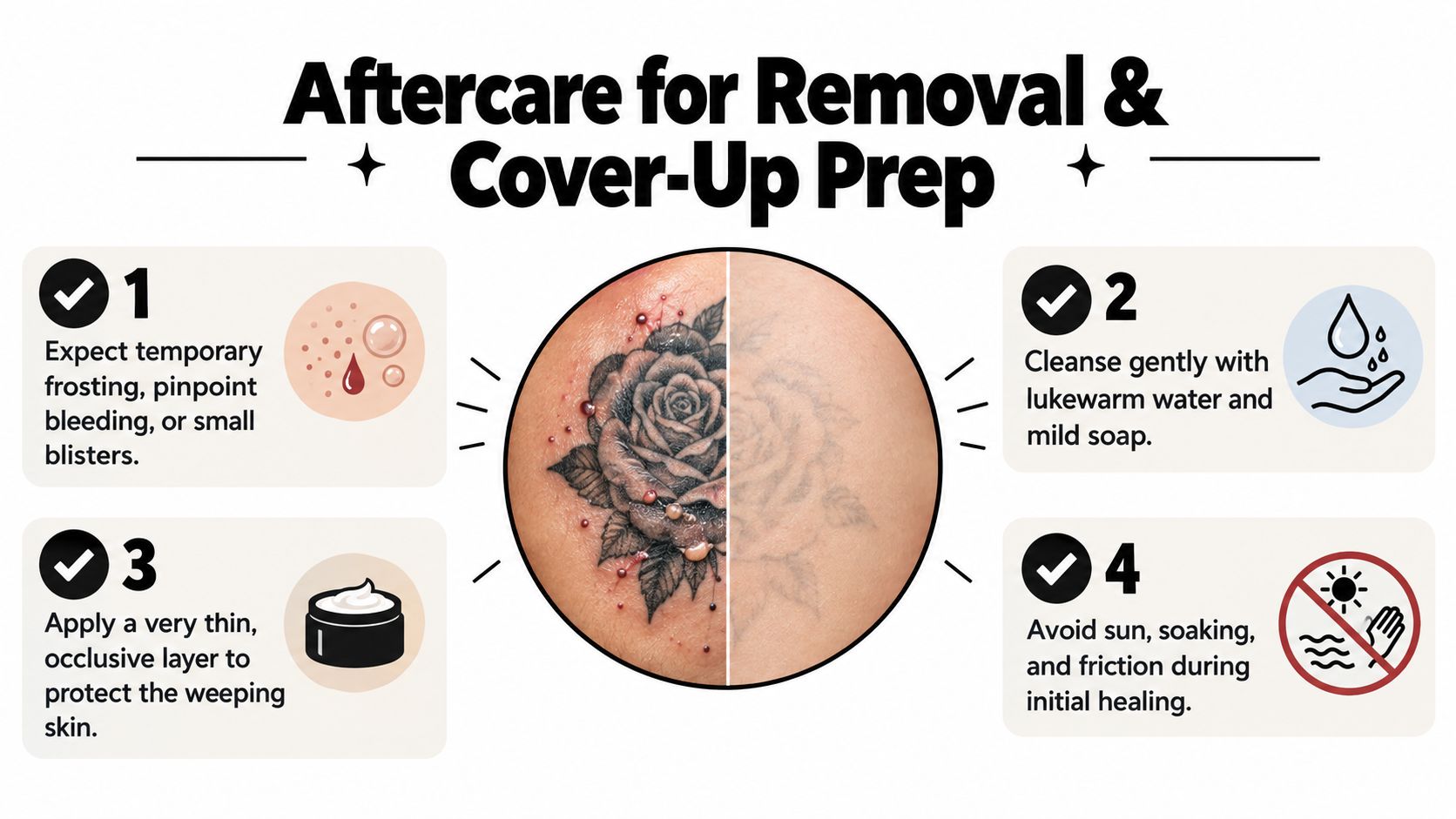
During blistering or weeping, a light occlusive layer can protect the surface from friction and help prevent the area from drying into a thick crust. Don't puncture blisters unless a qualified clinician tells you to do so. Once blisters flatten and the surface becomes less active, transition toward a plain moisturizer for the remaining healing period, following the provider's directions.
Protecting future cover-up work
Consistent aftercare matters when the goal is fading rather than complete removal. Picking scabs or repeatedly scraping flaky skin can create unnecessary inflammation and may complicate the appearance of the area before a future cover-up. Avoid sun exposure, soaking, and friction during initial healing, because treated skin is vulnerable while it re-epithelializes.
If cover-up preparation is your objective, you can learn more about preparing a tattoo for cover-up fading. A removal provider can also explain how its recommended ointment, cleansing routine, and treatment schedule apply to your skin and tattoo.
The same principle guides both fresh-tattoo care and post-laser care: protect the injured surface, avoid unnecessary ingredients, and reduce occlusion as the wound closes.
Common Mistakes That Slow Healing
A fresh tattoo can look dry and still need only a very thin protective film. Applying more ointment does not make the barrier recover faster. A heavy layer holds heat, plasma, and moisture against the surface, leaves more debris in place, and often leads to extra wiping. That repeated friction can irritate skin that is already repairing itself.
Myth and correction
Myth: “A glossy tattoo is a well-moisturized tattoo.”
The goal is a faint sheen, not a wet-looking surface. If the tattoo remains visibly slick long after application, gently remove the excess according to your artist's or clinician's instructions and use less at the next application. The surface should have enough support to reduce cracking without becoming coated.
Myth: “Petroleum jelly is always the gold standard.”
Petrolatum forms a dependable occlusive layer, but it does not provide every ingredient associated with barrier support. Some tattoo-care guidance cautions against applying pure petroleum jelly heavily during early healing. A simpler formula may reduce allergy exposure, yet petrolatum still works best when the amount and timing match the wound's condition. Ingredient count is not a measure of quality.
Myth: “An antibiotic ointment prevents every infection.”
Antibiotic ointments expose healing skin to ingredients such as neomycin or bacitracin, which can trigger allergic contact dermatitis. Earlier wound-care research in 922 dermatologic-surgery patients found no statistically significant healing advantage for bacitracin over plain white petrolatum. It recorded four allergic contact dermatitis cases with bacitracin and none with petrolatum. For a clean tattoo, routine antibiotic ointment is therefore not a default requirement. Reserve medicated products for advice from a qualified clinician.
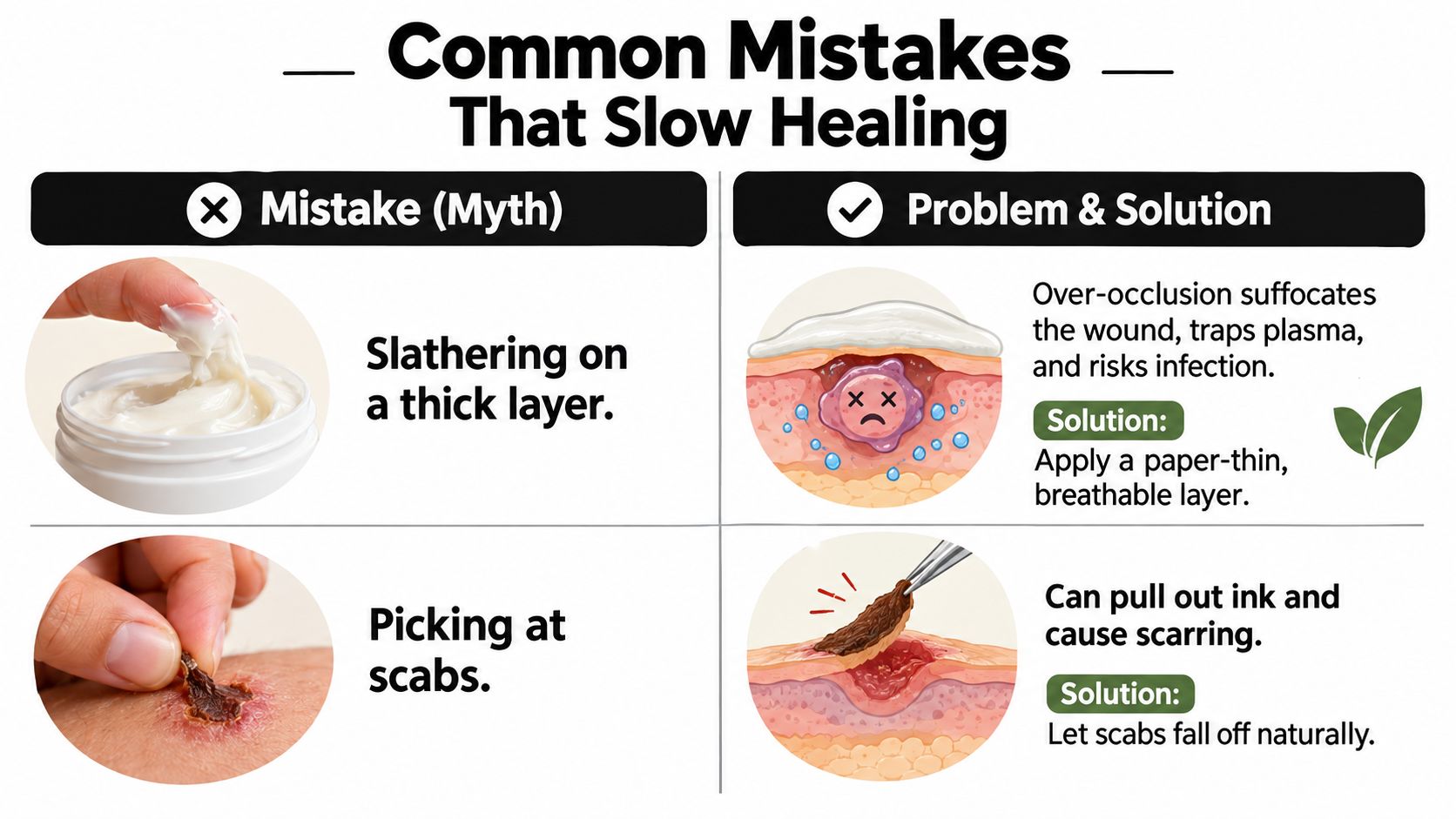
Small habits can also disrupt barrier recovery:
- Skipping hand washing: Clean your hands before touching the tattoo or ointment.
- Picking peeling skin: Allow flakes and scabs to detach on their own.
- Reusing dirty towels: Use a clean, soft towel or disposable paper towel.
- Exposing the tattoo to pet hair: Limit contact with avoidable debris.
- Switching products repeatedly: Introducing several formulas close together makes a new rash harder to identify.
Healing usually benefits from restraint. Clean gently, keep the ointment layer barely visible, avoid unnecessary additives, and contact your artist or clinician if symptoms persist or worsen.
A Simple Routine You Can Trust
A dependable routine doesn't require a complicated shelf of products. During the earliest healing days, choose a simple petrolatum or petrolatum-plus-panthenol ointment without fragrance, dyes, or unnecessary additives. If you know you react to lanolin, neomycin, fragrance, or another ingredient, read the full label rather than relying on the front of the package.
Use this sequence as a practical reminder:
- Clean hands with soap and water.
- Rinse gently with lukewarm water and a mild, fragrance-free soap.
- Pat dry with a clean towel or disposable paper towel.
- Apply a paper-thin ointment layer until the tattoo has only a faint sheen.
- Repeat two to three times daily during the first few healing days, unless your artist or clinician gives different instructions.
- Switch to fragrance-free lotion once weeping has stopped and the surface is closing.
- Monitor the skin and seek medical advice if redness continues beyond the expected early period, spreads, or comes with concerning symptoms.
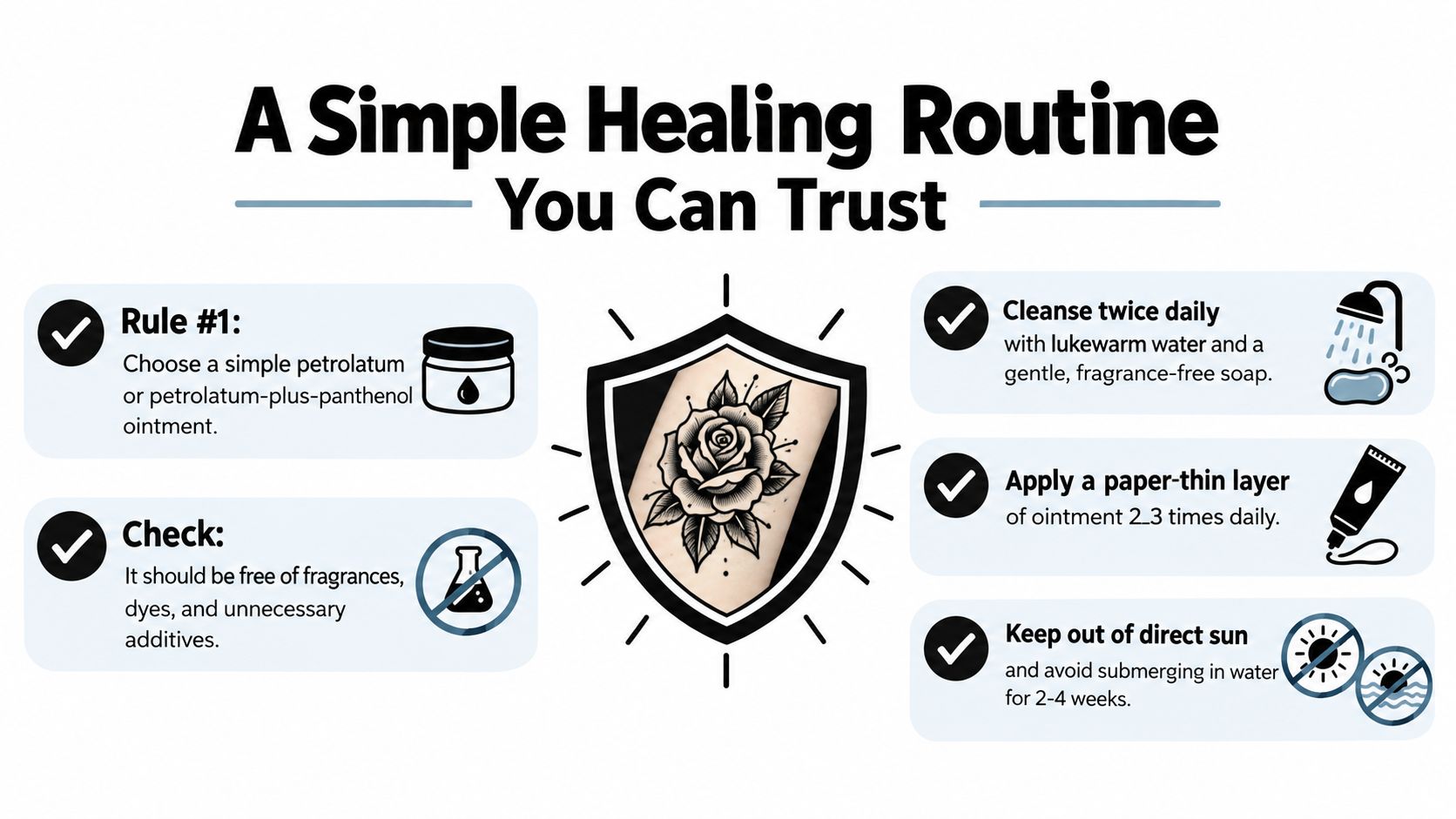
Wear breathable clothing, limit friction, avoid direct sun, and don't submerge the tattoo while it heals. The same restraint applies after removal treatment, where the correct product and duration should come from the provider who treated your skin.
The simplest formula and thinnest effective layer usually make the routine easier to monitor. If burning, spreading redness, hives, pus, fever, or worsening pain appears, stop experimenting with products and contact a qualified medical professional.
For clients considering complete tattoo removal or lightening before a cover-up, EradiTatt Tattoo Removal provides progressive laser treatment and post-treatment guidance, including topical aftercare recommendations. Visit the site to explore locations across Central and West Florida and schedule a consultation about a plan suited to your tattoo, skin, and goals.
2 Responses