
You finish what you believe is your last tattoo-removal session, wait for the skin to settle, and then notice a faint shiny line where the ink used to be. The mark feels slightly different under your fingertip, so you search healed tattoo removal scar late at night and assume the laser created permanent damage.
That conclusion may be wrong. A visible mark after ink fades can represent normal post-treatment texture, leftover pigment, a scar caused by treatment, or an older scar from the tattooing process that the ink had been hiding. The distinction matters because each possibility needs a different response. The following guide uses the skin's healing biology to help you understand what you're seeing and what to discuss with a qualified provider, including non-surgical tattoo removal options when complete laser treatment isn't the only goal.
Table of Contents
- When a Mark Shows Up After Removal and What It Means
- How Laser Removal Heals and Why Scars Sometimes Form
- The Four Types of Marks You Might See on Healed Skin
- Is It Really a Laser Scar or Just an Old One Revealed
- Prevention Habits That Keep Healed Skin Smooth
- Treatment Options for a Scar You Already Have
- Setting Realistic Expectations With Your Provider
When a Mark Shows Up After Removal and What It Means
Maya had finished her final laser session for a faded name on her wrist. She waited the standard eight weeks, expecting the area to look like ordinary skin, but one evening she noticed a faint, slightly shiny line following part of the old script. Her stomach dropped. The mark wasn't painful, yet it looked different enough to trigger an immediate search for “healed tattoo removal scar.”
That moment of panic is understandable, but it isn't automatically an emergency. Skin can look unusual while its deeper structure is still settling, and a mark that becomes visible after ink fades isn't proof that the laser produced a new scar.
Think of the tattooed skin as a wall that has been repainted. The ink is like a dark layer covering the surface, while the texture underneath may include an old patch, a shallow dip, or a raised line. As the color disappears, the underlying patch becomes easier to see. The removal process may have revealed a feature that was present from the beginning.
Four possibilities behind one visible mark
A mark after removal usually falls somewhere on a spectrum:
- Normal healing texture, such as temporary dryness, firmness, or uneven color.
- Residual pigment, which still follows part of the original tattoo design and may continue fading.
- Pre-existing tattoo-related scarring, created by repeated needle injury before laser treatment began.
- Treatment-related scar tissue, which can follow excessive injury, infection, picking, or an individual tendency toward raised healing.
The first useful step is to compare the area with photographs taken before treatment. A true assessment also considers whether the mark is raised, indented, shiny, firm, itchy, tender, or lighter or darker than nearby skin.
A calm pause is more useful than a quick label. Let the area heal fully, document what you see, and ask a trained clinician to assess texture as well as color.
How Laser Removal Heals and Why Scars Sometimes Form
Laser tattoo removal is designed to break pigment into smaller particles while limiting injury to nearby skin. The medical principle called selective photothermolysis made it possible to target tattoo pigment without destroying surrounding tissue and leaving a scar. Q-switched Nd:YAG, alexandrite, and ruby lasers are identified for selective tattoo removal in a peer-reviewed dermatology review (PMC review of laser tattoo removal).
The laser pulse creates a controlled injury around pigment particles. The body then clears the fragments through its normal repair and immune processes. The result depends not only on the device, but also on energy settings, spacing, cooling, skin characteristics, and aftercare.
The repair sequence under the skin
Inflammation begins first. Within the first 24 hours, edema, redness, and itching commonly appear, then usually settle within one to two weeks, as described by StatPearls guidance on tattoo removal. Crusting and blistering can occur during this phase. They aren't invitations to peel or drain the area yourself, because disrupting the surface can introduce infection or add mechanical trauma.
Proliferation follows. Fibroblasts produce a temporary collagen scaffold while the skin closes and strengthens. This repair activity continues beyond the first few days, so the surface may look healed before the deeper dermis has finished organizing itself.
Remodeling takes longer. The temporary collagen structure gradually becomes more orderly as the skin matures. A raised area, firm ridge, or altered shine may become more apparent during this period rather than immediately after the session. The clinical guidance on laser tattoo-removal scarring and prevention notes that raised or textured changes may emerge over roughly two to six weeks as dermal repair progresses.
How excessive injury changes the outcome
A laser-induced scar forms when the treatment injury extends beyond the intended pigment target. Excessive fluence, repeated pulses over the same spot, overlapping passes, or treatment applied before recovery can spread heat or mechanical stress into surrounding collagen. Infection, picking, trauma, and excessive sun exposure can further disturb repair.
A large clinical review of 1,041 patients who received at least five Q-switched Nd:YAG sessions found hypertrophic scarring in 0.28% of cases, equal to three patients, and keloid scarring in 0.00% of cases. The same review reported some degree of texture change, discoloration, or scarring in 5.3% of patients, foundational evidence that lasting changes are uncommon when modern protocols are used correctly (clinical review of Q-switched Nd:YAG tattoo removal).
The process resembles repairing a pothole. If the patch is placed carefully and allowed to set evenly, traffic eventually passes over a smooth surface. If the repair is overheated, disturbed, or reopened too soon, the patch can remain raised, sunken, or cracked.
For practical healing, keep the area clean, avoid strenuous exercise and excessive heat for 24 to 48 hours, and minimize sun exposure for at least two weeks, following the thresholds in StatPearls. The skin-healing guidance after tattoo removal can help you prepare questions for your provider about the recovery period.
The Four Types of Marks You Might See on Healed Skin
Not every unusual-looking area is a scar. The easiest way to begin sorting the possibilities is to assess height, depth, firmness, border, sensation, and color rather than relying on a photograph alone.
A hypertrophic scar is usually raised and firm. It may appear pink or red and often follows the original tattoo line closely. It stays within the area of the original injury, unlike a keloid, which can extend beyond the tattoo boundary as a shiny, rubbery growth. Keloids may itch or feel tender and are more likely in certain body locations and in people with a personal tendency toward keloid healing.
An atrophic mark has the opposite contour. Instead of extra collagen pushing the skin upward, the area appears shallow, thin, indented, or crepe-like. It can be more noticeable when light hits the skin from the side. The history of the tattoo, the original wound, and the treatment settings all matter when a depression is present.
Pigment shifts can look dramatic without being scars. Hypopigmentation produces lighter or white-looking patches, while hyperpigmentation creates brown or darker areas. These changes involve melanin distribution rather than a raised or sunken collagen structure. They may improve gradually with time and careful sun protection, while established raised scars generally need a more targeted assessment.
| Mark Type | Visual & Sensory Cues | Typical Behavior |
|---|---|---|
| Hypertrophic scar | Raised, firm, pink or red ridge that follows the former tattoo line | Stays within the original injury and may soften as it matures |
| Keloid | Shiny, rubbery, raised growth that extends beyond the tattoo border | May itch, feel tender, and remain active without treatment |
| Atrophic texture | Shallow pit, depression, or crepe-paper surface | Reflects lost or altered collagen support |
| Pigment shift | White, pale, brown, or darker patch without a clear change in height | May gradually improve with time and sun protection |
The fingertip often tells you more than the mirror. A color change can be pigment disruption. A firm ridge or depression points toward altered skin structure.
Is It Really a Laser Scar or Just an Old One Revealed
The phrase “laser scar” encourages a simple story: the laser touched the tattoo, and the laser caused the mark. Skin history is often more complicated.
Tattoo needles repeatedly puncture the dermis while depositing ink. That original process can create subtle texture changes, raised lines, or areas of altered pigment. When dark or colorful ink fades, those features may become visible for the first time. The person may experience the discovery after removal, even though the underlying change started before the first laser session.
Evidence that existed before treatment
Baseline photographs are valuable because they turn memory into a comparison. Look for whether the current mark:
- follows an old tattoo line exactly,
- matches a deliberate design feature,
- appears in an area that was already textured,
- or corresponds to a pre-treatment injury or scar.
Residual ink has a different pattern. It usually remains recognizable as part of the original design and can change in density from session to session. Scar tissue changes the contour, pliability, firmness, or shine of the skin itself.
A true treatment-related scar may be associated with aggressive settings, overlapping pulses, infection, picking, or a personal history of keloids. Some people have both residual ink and scar tissue, which makes visual judgment alone unreliable.
A recent review highlights this assessment problem. It notes that scarring is uncommon in expert summaries, with reported rates around 0.5% to 2% of treatments, while a 2026 practitioner-reported survey found hypertrophic scarring in 0.2% of treatments and pigment shifts in roughly 0.6% (review of tattoo-removal scarring and scar visibility). Those figures describe uncommon outcomes, but they don't identify the cause of an individual mark.
A careful consultation should review treatment records, medical history, and baseline images. If the area is still changing, waiting for healing to settle is safer than immediately treating residual pigment as a scar, or treating a scar as if it were pigment.
Prevention Habits That Keep Healed Skin Smooth
Scar prevention starts after every session, not when a raised area has already formed. The treated skin should be managed like a small healing wound, even when the treatment area looks minor.
The first days
Wash gently according to the provider's instructions, pat the area dry, and use only the dressing or aftercare product recommended for your skin. Don't substitute thick occlusive ointments without guidance. Avoid friction from tight clothing, pressure from equipment, shaving, scratching, and soaking while the surface is vulnerable.
Crusts and blisters protect the tissue beneath them. Picking can reopen the area, prolong inflammation, and create an avoidable route for infection. If a blister breaks, follow the provider's wound-care instructions rather than removing the remaining skin.
Protect the repairing surface
Sun exposure can intensify pigment changes during recovery. Keep the area covered when practical, avoid tanning beds, and once the skin has fully closed, ask your clinician when broad-spectrum sunscreen can be applied. StatPearls specifically recommends minimizing sun exposure for at least two weeks to reduce pigmentary changes.
Don't restart retinoids, exfoliating acids, abrasive scrubs, or other active products until the clinician confirms that the surface has recovered. The same caution applies to strenuous activity and heat. StatPearls recommends avoiding strenuous exercise and excessive heat for 24 to 48 hours, because sweating, friction, and increased irritation can complicate early healing.
The weeks after closure
A closed surface isn't necessarily a finished dermis. The tissue continues remodeling for weeks or months, and the next session should wait until the provider considers the area ready. The appropriate interval depends on skin type, tattoo response, treatment settings, and the condition of the treated area.
Don't judge the final texture while the skin is still biologically active. A mark that looks concerning early may flatten, soften, or normalize as repair continues.
Take baseline photographs under similar lighting before each session. Tell the provider about previous keloids, poor wound healing, connective-tissue disease, and medications that could affect repair. Silicone gel or sheets may be appropriate after the skin is fully closed, but timing and suitability should be individualized. For practical post-session reminders, review post-laser tattoo removal care.
Treatment Options for a Scar You Already Have
A healed mark should be treated according to its structure, not solely its color. The same procedure that helps a shallow depression may be unhelpful for a raised ridge, and repeated tattoo-removal passes over an unevaluated scar can increase irritation.
Raised scars
Hypertrophic scars and keloids are firm, raised, and sometimes itchy or tender. A dermatologist may consider intralesional corticosteroid injections, silicone gel or sheets, pressure therapy, or a combination of these approaches. Steroid creams shouldn't be applied casually, and over-the-counter scar creams generally can't flatten established keloid tissue.
Keloids may extend beyond the original tattoo boundary, so the treatment plan must account for the active border rather than only the area where ink remains. A history of keloids also changes the risk discussion before further laser work.
Depressed or uneven texture
Atrophic scars and uneven surfaces require a different strategy. Fractional laser resurfacing creates microscopic treatment zones that encourage collagen remodeling while preserving untreated tissue between them. A dermatology review describes fractional lasers as commonly used in scar treatment for this reason (review of laser technology in dermatology).
Resurfacing must be timed carefully after tattoo removal. Recently treated skin may need additional recovery before another controlled injury is appropriate. Experienced providers may coordinate pigment-clearing treatment with limited resurfacing, but aggressive procedures performed too close together can prolong inflammation.
Color changes
Hyperpigmentation may improve with strict sun protection and clinician-selected lightening products. Hypopigmentation has fewer dependable treatment options and may improve slowly or remain persistent. Because pigment change isn't the same as a contour change, the consultation should first determine whether the skin is raised or indented.
More resistant or restrictive scars may require referral to a dermatologist or plastic surgeon. Options can include subcision, surgical revision, or other specialist-led procedures, depending on the scar's depth, location, and symptoms. Information about laser tattoo removal at Chernoff can provide another perspective on how providers approach laser-based skin improvement.
EradiTatt Tattoo Removal can document the scar's borders, texture, symptoms, timeline, and remaining pigment before recommending a next step. Combination treatment may sometimes improve residual ink and texture during the same treatment window, but the sequence and spacing require clinical judgment. The practical cautions in tattoo removal gone wrong are especially relevant when a raised or changing area hasn't been evaluated.
Setting Realistic Expectations With Your Provider
A useful consultation doesn't promise that every tattoo will disappear perfectly or that every visible mark will be caused by the laser. It establishes a personal plan for fading, healing, scar assessment, and possible texture treatment.
The historical development of laser removal helps explain why modern protocols focus on controlled targeting. Laser tattoo removal became a modern medical procedure in the 1980s, the Q-switched ruby laser was first tested in Scotland during that decade, and Q-switched treatment was used successfully in the United States by 1991. The Q-switched Nd:YAG laser also received FDA approval for tattoo removal in 1991, according to this history of laser tattoo removal. Earlier techniques carried a much higher risk of visible damage.
What the fading curve can look like
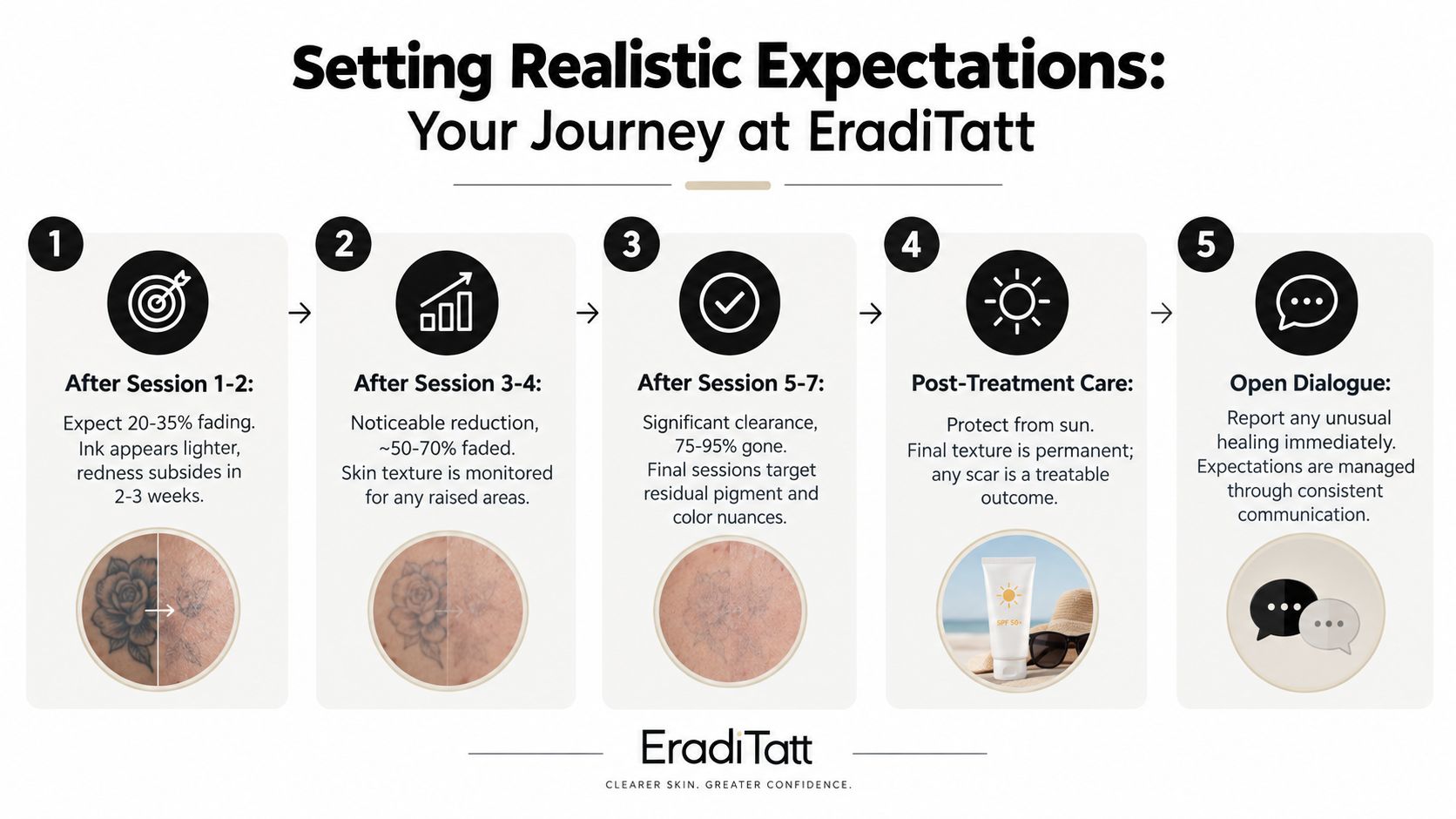
Treatment works progressively because the laser breaks pigment into particles the body can clear over time. The infographic associated with this article presents fading milestones of 20% to 35% after sessions one to two, approximately 50% to 70% after sessions three to four, and 75% to 95% after sessions five to seven. Those figures belong to the visual's expectation-setting checklist, not a guarantee for every tattoo.
A clinical report on traumatic facial tattoos describes consequential scarring risk after nanosecond Q-switched 1064 nm treatment ranging from 0.28% to 8.65%, depending on circumstances and technique. The same report found that alternating Q-1064 nm treatment with CO2 ablative fractional laser improved scar measures including vascularity, thickness, pliability, surface area, and total scar score compared with Q-1064 nm alone (clinical study of Q-1064 nm and fractional CO2 treatment).

Questions worth bringing to the appointment
Bring baseline photographs, disclose your Fitzpatrick skin type, and provide a complete medication list. Explain any history of raised scars, delayed healing, pigment changes, or previous reactions.
Ask specific questions rather than accepting a generic risk statement:
- Cause: Could this texture have existed before tattoo removal?
- Settings: What pulse duration, spot size, and cooling approach will be used?
- Timing: How will you decide that the skin is ready for another session?
- Texture: Would limited fractional resurfacing be appropriate, or should the scar be treated separately?
- Evidence: How will you distinguish remaining ink from scar tissue?
- Follow-up: What symptoms should be reported immediately, and what is the touch-up policy?
At a first appointment, a confident provider should examine the mark in person, compare it with baseline images, review treatment records, and ask about symptoms. You should leave knowing whether the current priority is pigment clearance, scar management, or observation while healing continues.
Emerging combination approaches make the conversation more nuanced. A 2024 systematic review found that laser intervention during wound-healing phases can reduce cutaneous scar formation, while a 2026 case series reported that a vacuum-assisted multimodal picosecond protocol made 81.3% of investigator-identified pre-existing scars no longer detectable after treatment (systematic review of laser treatments in tattoo removal). These findings are emerging evidence, not a promise that one protocol will erase every healed tattoo-removal scar.
EradiTatt Tattoo Removal offers progressive laser sessions for complete ink removal or cover-up fading, with treatment planning that considers tattoo characteristics, skin type, healing history, and visible texture. If you're concerned about a healed mark, visit EradiTatt Tattoo Removal to arrange a consultation focused on distinguishing residual ink, an old tattoo scar, and a true treatment-related scar before choosing the next step.