
You've passed the testing, picked a career field, and started planning for your ship date. Then a recruiter notices the tattoo on your hand, neck, face, or another visible area and tells you it may block enlistment. The problem isn't solved by saying the tattoo is small, old, or personally meaningful. Military tattoo removal is a calendar-driven eligibility project, and the final review can consider both the remaining ink and the condition of your skin.
The right response is to identify the exact branch rule, document the tattoo, and work backward from your accession date. Removal may be necessary for a prohibited location, size, or design, but fading alone doesn't guarantee approval. Recruiters, commanders, and medical reviewers need to see healed skin that complies with the current standard.
Table of Contents
- When a Tattoo Stands Between You and Enlistment
- How Laser Removal Actually Clears Ink
- Branch-by-Branch Tattoo Rules That Trigger Removal
- Realistic Session Counts and Healing Timelines
- Planning Treatment with EradiTatt in Florida
- Why Last-Minute Removal Rarely Works
- Your Enlistment-Ready Removal Checklist
When a Tattoo Stands Between You and Enlistment
A candidate I'll call Marcus learned this at the worst possible point. He'd completed his testing and was preparing for the next accession step when a recruiter asked for clearer photographs of a tattoo near his neckline. The design wasn't automatically disqualifying under every military policy, but its placement required a closer review. Marcus now had to determine whether he needed a waiver, alteration, or removal, while protecting his planned timeline.
That situation is common in principle, even though every applicant's facts differ. A tattoo can become an enlistment barrier after testing, job selection, or an initial review, because standards depend on the specific service, component, occupation, location, size, content, and current guidance.
Get the rule before booking treatment
Start with the regulation for your exact branch and accession path. The U.S. Army's published grooming standards have repeatedly restricted tattoos in highly visible areas, including the head and face, while allowing some existing personnel with prohibited tattoos to remain under removal requirements. The Army's current policy also permits limited tattoos on the hands, behind the ears, and the back of the neck, but those allowances have strict size limits, as detailed in the Army tattoo policy directive.
Ask your recruiter to identify the actual issue:
- Content: Is the design extremist, racist, sexist, indecent, gang-related, discriminatory, or otherwise prohibited?
- Location: Is it on the face, head, neck, hand, wrist, or another restricted area?
- Size: Does it exceed the permitted dimensions?
- Visibility: Can it be seen in the required uniform or with fingers closed?
- Timing: Is the tattoo recent, irritated, healing, or already altered?
Get the answer in writing or save the recruiter's digital confirmation. Internet summaries go stale, and an approval based on an older rule may not protect you at MEPS.
Build the removal file before the first session
Photograph the tattoo under consistent lighting. Record its location, colors, approximate size, depth, and completion date. Keep consultation notes, treatment dates, progress photographs, healing observations, and any clinic letter in one file.
If removal is required, reverse-plan from the target accession date. Clinical guidance for tattoo removal for military candidates explains that fading depends on pigment, wavelength matching, and immune-mediated clearance, with treatments spaced weeks apart. The practical target may be complete removal, substantial fading, or an unrecognizable design, but only authorized service personnel can decide what meets the standard.
Practical rule: Never trade a prohibited tattoo for preventable scarring. Aggressive treatment, picking, abrasion, and unlicensed removal methods can create a second appearance problem.
How Laser Removal Actually Clears Ink
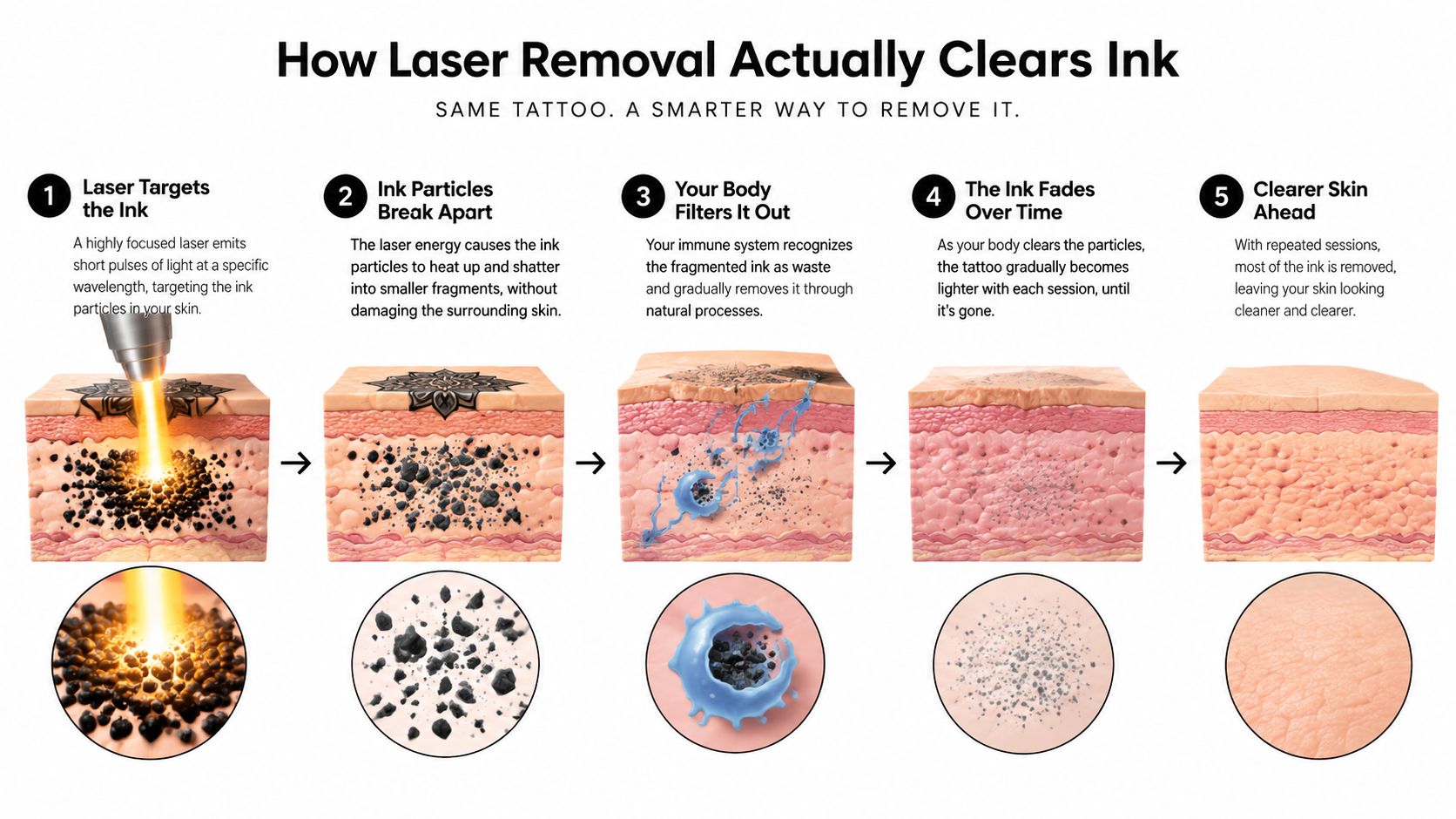
Laser removal doesn't lift tattoo ink out of the skin in one appointment. The laser delivers controlled pulses of light into the tattoo, and the pigment absorbs that energy. The ink fragments into smaller particles, after which the body gradually clears those particles through its immune and lymphatic processes.
That biology explains the calendar. The tattoo may look lighter after treatment, but the visible change continues during the recovery interval. A clinician must also allow the epidermis to recover before applying another treatment. For a plain-language walkthrough, review this complete breakdown of how tattoo removal works.
Wavelength and pigment determine the approach
Black ink commonly responds best to a 1064 nm Nd:YAG wavelength, while red and orange pigments often need 532 nm, according to clinical guidance on military tattoo removal. Mixed-color tattoos can therefore require more than one wavelength, and a saturated professional tattoo may respond differently from a lightly applied amateur mark.
Skin tone matters, too. Treatment settings need to balance pigment fragmentation against the risk of hypopigmentation, hyperpigmentation, burns, and scarring. A careful provider evaluates skin type, ink depth, color density, tattoo age, and previous treatments rather than promising a fixed result.
Treat the healing interval as part of treatment
Sessions are typically spaced six to eight weeks apart, with longer intervals when the skin needs more recovery, as described in the clinical guidance linked above. You should expect a series of appointments, not a one-session disappearance.
Between treatments, avoid tanning and don't pick at crusting or irritated skin. Keep a record of the date, treatment parameters, interval, photographs, and healing response. That documentation gives your recruiter a factual timeline, but it can't replace the recruiter's final interpretation of compliance.
The military objective also changes the treatment plan. If the service only needs the original design to become unrecognizable, complete blank-skin clearance may not be necessary. If the tattoo's content remains identifiable or the branch requires removal, the clinician may need to pursue a much greater degree of fading while protecting the skin's appearance.
Branch-by-Branch Tattoo Rules That Trigger Removal
There isn't one universal military tattoo rule. The same tattoo can create different questions in different branches, and the answer may also change depending on whether you're applying, already serving, seeking a waiver, or entering a specialized occupational field.
Use the comparison below as a screening tool, not as final approval. Your recruiter's current written guidance controls your enlistment plan.
| Service | Content restrictions | Location or visibility questions | Before treatment |
|---|---|---|---|
| Army | Extremist, racist, sexist, indecent, and other prohibited content can create a compliance issue. | Face and head tattoos remain prohibited. Limited hand, behind-ear, and back-of-neck tattoos are allowed only within strict size rules. | Obtain the current Army interpretation and ask whether removal, alteration, or a waiver is required. |
| Navy | Obscene, sexually explicit, discriminatory, gang-related, supremacist, extremist, and drug-advocating tattoos are prohibited. | A neck or behind-the-ear tattoo exceeding the permitted dimensions may require a waiver or removal review. | Confirm the content, dimensions, and accession status with recruiting personnel. |
| Air Force | Unauthorized or excessive tattoos can require removal or alteration before acceptance when standards aren't met. | Review head, face, neck, hand, and uniform-visibility concerns under current guidance. | Ask whether complete removal, alteration, or documentation is required. |
| Marine Corps and Space Force | Apply branch-specific content and appearance standards. | Review visible locations, uniform presentation, and any occupational restrictions. | Don't rely on an Army or Navy interpretation for another service. |
| Coast Guard | Prohibited tattoos, brands, piercings, or mutilations can bar enlistment or appointment. | Disqualifying markings are assessed during the joining process, not only after entry. | Ask whether alteration or removal allows later reconsideration. |
The Air Force policy manual states that members with unauthorized tattoos must initiate removal or alteration, and that complete removal or alteration may be required before acceptance when enlistment standards aren't met. Coast Guard guidance similarly treats prohibited markings as an enlistment gatekeeping issue, as shown in its personnel instruction.
The Navy deserves separate attention because it evaluates content, location, size, and cosmetic appearance. Its enlistment tattoo guidance identifies prohibited categories and explains that neck or behind-the-ear tattoos can require a waiver when they exceed the permitted dimensions.
The British Army uses a broader suitability test
Applicants considering the British Army should review its separate standard. The British Army tattoo policy states that tattoos unacceptable because of size, position, or nature can affect enlistment, re-enlistment, or continued service. That means removal may be relevant even when a tattoo isn't located on the face or hand.
Bring clear photographs and the exact policy wording to your consultation. A clinic can estimate fading, but it can't declare you eligible.
Realistic Session Counts and Healing Timelines
Military tattoo removal works backward from inspection, not forward from the first appointment. The useful question isn't, “How many sessions does removal take?” It's, “What must be healed and documented by the date a recruiter or medical reviewer examines me?”
Clinical guidance commonly places treatment intervals at six to eight weeks, and a practical benchmark for many removal plans is six to ten sessions, with a total timeline of roughly nine to eighteen months when fading and final healing are included. Those figures are planning ranges, not promises. Ink color, depth, saturation, skin response, treatment history, and the required degree of clearance all change the schedule.
| Tattoo Location | Goal | Sessions | Spacing | Total Time |
|---|---|---|---|---|
| Restricted visible area with dark ink | Compliance-level fading or clearance | 6 to 10 | 6 to 8 weeks | Roughly 9 to 18 months including healing |
| Mixed-color or heavily saturated tattoo | Near-complete clearance | More than a basic dark-ink plan may require | At least 6 to 8 weeks, adjusted for healing | Plan beyond the basic timeline |
| Tattoo requiring only design reduction | Make the original design less identifiable | Individual estimate required | 6 to 8 weeks is a common clinical interval | Depends on recruiter acceptance and skin recovery |
The timeline guide for tattoo removal is useful for setting expectations, but a consultation remains essential. A provider must inspect the actual tattoo before estimating its response.
Count healing, not just appointments
The skin may remain pink, darker, lighter, textured, or tender after pigment has faded. A recruiter can still see the treatment history on inspection day, and fresh erythema or raised scarring can create a new concern. Leave room after the final session for the skin to settle, photographs to be taken, and your recruiter to recheck the result.
Don't schedule your final treatment close to MEPS. Arrive with healed skin, no active redness, and a complete record of your progress. If the service needs the tattoo to be unrecognizable rather than perfectly erased, ask the recruiter to confirm that goal before treatment begins. A clinic can protect your skin while pursuing the required degree of fading, but it can't guess what an authority will accept.
Planning Treatment with EradiTatt in Florida
If you're in Florida and need a structured removal plan, EradiTatt's process begins with a consultation rather than a rushed treatment. The team photographs the tattoo under standardized lighting and assesses factors such as ink depth, color saturation, skin type on the Fitzpatrick scale, size, and the difference between complete removal and fading for a cover-up.
The treatment plan uses the PiQo4 laser, with dual-wavelength passes selected for the tattoo's pigment profile. Sessions are scheduled around a six to eight week healing interval, and progress photographs are uploaded to a shared patient portal so you can compare changes over time. That record can support recruiter communication, although the recruiter or reviewing authority remains responsible for determining compliance.
Set the right fading target
A military candidate shouldn't automatically demand absolute blank skin. If the branch only needs the design to become unrecognizable, pushing beyond the necessary target can expose the skin to avoidable treatment. If the tattoo is clearly prohibited by content or the recruiter requires full removal, the plan needs to reflect that stricter endpoint.
EradiTatt also coordinates with cover-up artists when fading is the objective. The clinic can work toward a soft shadow rather than blank skin, which may help limit unnecessary treatment and reduce the risk of pigment loss. For an enlistment candidate, that decision must be made only after the recruiter confirms that fading is sufficient.
Make the plan visible on your calendar
At consultation, ask for:
- A treatment range: Request the expected session range for your specific colors, size, depth, and skin type.
- A healing schedule: Put every proposed appointment on your calendar with recovery time protected afterward.
- Progress documentation: Confirm that standardized photographs and treatment notes will be maintained.
- A cost explanation: EradiTatt discloses pricing per square inch during consultation, with package discounts available when candidates commit to a full clearance series.
- Location options: Florida clients can use EradiTatt locations in Orlando, Bradenton/Sarasota, St. Petersburg, Palm Harbor, and Tampa, which may make appointment planning more flexible.
Don't treat a package commitment as proof that the final result is guaranteed. Your plan should remain tied to the branch's current written requirements and the condition of your skin at review.
Why Last-Minute Removal Rarely Works
Starting removal shortly before your ship date creates two problems at once. The ink may still be visible, and the skin may look actively treated. A tattoo that's pink after laser treatment can attract attention during recruiter photography and lead to another review rather than a clean approval.
The biology can't be compressed safely. The body needs time to clear fragmented pigment, while the skin needs time to calm and remodel. Repeating sessions too quickly can increase inflammation and raise the risk of hyperpigmentation, hypopigmentation, or texture changes.
The inspection-day problem
Recruiters and medical reviewers don't inspect an abstract treatment plan. They inspect your skin. If the area is red, crusted, raised, unusually light, or visibly scarred, the reviewer may need more information before deciding whether the appearance complies.
The Air Force dress and appearance instruction is a reminder that current guidance matters, while policy summaries also emphasize that resulting scars or depigmented areas can receive scrutiny. Don't assume removal automatically erases the eligibility issue.
Candidates who begin fewer than six months before a planned ship date face an especially compressed schedule. That may leave too little time for multiple treatment cycles, final healing, consistent photographs, and recruiter re-verification. Start as soon as the concern is confirmed, then protect the final healing window as carefully as the appointments themselves.
Your Enlistment-Ready Removal Checklist
Use this sequence during the first week. Keep the file current, and let the calendar control the plan.
- Week 1, pull the regulation: Get the current rule for your branch, component, and job from your recruiter.
- Week 1, photograph the tattoo: Take clear images in consistent lighting, including a wider view that shows location.
- Week 1, measure the area: Record the tattoo's size in square centimeters, because treatment estimates and pricing depend on measurement.
- Week 1, classify the issue: Write down whether the concern is content, location, size, visibility, or healing status.
- Week 2, book a consultation: Ask for a PiQo4 assessment, a realistic session range, and a removal or fading target.
- Week 2, reverse-plan the calendar: Schedule treatments around the standard six to eight week healing interval, and leave a final recovery buffer before inspection.
- Every session, save records: Keep timestamped photographs, laser settings, treatment dates, and healing notes in your recruiter file.
- After each session, update recruiting: Send progress only when your recruiter requests it, and ask whether the current result changes the accession plan.
- Before MEPS, verify healing: Arrive with no active redness, open skin, raised scarring, or obvious treatment irritation.
- Before inspection, bring documentation: Carry a printed clinic clearance letter and your treatment history, but remember that the reviewing authority makes the final decision.

For practical preparation before your first appointment, use this guide to preparing for tattoo removal. The strongest enlistment plan connects the branch rule, the treatment interval, the healing record, and the final inspection date from the beginning.
EradiTatt Tattoo Removal offers structured laser treatment for complete removal or military-focused fading, with consultations that account for tattoo size, color complexity, skin type, and your enlistment timeline. Visit EradiTatt Tattoo Removal to discuss your tattoo, build a realistic calendar, and start treatment early enough for the skin to heal before final review.