
Which laser tattoo removal technology fits your ink? Laser names can sound interchangeable, but they describe important differences. Pulse duration affects how energy breaks up pigment, while wavelength determines which colors absorb that energy and how the surrounding skin responds. A laser that suits dense black ink may not be the right choice for green, yellow, or a multicolor design.
Results also vary with pigment composition, ink depth, skin type, tattoo age, and the way your skin heals. Darker skin contains more melanin, which competes with tattoo ink for laser energy, so wavelength selection and epidermal protection need careful adjustment. Treatment planning should also account for whether you want complete removal or only enough fading for a cover-up.
This guide explains seven types of laser tattoo removal by pulse behavior, wavelength, and clinical role. You'll see how Q-switched, picosecond, ruby, alexandrite, KTP, combination, and adjuvant approaches relate to real tattoo colors and skin tones. The answer is straightforward: no single laser is best for every tattoo. A qualified provider should examine the tattoo, assess your skin, explain the available wavelengths, and build a plan around your specific goals.
Table of Contents
- 1. Q-Switched Nd:YAG Laser Technology
- 2. Picosecond Laser Technology
- 3. Ruby Laser Systems
- 4. Alexandrite Laser Treatment
- 5. Frequency-Doubled Nd:YAG Method
- 6. Combination Multi-Wavelength Laser Approach
- 7-Method Laser Tattoo Removal Comparison
- 7. Laser-Assisted Topical Adjuvant Treatment Method
- Choose the Approach That Matches Your Tattoo
1. Q-Switched Nd:YAG Laser Technology
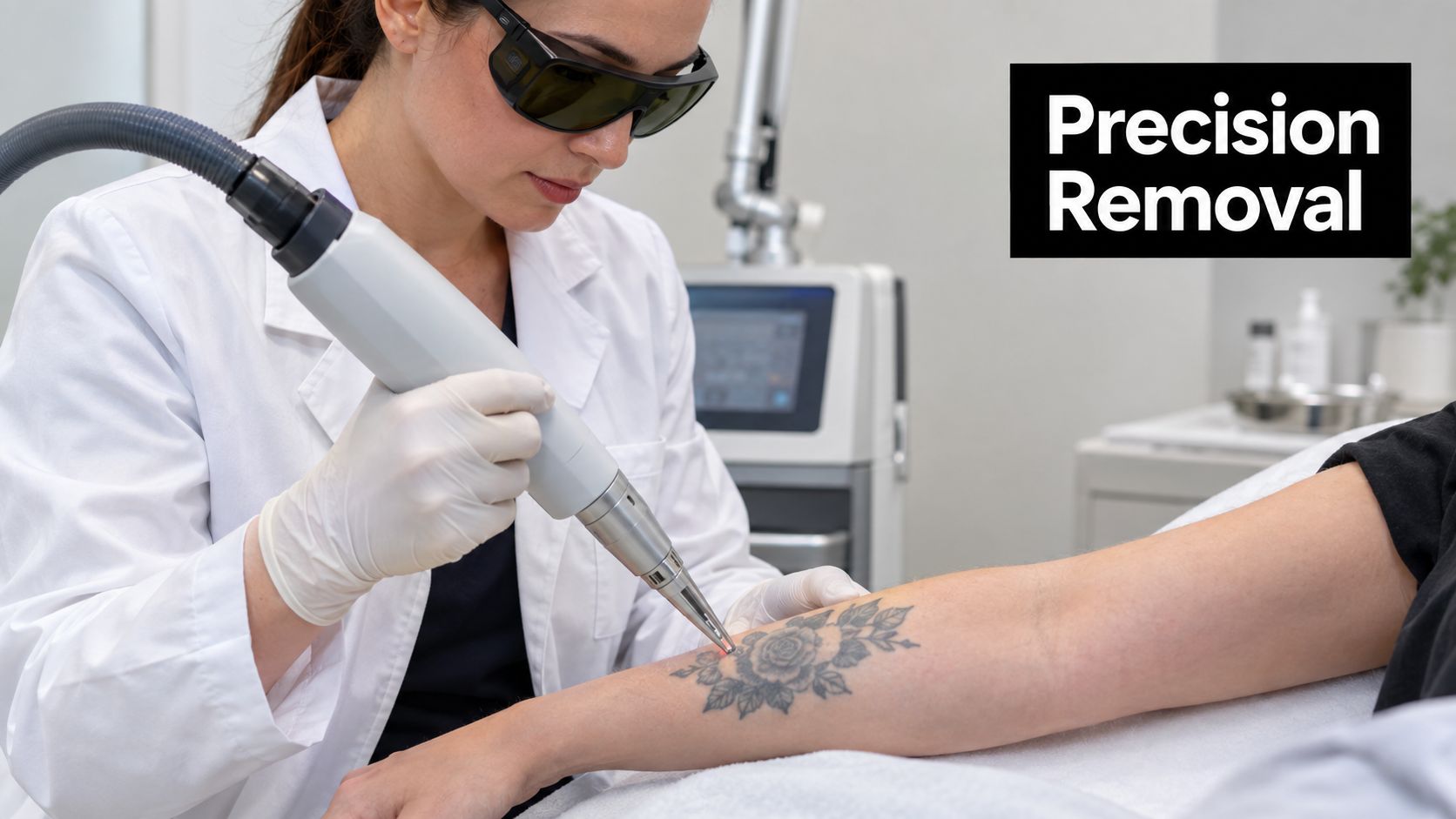
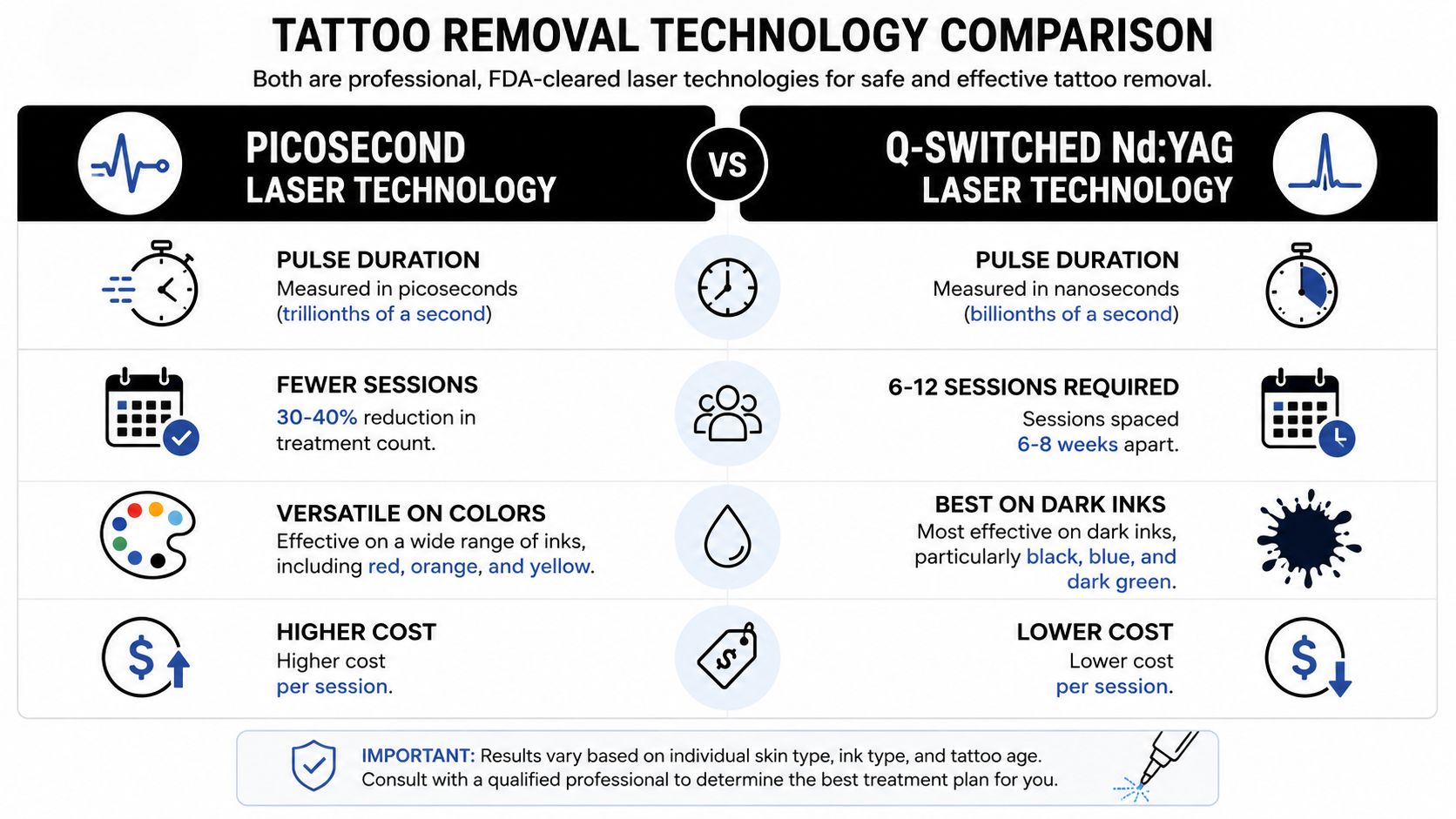
The Q-switched Nd:YAG laser remains a benchmark platform for professional tattoo removal. It uses nanosecond pulses, meaning energy reaches the ink in extremely brief bursts. The goal is selective photothermolysis, where the chosen wavelength is absorbed more strongly by tattoo pigment than by nearby tissue, causing the pigment to fragment for gradual clearance by the body. The medical overview of laser tattoo removal from NCBI explains how different wavelengths help clinicians match treatment to pigment and skin characteristics.
Its 1064 nm wavelength is especially useful for black and blue ink and is widely used across skin types, including darker complexions. The wavelength penetrates toward dermal tattoo pigment while limiting unnecessary absorption by melanin compared with shorter wavelengths. In an Italian clinical series, more than 40% of patients achieved complete removal, and the authors described Q-switched 1064/532 nm treatment as a gold-standard platform while noting that picosecond pulses may reduce the number of sessions needed. Read the clinical series on Q-switched and picosecond tattoo removal.
Where the technology fits
Q-switched Nd:YAG is a practical option for a large black back tattoo, a dense sleeve, or a professional design with substantial dark pigment. The 532 nm setting can address some warmer colors, but a provider may need another wavelength for green, blue, yellow, or complex mixed ink.
Ask a clinic:
- Which setting matches my ink: Confirm whether the provider plans to use 1064 nm, 532 nm, or another wavelength.
- How will skin type affect treatment: Discuss pigment-related risks, test spots, and protective measures.
- What happens after treatment: Follow the clinic's wound-care and sun-protection instructions, and disclose any history of keloids or hypertrophic scarring.
For a closer look at the platform's broader uses, review this explanation of Q-switched laser uses.
2. Picosecond Laser Technology
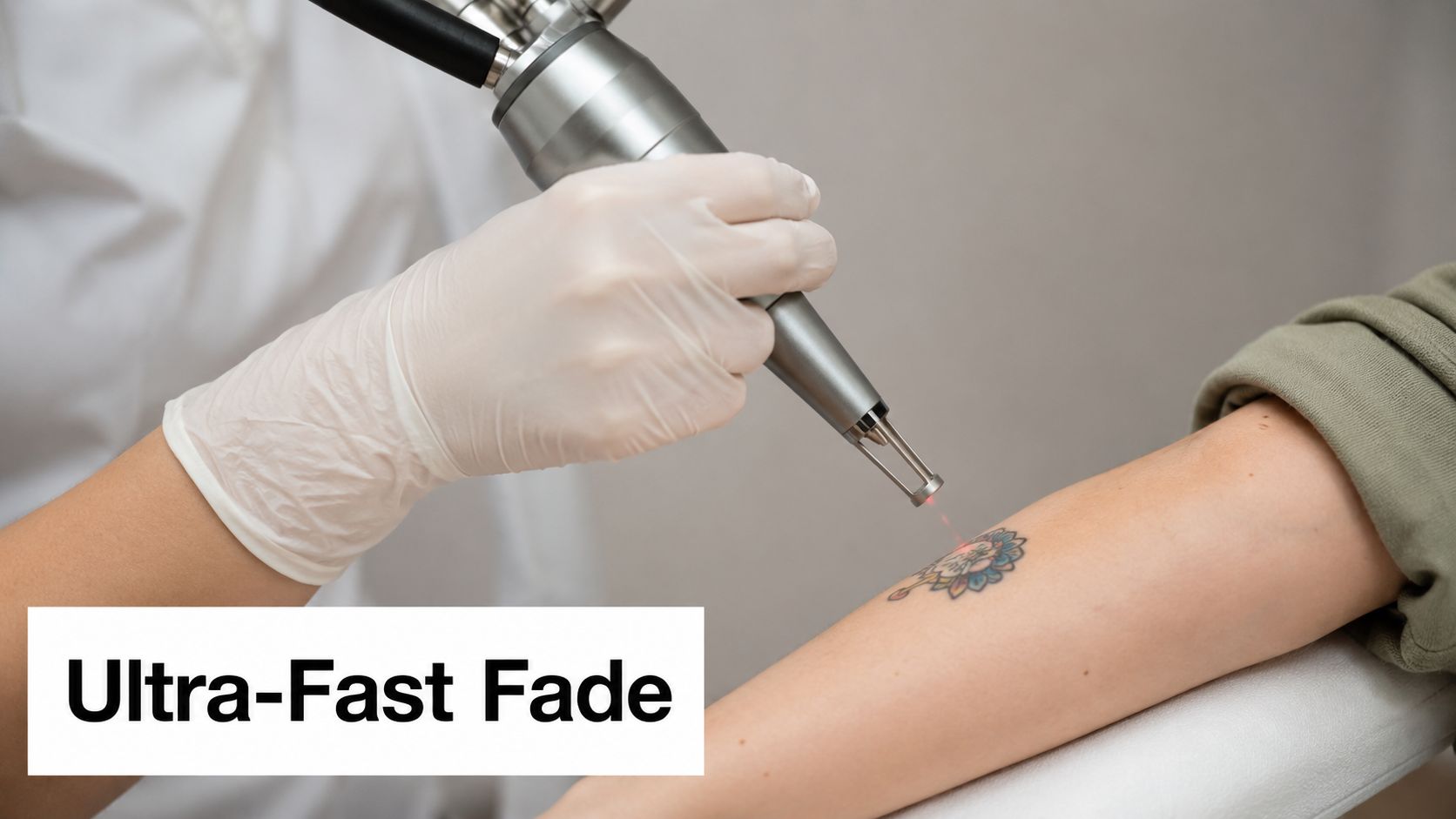
Picosecond systems differ from traditional Q-switched systems mainly through pulse duration. Q-switched lasers operate in the nanosecond range, while picosecond lasers compress the pulse to about 10^-12 seconds, a distinction described in the technical literature on picosecond tattoo removal. This review of picosecond laser principles describes the shorter pulse width as a newer approach designed to create a more efficient photomechanical effect.
In plain language, the laser delivers energy so quickly that it emphasizes mechanical fragmentation of pigment rather than prolonged heating. Picosecond platforms can operate at multiple wavelengths, including 532, 730, 755, 785, and 1064 nm, allowing clinicians to match treatment more closely to ink color and skin characteristics. Candela's summary of peer-reviewed Picoway articles describes 1064 nm for darker inks across Fitzpatrick skin types I to VI, while shorter wavelengths target selected warm or colorful pigments in appropriate skin types.
What patients may notice
Picosecond treatment is increasingly positioned as an upgrade for selected tattoos because it may achieve excellent clearance with fewer sessions. A comparative study found that picosecond treatments caused significantly less pain than nanosecond treatments, with shorter-lived transient reactions such as blistering, itching, and burning. Hypopigmentation occurred only after nanosecond treatment in that study, hyperpigmentation occurred with both, and no scarring was detected in either group. Review the comparative pain and safety findings.
A colorful forearm tattoo may need more than one wavelength even when a picosecond device is available. Ask whether the clinic can treat each pigment appropriately, whether a test spot makes sense for your skin, and how healing intervals will be selected.
For a practical overview of this technology, see Discovery Pico laser treatment. Patients comparing devices can also read this PicoWay overview for multicolored tattoos.
3. Ruby Laser Systems
A ruby laser operates at 694 nm and is one of the established laser options for tattoo removal. Its wavelength has a strong relationship with dark blue, green, purple, and black pigments, making it relevant when a tattoo's palette fits that absorption profile. Ruby systems aren't automatically the best choice because they're older or newer. The important question is whether the wavelength matches the pigment and whether the provider can adjust treatment safely for your skin.
A navy sailor-style tattoo illustrates the ruby laser's clinical role. Dark blue pigment can respond well to a wavelength designed for that color range, while a design containing red, orange, or yellow may require another laser. The same principle applies to an older professional tattoo with deep pigment. Ink age alone doesn't determine the result, but pigment color, depth, density, and prior treatment history all influence planning.
Strengths and limitations
Ruby treatment may be considered for tattoos dominated by black, blue, green, or purple ink. It becomes less suitable as the palette moves toward warm colors, and the provider may recommend a combination approach rather than forcing every color through one wavelength.
Practical rule: Ask whether the clinic still maintains and actively uses a ruby system. Availability varies, and a provider should explain why 694 nm fits your tattoo instead of presenting the device name as the main selling point.
Before treatment, discuss a test spot, comfort management, and the risk of pigmentary changes. Skin type matters with every laser, particularly when the wavelength and settings increase competition between melanin and tattoo pigment. A clinic should also explain whether ruby treatment is intended for complete clearance or for fading before a cover-up.
If the tattoo combines navy blue with red lettering, ruby may address one part of the design while another wavelength handles the rest. That plan is more logical than choosing a single laser based only on the tattoo's dominant color.
4. Alexandrite Laser Treatment
The alexandrite laser uses a 755 nm wavelength, placing it between shorter visible-light options and the deeper-reaching 1064 nm Nd:YAG wavelength. In tattoo removal, that position can make it useful for selected black, blue, green, and purple pigments. It may also play a role in tattoos where the clinician needs a different absorption profile from ruby or Nd:YAG treatment.
Consider a maritime-style tattoo containing black outlines and blue interior shading. Alexandrite may be relevant to the blue and dark pigment, but the clinician still needs to evaluate ink depth and skin tone before selecting settings. An amateur tattoo with uneven placement can behave differently from a dense professional tattoo, even when both appear black from a distance.
Matching 755 nm to the design
Alexandrite is most useful when the tattoo's colors fall within the wavelength's practical range. It isn't a universal solution for red, orange, or yellow ink, and mixed-color tattoos may need a sequence of wavelengths. The clinical review of laser types and pigment matching notes that alexandrite, ruby, Nd:YAG, KTP, and picosecond systems each have roles, with outcomes depending on pigment and skin-phototype tradeoffs rather than one universal device.
Ask these questions before booking:
- Does the tattoo contain blue or green pigment: Those colors may make 755 nm clinically relevant.
- Will another wavelength be required: Red, orange, and yellow sections may need a separate approach.
- How will darker skin be protected: The provider should explain settings, test spots, cooling, and post-treatment care.
A cover-up plan changes the objective. If complete removal isn't necessary, the clinician may focus on fading dense outlines or selected color blocks so a tattoo artist has a cleaner surface to work with. The consultation should define that goal before treatment begins.
5. Frequency-Doubled Nd:YAG Method
What happens when a tattoo contains red, orange, yellow, or brown ink? The 532 nm frequency-doubled Nd:YAG laser, often associated with KTP or green laser systems, targets these warmer pigments more directly than the deeper 1064 nm setting. Both settings can belong to the same Nd:YAG platform, but their wavelength and clinical role differ.
The 532 nm wavelength reaches pigment closer to the skin surface. That can make it useful for a red rose, orange sunset, or yellow decorative detail, while black and blue areas may require another wavelength. Because shorter wavelengths interact more strongly with skin pigment, the clinician must assess skin tone and the possibility of temporary color changes before choosing settings. NCBI's clinical reference on tattoo removal lasers describes 1064 nm and 532 nm Nd:YAG settings as options for matching treatment to both ink and skin characteristics.
Color mapping should come before treatment. A practitioner may plan 1064 nm for black outlines, 532 nm for red details, and a different wavelength for blue or green sections. A picosecond option may also have a role in suitable cases. Using separate settings reflects deliberate planning, not a failure of the device.
For a mixed-color tattoo, ask the clinic:
- Which pigments can 532 nm target: Confirm how the provider plans to address red, orange, yellow, or brown ink.
- How does skin tone change the plan: Ask about test spots, energy settings, cooling, and the risk of light or dark marks.
- Will each color be treated separately: A staged sequence may provide more controlled targeting than one setting across the design.
Aftercare supports the treatment plan. Protect the area from sun while it heals, and ask how the clinic will adjust sessions if colorful sections respond at a different pace from black ink. The practical objective is selective pigment treatment, not choosing the most powerful setting.
6. Combination Multi-Wavelength Laser Approach
Could one tattoo need several laser settings? Yes. A single design may contain pigments at different depths, densities, and colors, so treatment planning often combines pulse behavior and wavelengths rather than relying on one device. Q-switched pulses deliver short bursts, while picosecond pulses act over an even shorter interval. The choice depends on the ink, skin tone, previous treatment, and whether the goal is full removal or fading for a cover-up.
A portrait sleeve shows why color mapping matters. Black hair and outlines may suit 1064 nm, red highlights may suit 532 nm, and blue or green sections may need another wavelength. The wavelength is the color filter, while pulse duration helps determine how the pigment is broken up. Treating every section identically can leave some colors behind or expose the skin to unnecessary energy.
How clinicians build the sequence
The provider should assess the tattoo before selecting settings. That review covers pigment color, ink depth, density, skin type, earlier laser exposure, and current skin condition. EradiTatt's information about the Quanta Q-Plus C laser helps explain why a clinic may discuss multiple wavelengths when evaluating one design.
A useful consultation should connect each technical choice to a clinical role. Ask:
- Color mapping: Which wavelength is planned for each major pigment?
- Pulse behavior: Will the clinic use nanosecond, picosecond, or both, and why?
- Skin protection: How will settings, cooling, and epidermal protection change for your skin tone?
- Goal definition: Is the plan for complete removal or controlled fading?
- Healing plan: What interval will the provider recommend between treatments?
Darker skin needs careful settings because melanin can absorb laser energy alongside the ink, increasing the risk of epidermal injury or temporary color change. Read the clinical findings on picosecond tattoo removal and darker skin describes findings involving dual-wavelength picosecond treatment in Fitzpatrick skin types III and IV, plus treatment considerations for skin types IV to VI with a perfluorodecalin patch. The source supports asking how the clinic handles test spots, energy selection, and recovery monitoring.
7-Method Laser Tattoo Removal Comparison
| Technology | 🔄 Implementation Complexity | ⚡ Resource & Speed Efficiency | ⭐ Expected Outcomes | 📊 Ideal Use Cases | 💡 Key Advantages / Tips |
|---|---|---|---|---|---|
| Q-Switched Nd:YAG Laser Technology | Moderate, standard clinical training and calibrated settings | ⚡ Fast per session (5–20 min); more sessions (6–12); widely available equipment | ⭐⭐⭐⭐ High for black/dark inks; reliable clearance with multiple sessions | Dark/black tattoos, deep professional ink, most skin types | 💡 Schedule consult; space 6–8 weeks; avoid sun; SPF 50+ |
| Picosecond Laser Technology (Nd:YAG & KTP) | High, advanced devices and operator expertise required | ⚡ Very efficient overall (30–40% fewer sessions); higher per‑session cost; limited availability | ⭐⭐⭐⭐⭐ Superior on mixed/stubborn colors; faster overall timeline | Colorful tattoos, time‑sensitive clients, previously resistant ink | 💡 Verify picosecond capability, request test spot, confirm dual wavelengths |
| Ruby Laser (694nm) Systems | Moderate, older tech but requires experienced calibration | ⚡ Lower equipment cost; slower overall timeline; more sessions typical | ⭐⭐⭐⭐ Very effective on black/blue/green; slower on warm colors | Older, deep-set black or blue professional tattoos seeking cost-effective removal | 💡 Best for predominantly dark tattoos; expect 8–12 sessions; patch test advised |
| Alexandrite Laser (755nm) Treatment | Moderate, needs wavelength-specific tuning and experience | ⚡ Moderate efficiency; better on blue/green than ruby; fewer sessions than ruby | ⭐⭐⭐⭐ Versatile for black + blue/green; moderate on mixed-color work | Mixed black + blue/green designs, cover‑up preparation, amateur tattoos | 💡 Ask about availability; plan 6–10 sessions; combine for red/orange if needed |
| Frequency-Doubled Nd:YAG (532nm KTP/Green) Method | Moderate, often integrated into dual-wavelength systems | ⚡ Efficient for warm colors per session; superficial penetration requires complementary lasers | ⭐⭐⭐ Targeted high effectiveness on red/orange/yellow; ineffective on black/blue | Tattoos with red/orange/yellow elements; multi‑wavelength treatment plans | 💡 Request 532nm capability for warm inks; expect 6–8 sessions; protect from sun |
| Combination Multi-Wavelength Laser Approach | High, complex planning, sequencing, and multi‑platform skills | ⚡ Most time‑efficient overall (fewer total sessions); high resource/cost burden | ⭐⭐⭐⭐⭐ Best overall for full‑spectrum, complex tattoos; faster, more complete removal | Full‑color professional sleeves, portraits, mixed-ink sleeves | 💡 Choose clinics with multi‑platform capability; get a detailed color‑by‑color plan |
| Laser‑Assisted Topical Adjuvant Treatment Method | Moderate, adds protocol management and patient education | ⚡ Can accelerate clearance (~20–30% in some reports); needs extra products and compliance | ⭐⭐⭐⭐ Useful adjunct, improves healing and may reduce sessions; variable evidence | Patients seeking faster recovery or enhanced results as adjunct to laser | 💡 Follow protocols strictly (hydration, topical products, anti‑inflammatories); adherence is critical |
7. Laser-Assisted Topical Adjuvant Treatment Method
A laser can fragment tattoo pigment, but clearance still depends on the body removing those particles. Topical adjuvant care addresses the healing stage around the laser treatment. It may include wound care, hydration, sun protection, dressings, or selected anti-inflammatory measures. These steps support the skin, while pulse behavior and wavelength determine how ink is broken apart.
The clinical role is supportive, not a substitute for laser treatment. A topical product cannot compensate for a wavelength that does not match the ink, and it cannot guarantee faster fading. Recovery also varies with skin tone, tattoo density, treatment area, and the skin's response.
How adjunctive care fits the plan
The clinic should explain which products or dressings are suitable for the treated area and when to use them. Freshly treated skin may be sensitive, so adding an unapproved cream, exfoliant, or supplement can cause irritation and make healing more difficult. Sun protection matters because inflammation can increase the risk of pigmentary changes, particularly in skin with more melanin.
Aftercare matters: The safest routine is the one your treating provider has selected for the actual laser settings and the condition of your skin.
Ask practical questions before treatment:
- What reactions should I expect: How should blistering, crusting, redness, or tenderness be managed?
- Which products are safe: Is a recommended topical product appropriate for freshly treated skin, and when should it be applied?
- What should I avoid: Should I pause exfoliants, supplements, or other products during healing?
- How is progress reviewed: Will the clinic check the treated area before adjusting the next session?
A useful analogy is a two-part process. The laser breaks the pigment into smaller particles, while aftercare protects the skin as the body clears them. The second part can improve comfort and support healing, but it does not determine ink color response on its own.
Be cautious if a clinic promises a fixed accelerated timeline without examining the tattoo or explaining the treatment plan. Ask how pulse duration, wavelength, skin type, pigment, and healing response will guide the next decision.
Choose the Approach That Matches Your Tattoo
Choosing among the types of laser tattoo removal starts with the tattoo, not the device label. Ask which wavelengths the clinic has available and which one is intended for each color. A black tattoo may point toward 1064 nm Nd:YAG, while red, orange, or yellow sections may require 532 nm. Blue, green, or purple pigment can change the discussion again, particularly when the provider is considering alexandrite, ruby, or picosecond technology.
Skin type should be part of the first conversation. Darker skin contains more melanin, so the clinician needs to explain how settings, test spots, cooling, and epidermal protection will be adapted. Ask how the provider evaluates ink depth, density, age, previous treatment, and the condition of the skin before selecting a pulse duration or wavelength.
A useful consultation should answer practical questions:
- Which technology fits my tattoo: Will the plan use Q-switched nanosecond pulses, picosecond pulses, or both?
- How are colors treated: Does the clinic map each pigment to a suitable wavelength?
- Is a test spot appropriate: How will the provider assess your skin's response before broader treatment?
- What interval is recommended: How will healing determine the timing of the next session?
- What is the actual goal: Are you pursuing complete removal, or fading the tattoo for a cover-up?
EradiTatt Tattoo Removal can help Florida readers discuss a personalized plan across its listed locations in Orlando, Bradenton/Sarasota, St. Petersburg, Palm Harbor, and Tampa. Its treatment information describes the PiQo4 system as combining picosecond and nanosecond pulses with multiple wavelengths, with planning based on tattoo characteristics and skin type. The clinic can also discuss whether your goal is complete clearance or cover-up fading.
Read practical Think Tank Tattoo aftercare tips before your appointment, but follow the treating clinic's specific instructions after each session. Compare the treatment plan, safety process, expected timeline, and aftercare support, not just the laser name or an advertised session count.
EradiTatt Tattoo Removal offers consultations for complete tattoo removal and cover-up fading, with treatment planning based on ink color, tattoo depth, skin type, and your personal goal. Visit EradiTatt Tattoo Removal to review the Florida locations and schedule a conversation about which wavelengths and pulse technology may fit your tattoo.