If you're reading this, there's a good chance you're looking at a tattoo that used to feel right and doesn't anymore. In Bradenton, that often means a forearm piece you see every day at work, a name tied to a different chapter, or ink that now feels louder than the person you are today. The most important thing to know is that tattoo regret isn't unusual, and removal doesn't have to feel mysterious or intimidating.
A lot of clients come in thinking they're late to the decision, or that they should've acted sooner. That's rarely true. People start this process for career reasons, personal changes, cover-up plans, military or job requirements, weddings, or because they want their skin back. Recent industry data shows 38% of clients seeking removal are in their 30s, and 46% of removed tattoos are in highly visible areas like the forearm, hand, and neck, often tied to professional goals or life changes, according to Removery's tattoo removal trend data.

In clinic, the pattern is familiar. Someone walks in saying, "I don't even hate tattoos. I just don't want this one anymore." That's a practical place to start. If you're searching for how to remove unwanted tattoos Bradenton, what you usually want isn't hype. You want a straight answer about what works, how long it takes, what your skin will go through, and what you need to do to get a clean result.
That same need for clarity shows up across healthcare businesses in general. If you're curious how clinics build trust online before a patient ever calls, this overview of strategies for medical practice growth is a useful outside read.
Table of Contents
- Your Path to a Clean Slate in Bradenton
- Your First Step The EradiTatt Consultation
- Understanding the Removal Process Laser Technology Explained
- Preparing for Treatment and Mastering Aftercare
- Timeline Results and Managing Expectations
- Your Next Steps Booking Your Bradenton Appointment
Your Path to a Clean Slate in Bradenton
Tattoo removal usually starts discreetly. A long sleeve gets pushed down before a meeting. Jewelry gets adjusted to cover wrist ink. Someone catches their reflection and realizes the tattoo is still telling a story they stopped identifying with years ago.
That moment matters because it usually leads to a specific question. Not "Can tattoos be removed?" but "Can my tattoo be removed safely, and what will that process really look like on my skin?" The answer depends on the tattoo, the ink, the location, and whether your goal is total clearance or enough fading for a new piece.
A good removal plan doesn't begin with the laser. It begins with a realistic read of the tattoo in front of you.
In Bradenton, that often means balancing aesthetics with real life. Clients may need a visible tattoo faded before a job change. Others want to lighten a dense black design for a cover-up artist. Some want complete removal because they don't want another tattoo in that spot at all.
Three things usually surprise first-time clients:
- Removal is a process: The body clears shattered ink gradually. You won't judge results by the first few hours after treatment.
- Not every tattoo has the same endpoint: A simple black piece and a layered cover-up behave very differently.
- Planning saves frustration: The consultation shapes the timeline, session spacing, and aftercare approach.
A useful way to think about this journey is in phases. First, we identify the tattoo's traits and your goal. Then we treat in a controlled pattern, give your skin time to recover, and reassess how the fading is progressing from session to session. That rhythm matters more than speed.
If you've been putting this off because the process feels unclear, that's normal. Once you understand what happens at the consultation, why session spacing matters, and what aftercare entails, the path gets much simpler.
Your First Step The EradiTatt Consultation
A consultation is often expected to be quick. In practice, it should be thorough. There, the treatment plan is built, and unrealistic expectations get replaced with a strategy that fits your skin and your tattoo.
Professional consultations are foundational. They must evaluate ink color, density, tattoo location, and skin tone to build a realistic timeline, determining if full removal or fading is the most achievable goal for the client, as outlined in EradiTatt's Bradenton consultation guidance.
What gets evaluated
A proper assessment starts with the tattoo itself. Black ink usually behaves differently than multicolor work. Dense professional packing behaves differently than lighter shading. A tattoo on the hand, ankle, or other area with different circulation patterns may also respond differently over time.
Skin matters just as much. We look at your skin tone, how your skin heals, recent sun exposure, and whether the area has any textural changes from prior tattooing or attempted removal.
During consultation, these questions shape the plan:
- What is your end goal? Full removal and fading for a cover-up are not the same path.
- How old is the tattoo? Older ink can behave differently than newer saturation.
- Has the tattoo been reworked? Layering changes how energy reaches the pigment.
- Where is it located? Placement can affect healing and how visible your progress is between sessions.
Full removal or strategic fading
A lot of people walk in assuming complete removal is the only option. It isn't. If you're planning to work with a tattoo artist on a cover-up, partial lightening may be the smarter route. It often preserves more options for design and placement.
Practical rule: Bring the actual goal to the consultation, not just the tattoo. A cover-up plan, event deadline, or work requirement changes how the treatment plan should be built.
That conversation also helps avoid a common mistake. Some clients want aggressive treatment immediately, even when the better decision is measured progress. In removal, patience usually protects the skin and improves the result.
What you should ask
Come in ready to ask direct questions. Good ones include:
- How realistic is full removal for this tattoo?
- Would fading give me a better outcome for a cover-up?
- What part of this tattoo will likely respond first?
- What does healing usually look like on this body area?
If you're searching for how to remove unwanted tattoos Bradenton, this first appointment is where the vague idea becomes a working plan. Once that plan is clear, the laser portion makes much more sense.
Understanding the Removal Process Laser Technology Explained
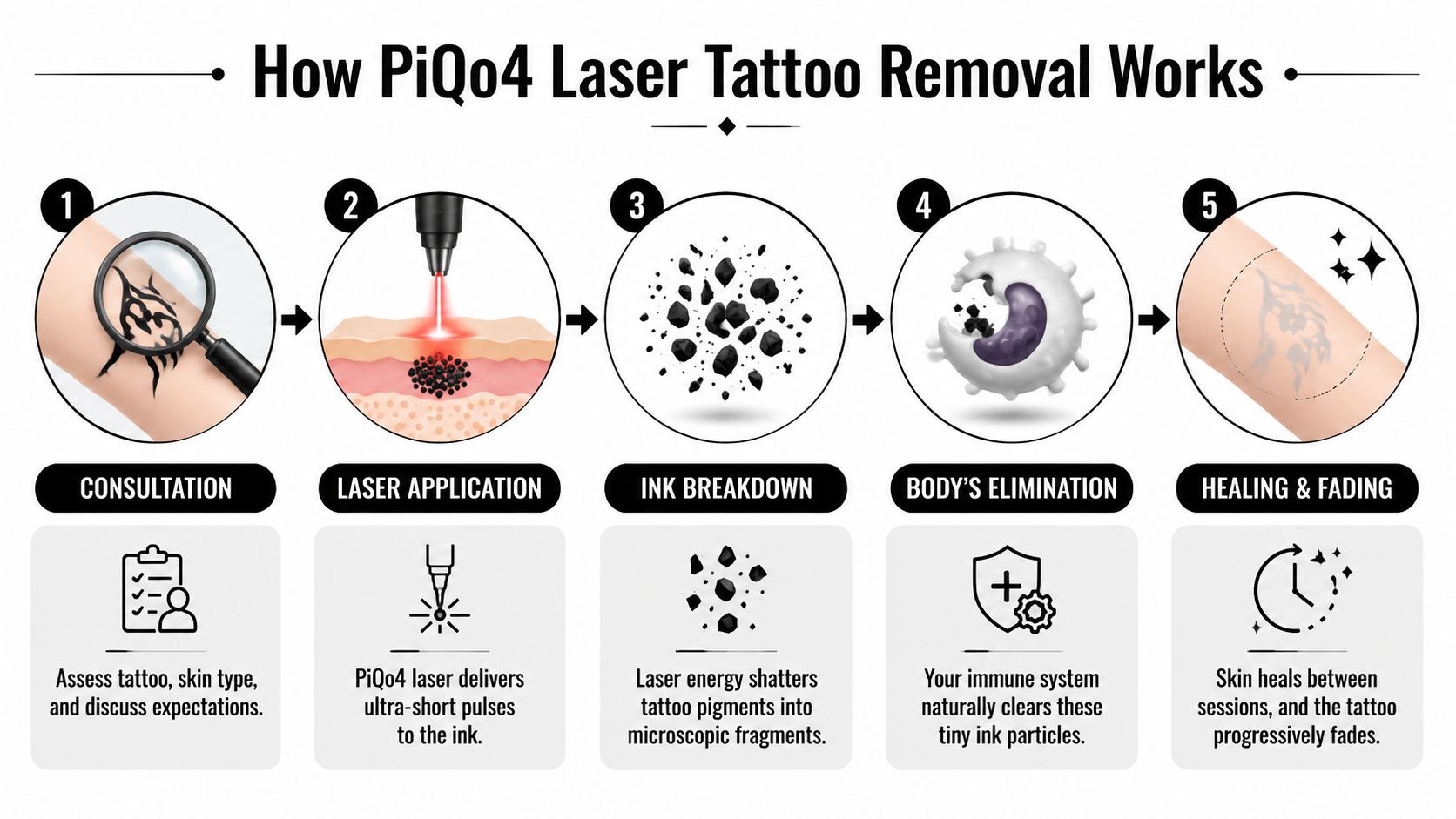
Laser tattoo removal works by delivering short bursts of energy into the pigment while leaving the surrounding skin as undisturbed as possible. With PiQo4, that energy is designed to break larger ink deposits into much smaller fragments so your body can gradually clear them.
The PiQo4 laser utilizes both picosecond and nanosecond pulses at multiple wavelengths, including 1064 nm for black and 532 nm for red ink, and can achieve up to 40% faster clearance than older nanosecond-only lasers, based on Cleveland Clinic's tattoo removal overview.
For a more detailed first-timer walkthrough, this complete breakdown of how tattoo removal works is a helpful companion read.
What the laser is actually doing
Think of tattoo ink like clusters of pigment embedded in the skin. The laser isn't scraping the tattoo off. It targets those pigment clusters with very short pulses so they fracture into smaller pieces. After that, your body does the clearing work over time.
That partnership between laser and immune response is why removal never happens in one dramatic moment. A treatment session starts the process. Healing and fading continue well after you leave.
A typical session includes:
- Skin prep: The area is cleaned and prepared for treatment.
- Targeted passes: The handpiece moves methodically across the tattoo to treat the pigment evenly.
- Immediate skin response: Many clients notice temporary whitening or "frosting." That's a short-term reaction at the surface and not the final result.
- Cooling and protection: The treated area is calmed and covered as needed.
The sensation is usually described as quick heat or repeated snaps against the skin. It isn't pleasant, but it's brief and manageable when the treatment is performed correctly and the skin is protected.
Why spacing matters
One of the biggest misconceptions is that closer sessions mean faster removal. They don't. The body needs time to process fragmented pigment and the skin needs time to recover between treatments.
At the clinic level, tattoo removal specialists recommend sessions be spaced 6 to 8 weeks apart so the lymphatic system has time to clear shattered ink particles and the skin can heal properly. Rushing treatment can compromise results and raise the risk of irritation or scarring.
Healing time is part of the treatment, not time lost between treatments.
That spacing also gives us useful feedback. We can see which parts of the tattoo are fading first, whether dense areas need a different strategy, and whether your goal still points toward complete removal or has shifted toward cover-up preparation. One session gives information. Multiple well-spaced sessions create results.
Preparing for Treatment and Mastering Aftercare
The laser matters, but the way you show up before treatment and care for the skin afterward matters just as much. Clients who do well tend to treat removal like a skin healing process, not a one-day cosmetic appointment.

When clients strictly follow aftercare protocols, the risk of significant side effects like scarring from modern laser tattoo removal is less than 5%, according to this review of tattoo removal methods and aftercare outcomes.
If you want a practical checklist before your appointment, this guide on how to prepare for tattoo removal covers the basics well.
Before your appointment
The goal before treatment is simple. Show up with calm, protected skin.
A few habits help:
- Keep the area out of the sun: Recently tanned or irritated skin is harder to treat safely.
- Stay hydrated: Well-hydrated skin generally handles treatment and recovery better.
- Avoid picking at the area beforehand: Any existing irritation complicates treatment day.
- Wear easy clothing: If the tattoo is on the shoulder, thigh, ankle, or back, make access simple.
If you're sick, badly sun-exposed, or the tattooed area is inflamed, say so before treatment. Delaying a session is sometimes the right call. Pushing through with irritated skin is not a badge of toughness. It's how preventable problems start.
After your session
Aftercare should be boring. That's a good sign. You want the skin protected, clean, and left alone.
Use this standard approach:
- Cool the area as directed. Heat lingers after treatment, and cooling helps settle the skin.
- Use the recommended ointment or dressing. Keep the barrier intact while the surface recovers.
- Avoid friction, heat, and heavy sun exposure. The treated site is temporarily more reactive.
- Don't pick or scrub. Let flaking or minor scabbing resolve naturally.
The clients who struggle most usually aren't the ones with the hardest tattoos. They're the ones who pick, overheat, or expose healing skin too soon.
You should also expect the tattoo to look different during healing. It may appear lighter, darker, slightly raised, or uneven for a period before it settles. That's one reason progress photos should be taken in a consistent way and judged over time, not day to day.
If you're serious about how to remove unwanted tattoos Bradenton, aftercare isn't an extra. It's part of the treatment plan.
Timeline Results and Managing Expectations
The two questions nearly everyone asks are, "How many sessions will I need?" and "Will it fully go away?" The honest answer is that timelines depend on the tattoo's characteristics and your goal. Still, there are useful benchmarks.
For professional black ink tattoos, full clearance is achieved in 75% to 95% of cases after approximately 10 sessions, while fading for a cover-up may require only 3 to 5 sessions to lighten the tattoo enough for new work, as noted earlier from Cleveland Clinic guidance.
What changes your timeline
Session count isn't random. It usually moves according to a handful of visible factors.
- Ink color: Black often responds more predictably than more complex color mixes.
- Density: Heavy saturation takes longer than fine line work or lighter shading.
- Layering: Cover-ups and reworked tattoos are usually slower because pigment sits in more complex patterns.
- Location: Some areas heal and fade more steadily than others.
- Goal: A tattoo being prepared for a cover-up doesn't need the same endpoint as complete removal.
This is also where expectations can get off track. People often think fading should happen in a smooth, uniform way across the entire tattoo. It usually doesn't. One section may break up early while another dense portion lingers. That's normal.
Removal is progressive, not perfectly linear. A stubborn patch doesn't always mean the treatment isn't working.
Tattoo Removal Goals Comparison
| Factor | Fading for Cover-Up | Complete Removal |
|---|---|---|
| Main objective | Lighten existing ink enough for a tattoo artist to work over it | Remove as much visible pigment as possible |
| Typical pace | Often shorter because the tattoo doesn't need to disappear entirely | Longer because the endpoint is much higher |
| Best for | Names, outdated designs, dark base layers, layout corrections | Tattoos you no longer want replaced |
| Decision point | Built around the future design and how much ink must be cleared | Built around skin response and long-term clearance |
| Mindset required | Strategic fading | Full-process commitment |
Cost conversations should happen at consultation because pricing depends on size, placement, and treatment scope. What's worth knowing now is that the cheapest-looking option isn't always the least expensive in practice if it leads to avoidable skin issues or poor fading.
A realistic plan is better than a fast promise. If your goal is complete removal, think in stages. If your goal is a cover-up, ask what level of fading your artist needs. Those are two very different finish lines.
Your Next Steps Booking Your Bradenton Appointment
Once you've decided to move forward, the next step is simple. Book a consultation and bring clear goals with you. A photo of the tattoo helps. If you're planning a cover-up, bring any inspiration or notes from your tattoo artist. If the tattoo affects work, appearance policies, or an upcoming event, say that up front.

For a clearer look at budgeting before you schedule, this page on tattoo removal cost in Bradenton is worth reading.
If you're comparing options, focus on the basics that affect outcomes:
- Technology fit: The laser has to match the tattoo's ink profile and your skin.
- Treatment planning: The provider should be able to explain why you're on a certain timeline.
- Aftercare support: You should leave knowing exactly how to protect the treated area.
One practical option for clients seeking laser removal is EradiTatt Tattoo Removal, which offers PiQo4-based treatment planning for complete removal or fading depending on the tattoo and the client's goal.
What to do before you call
Have these details ready:
- Tattoo location: Forearm, ankle, back, neck, and so on.
- General size: Small script, palm-sized design, full panel, sleeve section.
- Color profile: Black only or multicolor.
- Your goal: Full removal or lightening for a cover-up.
- Any urgency: Work deadline, wedding, enlistment, or travel schedule.
That short list makes the first conversation much more productive. It also helps the clinic team guide you toward the right appointment window and set expectations early.
A clean slate is possible, but good removal is never rushed. It's planned, treated carefully, and supported between sessions. If you're ready to stop wondering and get a real answer for your tattoo, the consultation is where that starts.
If you're ready to take the first step, contact EradiTatt Tattoo Removal to schedule a consultation and get a treatment plan built around your tattoo, your skin, and whether you want full removal or fading for a cover-up.