
A lot of people start looking into tattoo removal at a very specific moment. A job opportunity opens up. A wedding date gets close. A sleeve that once felt right now feels out of place. Or a name, symbol, or piece from another season of life just doesn't belong on your skin anymore.
The hesitation is understandable. Old tattoo removal stories about harsh treatments, drawn-out timelines, patchy fading, and skin damage are well-known. Those stories didn't come from nowhere. Earlier methods had real limits, especially with multicolored tattoos, darker skin tones, and clients who needed a treatment plan that fit real life instead of clinic theory.
That’s why new wave laser tattoo removal matters. This isn't just a newer machine with a better label. It's a different standard of care. The technology is more precise. The treatment planning is smarter. The safety profile is better. The overall experience, from consultation through healing, is more structured and more realistic.
In practice, that changes everything for the client. Removal can be approached as a clear process instead of a gamble. Fading for a cover-up can be done strategically. Complex color blends that used to be frustrating are now far more workable. Skin can be treated with more respect, which is what every good laser plan should prioritize.
Introduction The End of Tattoo Regret
Tattoo regret rarely shows up as drama. More often, it’s practical. A visible tattoo starts to feel like a problem in professional settings. A design from your early twenties stops matching the person you are now. A client comes in wanting a clean removal. Another wants enough fading to give their artist a better canvas for a cover-up.
What they usually bring with them is outdated fear.
They expect the process to be rough, unpredictable, and hard on the skin. They assume every tattoo needs the same approach. They often think removal means the laser burns ink away. Modern treatment doesn't work that way, and that’s a good thing.
Why the old reputation lingers
Older laser systems could work well in certain cases, especially darker inks, but they often struggled when tattoos became more layered, more colorful, or more cosmetically important to remove cleanly. That history shaped public perception.
Now the standard is higher. Better wavelength selection, better pulse behavior, better beam delivery, and better treatment planning have changed what clients can reasonably expect.
Most clients don't need hype. They need honest guidance about what can be removed, what can be faded, how long healing takes, and how to protect their skin through the process.
What a fresh start looks like now
Modern tattoo removal is still a process. It still requires patience. But it’s no longer something I’d describe as crude or one-size-fits-all. The best results come from matching the technology to the ink, the skin, and the client’s actual goal.
That goal may be full clearance. It may be selective removal. It may be just enough lightening to make a cover-up easier and cleaner.
New wave laser tattoo removal makes those paths more realistic. It gives clients a safer, more effective way forward, with less reliance on outdated compromises.
What Exactly Is New Wave Laser Tattoo Removal
New wave laser tattoo removal is best understood as a modern treatment approach, not a buzzword. It combines updated laser physics, better wavelength flexibility, stronger beam control, and a more careful treatment protocol from start to finish.
An easy way to think about it is this. Older laser systems were like dial-up internet. They could get the job done, but slowly, with clear limits. New wave systems are more like fiber optic internet. They move energy with far more precision, they handle more variables, and they perform better when the tattoo is complex.

It’s not just one machine
The term usually refers to the shift toward picosecond and advanced nanosecond systems, paired with better clinical decision-making. What separates this approach from older removal is that the laser isn’t just trying to dump heat into the tattoo. It’s trying to break pigment more efficiently while protecting surrounding skin.
That matters because pigment removal is only one part of the job. A good treatment also needs to limit unnecessary trauma.
One key upgrade is how ultra-short pulses work. As explained in this review of picosecond tattoo removal technology, picosecond lasers use a photomechanical effect to fragment ink into finer particles, which can lead to up to 50% faster clearance through the lymphatic system.
What clients actually notice
Clients don’t walk in asking about pulse duration. They notice the practical differences.
- More adaptable treatment plans because different colors and tattoo styles don't all respond the same way
- A better safety margin because modern delivery methods are designed to reduce unnecessary heat
- Cleaner progress over time because ink is being targeted more selectively
- A more manageable experience because planning, spacing, and aftercare are treated as part of the result
Practical rule: If a removal plan sounds identical for every tattoo and every skin tone, it’s probably not a modern plan.
This is why new wave laser tattoo removal should be viewed as a full client journey upgrade. Better technology is the center of it, but the main improvement is how that technology gets used.
How Modern Laser Technology Shatters Ink
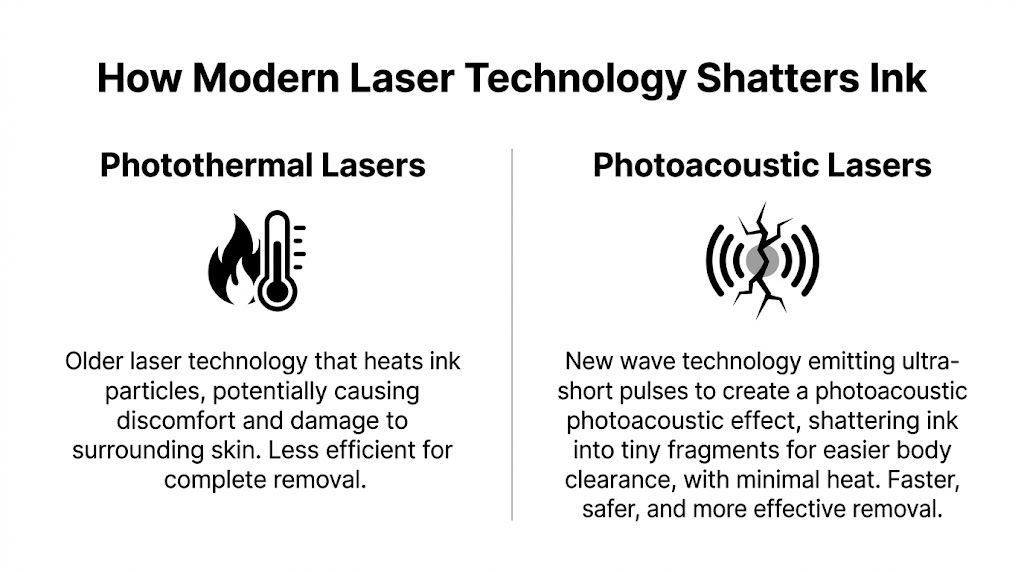
The biggest shift in tattoo removal is simple. Older systems leaned more heavily on heat. Modern systems are designed to create more of a shattering effect.
That difference is why newer treatment feels more controlled and why certain tattoos that used to stall can respond much better.
Heat versus shockwave effect
A useful comparison is a rock-breaking analogy. Nanosecond treatment is closer to hitting a rock with a hammer until it breaks into pebbles. Picosecond treatment is closer to applying a rapid shockwave that fractures those pebbles into much finer debris. Smaller fragments are easier for the body to clear.
That’s the reason newer systems can often produce more visible progress with less collateral disruption in the skin.
Modern removal also depends on color targeting. Tattoo ink isn’t one substance. Black, red, green, and blue pigments don't absorb light the same way, so wavelength choice matters. A well-equipped system can match wavelength to ink color instead of forcing one setting to do every job.
Why color response improved
Clinical data on picosecond technology shows that some systems can achieve up to 75% clearance on blue and green inks in just 1 to 2 treatments, and a 2021 study reported an 89% satisfaction rate linked to minimized side effects like hypopigmentation and scarring, as described in this overview of picosecond laser tattoo removal outcomes.
That matters because blue and green have historically been stubborn colors.
For black ink, the treatment logic is often more straightforward. For mixed-color tattoos, success depends much more on whether the device can target multiple pigment families well, and whether the provider uses that flexibility correctly. If you want a deeper look at one of the multi-wavelength platforms often discussed in this space, this overview of the Quanta Q-Plus C laser is a useful reference.
What works and what doesn’t
What works:
- Matching wavelength to pigment color instead of relying on a limited setup
- Allowing time between sessions so the body can clear fragmented ink
- Using conservative settings when skin needs it rather than chasing aggressive one-session change
- Treating removal and fading as different goals because they are
What doesn’t work:
- Treating every tattoo like black linework
- Ignoring skin response in pursuit of speed
- Promising uniform clearance across all pigments
- Confusing immediate whitening or frosting with final results
Frosting is a short-term skin response after treatment. It isn't the same thing as ink being gone.
The science sounds technical, but the practical takeaway is easy. Better shattering leads to better clearance potential, especially when the system can also address multiple colors with precision.
Key Benefits Over Older Tattoo Removal Methods
The technology only matters if it improves the client experience. In real practice, it does. The benefits show up in speed, color range, safety, and day-to-day comfort.

Four upgrades clients actually care about
First, results move more efficiently. That doesn't mean every tattoo disappears quickly, because tattoos still vary widely. It means the laser is doing a better job of breaking pigment in a way the body can process.
Second, multicolor work is more realistic to treat well. Advanced multi-wavelength systems can integrate three stable wavelengths, including 1064 nm for black, 532 nm for red, and another wavelength for green and blue, which addresses an old limitation of earlier lasers that struggled with multicolored designs, according to this review of multi-wavelength tattoo removal technology.
Third, skin safety is better when the treatment is properly planned. More controlled energy delivery helps reduce the kind of unnecessary thermal spread that can increase risk.
Fourth, comfort is usually improved. Not because tattoo removal becomes painless, but because precision matters. A laser that does a cleaner job doesn't need to behave like a blunt instrument.
New Wave vs. Older Laser Technology
| Feature | Older Laser Technology | New Wave Laser Technology |
|---|---|---|
| Energy delivery | More reliant on broader heat effect | More precise targeting with modern pulse behavior |
| Color handling | Often strongest on limited pigment ranges | Better suited for tattoos with multiple ink colors |
| Skin impact | Higher chance of unwanted heat in surrounding tissue | Designed to reduce excess thermal injury |
| Treatment planning | More device-limited | More customizable to tattoo and skin variables |
| Cover-up fading | Can work, but often less controlled | Better for strategic lightening and selective treatment |
Where older methods still disappoint
Some older approaches can still lighten a tattoo. That’s true. But the trade-off has often been longer treatment paths, weaker response on certain colors, or more concern about texture and pigmentation changes.
Better tattoo removal isn't only about stronger energy. It's about delivering the right energy to the right ink without asking healthy skin to absorb the cost.
That’s the core advantage of new wave laser tattoo removal. It gives the provider more useful options, and it gives the client a treatment path that feels more deliberate and less outdated.
Are You a Good Candidate for New Wave Removal
Most adults with unwanted ink are candidates for some form of modern laser treatment. The better question is not whether you qualify in a general sense. It’s how your tattoo and skin shape the treatment plan.
What affects your plan
Several factors matter when setting expectations:
- Ink color mix. Black usually behaves differently from green, blue, red, or purple.
- Tattoo density. Heavy saturation and layered work tend to need a more patient approach.
- Age of the tattoo. Older tattoos sometimes respond differently than fresh, densely packed ink.
- Location on the body. Some areas heal and clear ink more efficiently than others.
- Your skin tone. This affects wavelength choice, settings, and how cautiously treatment is paced.
- Lifestyle factors. Sun exposure, healing habits, and overall consistency with aftercare all matter.
Why modern technology expands candidacy
Newer systems make a meaningful difference. They broaden what can be treated well. A client with a colorful tattoo has more options than they would have had with older equipment. A client with deeper skin tone can often be treated more safely because modern protocols put more emphasis on wavelength selection, pulse behavior, and heat control.
If darker skin is one of your concerns, this guide on tattoo removal on dark skin explains the safety considerations in plain terms.
Good candidates think in goals, not guesses
You don’t need to walk into a consultation knowing exactly how many sessions you’ll need. You do need to know your goal.
Are you trying to remove the tattoo completely. Fade it for a cover-up. Lighten just one section. Work around a deadline. Avoid pigment changes as much as possible. All of those goals affect how an experienced technician builds the plan.
The best candidates aren't the ones with perfect tattoos for treatment. They're the ones willing to follow a realistic plan and give the skin time to respond.
That mindset is often underestimated. Modern removal can do more than older methods, but strong outcomes still depend on matching the treatment strategy to the desired outcome.
Your Treatment Journey From Start to Finish
Most anxiety around tattoo removal comes from not knowing what the process will feel like. Once people understand the sequence, it becomes much easier to manage.
The consultation and first session
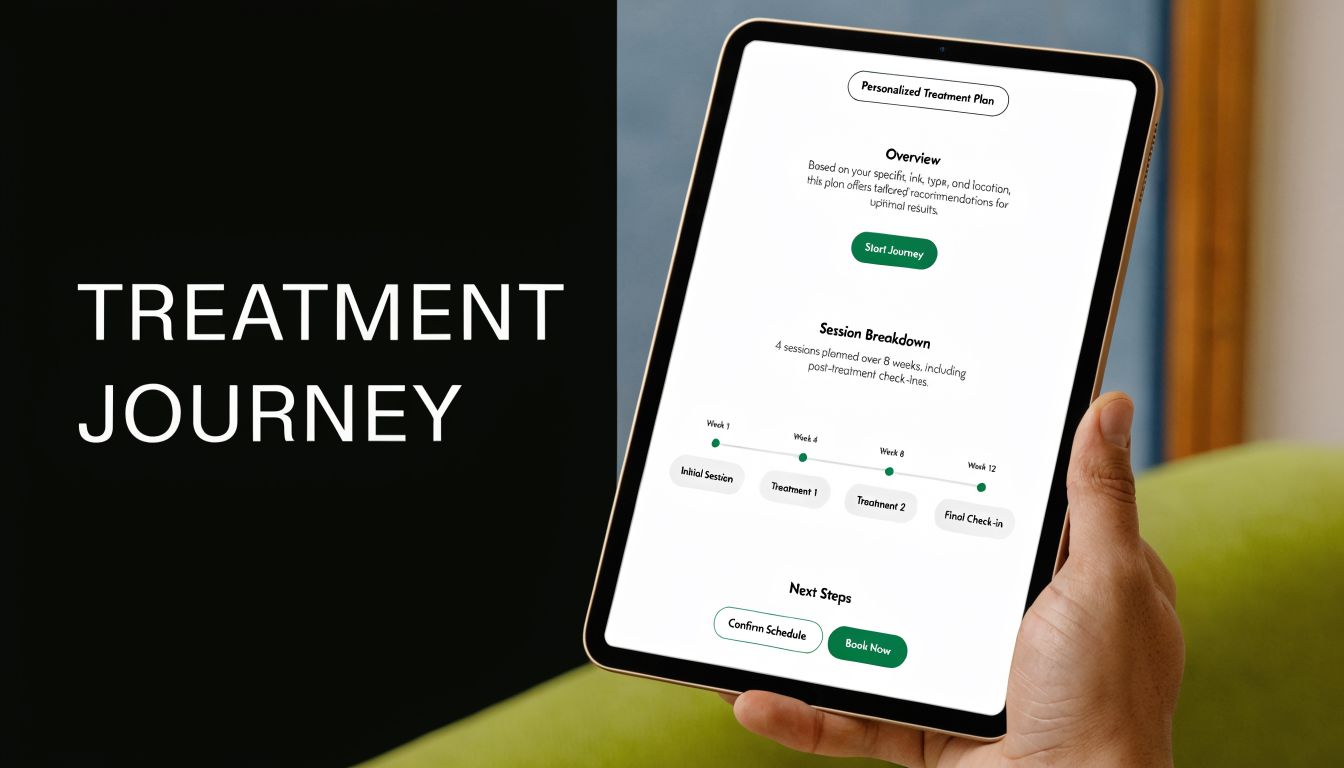
The process starts with an assessment of the tattoo itself, your skin, and your end goal. Complete removal and cover-up fading are not planned the same way. Neither is a small black tattoo compared with a multicolored, high-density piece.
A good consultation should also address your timeline realistically. The psychological and financial burden of multiple sessions is significant, especially for professionals or people preparing for life events, and realistic planning around a multi-month timeline, financing, and the overall process is important for a positive experience, as noted in this discussion of laser tattoo removal planning and expectations.
Before your first appointment, practical prep makes a difference. This guide on how to prepare for tattoo removal is worth reviewing so you show up with the right expectations and skin condition.
What happens right after treatment
During treatment, the laser targets the ink and creates a visible immediate response in the skin. Many clients notice whitening, often called frosting, followed by redness and some swelling. Those effects are common short-term reactions. They are not the final cosmetic result.
The treated area then enters a healing phase. That’s when aftercare matters most.
- Keep the area protected so you don't add friction or irritation.
- Don't pick at healing skin even if you see flaking or surface changes.
- Watch sun exposure closely because recently treated skin is more reactive.
- Stick to the spacing your provider recommends because healing time is part of the removal itself.
If you’re not confident about sun habits, a plain-language guide to understanding clinical sun protection can help you think more clearly about daily exposure while your skin is recovering.
The weeks between sessions
This is the part many people underestimate. The laser session breaks up the ink, but your body does the clearing over time. Fading happens gradually between visits, not all at once in the treatment room.
That’s why patience is part of good tattoo removal, not a sign that something is wrong. Sessions are typically spaced 4 to 6 weeks apart according to the verified guidance above, and some tattoos need a much longer overall journey than people initially expect.
Steady progress is the goal. Chasing treatment too aggressively usually creates more problems than it solves.
The best client experience comes from understanding that this is a managed process, not a sprint.
Your Fresh Start Begins at EradiTatt in Florida
If you’ve been carrying an unwanted tattoo for years, the hardest part is often deciding to start. Modern removal gives you a better option than people had in the past. The process is more precise, more strategic, and more respectful of the skin.
That matters whether you want complete removal, selective lightening, or fading for a cover-up. It also matters if your tattoo includes difficult colors or if your skin requires a more careful approach. New wave laser tattoo removal is the standard clients should expect now, not a luxury add-on.
For people in Florida, access also matters. EradiTatt serves clients across Tampa, Orlando, St. Petersburg, Bradenton/Sarasota, and Palm Harbor, making it easier to get evaluated and build a plan that fits your schedule.
A better experience starts with realistic guidance
The right clinic won't promise fantasy results. It will explain the trade-offs, protect your skin, and map out the treatment based on your tattoo, not a generic script.
Even recovery support should be practical. For example, when clients ask how to handle post-treatment discomfort, it helps to understand the basics of heat therapy vs cold therapy so you're making better decisions about soothing irritated tissue during healing.
Taking the next step
If your tattoo no longer fits your life, you don't have to stay stuck with old assumptions about removal. Start with a consultation. Ask direct questions. Bring your timeline. Be clear about whether you want full clearance or a cleaner base for a cover-up.
That first conversation is where the process becomes manageable.
If you're ready to talk through your options, schedule a consultation with EradiTatt Tattoo Removal. With locations in Orlando, Bradenton/Sarasota, St. Petersburg, Palm Harbor, and Tampa, the team can help you plan a safe, personalized path toward complete removal or strategic fading.
One Response