
Most individuals need 6 to 12 sessions spaced 4 to 8 weeks apart, which means a typical full removal timeline runs roughly 12 to 24 months from first appointment to last. The laser work itself may take only minutes, but healing and ink clearance control the calendar.
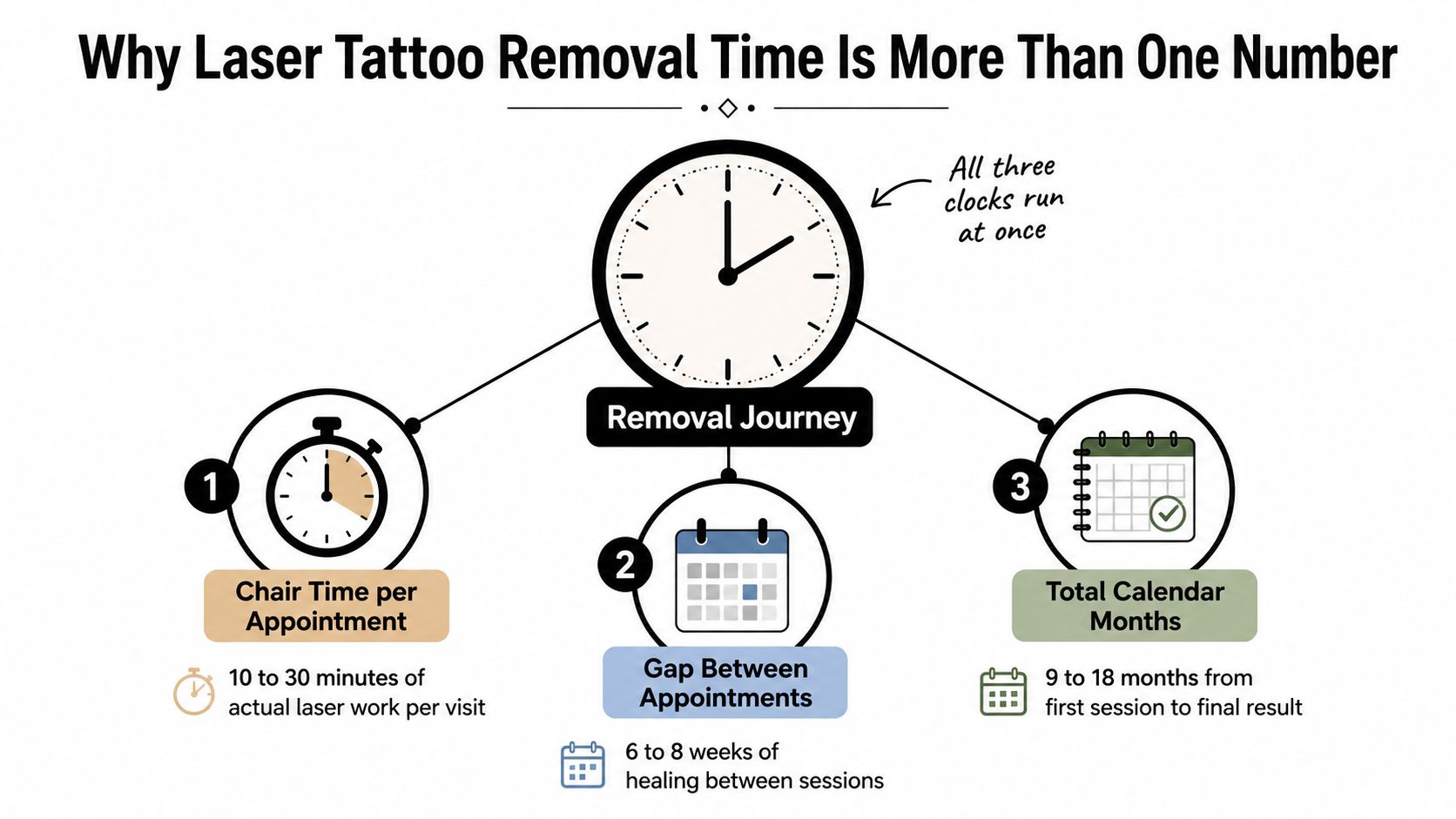
Why does a tattoo that takes minutes to treat require months, or even years, to remove? The answer becomes clearer when you separate chair time, the gap between appointments, and the total calendar time to your goal. Those three clocks run together, but ink density, color, layering, body location, and skin type affect each one differently.
Table of Contents
- Why Laser Tattoo Removal Time Is More Than One Number
- What Happens During a Single Removal Session
- Why Healing Time Sets the Spacing Between Sessions
- Total Timeline for Fading Compared to Full Removal
- How Your Tattoo Characteristics Stretch or Shorten the Timeline
- The Week by Week Recovery Window After Each Session
- Does Faster Laser Technology Mean Less Total Time
- Planning Your Removal Around Real Life Deadlines
Why Laser Tattoo Removal Time Is More Than One Number
A technician can treat a small tattoo quickly, yet that doesn't mean the tattoo will disappear quickly. The first clock measures how long you sit in the treatment chair. The second measures how long your skin and immune system need before another session. The third measures the complete journey from the first appointment to visible fading, a cover-up, or full removal.
For most patients, the practical starting point is 6 to 12 sessions, with appointments spaced 4 to 8 weeks apart. Medical guidance commonly places the overall requirement at about 4 to 15 sessions or more, and a clinical review reports an average of 7 to 10 treatments (WebMD's overview of laser tattoo removal). The FDA also explains that multiple treatments are necessary, with several weeks between procedures so the skin can heal (FDA guidance on tattoo removal).
The three clocks
Think of the first clock like a coffee cup. A small black symbol is a small cup, while a sleeve is a larger one. The laser may work for only a short period, but a larger or multicolor tattoo requires more pulses and more preparation.
The second clock is a stack of calendar pages. After each session, the laser has already done its part by breaking ink into smaller fragments. Your body needs time to process and clear those fragments, while the treated skin repairs itself. The third clock is a cross-country road trip. You aren't measuring only how long the car runs. You also have to account for rest stops, road conditions, and the distance to the destination.
A dense, professionally applied tattoo may need more sessions because it contains more pigment. Layered cover-up ink adds another obstacle. Lower legs, ankles, and fingers often clear more slowly than areas with stronger circulation and lymphatic drainage. Skin type can also require more conservative settings, which may lengthen the treatment plan.
Practical rule: A short appointment doesn't guarantee a short removal journey. The slowest clock is usually the body's recovery and ink-clearance process.
What Happens During a Single Removal Session
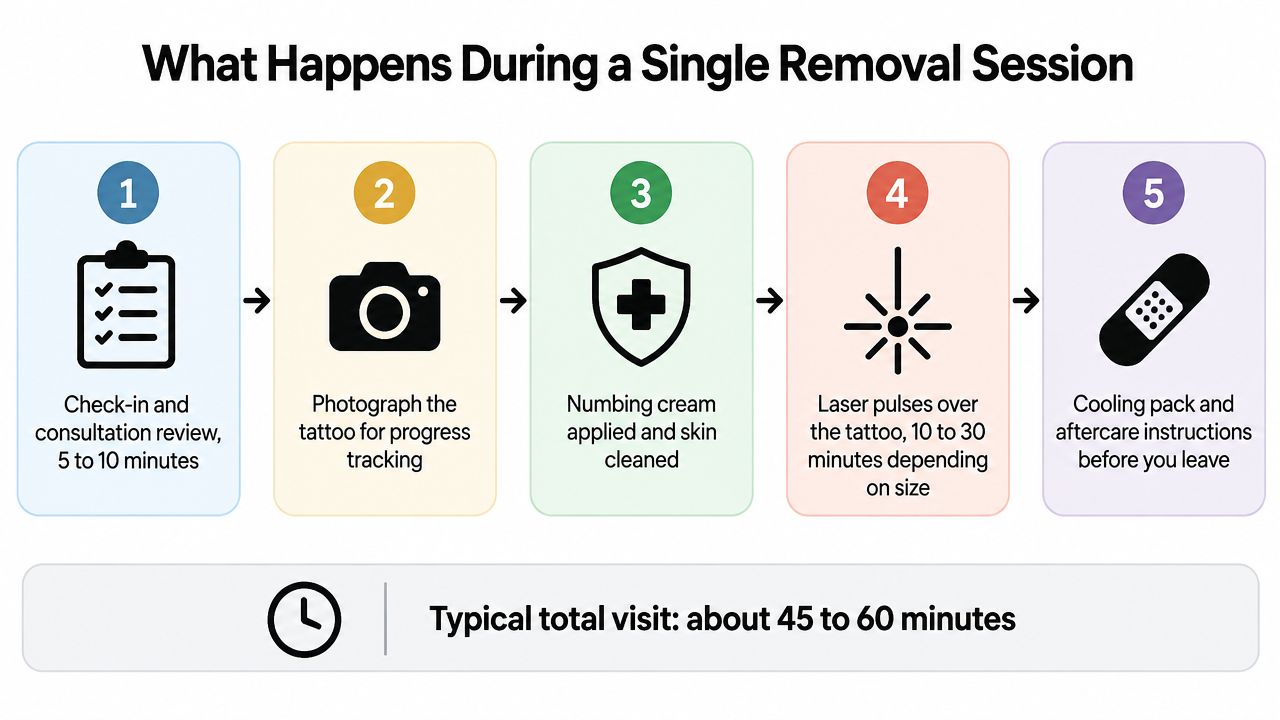
A removal appointment starts before the laser fires. The technician reviews your health information, checks how the tattoo responded to the previous session, confirms the treatment goal, and photographs the area for progress tracking. The consultation review may take 5 to 10 minutes, but the exact time depends on the tattoo and the clinic's process.
Numbing is usually part of the preparation. A topical anesthetic or cold air may be used for 10 to 20 minutes, followed by skin cleansing and protective eyewear. The sensation during treatment is often described as a series of quick snaps, while the treated area may develop a temporary white frosting response as the ink absorbs laser energy.
The laser portion
Actual laser work commonly takes about 10 to 30 minutes, depending on tattoo size and complexity. A coin-sized black tattoo might require 200 to 400 pulses, while a full sleeve could require 2,000 to 4,000 pulses. Those pulse counts and treatment durations are practical estimates used to visualize appointment scale, not guarantees for an individual tattoo.
The laser's pulse rate determines how quickly the technician can cover the area, but it doesn't determine how fast your body removes the pigment. A small tattoo may take only a few minutes of firing. A full sleeve, especially one with several colors or layers, requires more passes, more positioning, and more careful monitoring.
After treatment, the technician cools the skin and applies a dressing or protective covering. The full visit may last about 15 minutes for a small tattoo and 60 to 90 minutes for a large or multicolor piece, even though the laser itself fires for only part of that time.
The difference matters when you schedule work, travel, or childcare. Ask the clinic about both the active lasing time and the total visit time, because they aren't the same measurement.
Why Healing Time Sets the Spacing Between Sessions
The laser doesn't vacuum ink out of your skin. It delivers energy that fractures pigment into much smaller particles. Your immune system then processes those fragments, with immune cells and the lymphatic system gradually transporting them away. This is why a treatment can look unchanged immediately afterward but become lighter during the following weeks.
The skin also needs to repair itself. Laser treatment creates a controlled injury, so the area moves through inflammation, surface repair, and deeper remodeling. Treating again before the skin has recovered can interfere with healing and may increase the chance of an unwanted reaction.
The healing phases
| Phase | Timeframe | What Is Happening | Why It Matters for Spacing |
|---|---|---|---|
| Inflammation | Days 1 to 3 | Redness, swelling, tenderness, and a sunburn-like feeling may appear | The skin is responding to treatment and isn't ready for another exposure |
| Proliferation | Days 4 to 14 | The surface repairs itself while fragmented pigment remains available for immune processing | Blisters, scabs, or peeling need time to resolve naturally |
| Remodeling | Weeks 3 to 6 and beyond | Deeper tissue continues settling while the body clears more pigment | Fading can continue after the surface looks healed |
Clinical sources commonly recommend at least 4 to 8 weeks between sessions. A review notes that a minimum of one month supports wound healing and ink removal, while other guidance recommends about six weeks to allow wounds to heal and the body to absorb as much ink as possible (American Society of Plastic Surgeons guidance).
Smaller or lighter tattoos may be ready closer to the shorter end of the interval. Dense black work, saturated color, slower-healing locations, or skin that remains irritated may need the longer end. Your technician should inspect the area rather than treating the calendar date as an automatic green light.
For practical aftercare guidance, review post-laser tattoo removal care and follow the treating clinic's specific instructions. Don't pick blisters or scabs, and tell the clinic if redness, tenderness, or pigment changes persist.
Total Timeline for Fading Compared to Full Removal
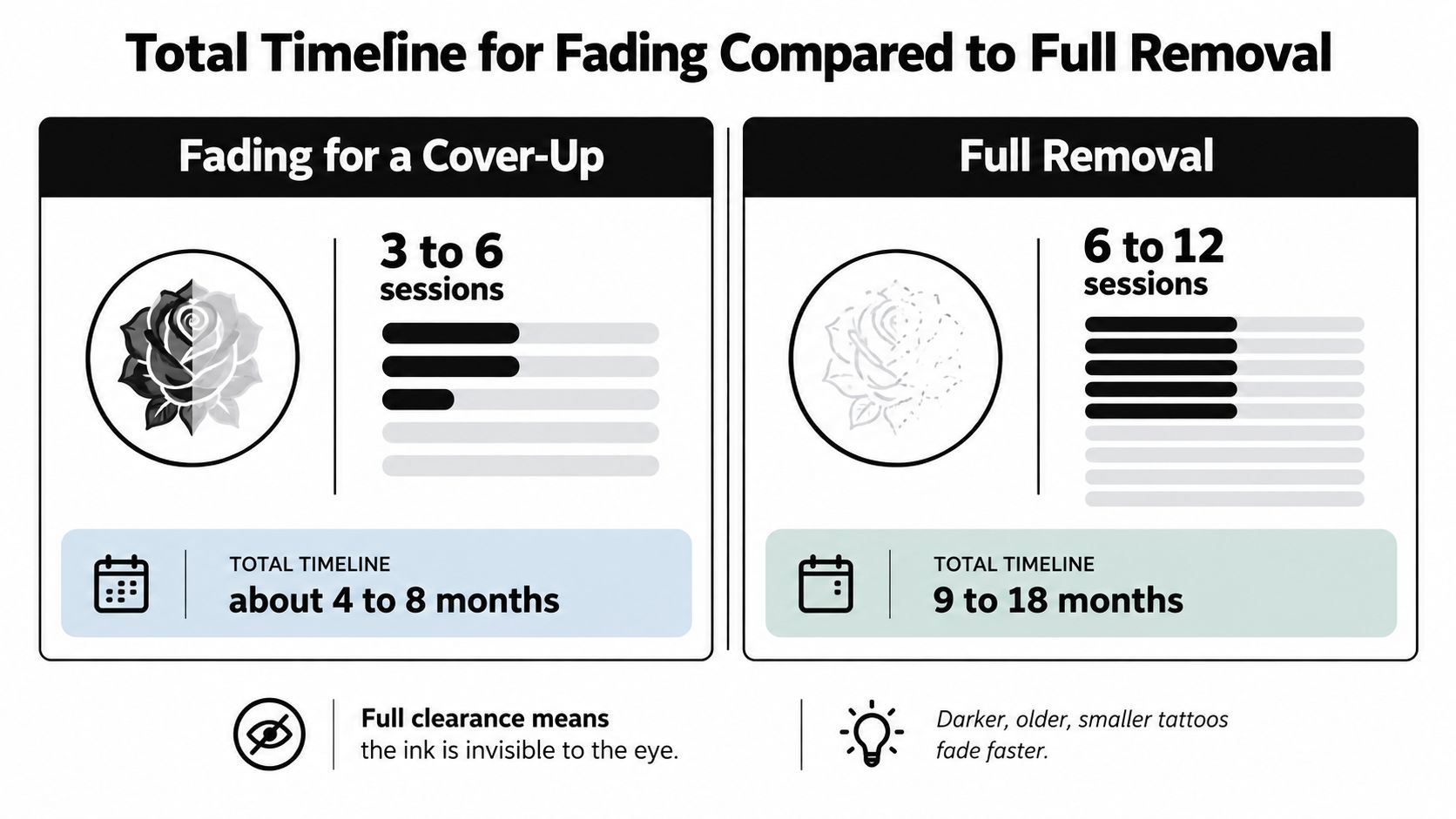
Your target changes the timeline. Cover-up fading means reducing the old tattoo enough for a tattoo artist to work over it. Full removal means continuing until the ink is no longer visible to the eye. Those are different destinations, so they shouldn't share the same session estimate.
Full clearance commonly takes 6 to 12 sessions, while cover-up work may need 2 to 4 sessions when the artist only needs the original lines softened. The Cleveland Clinic describes laser tattoo removal as taking 6 to 12 visits, with time between visits for the body to flush away fragmented ink (Cleveland Clinic's tattoo removal overview).
A simple calendar estimate
Use this planning formula:
Estimated timeline = session count multiplied by appointment gap, plus about two weeks for final settling.
The formula is only a planning aid. A course involving 6 to 12 sessions at 4 to 8 week intervals can occupy roughly 6 to 18 months, while a slower case may extend beyond that. The FDA and medical guidance emphasize that the body needs recovery time between treatments, so compressing appointments isn't a reliable shortcut.
Amateur ink and simple black script often fall toward the quicker end. Layered cover-ups, dense professional work, and full-color sleeves can require more treatment because the laser must address more pigment with different absorption properties.
If you have a wedding, interview, or cover-up appointment ahead, partial fading can be staged around that date. You don't always need to wait for complete removal before reaching a useful cosmetic goal, but you do need enough time for the skin to settle before another procedure.
How Your Tattoo Characteristics Stretch or Shorten the Timeline
Why can two tattoos of similar size need very different removal timelines? Size affects the appointment itself, but ink density, color, body location, tissue condition, and layering often determine how many appointments the skin can handle and how quickly the pigment clears.
The Kirby-Desai framework considers six variables: skin type, location, ink color, ink amount, scarring or tissue change, and layering (clinical discussion of tattoo removal prediction). These factors influence three separate clocks: the length of each session, the gap before the next visit, and the total calendar time until fading or removal.
Six variables that change the estimate
| Variable | Faster, fewer sessions | Slower, more sessions |
|---|---|---|
| Skin type | Skin that permits effective settings and straightforward healing | Skin requiring conservative settings because of pigment sensitivity |
| Tattoo location | Chest, arms, and head, where circulation and lymphatic drainage may support clearance | Lower legs, ankles, and fingers, where clearance may be slower |
| Ink color | Black and dark blue often respond efficiently to suitable wavelengths | Pale greens, sky blues, and other resistant shades may need additional treatment |
| Ink amount | Light, shallow, or amateur application | Dense, saturated professional application |
| Scarring or tissue change | Smooth tissue without significant prior damage | Scarred or overworked skin that can make pigment harder to treat |
| Layering | A single tattoo pass | Cover-ups or repeatedly tattooed areas |
Pigment density changes the workload much like adding more pages to a document that must be processed. Low-density tattoos averaged about 3.2 sessions, while high-density tattoos averaged about 9.0 sessions. More pigment gives the laser and the body's clearance process more material to handle.
Color changes the laser's physics. Black and dark blue absorb 1064 nm energy efficiently, while red commonly requires 532 nm. Pale greens and sky blues may respond more slowly, so wavelength selection and treatment settings need closer attention.
A small black monogram on the shoulder might be assessed at 3 sessions, with 6 weeks between visits, creating a course of about 4 months from first treatment to final settling. A colorful half-sleeve with cover-up history can exceed 15 sessions and extend beyond 22 months when density, layering, color, and location all slow clearance. These examples show how widely the three clocks can vary, not what any individual tattoo is guaranteed to require.
The Week by Week Recovery Window After Each Session
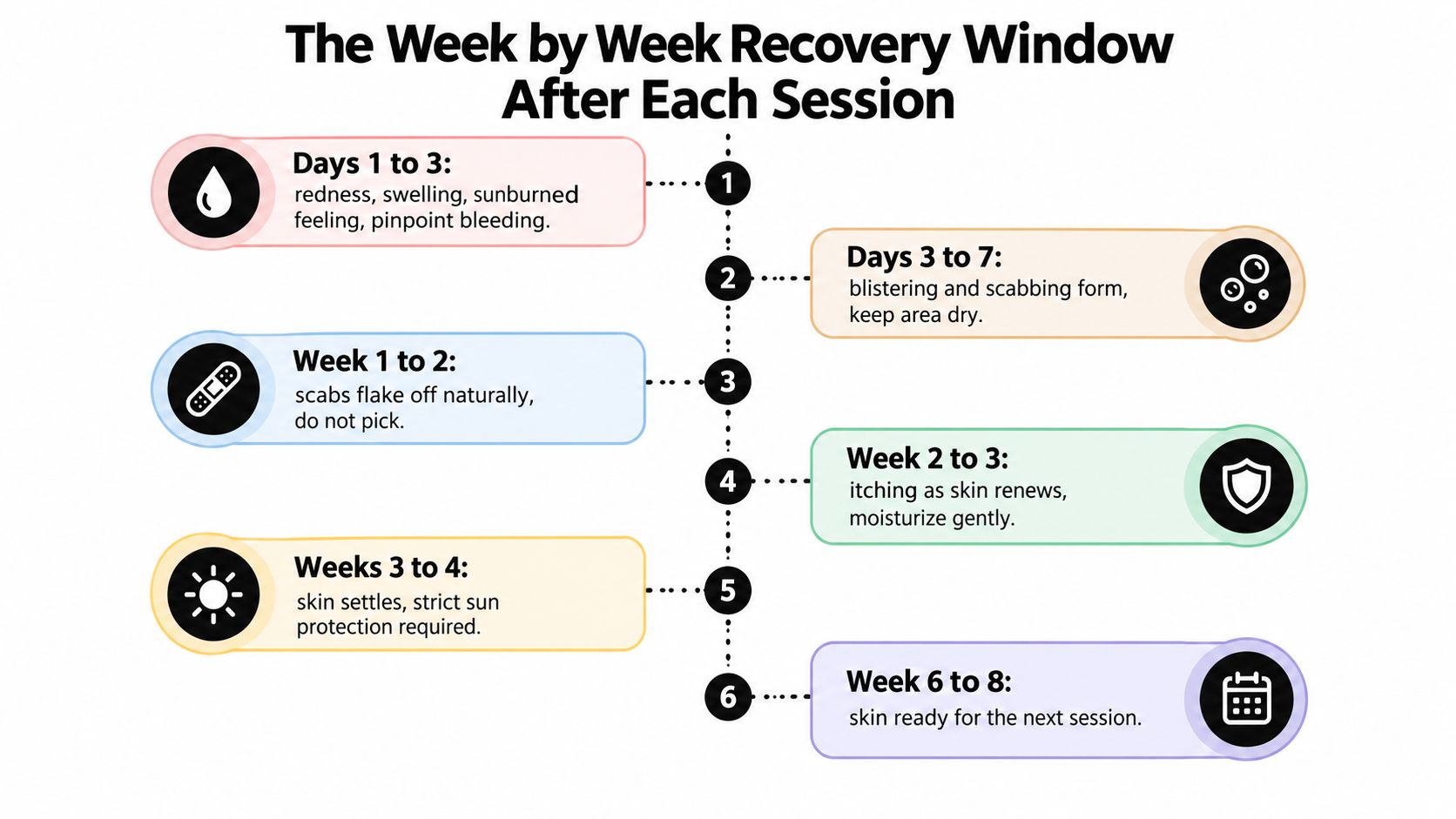
What should you do each week after laser tattoo removal, and when is the skin ready for another appointment? Use this checklist to track visible changes and decide when to contact your clinic. The exact appearance varies with treatment settings, ink density, color, and body location.
| Time | What you may notice | What to do |
|---|---|---|
| Days 1 to 3 | Redness, swelling, tenderness, and possible pinpoint bleeding | Cool the area as directed. Keep it protected from rubbing and unnecessary contact. |
| Days 4 to 7 | Blisters, frosting, or thin scabs may appear | Do not pick, puncture, or peel. Let the surface shed on its own. |
| Weeks 2 to 3 | Peeling and flaking settle; pinkness or uneven tone may remain | Wash gently, avoid friction, and watch for changes rather than judging fading too soon. |
| Weeks 3 to 6 | The skin generally looks calmer while fading may continue | Maintain sun protection and avoid avoidable irritation. |
| Weeks 6 to 8 | The area may be ready for a clinical check | Book reassessment only after the skin has fully recovered. |
Your daily routine may need a temporary adjustment. Loose clothing can reduce rubbing, while exercise or workplace contact may need modification if either repeatedly touches the treated area. An ankle tattoo creates a different practical problem: if you stand all day for work, swelling and friction may persist, so plan for the longer end of weeks 3 to 6 before reassessment rather than assuming the earliest appointment will suit your skin.
The area can look more noticeable before it looks lighter. Blisters and scabs are part of the surface response, but removing them early can disturb new skin and increase the chance of marks. Visible healing is only one clock. Fragmented ink may continue clearing after irritation has settled, so a calmer surface does not mean the tattoo has finished fading.
A clinical review reports that initial redness and swelling may take 1 to 2 weeks to heal, while full recovery can continue for several months as the body clears fragmented ink (review of laser tattoo removal outcomes and healing). Contact your clinic and postpone treatment if pain increases, redness spreads, drainage appears, infection signs develop, hyperpigmentation persists, or the skin has not returned toward baseline. The next appointment may need to move out by another month or longer.
Does Faster Laser Technology Mean Less Total Time
Picosecond lasers can change the number of treatments, but they don't remove the biological waiting period. Historical reports describe progress from Q-switched ruby treatments averaging 8.9 treatments to later picosecond studies averaging 6.5 treatments, while recent research reports that picosecond systems may achieve clearance in roughly 5 to 8 sessions in suitable cases (NCBI clinical review of tattoo removal; recent predictive research on picosecond treatment).
A picosecond pulse is shorter than a traditional nanosecond pulse. That changes how energy creates a photoacoustic effect, helping fracture some pigment into smaller particles. The laser may be more useful for resistant colors or tattoos that have responded slowly to previous treatment.
Three different meanings of faster
Faster pulse duration describes the length of each laser pulse. It doesn't mean your body clears pigment immediately.
Faster session speed describes how quickly the technician can cover the tattoo. It may reduce active chair time, but preparation and aftercare still take part of the visit.
Faster total course describes whether you need fewer appointments. Even if a device reduces session count, your skin still needs time to heal and your immune system still needs time to process the fragments.
The evidence supports a potential reduction in sessions, not an automatic collapse of the calendar. Tattoo age, density, color, fluence, skin response, and treatment spacing still matter. The slowest clock is often biology, not hardware.
For a broader explanation of changing device approaches, see the new wave of laser tattoo removal. A clinic should explain which part of your estimate the technology may improve, rather than presenting a device name as a guaranteed deadline.
Planning Your Removal Around Real Life Deadlines
Start with the goal, then work backward through the three clocks. A cover-up plan may involve roughly 3 to 5 visits over 3 to 6 months, depending on how much fading the new design requires. Complete removal commonly needs 12 to 24 months for an average tattoo, while dense black sleeves may extend to 24 to 36 months when treatment burden and healing delays are substantial.
These are planning ranges, not promises. A wedding-ready fade in 9 months may be realistic for a lighter tattoo when the objective is softening rather than full clearance. A job-related removal goal planned across 18 months gives more room for a typical multi-session course. A small wrist piece may require roughly a year when its location, ink density, and skin response slow the process.
Build the calendar backward
Use the final event as the anchor:
- Define the visual goal. Decide whether you need full removal, selective removal, or enough fading for a cover-up.
- Estimate the session range. A technician should assess size, depth, density, colors, layering, location, skin type, and any scarring.
- Reserve the healing gaps. Keep 4 to 8 weeks between appointments unless your clinician recommends a longer interval.
- Add a buffer. Blistering, pigmentation changes, illness, travel, or work interruptions can push a session back.
- Book early. A consultation 6 to 9 months before a target date gives the plan room to absorb delays, although longer courses need substantially more lead time.
For wedding planning, tattoo cover-up preparation can help you think about fading as a staged design process rather than an all-or-nothing removal project. The most useful estimate comes from an in-person assessment, where a technician can inspect the tattoo's size, depth, color mix, layering, and tissue condition before projecting a personalized session count and calendar.
EradiTatt Tattoo Removal offers progressive laser treatments for complete removal or cover-up fading, with consultations customized to tattoo size, color, skin type, and personal deadlines. Visit EradiTatt Tattoo Removal to discuss your timeline and arrange an assessment at a convenient Florida location.