
97% of patients experience temporary local reactions such as blistering, swelling, redness, and pain after laser tattoo removal, while permanent complications occur in roughly 6% to 8% of cases. The common reactions are usually manageable and short-lived, but lasting pigment changes, scarring, and incomplete clearance deserve an honest discussion before treatment.
You may be reading this with a photo of your tattoo open on your phone, wondering whether the redness will be tolerable, whether the ink will disappear, or whether your skin could look worse afterward. That anxiety is understandable. Tattoo removal side effects are often described as one alarming list, even though temporary inflammation and permanent skin damage are very different outcomes.
The most useful question isn't whether treatment has risks. It does. The useful question is which reactions are expected, which are uncommon, and what affects your personal risk. The sections below separate those categories using clinical data and practical aftercare guidance.
Table of Contents
- Understanding Tattoo Removal Side Effects Before You Start
- Common Temporary Reactions During Healing
- Rarer Long-Term Complications and Their Likelihood
- Risk Factors That Increase Your Chances of Complications
- How to Minimize Side Effects and Support Safe Healing
- When to Contact Your Tattoo Removal Clinic Immediately
Understanding Tattoo Removal Side Effects Before You Start
The moment before a first session often feels worse than the treatment itself. You've researched lasers, seen photographs of blisters, and started imagining the worst possible result. A more accurate expectation is that the treated area will usually look and feel irritated for a while because the laser has created a controlled injury around pigment particles.
A large clinical review reported local reactions in 97% of participants, with blistering, edema, crusting, erythema, and pain among the most common immediate effects (clinical review of laser tattoo removal reactions). That figure doesn't mean 97% of people suffer permanent harm. It means short-term inflammation is a normal part of the process, not an unusual failure.

Temporary inflammation versus lasting injury
Laser energy targets tattoo pigment, and the surrounding skin can respond with heat, redness, swelling, tenderness, and surface changes. Your immune system then helps clear fragmented ink over time. That visible response can be uncomfortable, but it isn't automatically evidence that the skin has been permanently damaged.
Permanent complications can include scarring, hyperpigmentation, hypopigmentation, and pigment color change, according to the same clinical review. Those outcomes matter, especially if you're seeking complete removal rather than lightening a tattoo for a cover-up, but they belong in a different risk category from ordinary post-treatment redness or crusting.
A separate large prospective study found adverse effects in 6.2% of patients, with hyperpigmentation the most common specific complication at 4.8% (independent medical review of laser tattoo-removal complications). Newer practitioner-reported data places complications at 8.1% of treatment sessions, with most reported events mild or transient.
What your device choice means
People often ask whether a particular laser eliminates side effects. It doesn't. A modern device such as the PiQo4 may be selected as part of a treatment plan based on pigment, skin tone, tattoo depth, and the response seen during consultation, but no laser makes healing reactions disappear or guarantees complete clearance.
Practical rule: Expect some short-term reaction, but don't accept vague answers about your long-term risk. A careful consultation should address your skin tone, ink colors, medical history, and the possibility of residual pigment.
Before scheduling, review a detailed explanation of laser tattoo removal risks and recovery and ask how the clinic distinguishes normal healing from a complication.
Common Temporary Reactions During Healing
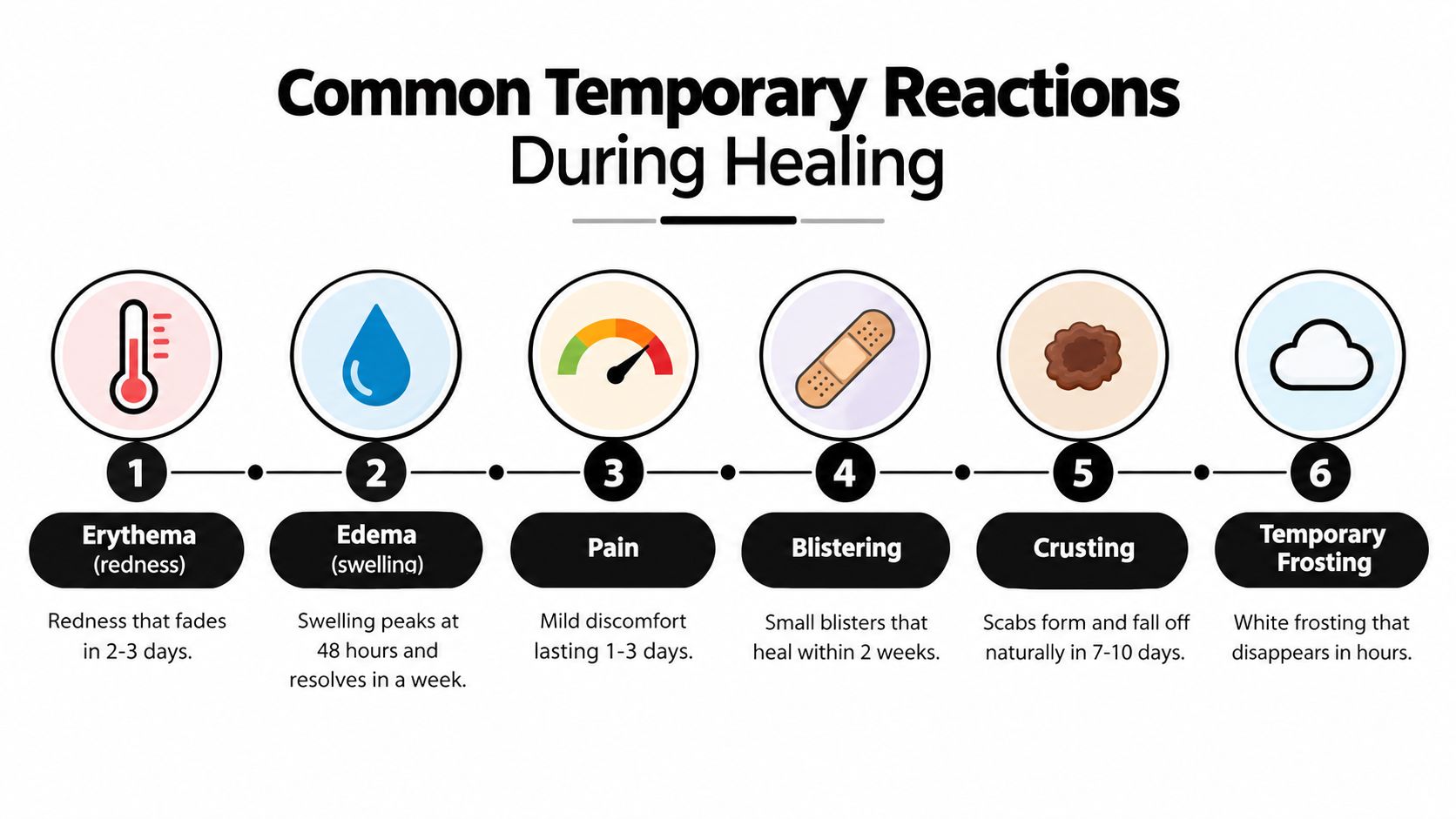
The first hours can look dramatic. The tattoo may become lighter or cloudy, the skin can feel hot or tender, and swelling may develop around the treated area. These changes usually represent the skin's immediate inflammatory response and should gradually settle rather than intensify without limit.
What usually happens first
Erythema, or redness, is common immediately after treatment. Edema, or swelling, can make the tattoo feel tight, especially where skin is thin or movement creates friction. Pain and tenderness may last beyond the appointment, but the intensity varies with tattoo location, density, depth, and individual sensitivity.
A large practitioner-reported dataset recorded edema in 3.0% of treatment sessions and blistering in 1.9%, while a broader clinical review identified blistering, edema, crusting, erythema, and pain as common immediate effects (modern complication data for laser tattoo removal). These figures describe recorded complications or reactions in particular datasets, so they shouldn't be treated as a personal prediction.
The visible timeline
Temporary frosting is the immediate white or gray appearance that can develop when gas forms in the skin during the laser pulse. It often looks alarming, but it typically fades within hours. Redness and swelling then become more noticeable as the initial frosting clears.
Small blisters and crusts can appear as the skin repairs itself. Don't puncture blisters or pull away crusts, because exposing or traumatizing the healing surface raises the chance of infection and scarring. A clinical summary notes that edema, erythema, and itching commonly appear within the first 24 hours and usually subside within 1 to 2 weeks (NCBI StatPearls review of tattoo removal).
Basic comfort measures include a clean cold pack wrapped in fabric, loose clothing, gentle cleansing, and the ointment or dressing recommended by your clinician. Avoid scrubbing, soaking, heat, and friction. If pain becomes progressively worse instead of easing, treat that change as clinically relevant rather than assuming the laser worked well.
Rarer Long-Term Complications and Their Likelihood
Long-term complications deserve precision, not reassurance without evidence. The clinical record shows that pigment changes and scarring can happen, but the available datasets don't suggest that every patient faces the same level of danger.
A large prospective study summarized in medical literature found adverse effects in 6.2% of patients, while a newer practitioner-reported dataset found complications in 8.1% of treatment sessions (prospective and practitioner-reported complication data). The reported event rate isn't identical to the rate of permanent damage, because it includes short-lived reactions such as swelling and blistering.
Incidence of side effects after laser tattoo removal
| Side Effect | Typical Incidence |
|---|---|
| Any adverse effect in a prospective patient study | 6.2% |
| Hyperpigmentation in the prospective study | 4.8% |
| Any reported complication per treatment session | 8.1% |
| Edema per treatment session | 3.0% |
| Blistering per treatment session | 1.9% |
| Hematoma per treatment session | 0.7% |
| Hypopigmentation or hyperpigmentation per treatment | About 0.6% each |
| Hypertrophic scarring per treatment | 0.2% |
| Paradoxical darkening per treatment | 0.2% |
The table shows why broad statements such as “laser removal is risk-free” are misleading. It also shows why treating every red mark as a permanent scar creates unnecessary fear. Scarring, keloid formation, allergic reactions, infection, and paradoxical darkening were each reported at about 0.1% in one modern practitioner dataset (modern laser tattoo-removal complication study).
What patients often underestimate
The most common lasting disappointment may be incomplete clearance, not dramatic tissue damage. A recent review reported an overall adverse-reaction incidence of 24% after Q-switched laser tattoo removal, and emphasized that outcomes vary with ink color, pigment depth, and body location (review of Q-switched laser tattoo removal reactions).
Use this prevention checklist before treatment:
- Ask for a risk assessment: Confirm how your skin tone, tanning history, tattoo location, pigment colors, and previous scars affect the plan.
- Discuss a test spot: A controlled test can help the practitioner assess your skin response before treating a larger area.
- Clarify the goal: Complete removal and fading for a cover-up may require different decisions about acceptable residual pigment.
- Review your history: Mention allergies, medications, active skin conditions, and any tendency toward raised scars.
- Get aftercare in writing: You should know what to apply, what to avoid, and whom to contact if the reaction changes.
Risk Factors That Increase Your Chances of Complications
Two people can receive treatment for similar-looking tattoos and still have different outcomes. The difference usually comes from the interaction of skin biology, pigment chemistry, laser settings, and treatment location, not from one isolated factor.
Skin tone and recent tanning
Pigmentary changes deserve extra attention in darker or recently tanned skin. Laser energy can affect melanin as well as tattoo pigment, increasing the chance of hypopigmentation or hyperpigmentation. The modern complication review specifically notes that pigmentary change is more likely in darker or tanned skin and with higher fluence (clinical complication and risk-factor review).
That doesn't mean darker skin can't be treated safely. It means the practitioner should account for baseline pigmentation, choose settings carefully, and avoid treating recently tanned skin as though it has the same response profile as untanned skin.
Ink color and paradoxical darkening
Red ink deserves a specific conversation. Some red pigments can contain compounds that react unpredictably to laser energy, and red tattoos have been associated with allergic reactions and paradoxical darkening. Titanium dioxide and iron oxide pigments can also produce paradoxical hyperpigmentation, especially in colors such as red, pink, white, or flesh tones.
This reaction is easy to miss during consultation if the practitioner only discusses standard redness and swelling. Ask whether the ink appears cosmetic, contains lightening pigments, or may include titanium dioxide or iron oxide. A test spot can be particularly valuable when pigment chemistry is uncertain.
Device, fluence, and body location
Laser selection should match the pigment rather than follow a one-device-fits-all approach. Q-switched Nd:YAG treatment is especially associated with hypopigmentation in some guidance, while excessive fluence can increase tissue stress and pigmentary risk.
Location matters, too. Recent clinical summaries identify the neck and shoulders as areas with higher scarring risk (review of tattoo-removal adverse reactions and treatment variables). Ask how the clinic adapts settings for those sites, rather than assuming that a successful result on an arm predicts the same result on the neck.
The right question isn't “Which laser is strongest?” It's “Which settings and wavelength are appropriate for this pigment and this skin?”
How to Minimize Side Effects and Support Safe Healing
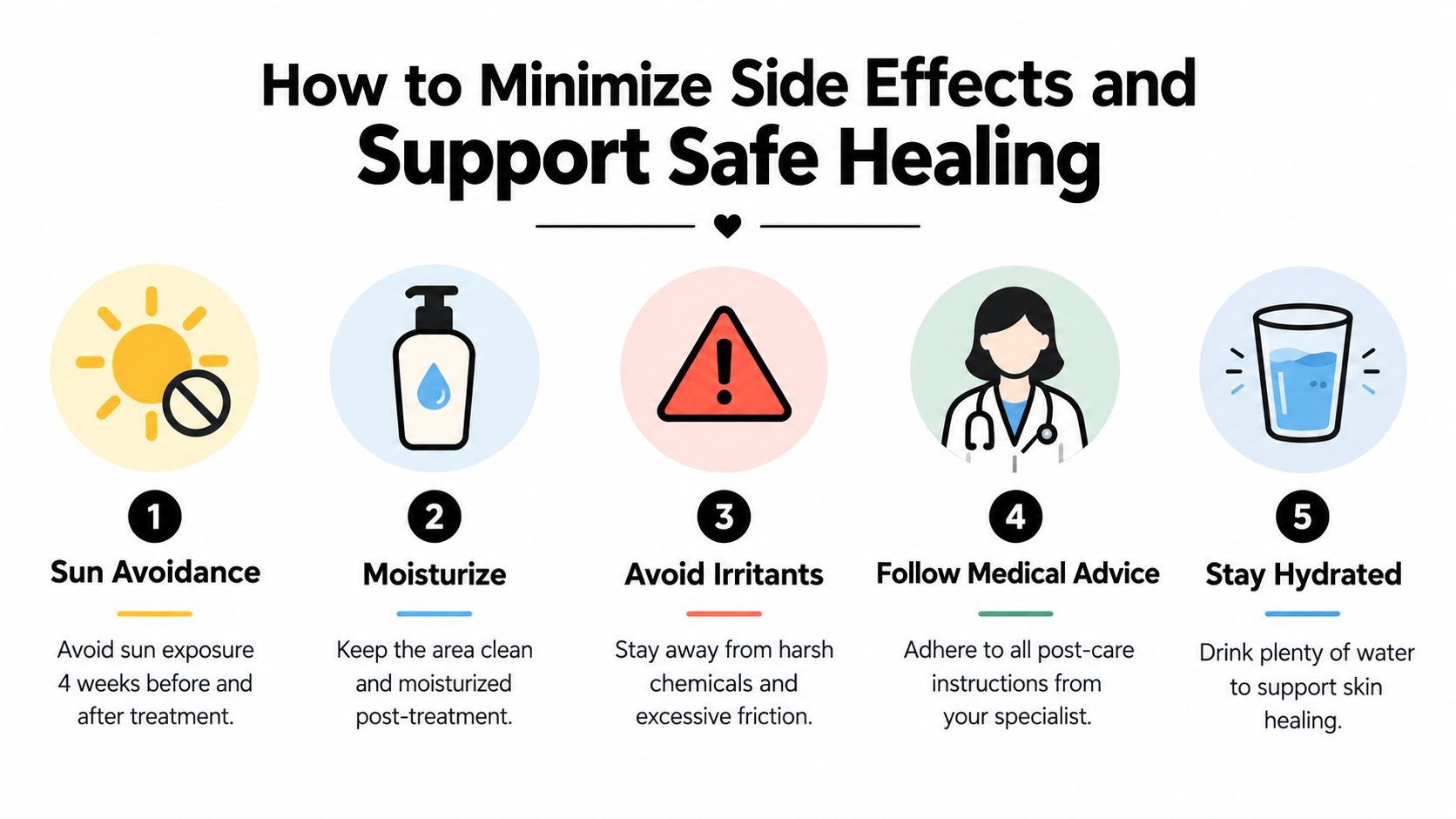
Good aftercare can't remove every risk, but it can prevent avoidable problems. The most damaging choices are usually simple ones, such as picking a scab, exposing fresh skin to strong sunlight, or hiding worsening pain because you don't want to bother the clinic.
Before the appointment
Arrive with the treatment area clean and free from irritants. Tell the practitioner about medications, allergies, active rashes, previous abnormal scars, and any recent tanning. Don't conceal a change in the skin just to keep an appointment.
After treatment, follow the clinic's written instructions rather than combining several internet routines. Gentle cleansing, a suitable dressing, and the recommended ointment can protect the area while the surface repairs. Loose clothing reduces rubbing, and avoiding harsh chemicals or excessive friction prevents additional irritation.
Compare expected reactions with complications
| Temporary reactions | Possible lasting or clinically concerning complications |
|---|---|
| Redness and mild warmth that gradually settle | Pigment change that persists or becomes more pronounced |
| Swelling and tenderness after treatment | Worsening swelling, spreading redness, or severe pain |
| Small blisters or crusts during repair | Infection, significant scarring, or a raised scar |
| Itching as the surface heals | Allergic symptoms or a reaction beyond the treated area |
| Short-term frosting after the laser pulse | Unexpected darkening of red, white, pink, or flesh-toned ink |
Keep blisters intact, let crusts detach naturally, and protect the area from sunlight. Sun exposure can make pigmentary changes more noticeable and can interfere with the appearance of healing skin. Don't resume treatment just because the surface looks better on the outside. The deeper inflammatory response and immune clearance process still need time.
A clinic such as EradiTatt Tattoo Removal can provide progressive treatment planning for complete removal or cover-up fading, with decisions customized to skin type, tattoo size, color complexity, and lifestyle goals. Its post-laser tattoo removal aftercare guidance reinforces the importance of protecting the treated area and following specialist instructions.
When to Contact Your Tattoo Removal Clinic Immediately
Normal healing should trend in the right direction. Redness, tenderness, swelling, crusting, and itching may be expected after treatment, but they shouldn't keep expanding or intensifying without explanation.
Contact the clinic promptly if you notice:
- Spreading redness: Redness that moves beyond the treated area can signal infection or a stronger inflammatory response.
- Pus or unusual drainage: Yellow or cloudy fluid, especially with increasing warmth, needs professional assessment.
- Worsening pain after day three: Pain that becomes stronger rather than gradually easing should not be dismissed.
- Fever or feeling unwell: Systemic symptoms require timely medical advice.
- Persistent or expanding pigment change: New darkening or lightening that becomes clearer days or weeks later should be documented and reviewed.
- Unexpected darkening of red ink: Paradoxical darkening can occur with certain pigments and may need a revised treatment plan.
Don't apply unapproved acids, bleaching agents, or aggressive exfoliants to correct a color change. They can injure the skin and make the original problem harder to assess. Take clear photographs in consistent lighting and send them to the clinic alongside the date of treatment and a description of how the reaction has changed.
The same principle applies when evaluating post-procedure symptoms in other aesthetic treatments. For broader context on recognizing reactions and recovery concerns, review what to expect after injectables, while remembering that injectable aftercare and laser tattoo removal follow different clinical protocols.
Experienced practitioners can usually address concerns more effectively when they hear about them early. Waiting until a blister, infection, or pigment shift has clearly worsened gives the skin less opportunity for a straightforward recovery.
If you're considering complete removal or fading for a cover-up, schedule a consultation with EradiTatt Tattoo Removal to review your tattoo color, skin tone, location, and likely side effects before treatment. Ask for a personalized plan and written aftercare instructions so you know what normal healing should look like and when to call the clinic.