
Active laser time is often under 5 minutes for a small tattoo and about 10 to 30 minutes for a larger piece, while the full appointment, including preparation and aftercare, typically lasts 10 to 45 minutes. The exact answer depends on the tattoo's size, colors, location, and the clinic's workflow.
You may be asking because you're trying to fit a first appointment around work, childcare, traffic, or a trip to a Florida clinic. A booking that sounds like a “laser session” can mean the few moments when the device is firing, or the entire visit from check-in through aftercare. Those are very different timeframes, and understanding the difference makes the appointment easier to plan.
A small, single-color tattoo may need only a short burst of active treatment. A dense, multicolor design can require more careful coverage, cooling, and skin checks. The provider may also spend time documenting the tattoo, assessing your skin, discussing comfort options, and explaining what to do afterward.
A realistic planning range
A typical session falls somewhere between 10 and 45 minutes, while smaller tattoos or single-color touchups often require 5 to 15 minutes of treatment. Preparation, numbing, and aftercare can add 10 to 20 minutes to the appointment, according to clinical timing guidance for laser tattoo removal.
That means a five-minute laser treatment doesn't necessarily mean you'll be in and out of the clinic in five minutes. It may describe only the active laser portion of a visit that also includes consultation and skin care.
Planning rule: Ask whether a quoted duration means laser-on-skin time or total time at the clinic.
Table of Contents
- A realistic planning range
- Introduction to Laser Session Timing
- What Counts as a Laser Session
- How Tattoo Size Color and Location Affect Time
- Inside Your Appointment From Prep to Aftercare
- Why Session Length Varies Between Clinics
- Real World Examples by Tattoo Type
- Making Your Laser Appointment More Efficient
Introduction to Laser Session Timing
Consider a busy professional with a small tattoo on the wrist. They've arranged a short gap between meetings and want to know whether they can return to work afterward. If someone tells them the laser treatment takes only a few minutes, that may be accurate, but it doesn't answer how long they'll spend in the clinic.
The provider still needs to confirm the treatment area, examine the skin, review the tattoo's history, and take any relevant photos. After treatment, the skin may be cleaned and covered, and the patient receives aftercare instructions. The appointment can therefore last much longer than the laser exposure itself.
Why the wording causes confusion
Clinics may use “session” to describe three related things:
- Laser-on-skin time: The period when pulses are delivered to the tattoo.
- Treatment time: The active procedure, including passes over the tattoo and brief cooling or assessment.
- Appointment time: The complete visit, including preparation, numbing when appropriate, treatment, documentation, and aftercare.
A clinic describing a short active treatment isn't necessarily giving a shorter or less thorough appointment. Another provider may include every part of the visit in the estimate, which produces a longer number for the same tattoo.
Size remains one of the clearest predictors. A small design may take under five minutes of lasering, while a large or multicolor tattoo may take fifteen to thirty minutes or more. Dense pigment also requires deliberate coverage, because the practitioner needs to treat the ink without creating unnecessary overlap that could increase heat in the upper skin.
Location affects the practical pace
Body location matters because some areas are easier to position and treat than others. A flat, accessible area may let the practitioner work steadily, while a curved, mobile, or sensitive area can require repositioning and extra attention.
For those wondering, the reassuring answer is that the laser portion is brief by design. The longer part of the experience usually comes from clinical preparation and responsible aftercare, not from continuous lasering.
What Counts as a Laser Session
Think of the laser like a camera flash. The flash itself happens in an instant, but taking a good photograph involves positioning the subject, checking the frame, pressing the shutter, and reviewing the result. Tattoo removal works in a similar way. The pulse is extremely brief, while the clinician controls the sequence around it.
Three layers of time
First comes the laser pulse. Tattoo-removal devices use Q-switched or picosecond-class technology that delivers high peak power in extremely short bursts. Published laser-tissue literature describes common Q-switched pulse durations of roughly 5 to 10 nanoseconds for Nd:YAG, 28 to 40 nanoseconds for ruby, and 50 to 100 nanoseconds for alexandrite in laser-tissue literature on tattoo removal.
Next comes the pass. The practitioner moves the handpiece across a defined portion of the tattoo, watching the skin's response and maintaining an appropriate treatment pattern. The immediate whitening response after a pass can last about 20 minutes, and the R20 approach was designed around repeating up to four passes in one session, with 20-minute intervals between passes, as described in this clinical review of laser tattoo removal.
Finally, there's the visit. This includes preparation, skin evaluation, possible numbing, laser treatment, cleaning, documentation, and aftercare. A small tattoo can therefore have only moments of laser exposure while still requiring a meaningful appointment.
Why the device doesn't simply keep firing
Each pass fragments only part of the ink. The body then relies on macrophage activity and lymphatic clearance to transport and remove the fragmented particles. That biological process is why clinics usually space treatments about 6 to 8 weeks apart, rather than repeatedly treating the same tattoo on consecutive days.
The minutes spent under the handpiece matter, but the waiting period between visits matters more for the overall treatment plan.
When you ask a provider how long a laser session takes, ask two follow-up questions: “How much of that time is active laser treatment?” and “How long should I plan to be in the clinic?” Those answers will give you a much more useful schedule.
How Tattoo Size Color and Location Affect Time
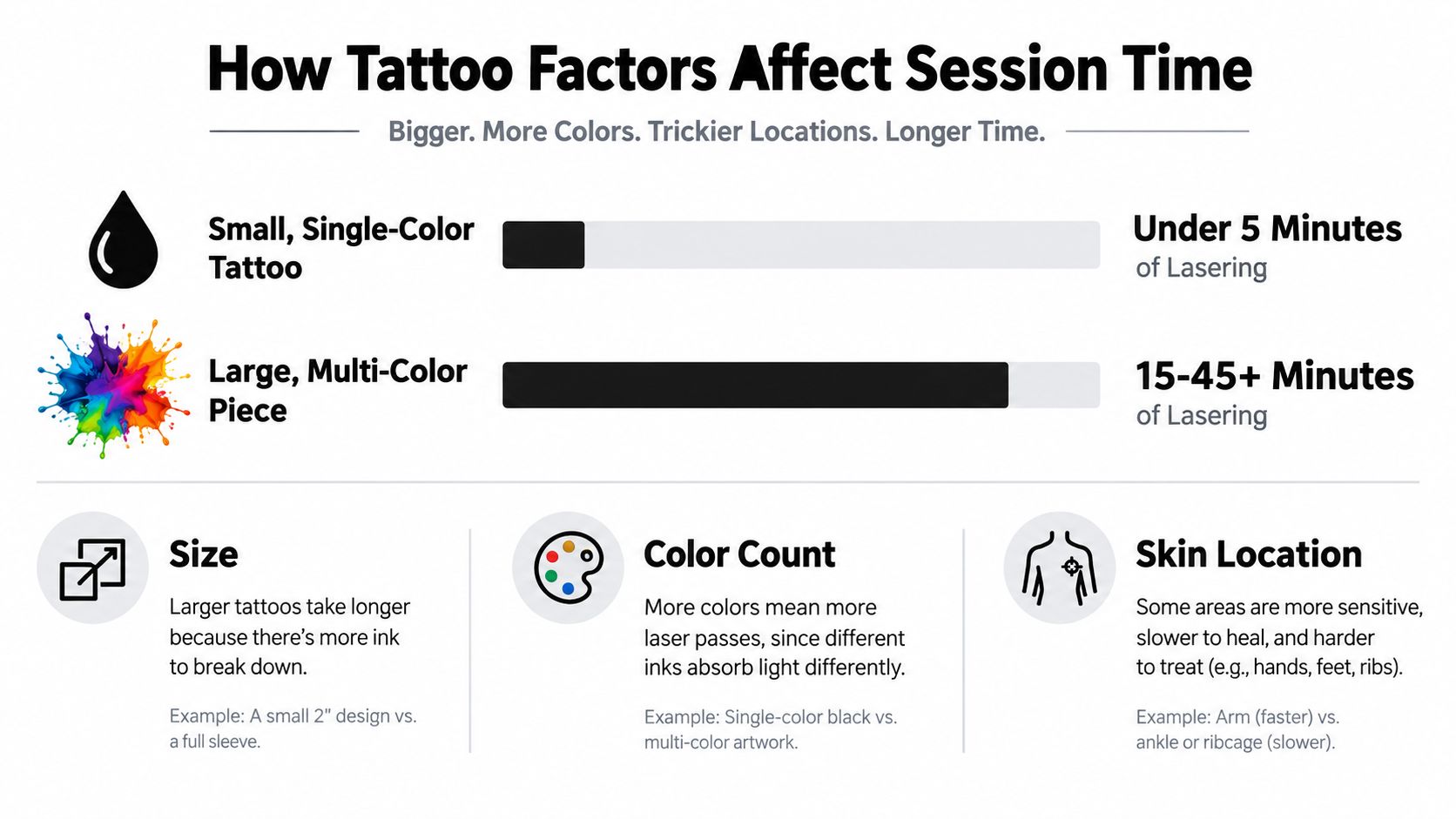
Tattoo characteristics determine how much surface area the practitioner must cover and how carefully the laser must be used. A tiny black symbol and a large shaded sleeve aren't different versions of the same task. They present different coverage, pigment, and positioning challenges.
Size creates the first timing bracket
A small tattoo may need under 5 minutes of lasering, while a large or multicolor piece can take 15 to 30 minutes or more. Independent guidance also places large or complex treatments toward the broader 30 to 45 minute range, depending on the area and workflow, as outlined in this tattoo removal timing guide.
The practitioner needs enough passes to cover the ink consistently. They also need to avoid excessive overlap, because repeatedly heating the same epidermal area can increase discomfort and skin stress.
Color changes the work
A simple black outline is usually easier to map than a design containing several shades. Multiple colors may require different settings or a more deliberate sequence, and dense areas of pigment can take longer than a lightly inked outline of similar dimensions.
Color doesn't operate independently from size. A small, heavily saturated design may take longer than a larger but faint outline, while a broad multicolor piece generally requires more careful treatment than a single-shade tattoo.
Location changes positioning
The wrist, forearm, back, and other sites don't all offer the same working surface. Curved areas, high-movement regions, and sensitive locations can require repositioning, slower handpiece movement, or additional checks. Skin tone and the tattoo's placement also influence the provider's treatment decisions and long-term progress, as discussed in this guide to factors affecting tattoo removal progress.
To estimate your own visit, start with tattoo area, then consider pigment density and color count. Add extra planning time if the location is difficult to position or especially sensitive. A consultation gives the provider the information needed to replace a broad range with a more personal estimate.
Inside Your Appointment From Prep to Aftercare
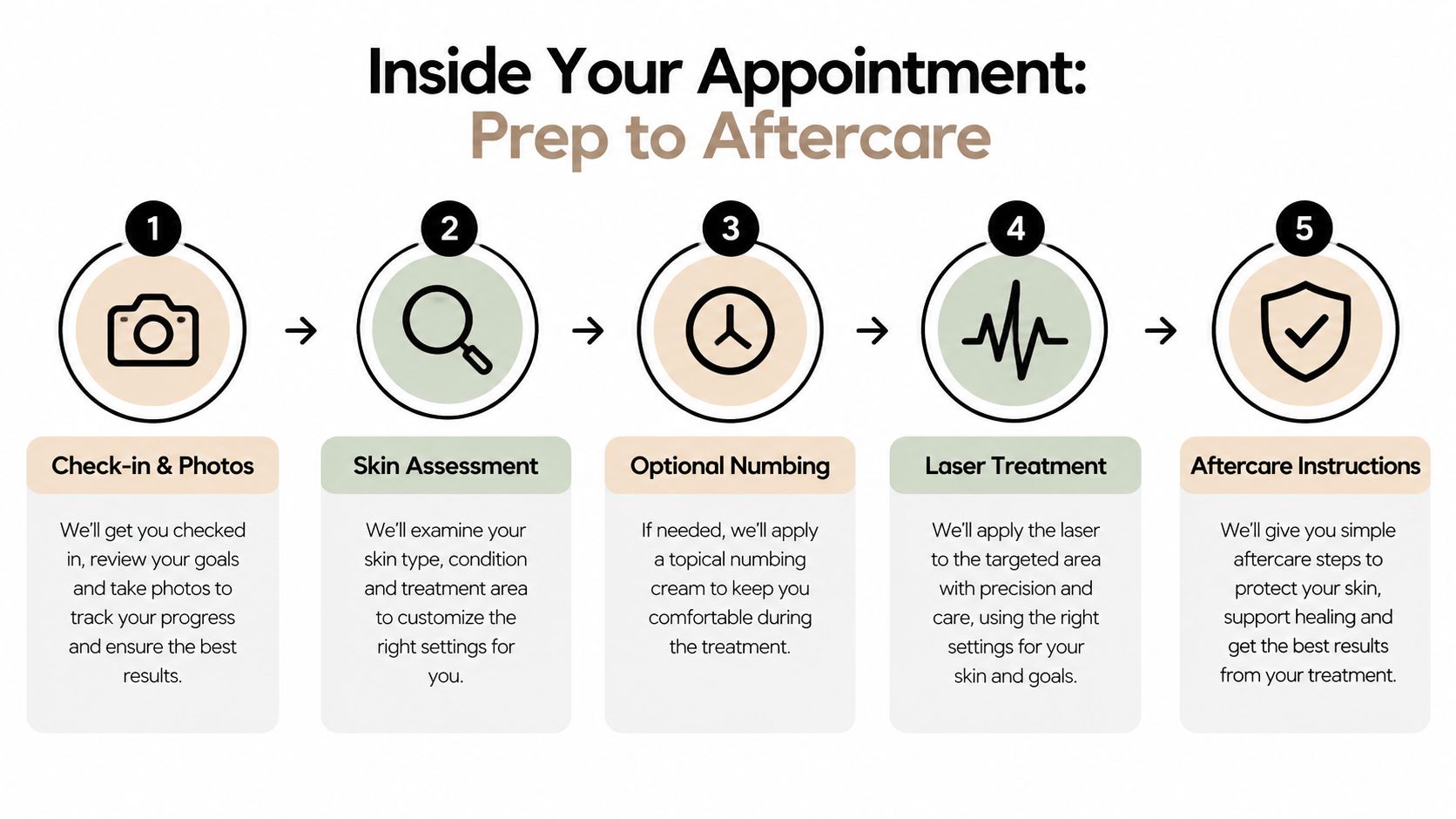
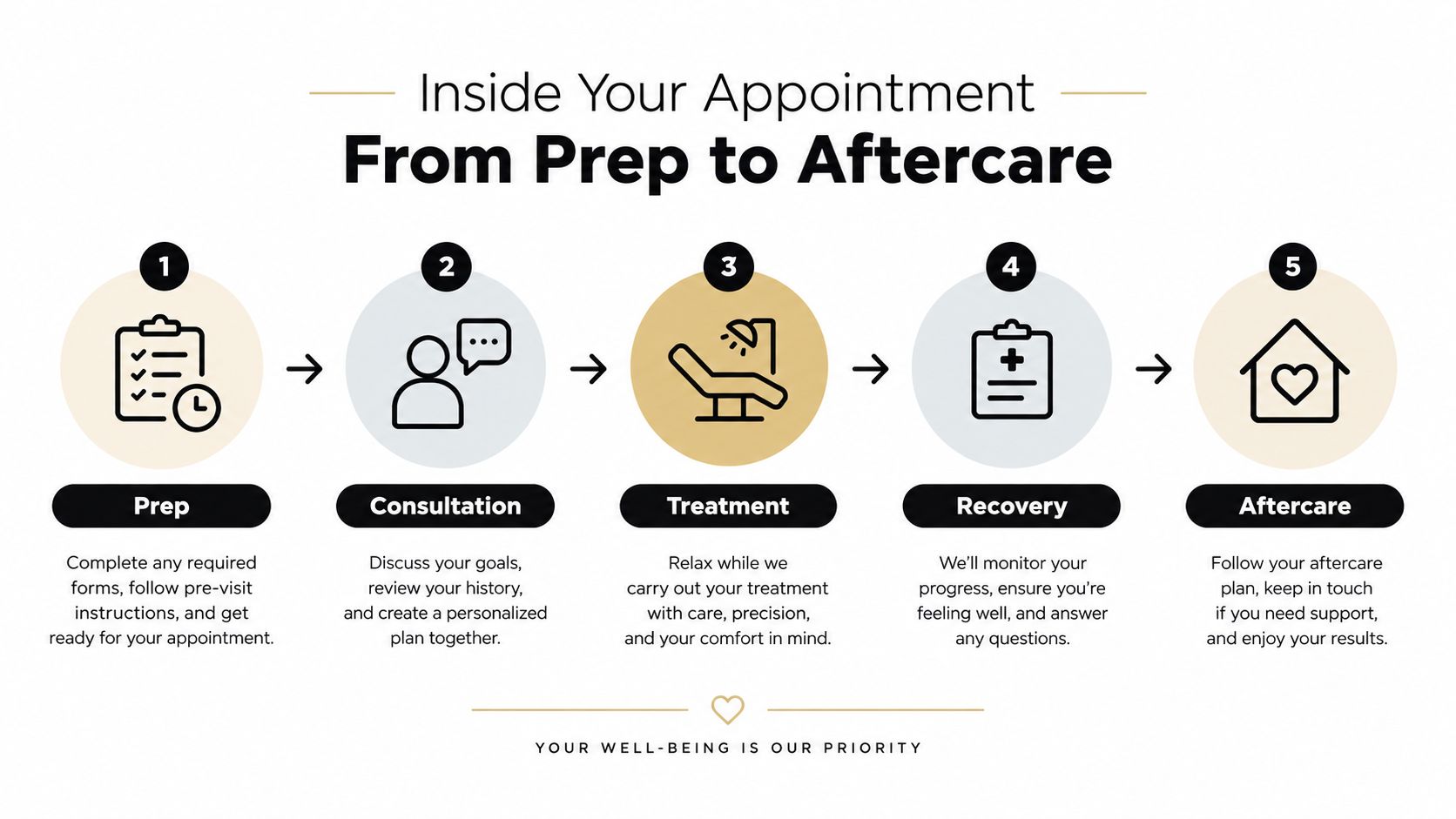
A tattoo-removal appointment usually follows a predictable sequence. Knowing the order helps first-time patients understand why the total visit lasts longer than the laser firing.
The appointment sequence
- Check-in and photos: The clinic confirms your information and may photograph the tattoo so future progress can be compared consistently.
- Skin assessment: The provider examines the tattoo and surrounding skin, checks for factors that could affect treatment, and confirms the area to be treated.
- Optional numbing: Some patients discuss a topical comfort option. If numbing is used, the appointment may include additional waiting time before the laser begins.
- Laser treatment: The practitioner treats the tattoo in controlled passes. Cooling or brief pauses may be used to keep the process comfortable and to observe the skin.
- Aftercare instructions: The area is cleaned, protected when appropriate, and reviewed with you before you leave.
Where the extra minutes go
Preparation and aftercare commonly add 10 to 20 minutes to the appointment, according to guidance on laser tattoo removal timing factors. That added time isn't wasted. It gives the provider room to assess the skin, document the treatment, answer questions, and explain how to care for the area afterward.
Numbing is optional and depends on the tattoo, the treatment area, your comfort preferences, and the provider's approach. It can make the appointment feel more manageable, but it may also extend the time before treatment begins.
For a small tattoo, active laser work might finish quickly. The appointment still needs a proper beginning and end, just as a short dental procedure includes check-in and discharge instructions rather than only the procedure itself.
Before booking, ask whether you should arrive early, whether numbing is recommended, and whether the clinic includes photos and aftercare in its time estimate. You can also review how to prepare for tattoo removal so the visit starts smoothly.
Why Session Length Varies Between Clinics
Two clinics can quote different durations for the same tattoo without either one being misleading. One may quote only active laser time, while the other may reserve a longer appointment slot that includes consultation, preparation, numbing, photographs, cooling, and aftercare.
Compare the definition before the number
A five-minute estimate might describe a small tattoo's laser exposure. A forty-five-minute estimate might describe the complete appointment for a larger or more complex design. The first number is useful for understanding how long the device may be on the skin, while the second is more useful for scheduling travel and work.
Clinic workflow also affects the estimate. Providers differ in how they document treatment, apply topical numbing, organize treatment passes, and explain aftercare. Some may build buffer time into the appointment so patients aren't rushed if the skin needs closer observation.

The technology is fast, but the biology sets the pace
Q-switched and picosecond-class devices use pulses measured on the nanosecond scale. Through selective photothermolysis and photoacoustic fragmentation, the device targets pigment while limiting unnecessary thermal spread into nearby tissue. That doesn't mean the practitioner should rush. The clinician still needs to choose settings, maintain coverage, and monitor the skin's response.
Ink clearance continues after you leave. Because the body must transport fragmented pigment, clinics generally schedule visits about 6 to 8 weeks apart, with some providers using 8 to 12 weeks for darker skin or delicate areas, according to this overview of tattoo-removal session spacing.
When comparing providers, ask:
- What does the quoted time include?
- Will numbing or cooling be part of the appointment?
- How do you document progress?
- What interval do you recommend between treatments?
For clinics and medical practices, operational resources such as this spa scheduling software features checklist can also clarify why appointment slots may include more time than the active procedure.
Real World Examples by Tattoo Type
Examples make the distinction between laser time and appointment time easier to apply. The ranges below are planning illustrations based on the documented timing ranges for small tattoos, larger pieces, preparation, and aftercare. Your provider may adjust them after examining the tattoo in person.
| Tattoo Example | Active Laser Time | Total Appointment Time | Why Time Varies |
|---|---|---|---|
| Small black wrist tattoo | Under 5 minutes | About 10 to 25 minutes | Small area, one color, but wrist positioning and setup still take time |
| Medium single-color forearm piece | About 5 to 15 minutes | About 15 to 35 minutes | Moderate coverage with relatively simple pigment |
| Large colorful back tattoo | About 15 to 30 minutes or more | About 30 to 45 minutes or more | Broad surface, multiple colors, dense pigment, and positioning |
| Fading session for a cover-up | A few minutes to about 15 minutes | About 10 to 30 minutes | The provider may target selected sections rather than the entire design |
A small black wrist tattoo often represents the shortest practical visit. The laser work may be over quickly, but the provider still needs to assess the skin and complete aftercare. If the tattoo sits over a curved or frequently moving area, positioning can add some time.
A medium forearm tattoo with one color usually falls into a middle range. The practitioner must cover more surface area than a tiny wrist design, but the color pattern may be easier to manage than a shaded multicolor piece.
A large back tattoo can require the broadest appointment window. Size, saturation, multiple colors, and the need to keep the patient positioned comfortably all contribute to a longer visit.
Cover-up fading can be different. The practitioner may treat only the portions that must be lightened for the new design, so active laser time can be shorter than complete removal of the entire tattoo. That doesn't eliminate the need for repeat appointments, because treatment results depend on progressive ink clearance rather than one extended visit.
Making Your Laser Appointment More Efficient
You can't safely compress the biological work into one rushed visit, but you can reduce avoidable delays. Efficiency starts before you arrive and continues through aftercare.
Prepare the appointment properly
Arrive with the treatment area ready according to the provider's instructions. Avoid adding unapproved products or changing the skin immediately before treatment, and tell the clinician about anything that could affect the area. Clear information helps the provider make decisions without interrupting the appointment to resolve missing details.
Wear clothing that gives the practitioner easy access to the tattoo and won't rub the treated skin afterward. If you're traveling to a Florida clinic, allow time for parking, check-in, and the possibility that the visit includes more than active laser exposure.
Discuss comfort before the day
Ask whether numbing is appropriate and whether you need to apply anything before arriving. If a topical option is recommended, follow the clinic's instructions rather than applying a product independently. Planning this step prevents confusion and helps the provider begin treatment at the intended time.
After treatment, follow the clinic's care instructions closely. Avoiding unnecessary irritation supports a smoother recovery and reduces the chance that you'll need extra contact with the clinic for preventable questions.
Protect the long-term schedule
The most important timing decision isn't shaving a few minutes off one appointment. It's allowing the body enough time to clear fragmented ink between treatments. A standard treatment plan may require 4 to 15 sessions, depending on factors such as tattoo age, color, and placement, according to the clinical review of tattoo-removal protocols.
Academic and clinical sources describe amateur tattoos commonly requiring 5 to 10 sessions, professional tattoos often requiring 15 to 20 sessions, and rare cases reaching 25 sessions. One prospective study reported a predicted average near 9.7 sessions, while outcomes in a specific protocol ranged from 1 to 4 sessions, showing how widely treatment requirements can vary by tattoo and protocol, as detailed in this review of tattoo-removal outcomes.
For broader context, another academic review of laser tattoo removal describes a standard course as often 8 to 12 sessions, with amateur tattoos commonly needing 5 to 10, professional tattoos 15 to 20, and rare cases up to 25. These figures describe the overall journey, not the length of one visit.
A clinic's administrative support can also affect how smoothly appointments are arranged. Practices exploring staffing options may find a Medical virtual assistant useful for scheduling and patient communication, while patients should focus on clear arrival instructions and realistic spacing.
For practical treatment planning, review how to make laser tattoo removal more effective and bring specific questions to your consultation. Ask for both active laser time and total appointment time, then plan around the longer figure.
EradiTatt Tattoo Removal offers consultations and personalized laser tattoo removal plans for complete removal or cover-up fading across convenient Florida locations. Visit EradiTatt Tattoo Removal to discuss your tattoo's size, colors, location, expected session length, and the schedule that fits your goals.