
You're watching a laser tattoo removal video late at night, replaying the moment the inked skin turns white under the laser. The frosting looks dramatic, the treatment seems quick, and the before-and-after reveal may suggest that unwanted ink can disappear after a single visit. If you're dealing with tattoo regret, planning a cover-up, or wondering whether removal will hurt, that short clip can feel like both an answer and a source of new questions.
A video can show the pulse, the sound, and the immediate skin response. It usually can't show the assessment before treatment, the healing process afterward, the time between sessions, or the patient's individual skin and tattoo characteristics. Use the guide below to separate useful clinical information from edited marketing, then turn what you see on screen into realistic questions for a consultation.
Table of Contents
- Why Laser Tattoo Removal Videos Capture Attention
- What Procedure Steps Actually Show on Camera
- Pain Levels and Recovery That Cameras Often Miss
- Fading Across Sessions and Realistic Timelines
- How to Judge the Credibility of a Removal Video
- Turning Video Curiosity Into a Personalized Consultation
Why Laser Tattoo Removal Videos Capture Attention
The most compelling clips focus on a visible transformation. A technician places protective eyewear on the patient, presses the handpiece against the tattoo, and delivers a rapid series of pulses. The skin may develop a pale, frosted appearance almost immediately. A later clip shows the same tattoo looking lighter, and the contrast creates a powerful impression of speed.
That reaction is understandable. Someone watching may be carrying regret from an impulsive design, anxiety about a visible tattoo at work, or excitement about preparing the area for a cover-up. The video offers a controlled glimpse of something that can feel emotionally difficult. It also makes a complex medical process look simple because the camera usually captures only the most visually striking moments.
The story behind the flash
Laser tattoo removal isn't a new trend built around social media. The first laser was built in 1960, and the first reported laser tattoo-removal use followed in 1965 with a ruby laser. Broader adoption accelerated after selective photothermolysis was described in 1983, helping modern Q-switched approaches target ink more selectively while limiting unnecessary injury to surrounding skin. These milestones are documented in the NCBI clinical overview of tattoo removal.
Demand has also expanded as tattoo ownership has become more common. A 2016 Harris Poll found that 30% of U.S. adults had at least one tattoo, compared with 20% in 2012, while a 2023 Pew survey reported 32% overall and 22% with more than one tattoo. The same clinical reference reports that 24% of people with tattoos regret getting one, 11% have had or plan to undergo removal, and more than 52,000 tattoo-removal procedures were performed in the United States in 2018. Those figures help explain why removal videos attract such a broad audience, from people seeking complete clearance to people wanting enough fading for a new design.
Practical rule: Treat a video as a visual sample of one treatment moment, not as a promise about your own result.
A credible viewer asks what happened before the camera started and what happened after it stopped. Was the tattoo assessed for color, depth, density, and skin type? Was the footage recorded across several appointments or cut together from unrelated moments? Did the creator show healing, or only the frosting response that makes the procedure look dramatic?
The purpose of watching isn't to avoid videos altogether. It's to learn how to read them. Once you understand what the laser is doing, what recovery may involve, and why session plans differ, the footage becomes useful research instead of a substitute for clinical advice.
What Procedure Steps Actually Show on Camera
Most laser tattoo removal videos follow a recognizable sequence. The order matters, but the details matter more. A polished clip may make every treatment look identical, while a careful provider changes the plan according to the tattoo and the person's skin.
1. Cleansing and preparation
The provider first cleans the treatment area and checks that the skin is intact. This removes surface products and gives the technician a clear view of the ink. Credible footage may also show photographs, consent discussion, and a review of recent sun exposure, because recently tanned or sunburned skin can change treatment timing and pigment risk. Independent laser tattoo-removal treatment guidance advises avoiding sun exposure, tanning beds, and self-tanner for at least 4 weeks before treatment, and notes that a session may be postponed after sunburn or intense recent exposure.
2. Skin and tattoo assessment
A professional assessment should consider Fitzpatrick skin type, tattoo color, ink density, location, age, and whether the goal is complete removal or fading for a cover-up. These factors affect wavelength selection and energy settings. A patch test may be appropriate, especially when the provider needs to evaluate how the skin responds before treating a larger area.
3. Protective eyewear and positioning
The patient and treatment provider use appropriate eye protection. The handpiece is positioned over the tattoo, often with a deliberate pattern that helps the operator cover the area evenly rather than repeatedly treating one visible section. A video that shows the operator working methodically gives more useful information than a close-up that hides the treatment field.
4. Pulse delivery and frosting
The laser delivers short pulses of energy that target tattoo pigment. The immediate whitening, often called frosting, reflects a rapid interaction between the laser energy and the target pigment. It's a visible treatment response, not proof that the ink has vanished. The ink fragments still need to be cleared gradually by the body, and the final result can't be judged from the first few seconds after treatment.
5. Cooling and aftercare
Some videos show cooling during or after treatment, while others cut directly from the last pulse to a clean dressing. Numbing cream, forced-air cooling, and other comfort measures may be used differently from one clinic or patient to another. Immediate aftercare can include wound-care instructions, a dressing, and guidance about swelling, sun exposure, and activities that could irritate the area.
Reading the equipment label
Q-switched systems commonly use nanosecond pulses, while picosecond systems use shorter pulse durations. Picosecond and Q-switched Nd:YAG systems operate in the 1064/532 nm range. In a comparative study, picosecond 1064 nm treatment produced excellent clearance in 78.1% of cases compared with 54.4% for Q-switched 1064 nm, with median sessions of 3 versus 4 in that study of dark ink. The findings are reported in this comparative clinical study of picosecond and Q-switched laser treatment.
The operator's behavior matters as much as the product label. Watch for adjustments in settings, attention to skin response, and a clear explanation of what the patient should expect. A one-size-fits-all approach is harder to trust than a video showing individualized decisions.
Pain Levels and Recovery That Cameras Often Miss
A laser tattoo removal video can capture the sound of each pulse, but it can't transmit the full sensation. Patients often describe treatment as a quick snapping or elastic-band feeling, with discomfort influenced by the tattoo's density, location, size, wavelength, and the person's sensitivity. The footage may also omit cooling pauses, numbing preparation, or breaks because those moments don't create dramatic content.
Picosecond and older nanosecond systems can feel different, but the device name alone doesn't determine the experience. A 2026 systematic review found that both nanosecond and picosecond Nd:YAG lasers remain effective for dark ink, while picosecond systems generally reported lower pain scores and could reduce treatment burden. The review is linked in the research source supplied for laser tattoo-removal video context.
What the skin response means
Frosting is an immediate optical response. Redness, swelling, pinpoint bleeding, blistering, tenderness, and crusting can vary according to ink density, treatment settings, wavelength, and skin characteristics. A short-form video often selects the cleanest-looking frame, applies color correction, or ends before the skin's recovery becomes visible.
Skin tone also deserves careful attention. Darker skin can be treated, but the provider must balance pigment targeting with the risk of unwanted pigment changes. Hypopigmentation or hyperpigmentation may become apparent after the video ends, and a quick clip can't tell you how a particular skin type will respond. A FDA 510(k) summary for a 1064 nm laser system identifies 1064 nm use for dark ink tattoo removal, specifically black ink, and reports submitted safety and effectiveness data without new safety or efficacy questions.
| Aspect | Typical Video Portrayal | Clinical Reality |
|---|---|---|
| Pain | A few quick snaps with little reaction | Sensation varies by location, ink density, settings, and comfort measures |
| Frosting | The tattoo appears to turn white instantly | Frosting is an immediate response, not completed clearance |
| Swelling | Often cropped out or shown briefly | Swelling and tenderness may require practical aftercare |
| Blistering or bleeding | Rarely included in promotional edits | Some patients experience stronger skin responses than the clip suggests |
| Work and daily activities | “Walk out and go straight back to work” | Some people resume normal activities quickly, while others need time for tenderness and wound care |
| Skin tone | Frequently represented by lighter skin | Fitzpatrick type affects setting choices and pigment-change risk |
Aftercare instructions commonly emphasize protecting the treated area, monitoring the skin, and avoiding sun exposure. The FDA-cleared laser summary listing treatment across Fitzpatrick I through VI specifically identifies 1064 nm use across those skin types and lists black, brown, green, blue, and purple among treatable colors. That clearance doesn't mean every tattoo responds identically, and it doesn't replace an in-person assessment.
For a practical look at comfort questions to raise before booking, review ways to manage pain during laser tattoo removal. The useful takeaway is simple: a video can show the pulse, but your provider must explain the recovery plan.
Fading Across Sessions and Realistic Timelines
The biggest distortion in many removal videos comes from time compression. A creator may show the first treatment, then jump to a later image without making the interval or session count prominent. The tattoo appears to disappear in seconds, even though the biological clearance process has been unfolding between appointments.
Ink removal is progressive. After treatment, fragmented pigment is gradually cleared by the body, so the visible change may continue after the appointment. A tattoo may lighten unevenly, leaving darker pockets, resistant colors, or outlines that become more noticeable as surrounding areas fade.
What the data actually supports
Clinical results show why “gone in one session” should trigger caution. In a large cohort of Q-switched laser treatment, cumulative successful removal reached 47.2% after 10 sessions and 74.8% after 15 sessions. Another dataset reported an average of 3.77 sessions per patient, with a range from 1 to 16 sessions and an average interval of 49.23 days. More recent modeling reported an average of 6 sessions, with a range from 2 to 20 sessions. These figures come from the compiled tattoo-removal clinical statistics reference.
Those ranges aren't contradictory. They show that treatment plans are individualized. A small, older, dark tattoo may behave differently from a dense multicolor design. Complete removal and cover-up fading are also different goals, so the number of visits needed depends on what “finished” means for the patient.
Ink color is a major variable. Reviews generally identify 1064 nm for black, 532 nm for red and orange, and 755 or 694 nm systems for green. Picosecond lasers may perform better for blue, green, and yellow pigments, while both picosecond and Q-switched lasers can perform well on black ink. The systematic review of picosecond versus Q-switched tattoo removal explains why multicolor tattoos tend to be less predictable.
A more honest viewing framework
| Session Number | Approximate Ink Reduction | Elapsed Time | What You'll Notice |
|---|---|---|---|
| Early treatment | Variable, depending on pigment and response | The first interval after treatment | Immediate frosting is visible, but final fading hasn't occurred |
| Middle treatment | Gradual and uneven | Several treatment intervals | Some sections lighten faster, while dense or resistant pigment remains |
| Later treatment | Increasingly dependent on residual ink | Many months may pass | Remaining color pockets and fine lines can become the main focus |
| Final planning stage | Determined by the treatment goal | Personalized to healing and clearance | The provider evaluates whether to continue, stop, or shift toward cover-up preparation |
The table avoids pretending that every patient follows the same reduction curve. A credible time-lapse labels the session number, date or interval, laser type, and treatment goal. It may show session one with frosting, a later appointment with patchy fading, and a subsequent stage where only resistant areas remain.
For questions about the factors that influence duration, use this guide to how long tattoo removal takes. The video should support that conversation, not replace it.
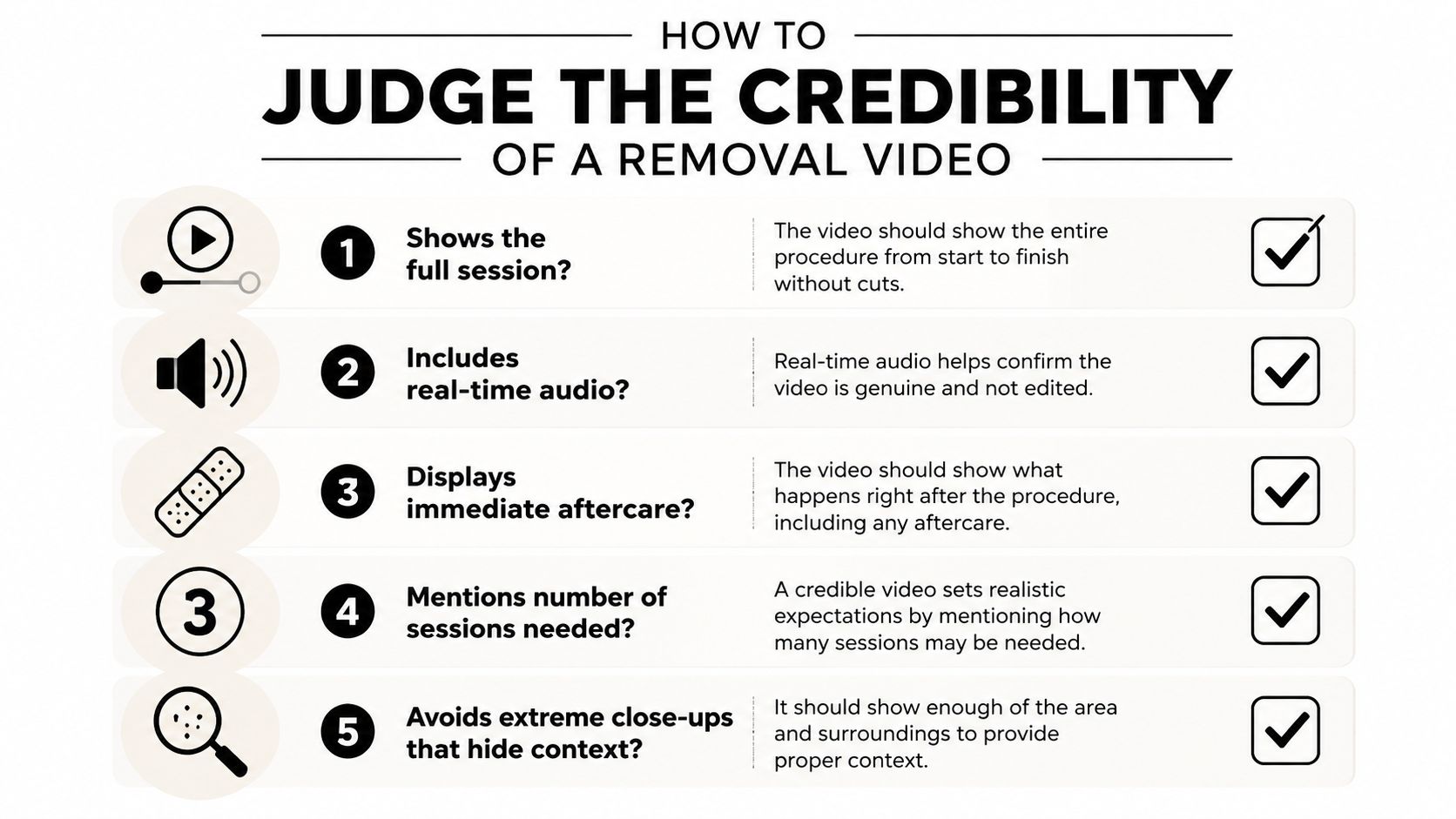
How to Judge the Credibility of a Removal Video
Not every educational-looking clip is educational. Some videos are edited to maximize visual impact, minimize discomfort, and make the service appear more predictable than it is. The absence of information can be more revealing than the presence of a laser flash.
Look for the missing context
A trustworthy video identifies the laser model and wavelength or explains why those details aren't shown. It also gives the tattoo's treatment goal, such as complete removal or fading for a cover-up, and makes the session count clear. Without that context, a before-and-after sequence may compare different lighting, angles, or stages of healing.
Pay attention to representation. If every subject has very light skin, the video doesn't help you understand how treatment planning may differ for Fitzpatrick III, IV, V, or VI skin. A clinical study of a 1064/532 nm picosecond laser found effective decorative tattoo removal with minimal risk of long-term adverse events in Fitzpatrick III or IV skin types, while early adverse events were common but generally didn't persist. The relevant FDA clinical summary provides the documented context.
A practical credibility checklist
- Treatment details: The creator identifies the laser technology, wavelength, and whether the system uses picosecond or nanosecond pulses.
- Patient context: The footage explains skin type, tattoo colors, ink density, location, and the intended outcome.
- Complete sequence: The video shows preparation, protective eyewear, treatment, cooling, and immediate aftercare instead of only the most dramatic pulses.
- Session labeling: Each result is tied to a session number and interval, so viewers can distinguish a true progression from a montage.
- Unfiltered reactions: Redness, swelling, crusting, and other expected responses aren't automatically removed through editing.
- Safety discussion: The provider addresses pigment changes, scarring risk, wound care, and sun avoidance without promising certainty.
- Qualified operator: Credentials, training, and the clinic setting are clear enough for viewers to evaluate.
- Consent and privacy: The patient's permission and identity protections are handled transparently.
- Consistent photography: Lighting, camera distance, skin position, and angles remain comparable across updates.
- No absolute promise: The creator avoids implying that every tattoo will be removed in one visit or that every skin type will respond the same way.
A video that checks several of these boxes still can't predict your result. It can, however, help you form better questions. You can also compare promotional claims with removal reviews and patient-focused information rather than relying on a single edited reel.
A polished clip shows what the clinic wants you to notice. Transparent documentation shows what you need to know.
Be cautious when the operator never adjusts settings, the video omits post-treatment skin, or the final image appears without a session count. “Gone in one session” is especially weak as a standalone claim because clinical outcomes vary across tattoo color, depth, skin type, and treatment objective.
Turning Video Curiosity Into a Personalized Consultation
Saved videos can make a consultation more productive when you use them as discussion tools. Bring the clips that raised questions about pain, frosting, healing, color response, or the number of appointments. A technician can explain which parts are relevant to your tattoo and which depend on details the camera can't capture.
At a consultation, the provider should assess ink density, pigment colors, depth, tattoo size, location, and skin type. Those factors guide wavelength selection, energy settings, comfort measures, and the spacing of future appointments. The FDA summary describing 1064 nm treatment for dark ink illustrates why wavelength matters, while the clinical evidence above shows why picosecond and Q-switched systems may behave differently across colors.
A thoughtful appointment may include skin analysis, discussion of a test spot, a personalized session roadmap, and clear pricing. The plan should also distinguish between complete removal and fading for a cover-up, because those goals don't require the same endpoint.
EradiTatt Tattoo Removal offers laser tattoo removal using the PiQo4 picosecond system, with Zimmer Cryo 6 cooling used alongside treatment for comfort. Its technicians can evaluate the tattoo in person and discuss a progressive plan rather than copying the timeline from a viral clip. Bring your saved videos and ask the provider to explain the differences frame by frame.
EradiTatt Tattoo Removal offers personalized laser tattoo removal for complete clearance or cover-up fading, with treatment plans shaped around tattoo characteristics, skin type, and practical goals. Visit EradiTatt Tattoo Removal to explore consultation options and turn online video research into a realistic treatment plan.