
You're probably doing what is commonly done at the start. You open Google, type in tattoo removal near you, and suddenly you're staring at a wall of star ratings, glowing testimonials, horror stories, before-and-after photos, and promises that all sound polished.
That's a hard way to choose someone who'll be firing laser energy into your skin.
Reviews matter, but they only help if you know how to read them. A tattoo removal clinic can look impressive online and still be vague in consultation, careless with aftercare, or unrealistic about results. On the other hand, a clinic with a few mixed reviews may still be the safer, more honest choice if the details show consistent care, clean technique, and good communication.
The smartest approach is to treat removal reviews like evidence, not reassurance. You're not looking for perfect praise. You're looking for patterns, specifics, and proof that the provider knows how to manage your tattoo, your skin, and the long process ahead.
Table of Contents
- Starting Your Search for a Tattoo Removal Provider
- Where to Find Trustworthy Removal Reviews
- How to Decode What Reviews Are Actually Saying
- Verifying a Clinic's Expertise Beyond Reviews
- Your Consultation Checklist of Questions to Ask
- Choosing a Clinic in Florida and Making Your Final Decision
Starting Your Search for a Tattoo Removal Provider
A common starting point involves ratings. That's normal. It's also where mistakes start.
A tattoo removal decision isn't like picking a coffee shop or even a haircut. Laser tattoo removal typically requires 6 to 10 treatments to fully remove a tattoo, though the total number can range from 4 to 15 sessions depending on the tattoo's age, color, quality, and placement mechanism, according to the FDA's tattoo removal overview. That means you're not choosing a one-time service. You're choosing a provider you may see repeatedly over months.
Start with a short list, not a favorite
The first job isn't to find “the best clinic” from one search result. It's to narrow the field to a few providers worth checking further.
Use reviews to answer practical questions first:
- Does the clinic mention consultation quality in multiple reviews?
- Do clients describe healing clearly, not just the treatment room experience?
- Do reviewers sound like real patients with tattoos, timelines, and specific concerns?
- Does the clinic seem honest about session count, fading versus full removal, and likely limitations?
If you can't find detail, that's a problem. Tattoo removal takes planning, and a provider who communicates poorly online often communicates poorly in person too.
Think in terms of risk, not convenience
You're weighing three things at once: skin safety, outcome quality, and whether the clinic manages expectations responsibly. Cheap pricing or flashy branding can distract from the basics.
Practical rule: A trustworthy clinic usually sounds measured, not magical. If every promise sounds fast, easy, or universal, slow down.
It also helps to prepare yourself before you book anything. A good patient usually gets a better consultation because they ask sharper questions. If you want a head start, review this guide on how to prepare for tattoo removal.
Use reviews as a filter, not a verdict
A high rating can earn a clinic a place on your list. It shouldn't win the decision by itself.
A useful search process looks more like this:
- Scan broad ratings to find possible options.
- Read the detailed reviews to spot patterns.
- Verify the clinic independently through photos, equipment, credentials, and consultation quality.
That's how you stop shopping for reassurance and start choosing with judgment.
Where to Find Trustworthy Removal Reviews
Start wide, then narrow. Reviews make more sense when you compare what different platforms reward and what they tend to hide.

What each source does well
Google reviews are usually the first stop because they're easy to access, tied to local maps, and often high in volume. They're useful for identifying broad patterns in staff behavior, scheduling, cleanliness, and whether patients felt respected. Yelp can add another layer, especially when reviewers write longer narratives.
Clinic websites can help too, but they need context. Testimonials on a clinic's own site are selected content. That doesn't make them false. It just means they shouldn't carry the full weight of your decision.
Then there are niche communities. Reddit can be especially useful because people often post progress photos, setbacks, and blunt opinions they might not leave under their real name. If you want to understand how these discussions work and what kinds of tattoo removal threads are worth your time, this breakdown of tattoo removal Reddit discussions is a practical place to start.
Cross-check instead of trusting one platform
A clinic may look spotless on one platform and mixed on another. That doesn't automatically mean anything is wrong. It means you need to compare the types of complaints and praise.
Here's a quick way to read sources differently:
| Review source | Best use | Watch out for |
|---|---|---|
| Broad reputation, recent patient activity, staff responsiveness | Short reviews with little detail | |
| Yelp | Longer service stories, complaints with context | Smaller sample size in some markets |
| Reddit and forums | Unfiltered experiences, healing talk, progress photos | Personal bias and uneven expertise |
| Clinic website | Before-and-after framing, brand voice, treatment philosophy | Curated testimonials only |
A side note matters here. Businesses in every industry actively shape how they appear online. If you want to understand that from the business side, this article on optimizing online reputation for businesses is useful because it shows how review profiles can be influenced by systems, follow-up, and response habits rather than pure chance.
Don't trust the platform. Trust the consistency you see across platforms.
Give extra weight to recurring specifics
One reviewer saying “great service” tells you almost nothing. Five people describing careful consultations, clear aftercare instructions, realistic timelines, and respectful follow-up tells you a lot.
On the negative side, one complaint about discomfort may be normal. Repeated complaints about pressure to buy packages, missed explanations, or poor healing support deserve attention.
Useful removal reviews usually include at least one of these:
- Treatment context such as tattoo age, color, or size
- Consultation detail including whether risks and limits were explained
- Healing detail instead of just front-desk compliments
- Timeline honesty about fading versus complete removal
- Staff behavior under stress, not just when things went smoothly
That combination gives you something you can verify later.
How to Decode What Reviews Are Actually Saying
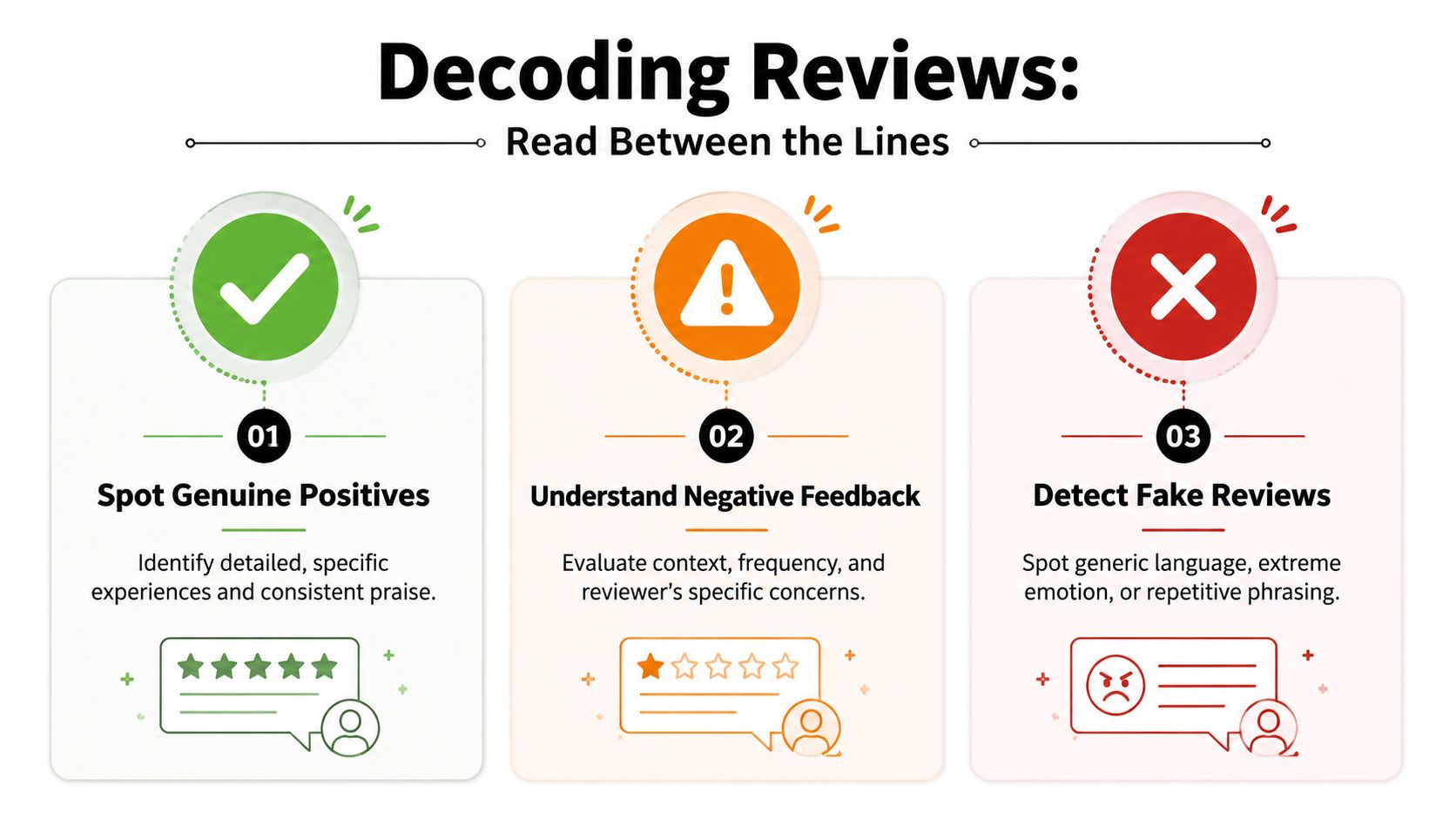
A five-star review can be useless. A two-star review can be valuable. The score is the least interesting part once you know how to read the body of the review.
Separate subjective complaints from safety signals
Tattoo removal hurts. Healing can be annoying. Some people swell more, blister more easily, or feel frustrated by how long fading takes. Those experiences are real, but they aren't always signs of a bad clinic.
What matters is whether the review points to a personal reaction or an avoidable clinic problem.
Use this split:
Subjective issues
Pain tolerance, impatience with fading speed, dislike of waiting between sessions, anxiety during treatmentObjective concerns
Dirty rooms, inconsistent aftercare instructions, pressure to buy products, careless laser use, lack of informed consent, dismissive handling of complications
One review that says “it hurt more than I expected” doesn't tell you much. A review that says “they rushed me, didn't explain aftercare, and brushed off a skin reaction” deserves real attention.
Watch for dangerous product language
This is one of the easiest credibility checks you can make. The FDA has explicitly approved certain laser devices for tattoo removal, while it has not approved any tattoo removal ointments, creams, or do-it-yourself kits, which may cause skin rashes, burns, or scars instead of removal, as stated in the FDA consumer guidance on tattoo removal options.
If reviews repeatedly mention a clinic pushing creams, “miracle fading” products, or home-removal shortcuts as if they're equivalent to laser treatment, that's not a small marketing quirk. It suggests weak standards.
If a clinic blurs the line between approved laser treatment and unapproved topical shortcuts, treat that as a judgment problem.
Spot signs of fake or managed reviews
Not every suspicious review is fake, but some patterns show up often.
A business-focused guide on Google review management is helpful here because it explains how companies organize responses, monitor profiles, and shape customer feedback systems. Read that kind of material and you start noticing patterns faster.
Reviews deserve skepticism when they have several of these traits:
Generic praise only
“Amazing staff.” “Best experience ever.” “Highly recommend.” No tattoo detail, no treatment detail, no reason.Extreme emotional tone
Over-the-top adoration or outrage without specifics. Real patients usually mention at least one concrete moment.Repeated phrasing
Similar wording across multiple reviews can suggest a managed pattern.No discussion of process
Tattoo removal is a process. Real reviews often mention consultation, treatment feel, healing, or wait time between visits.
Give more weight to timeline-aware reviews
The best removal reviews usually sound grounded. The reviewer knows fading is gradual. They discuss session spacing, skin response, and whether the clinic stayed realistic.
A review becomes more trustworthy when it includes details like:
What the tattoo was like
Black ink, multicolor, older piece, cover-up prep, dense professional workHow the clinic handled expectations
Whether the provider explained uncertainty without hedging everything into useless vaguenessWhat happened after the session
Not just “great staff,” but whether aftercare support was available and consistent
“I trust a review more when the patient sounds informed by the end of it.”
That's usually the sign of a provider who educates instead of selling.
Verifying a Clinic's Expertise Beyond Reviews
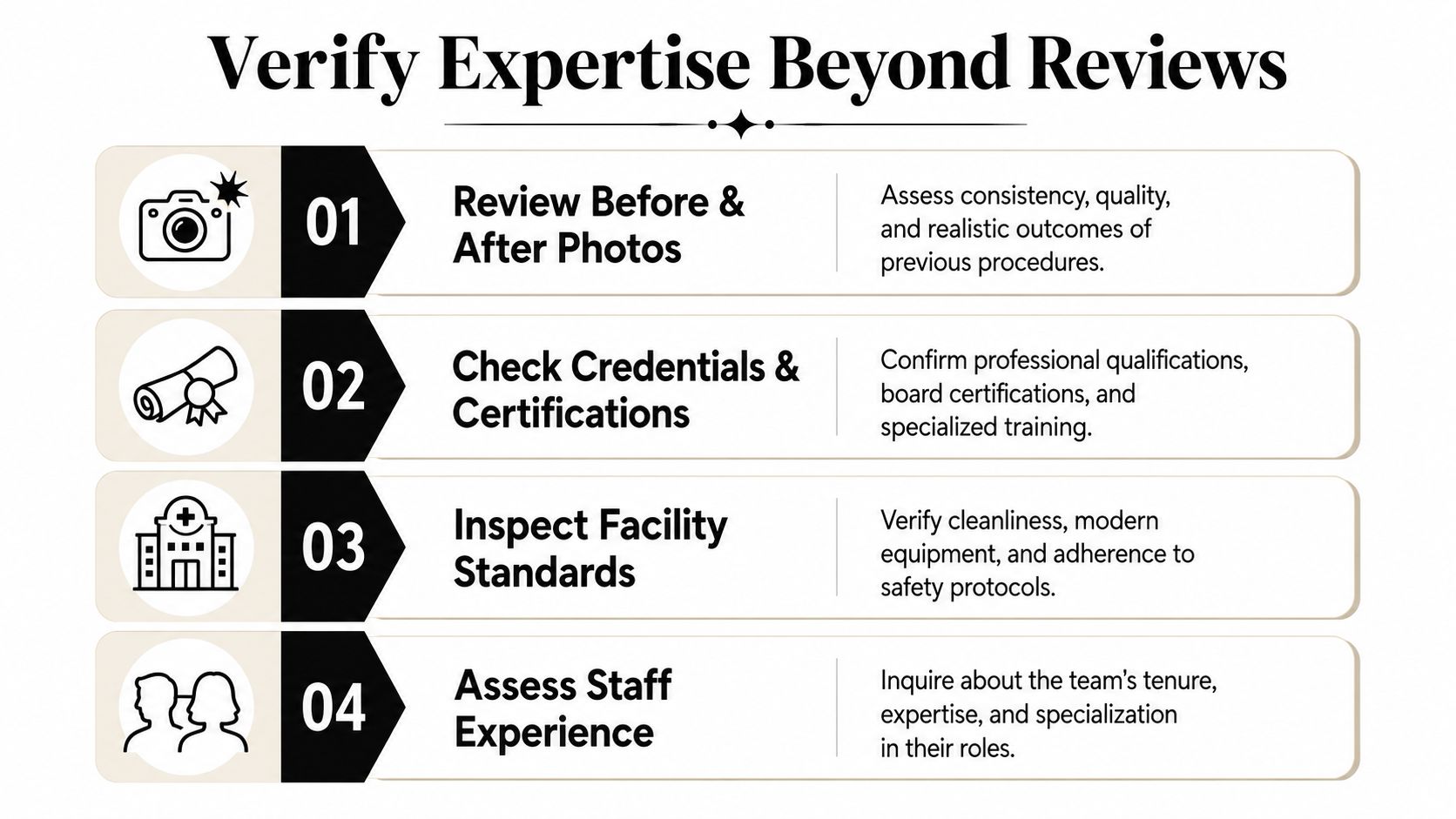
Reviews can narrow the field. They can't confirm technical skill on their own. Once a clinic makes your shortlist, you need to verify what's behind the marketing.
Read the before-and-after gallery like evidence
A strong gallery doesn't just show dramatic “after” shots. It shows consistency.
Look for photos with similar lighting, similar angles, and a clear sense that you're seeing the same tattoo over time. If every image is cropped tightly, heavily filtered, or taken under different conditions, the gallery tells you less than it seems to.
Good galleries often reveal the clinic's honesty in quieter ways:
- Progress photos across sessions are more useful than one final image.
- Different tattoo types matter more than a page full of easy black ink examples.
- Skin texture visibility matters. You want to see skin, not just faded pigment.
If the clinic only showcases perfect outcomes and avoids in-process work, they may be selling aspiration more than documenting treatment quality.
Check whether the technology matches the tattoo problem
A clinic should explain its laser platform clearly and in plain English. You don't need a physics lecture, but you should know what device they use and why they think it suits your tattoo.
For carbon-based black tattoos on fair-skinned individuals treated with Q-switched lasers, the chance of complete clearance exceeds 90%, whereas multi-color tattoos require significantly more treatments, averaging 12.3 sessions to achieve 90% clearance according to a 2023 meta-analysis, as reported in this review of laser tattoo removal evidence.
That doesn't mean one laser is automatically right for everyone. It means the clinic should connect the equipment to the realities of your tattoo. If they talk as if every color responds the same way, or every tattoo follows the same timeline, that's weak technical communication.
Credentials should be easy to find
A serious clinic doesn't bury staff qualifications. You should be able to identify who performs treatment, what training they've had, and whether the clinic explains safety protocols clearly.
Use a simple verification checklist:
| What to check | What a strong clinic shows |
|---|---|
| Staff identity | Named practitioners, not anonymous “team” language |
| Training | Laser-specific education and role clarity |
| Equipment | Brand or platform details with plain-language explanation |
| Safety | Consultation process, aftercare, contraindications, skin assessment |
If you're unsure how much medical oversight matters for your situation, this guide on laser tattoo removal and dermatologist considerations can help you frame the right questions.
Inspect the site for what it avoids
What a clinic leaves out is often more revealing than what it says.
Be cautious if the website avoids details on:
- Session variability
- Color-specific challenges
- Skin reaction management
- Aftercare responsibilities
- Limits of complete clearance
A provider who understands tattoo removal well usually speaks comfortably about uncertainty.
That's not a weakness. It's a mark of experience.
Use contact behavior as part of verification
Call or message the clinic before booking. Pay attention to whether they answer basic questions directly or funnel everything into a sales script.
You're listening for signs like these:
- They explain rather than deflect.
- They distinguish fading for a cover-up from full removal.
- They don't guarantee identical outcomes for every tattoo.
- They can discuss equipment, healing, and candidacy without sounding annoyed.
A clinic's professionalism doesn't begin when you walk in. It shows up in how they handle simple questions before they have your money.
Your Consultation Checklist of Questions to Ask
The consultation is where polished reviews meet real-world accountability. If a clinic is excellent, its true quality usually becomes obvious at this stage. If the online image is doing too much of the work, cracks tend to show during this interaction.

Ask questions that test clarity
Don't ask only, “How much does it cost?” Ask questions that force the provider to think about your tattoo.
These usually get more revealing answers:
- What makes my tattoo harder or easier to remove?
- Are you aiming for complete removal or is fading the better goal here?
- How do you decide which laser settings to use on my skin and ink colors?
- What should normal healing look like after a session, and what would concern you?
A good clinician won't sound defensive. They'll sound specific.
Use reviews to pressure-test the clinic
If reviews mention slow callbacks, blistering concerns, or great aftercare, bring that into the room indirectly. You're not trying to trap anyone. You're checking consistency.
Try questions like these:
- How do you handle aftercare follow-up if a client is worried about healing?
- What do you do if someone feels they're not progressing as expected?
- How do you set expectations for dense professional ink versus simpler pieces?
The answers matter, but so does the tone. Strong providers stay calm, detailed, and patient when a client asks smart questions.
Ask about color surprises before treatment starts
This is a big one, especially for dark or mixed tattoos. Data shows 30% of subjects experienced unexpected color changes post-treatment with picosecond lasers, specifically the unmasking of orange tones that require a secondary 532-nm laser to resolve, according to this retrospective review of laser removal outcomes.
That means you should ask directly:
- If my dark tattoo reveals hidden tones during treatment, how would you handle that?
- Do you have a plan if orange or other underlying pigment becomes visible?
- Would that change the treatment sequence or expected duration?
A clinic that has never thought about this may not be prepared for less obvious tattoo behavior.
Some of the best consultation answers begin with, “It depends on your tattoo, and here's why.”
Pay attention to what they ask you
The consultation isn't only about your questions. It's also about whether the clinic asks good ones.
A careful provider should ask about your tattoo history, any cover-up layers, prior removal attempts, sun exposure habits, your skin response history, and what result you want. Full removal and light fading are not the same plan.
Here's a simple scorecard you can use mentally during the visit:
| Consultation sign | What it suggests |
|---|---|
| Specific questions about the tattoo | Real assessment, not generic selling |
| Clear explanation of trade-offs | Experience and confidence |
| Honest uncertainty where appropriate | Better judgment |
| Pressure to commit immediately | Sales-first culture |
Leave with a written or at least repeatable plan
You don't need a perfect prediction. You do need a coherent one.
Before you leave, make sure you understand:
- The likely treatment goal
- The expected pacing
- The main risks for your tattoo and skin
- What support looks like between sessions
If the provider can explain those points plainly and consistently, the reviews are starting to line up with reality.
Choosing a Clinic in Florida and Making Your Final Decision
At this point, your decision should feel narrower and calmer. You're no longer comparing marketing. You're comparing consistency.
In Florida, geography matters more than people think. Tattoo removal takes repeat visits, so practical access matters. If you're choosing between clinics across places like Orlando, Tampa, or the Sarasota area, look at travel time, scheduling flexibility, and whether the business appears stable across locations. Multiple established locations can be a good sign, but only if the quality signals stay consistent from one office to the next.
Use a final three-part check
Before you commit, ask yourself:
- Do the reviews, website, and consultation match each other?
- Did the clinic speak frankly about limits, not just possibilities?
- Do I trust this provider to manage setbacks, not just routine sessions?
That last question matters because response isn't equal for everyone. Key predictors of poor response, including smoking, tattoo location on feet or legs, and higher color density, must be addressed in the pre-treatment protocol to optimize outcomes, according to the NCBI overview of tattoo removal factors.
If a clinic minimizes the factors that make your tattoo harder to remove, they're not protecting your expectations.
A final decision usually comes down to this. Choose the clinic that gives you the clearest explanation, the most realistic plan, and the strongest sense that your skin is being treated with care, not just processed.
If you're ready to talk through your tattoo, your skin type, and whether full removal or fading makes more sense, EradiTatt Tattoo Removal offers consultations across Florida with a practical, supportive approach. It's a good next step if you want clear answers, realistic guidance, and a treatment plan built around your actual tattoo rather than a generic promise.
One Response