
You're staring at an old tattoo on your upper arm, wondering whether a larger design can make it disappear. The answer usually depends less on the tattoo idea you like and more on ink density, pigment color, placement, skin condition, and how much room you'll give the new composition. A tattoo cover up half sleeve can produce a strong result, but only when the artist and removal specialist treat it as a planning project rather than fresh ink placed over a problem.
The most important decision comes early: cover directly or fade first. A direct cover-up may work for lighter, simpler tattoos. Dense blackwork, saturated color, prominent lettering, and scarred skin often need preparation so the new half sleeve doesn't heal into a muddy layer of competing lines.
Table of Contents
- Evaluating Whether Your Tattoo Can Become a Half Sleeve
- Deciding Between Direct Cover-Up and Laser Fading First
- Finding the Right Cover-Up Artist for Your Half Sleeve
- Design Strategies That Actually Conceal Old Ink
- Understanding the Full Timeline and Investment Required
- Aftercare Protocols and Getting Started in Florida
Evaluating Whether Your Tattoo Can Become a Half Sleeve
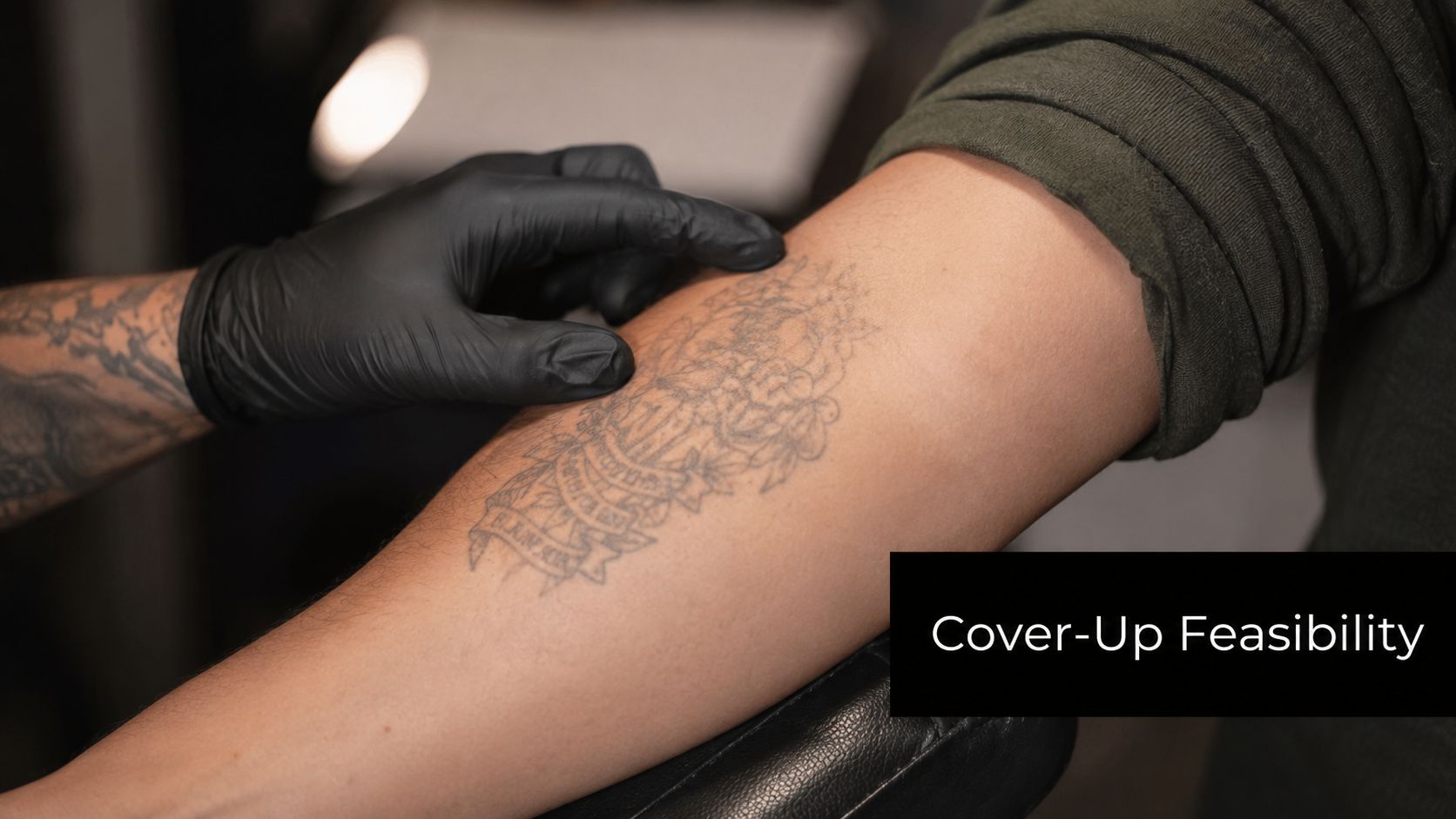
A useful assessment starts with the tattoo you already have, not the design you hope to receive. Look at the darkest sections, the strongest outlines, and any areas where the skin feels raised or uneven. A half sleeve can redirect attention across the arm, but it can't make old pigment behave like untouched skin.
The variables that control the result
Ink density is usually the first obstacle. A faint outline gives an artist more freedom than solid black shading. Dense areas require darker new elements, stronger contrast, or a composition that breaks the old shape into less recognizable fragments.
Color matters just as much. Blue, green, and yellow can be particularly difficult to bury cleanly. If the new concept depends on pale highlights, open skin, or delicate linework, those colors may need to be lightened before tattooing.
Placement changes the design problem. Ink over the outer bicep can often be incorporated into a larger flow, while a dense mark crossing the elbow or sitting in the focal center of the arm may force the artist to enlarge the composition or shift its main subject. The artist must also inspect the skin for texture, raised lines, and signs of previous trauma, because uneven skin can affect saturation and healing.
Why size protects the design
Expert cover-up guidance commonly recommends making the new work about 2 to 3 times the area of the original tattoo, with darker, higher-saturation elements positioned over the densest old ink. The recommendation isn't arbitrary. More surface area lets the artist distribute contrast, add background structure, and move the viewer's eye instead of concentrating all the dark pigment in one cramped patch. Cover-up planning guidance also emphasizes using a photo overlay to map the new composition before tattooing begins.
Practical rule: If the proposed half sleeve is only slightly larger than the old tattoo, ask what happens to the uncovered edges and the darkest central areas after healing.
Common visual failures come from choosing a design that's too small, placing light detail directly over dense ink, or insisting on rigid geometry that can't follow the existing tattoo. A strong candidate for direct cover-up has manageable density, a workable location, and enough surrounding skin for the new composition. If those conditions aren't present, fading first usually creates better design options.
Deciding Between Direct Cover-Up and Laser Fading First
The direct route is faster, but it can force you into a darker, heavier design. Laser fading takes longer and adds treatment and healing stages, yet it may preserve the possibility of a softer black-and-grey piece, clearer negative space, or more detailed focal imagery.
For cover-up preparation, industry guidance describes 50% to 70% fading from 2 to 4 laser sessions as enough to create a cleaner canvas in many cases. It describes 70% to 80% fading as ideal for most cover-ups, while 90% or more may be needed when light colors or delicate details must sit over the old tattoo. These are planning ranges, not guarantees. Cover-up fading guidance explains why the right endpoint is often fading rather than complete removal.
Direct cover-up versus fading first
| Ink Characteristic | Direct Cover-Up Viable | Laser Fading Recommended |
|---|---|---|
| Light, aged linework | Often, if the new design overlaps fully | Optional when the desired design uses very light detail |
| Dense black shading | Only with a larger, darker composition | Yes, when you want lighter values or more flexibility |
| Saturated blue, green, or yellow | Limited, especially under pale colors | Strongly consider fading first |
| Lettering or symbols with clear shapes | Possible with organic, high-contrast composition | Recommended if the old shape sits in the new focal area |
| Raised or scarred skin | Requires an experienced specialist | Consider preparation and a cautious multi-stage plan |
| Professional timeline with little flexibility | Direct may be faster | Fading may be worthwhile if a rushed result would create a larger problem |
A controlled clinical study found that adding a rapid-access pulse strategy to laser treatment increased average fading from 24.8% to 44.2% at 12 weeks, while the proportion of tattoos achieving more than 50% fading rose from 9.4% to 37.5%. The study is useful evidence that treatment strategy can influence fading, but individual response still depends on pigment, skin, tattoo depth, and treatment planning. Clinical laser study
The same review literature reports that picosecond lasers outperform QS Nd:YAG systems for blue, green, and yellow pigments, which can influence the choice of technology when those colors dominate the arm. If you're still developing the visual direction, browsing find cover-up tattoo styles can help you identify styles that tolerate darker values and broader compositions.
For a practical preparation overview, see preparing for a tattoo cover-up with fading support. Bring the intended design to your consultation. The right fading target is determined by what the artist must place over the old ink, not by a generic goal of erasing every trace.
Finding the Right Cover-Up Artist for Your Half Sleeve
A talented tattooer isn't automatically a cover-up specialist. Fresh-skin work gives the artist broad control. A half-sleeve cover-up requires visual mapping, pigment judgment, restraint over previously tattooed skin, and an understanding of how the result will look after it settles.
Start with healed work
Ask to see healed cover-up photographs, not only fresh images taken immediately after the appointment. Fresh pigment can look more opaque than the healed result, so a portfolio that shows only new tattoos doesn't tell you whether the old lines remain visible later.
Look for examples that resemble your situation:
- Similar density: A delicate linework cover-up doesn't prove the artist can handle solid black or saturated color.
- Comparable placement: Ask for upper-arm, bicep, elbow, or forearm work when those areas match your project.
- Large compositions: A successful half sleeve should flow around the arm, not look like an isolated patch placed over an old mark.
- Before-and-after documentation: The comparison should make the transformation and the concealment strategy clear.
An artist may have a beautiful preferred style, but style alone isn't enough. A fine-line design can be attractive and still be technically unsuitable if the old tattoo is dark and dense. Flexibility about scale, subject, contrast, and background elements often matters more than reproducing an inspiration image exactly.
Questions for the consultation
Ask the artist to explain how they'll map the new piece over the existing tattoo. A photo-based overlay can show where the darkest new shapes will sit and whether the composition fully overlaps the old work. You should also ask:
- What parts of the old tattoo will remain the most difficult to conceal?
- Will the design need to extend beyond the original tattoo?
- Does the skin show texture or scarring that could affect saturation?
- Would fading first create a noticeably better design?
- How many tattoo appointments might the composition require?
- What is the policy if a healed area needs a touch-up?
- Do you coordinate with a laser removal clinic when pre-fading is appropriate?
Don't accept a confident promise that every mark will vanish under any design. An experienced specialist should discuss compromises openly, including darker values, larger scale, additional background, or a staged plan. For more guidance on evaluating an artist, review this cover-up tattoo artist selection guide.
Design Strategies That Actually Conceal Old Ink
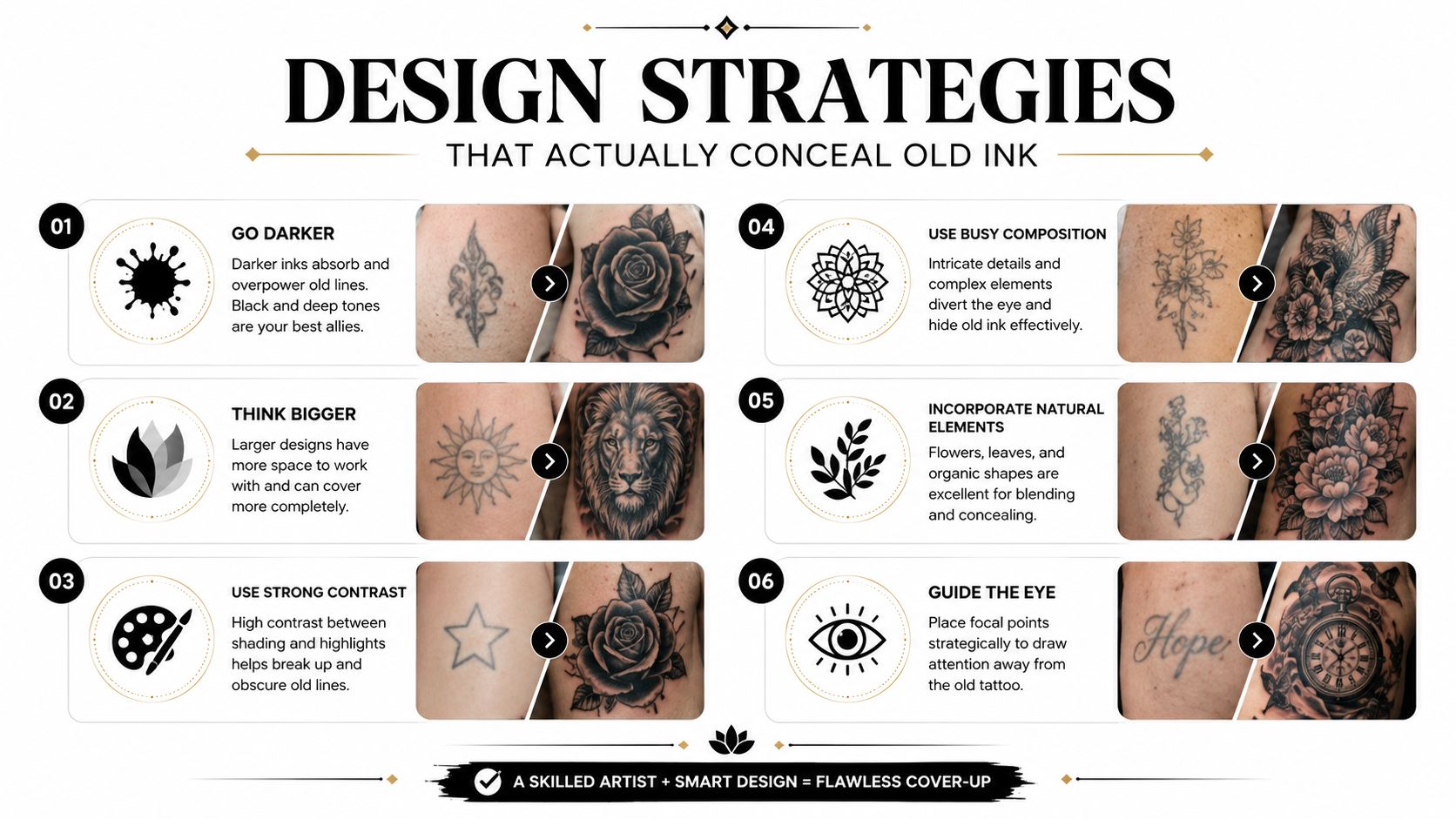
A successful design doesn't just place more pigment over the old tattoo. It breaks up recognizable shapes, controls where the eye lands, and uses texture and contrast so the finished half sleeve reads as one deliberate composition.
Organic forms usually provide more camouflage options than rigid geometry. Florals can place petals and dark centers across uneven areas. Waves and smoke can redirect existing lines. Abstract patterns can fragment lettering or symbols without making the new piece look like an obvious repair. Realistic subjects with texture, such as fur, scales, leaves, or layered fabric, can also give the artist more ways to disguise old edges.
Match the strategy to the ink
Blackout elements work when you like a bold, dark visual language. They can create a strong foundation, but they aren't white paint over black marker. Underlying linework or texture may still influence the surface, especially where the old tattoo is heavy or the skin is uneven.
Negative space can preserve visual breathing room around darker sections, but it must be placed where the old pigment is already light enough to support it. Leaving pale open areas over the darkest part of the original tattoo can make the old design remain legible.
Patchwork compositions allow the artist to build several connected visual zones instead of forcing one subject over every existing mark. This approach can suit an arm with multiple unrelated tattoos, provided the background and spacing unify the separate pieces.
Contrast needs to be distributed, not dumped into one location. Dark values should cover the densest old ink, while lighter areas and highlights should sit where the skin can support them after healing. Color choices also need to account for how old and new pigments visually interact, so a fresh design should be judged as a long-term composition rather than an immediate photograph.
Ask your artist to show the overlay before the first session. That map should identify the old tattoo, the new boundaries, focal points, dark coverage zones, and areas where negative space will remain. If the proposed artwork only looks convincing when the old tattoo is digitally hidden, it hasn't been planned well.
Understanding the Full Timeline and Investment Required
A half-sleeve cover-up is a sequence of decisions, appointments, healing periods, and possible revisions. The fastest route isn't always the most efficient one, because placing a heavy design over dense ink can reduce your options later.
A realistic project sequence
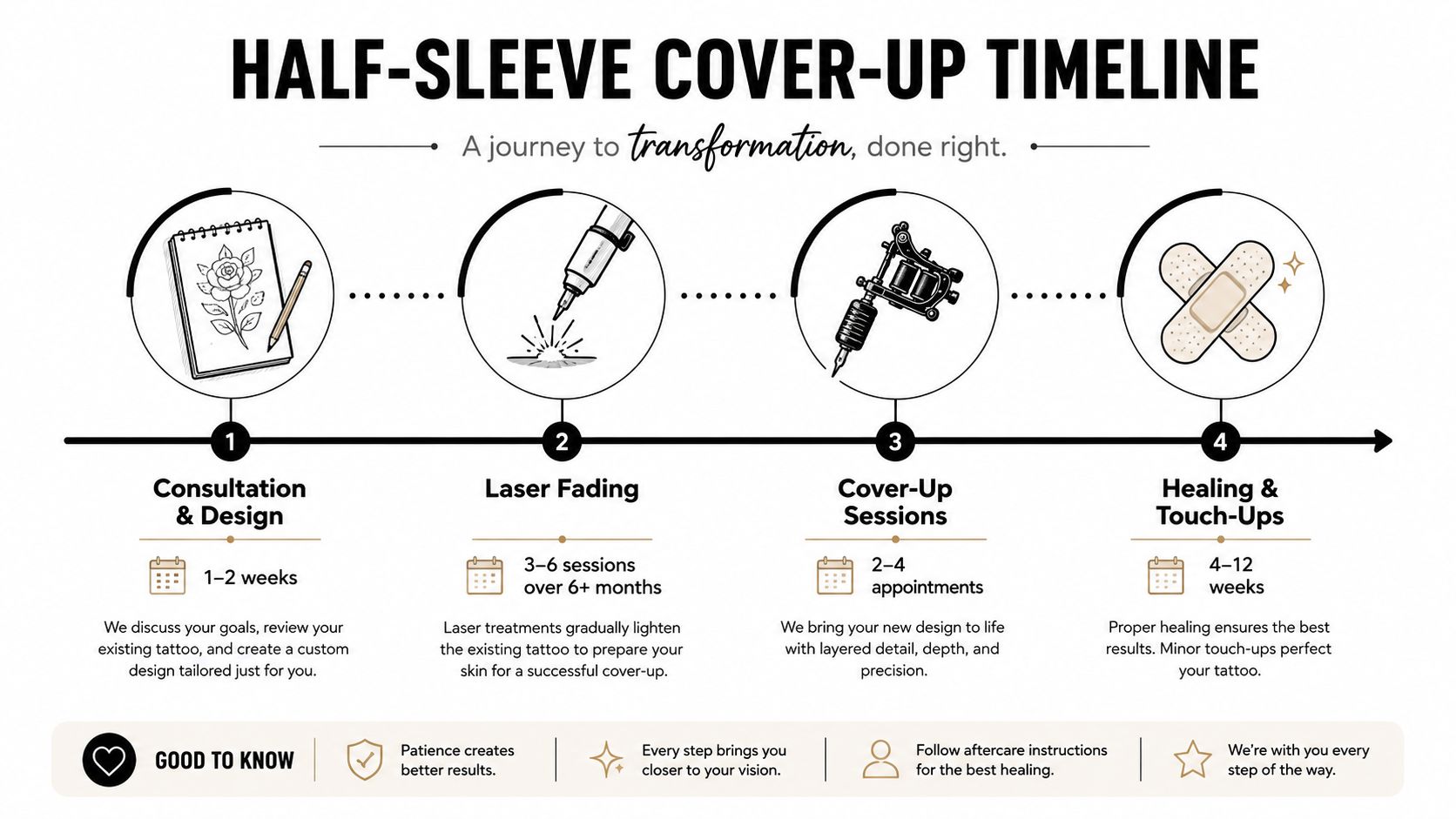
The first appointment is the consultation. You'll provide clear photos, discuss the desired style, identify the most visible parts of the old tattoo, and determine whether the artist needs a direct cover-up or a fading phase. A design may be drafted around the arm so the composition follows the bicep, shoulder, elbow, or forearm instead of treating the old tattoo as a flat rectangle.
If laser preparation is chosen, the fading plan is based on the cover-up design. The reference timeline supplied for this topic describes a laser phase of 3 to 6 sessions over 6 or more months, but the actual schedule depends on how the skin responds and what fading level the artist needs. Complete healing after laser work can take up to 8 weeks, and cover-up appointments are commonly scheduled 8 to 12 weeks after the final fading session. Tattoo removal timeline guidance offers additional context for planning the removal phase.
Tattooing and healing affect the calendar
The cover-up itself may require 2 to 4 appointments, especially if the design contains large saturated areas, complex shading, or skin that needs a cautious approach. A larger piece or skin with delayed healing may need 3 to 6 months to stabilize before revision or additional cover-up work, according to revision and aftercare guidance.
Cost varies with the number of laser sessions, the clinic's pricing structure, the artist's rate, the scale of the half sleeve, and whether the project requires touch-ups. A cover-up is often more complex than a standard tattoo of similar size, so comparing prices without comparing the plan can be misleading. Ask for the expected phases, what each appointment covers, and whether future touch-ups are included or charged separately.
A realistic calendar protects the result. If you need a professional appearance by a specific date, discuss that deadline before choosing a direct cover-up.
Rushing can create a larger, darker piece that takes longer to heal and offers fewer options. A phased plan may require patience, but it can give the artist more freedom to build a half sleeve you'll want to keep.
Aftercare Protocols and Getting Started in Florida
Aftercare protects both the new tattoo and the skin that has already undergone tattooing or laser treatment. Follow your tattooer's dressing instructions first, because the correct routine can vary with the bandage type and the condition of your skin.
The first hours and first weeks
Aftercare guidance commonly recommends keeping the initial dressing on for only a few hours, then washing gently and applying moisturizer lightly. Use clean hands, lukewarm water, and a mild cleanser. Pat the area dry rather than rubbing it, and don't apply a thick layer of product that leaves the skin sealed and overly moist. Cover-up aftercare guidance outlines these early-care principles.
Avoid heavy exercise for 5 to 7 days, since sweat, friction, and stretched skin can irritate a fresh half sleeve. Avoid pools, hot tubs, baths, and other soaking for 2 to 4 weeks. Don't pick flakes or scabs, scratch the area, or cover it with tight clothing that repeatedly rubs against the tattoo.
Normal healing can include redness, tenderness, swelling, itching, flaking, and gradual changes in surface appearance. Contact your tattoo artist or a medical professional if redness spreads, pain worsens instead of settling, swelling becomes severe, discharge develops, or you experience fever or other signs of illness. Don't attempt to manage a possible infection by applying random products over the area.
Planning your Florida consultation
Florida residents can start by gathering clear photos of the existing tattoo, noting its location and approximate size, and bringing any cover-up concept to the consultation. EradiTatt provides laser tattoo removal for complete removal or light fading to prepare for a cover-up, with locations serving Orlando, Tampa, St. Petersburg, Bradenton, and Palm Harbor. The fading plan should be coordinated with the tattoo artist so treatment targets the ink that limits the new half sleeve.
If you're under a deadline for work, enlistment, a wedding, or another life event, disclose it at the first consultation. That allows the team to discuss realistic healing requirements instead of building a plan around an unsafe rush.
EradiTatt Tattoo Removal can assess unwanted ink and create a fading plan for a future tattoo cover up half sleeve, without assuming that complete removal is necessary. Visit EradiTatt Tattoo Removal to schedule a consultation and discuss the next step at a convenient Florida location.