
You're probably staring at an old tattoo that no longer fits your life. Maybe it's a name, a symbol tied to a rough chapter, or just a design that looked right once and feels wrong now. In such situations, the desire is often consistent: to have it gone without making the next decision another regret.
That's where people often get stuck. They search for a cover up tattoo artist, collect a few inspiration photos, and assume the new tattoo needs to go on top of the old one. In practice, cover-ups work when the project is planned like a collaboration between two specialties: fading what limits the design and building a new piece that stands on its own.
A strong cover-up isn't a quick fix. It's a controlled reset. If you prepare the skin properly, give the artist room to solve the problem, and accept the trade-offs, your options improve fast.
Table of Contents
- Your Guide to a Tattoo Cover-Up You Will Love
- Preparing Your Canvas for a New Tattoo
- How to Find an Artist Who Specializes in Cover-Ups
- Vetting Your Artist and Nailing the Consultation
- Understanding the Cover-Up Timeline and Costs
- Your Fresh Start Is a Project Worth Planning
Your Guide to a Tattoo Cover-Up You Will Love
The tattoo you want covered probably isn't just ink. It carries a story, a version of you, or a memory you're finished carrying on your skin. That's why cover-ups feel emotional in a way standard tattoo appointments often don't.
The mistake I see most often is treating cover-up work like regular tattoo shopping. It isn't. A fresh-skin tattoo starts with open space. A cover-up starts with restrictions: existing pigment, placement, shape, scar tissue, and how much darkness is already sitting in the skin. The outcome depends on how realistically those limits are handled from day one.
Practical rule: The best cover-ups don't just hide the old tattoo. They redirect the eye so completely that the new piece reads as intentional artwork, not damage control.
That takes planning from both sides. The artist has to build around what's already there. The client has to stay flexible about size, contrast, and sometimes even subject matter. If the old piece is dark and dense, the smart first move may not be booking the tattoo session. It may be preparing the area so the artist has more than one narrow design path.
A good process usually includes these decisions early:
- Assess the old tattoo. Darkness, saturation, age, and placement matter more than the original subject.
- Decide whether to fade first. Some tattoos can be covered directly. Others need lightening if you want something cleaner and less heavy.
- Choose a specialist, not just a good tattooer. Cover-up work is its own discipline.
- Treat the consultation like a planning meeting. Bring clear photos, realistic ideas, and openness to change.
If you approach the project this way, the whole experience gets better. You're no longer trying to force a miracle out of stubborn old ink. You're building the conditions for a result you'll want to live with.
Preparing Your Canvas for a New Tattoo
The quality of the final cover-up starts before a needle touches the skin. If the existing tattoo is faded, soft, and broken up by time, an artist may be able to work over it directly. If it's dark, crisp, and heavily packed, direct cover-up is still possible, but the design lane gets much narrower.
Two valid paths with very different limits
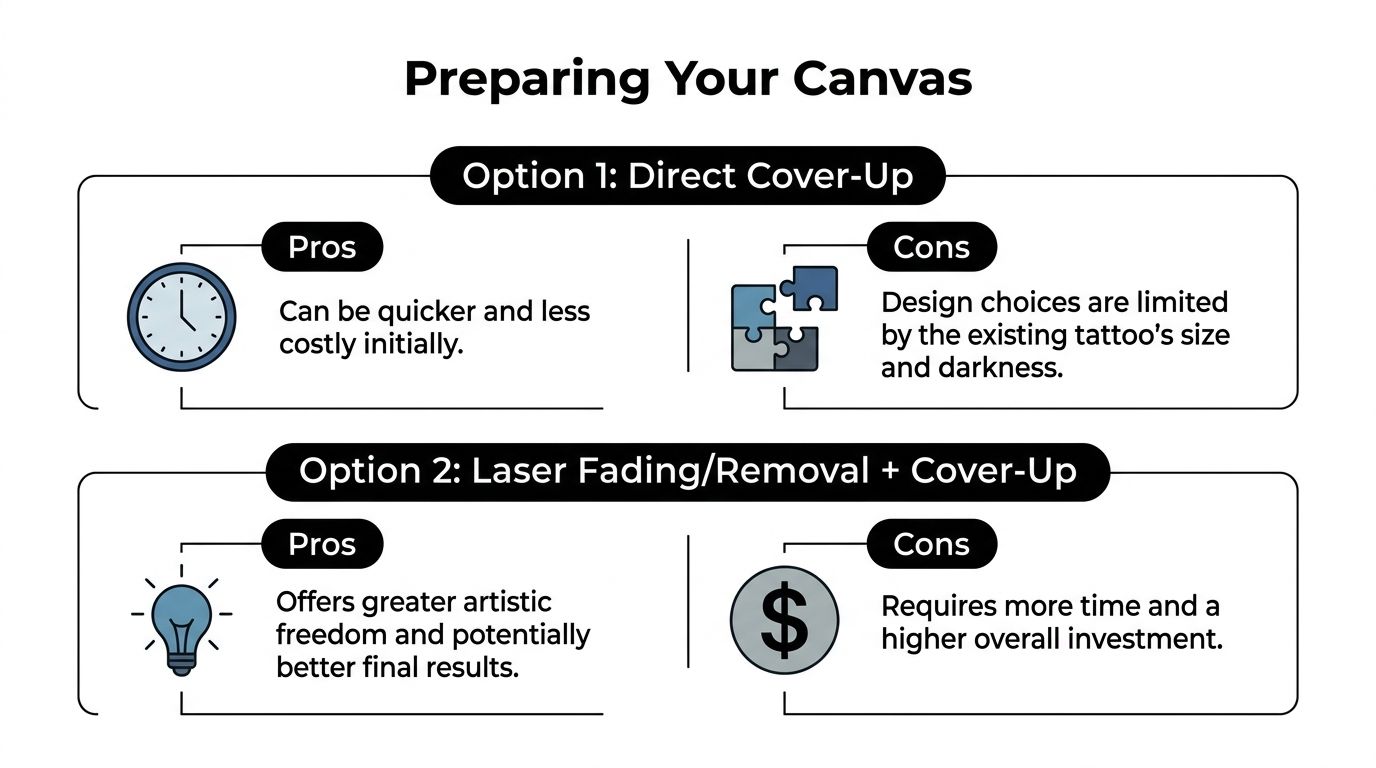
You generally have two paths: cover it as-is, or lighten it first and then cover it. Both are legitimate. They just produce different levels of freedom.
| Factor | Direct Cover-Up (No Fading) | Cover-Up After Laser Fading |
|---|---|---|
| Design freedom | More restricted by old lines and dark areas | Broader options for shape, detail, and contrast |
| Color range | Usually pushes the artist toward darker, denser choices | Gives the artist more room to use varied values |
| Size pressure | Often requires a heavier expansion around the old tattoo | Can reduce how aggressively the new piece has to compensate |
| Timeline | Fewer steps up front | Adds prep time before tattooing |
| Upfront investment | Lower at the start | Higher because preparation is part of the project |
A hybrid plan often produces the cleanest result. According to guidance on laser fading and cover-up planning, a hybrid approach combining laser fading and cover-up yields superior aesthetic results, clients should wait 6 to 12 weeks minimum after laser fading before booking the cover-up, and most cover-ups benefit from 1 to 3 fading sessions.
That doesn't mean everyone needs full removal. Usually they don't. The goal is often simple: turn a hard, dark tattoo into a softer shadow that the artist can design around.
What fading changes for the artist
Here's the practical advantage. Fading gives the artist more control over the final image. Instead of spending the whole design trying to overpower old pigment, they can focus on composition, movement, cleaner linework, and better balance.
For clients in that planning stage, preparing for a tattoo cover-up with the right fading strategy is a useful way to think about the process. The point isn't to erase every trace before tattooing. The point is to remove enough resistance that the cover-up artist can do better work.
A direct cover-up can solve the problem fast. A faded canvas usually solves it better.
There are trade-offs either way:
- Choose direct cover-up if the old tattoo is already light, you're open to darker imagery, and you want fewer steps.
- Choose fading first if you want more design options, lighter areas in the new piece, or a result that doesn't look forced.
- Pause and reassess if the tattoo is very dark, very saturated, or sitting in awkward placement. That's where rushed decisions tend to create oversized, muddy follow-up tattoos.
A cover-up artist can only work with the canvas you hand them. Better preparation doesn't guarantee perfection, but it gives them a real chance to create something elegant instead of just something passable.
How to Find an Artist Who Specializes in Cover-Ups
Not every excellent tattoo artist is the right artist for cover-up work. That isn't an insult to their skill. It's just a different kind of problem set.
Why many artists say no
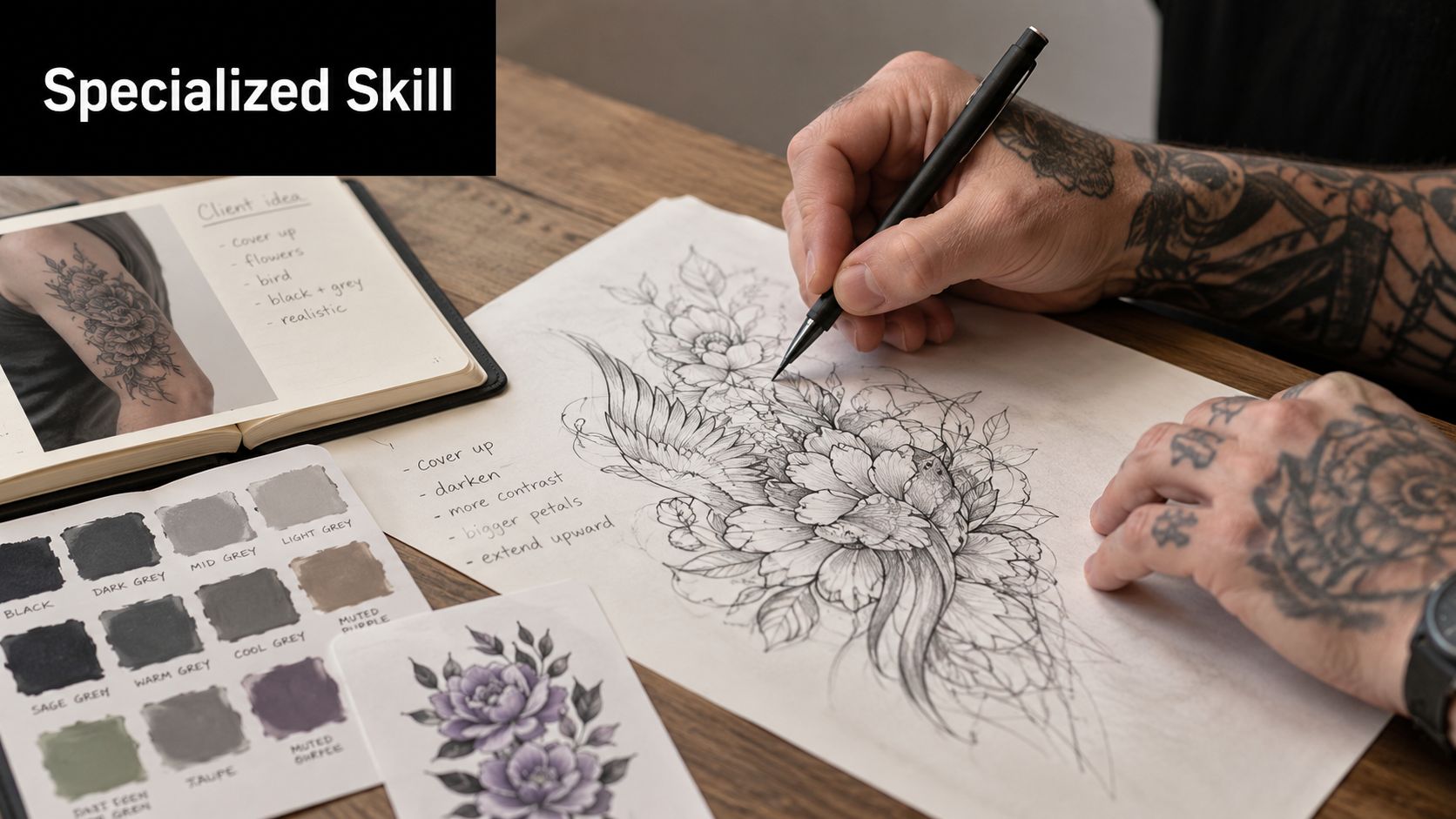
Many clients take rejection personally when artists decline the project. In reality, many top tattoo artists refuse cover-ups because the healed result rarely looks as pristine as work on fresh skin, which limits what they can show in a portfolio, as discussed in this industry conversation about why artists refuse cover-ups.
That's why your goal shouldn't be finding the most famous artist in your area. It should be finding the artist who likes solving these problems.
A specialist usually signals that in plain sight:
- They post before-and-after work instead of only fresh tattoos.
- They explain limitations clearly rather than promising anything.
- They show healed results when possible because cover-ups need to age well, not just photograph well on day one.
- They talk about structure such as darkness placement, flow, and breaking up obvious shapes.
What to look for in a real specialist
Search platforms where artists actively show process and finished work. Look through tags related to cover-ups, laser fading, reworks, and name cover-ups. Then slow down and study what you're seeing.
A strong portfolio won't just show that the old tattoo disappeared in a fresh photo. It will show that the new tattoo has its own identity. Florals should feel designed, not stuffed in to hide lettering. Birds, ornamental work, black and grey, and dense illustrative pieces should have believable flow instead of suspiciously heavy patches dropped right on top of the old ink.
If you're evaluating artists online, it also helps to understand how they present their studio and booking information. Resources on building websites for tattoo artists can make it easier to spot whether an artist has organized their services clearly, including whether they mention cover-up work as a specialty rather than an occasional add-on.
You can also browse examples and planning ideas through cover-up tattoo insights and related posts to get a better sense of the range between straightforward covers and projects that need prep first.
Use this filter when reviewing candidates:
- Do they show cover-ups often enough to prove experience?
- Do their cover-ups still look readable as art?
- Do they appear comfortable saying no to bad ideas?
- Do they mention laser fading as part of planning when needed?
If an artist says yes to every concept, every size request, and every color scheme without hesitation, that usually isn't confidence. It's a warning.
The right cover up tattoo artist doesn't sell fantasy. They give you a design route that works in real skin.
Vetting Your Artist and Nailing the Consultation
Once you've narrowed your list, the consultation matters more than the portfolio. A portfolio gets an artist onto your shortlist. The consultation tells you whether they can solve your specific tattoo.
What a strong consultation should include
Bring clear photos of the current tattoo, including one in flat natural light. Bring the rough dimensions. Bring references for mood, not rigid expectations. If you walk in attached to one exact tiny design that ignores the old tattoo underneath, you'll leave frustrated.
A strong artist will assess four things quickly: how dark the old tattoo is, how readable its shapes still are, how the placement affects composition, and how much room they need to break visual recognition.
One of the most important rules should come up early. A cover-up planning guide from Melina van der Werf states that the new tattoo must be at least double the size of the original, and for solid, dark tattoos it may need to be 2 to 3 times larger. If an artist is pretending size won't change when the old tattoo is heavy, they're avoiding the hard truth.
That size increase isn't arbitrary. It gives the artist space to redirect the eye with new forms, darker anchors, and supporting movement around the original shape.
Questions that reveal actual cover-up skill
Ask direct questions and listen for specific answers.
- How would you break up the old tattoo's shape?
You want to hear strategy, not just “we'll cover it.” - Where would the darkest values go?
A capable artist can explain placement logic. - Do you think fading first would improve the result?
Honest artists won't force tattooing if the canvas is fighting them. - Can you show me cover-ups similar in darkness or placement?
Similar problems matter more than similar styles. - What parts of my idea are realistic, and what needs to change?
This question tells you whether they can guide instead of just agree.
A consultation is also about communication style. You need someone who can explain limitations without making you feel cornered. Good cover-up planning is technical, but it should still feel collaborative.
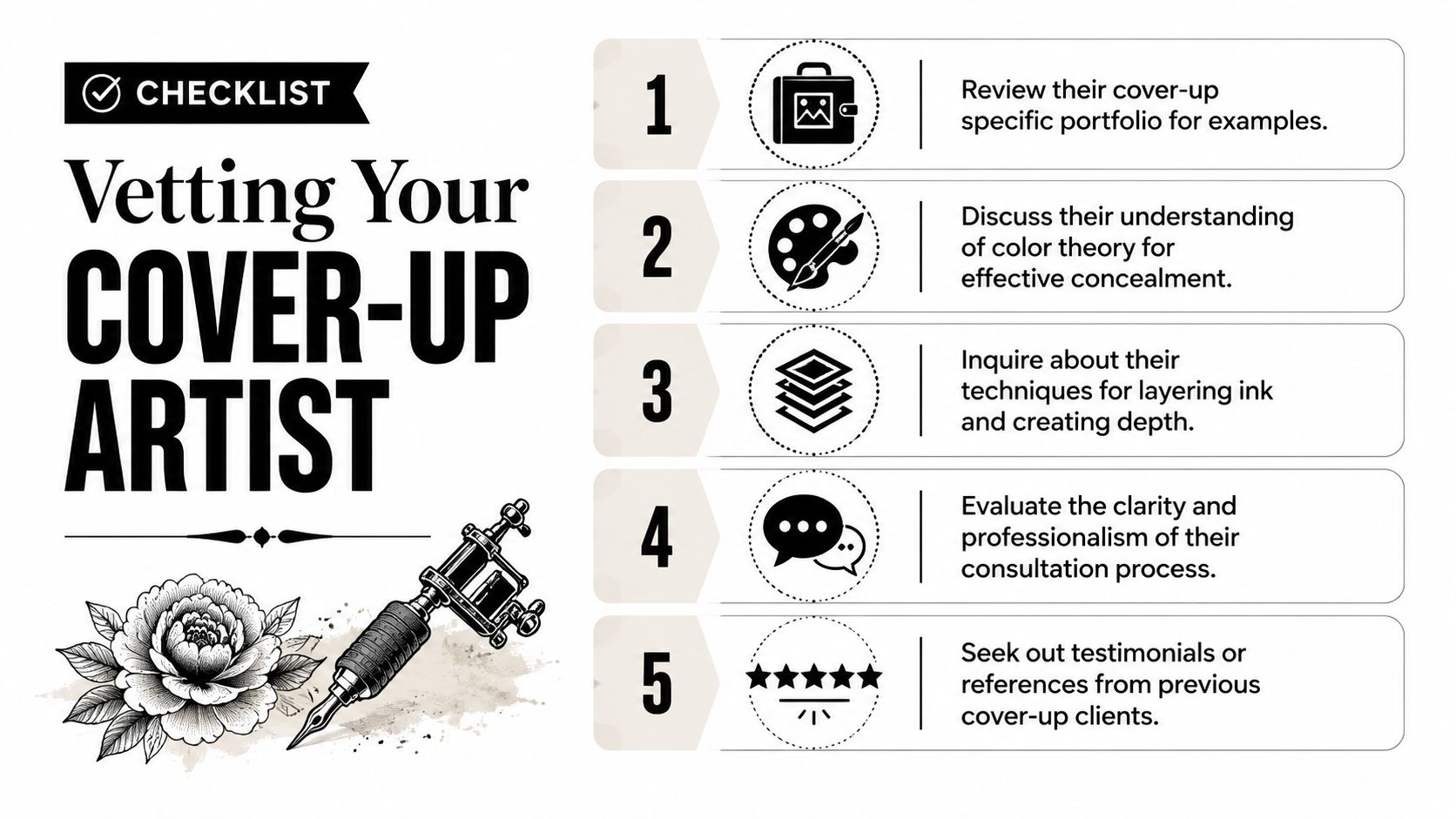
Here's a simple consultation checklist:
| Checkpoint | What you want to hear |
|---|---|
| Portfolio review | Examples of actual cover-ups, not only fresh tattoos |
| Design honesty | Clear limits on size, detail, and subject matter |
| Color approach | Realistic discussion of darker saturation and concealment |
| Session planning | Willingness to split work if the skin or design demands it |
| Healing expectations | No promises of magic, only a workable plan |
If you're searching locally and trying to verify that a studio is established, updated, and easy to contact, it helps to understand what Google Business Profile is and how legitimate local businesses use it for reviews, location details, and service visibility. It won't prove artistic quality on its own, but it can help you confirm you're dealing with an active studio rather than a half-maintained social account.
Consultation reality check: If you leave the meeting with a bigger tattoo, a darker design plan, or a recommendation to fade first, that doesn't mean the artist failed you. It usually means they told you the truth.
The best consultations don't flatter. They clarify.
Understanding the Cover-Up Timeline and Costs
A client books what they assume will be a one-day cover-up, then learns the old tattoo is too dark, the design needs to be larger than expected, and the skin needs time between steps. That is a normal cover-up conversation. The timeline usually runs longer than people expect because the artist is solving two problems at once. They have to hide old ink and build a new tattoo that still reads cleanly after healing.
Why cover-ups take longer
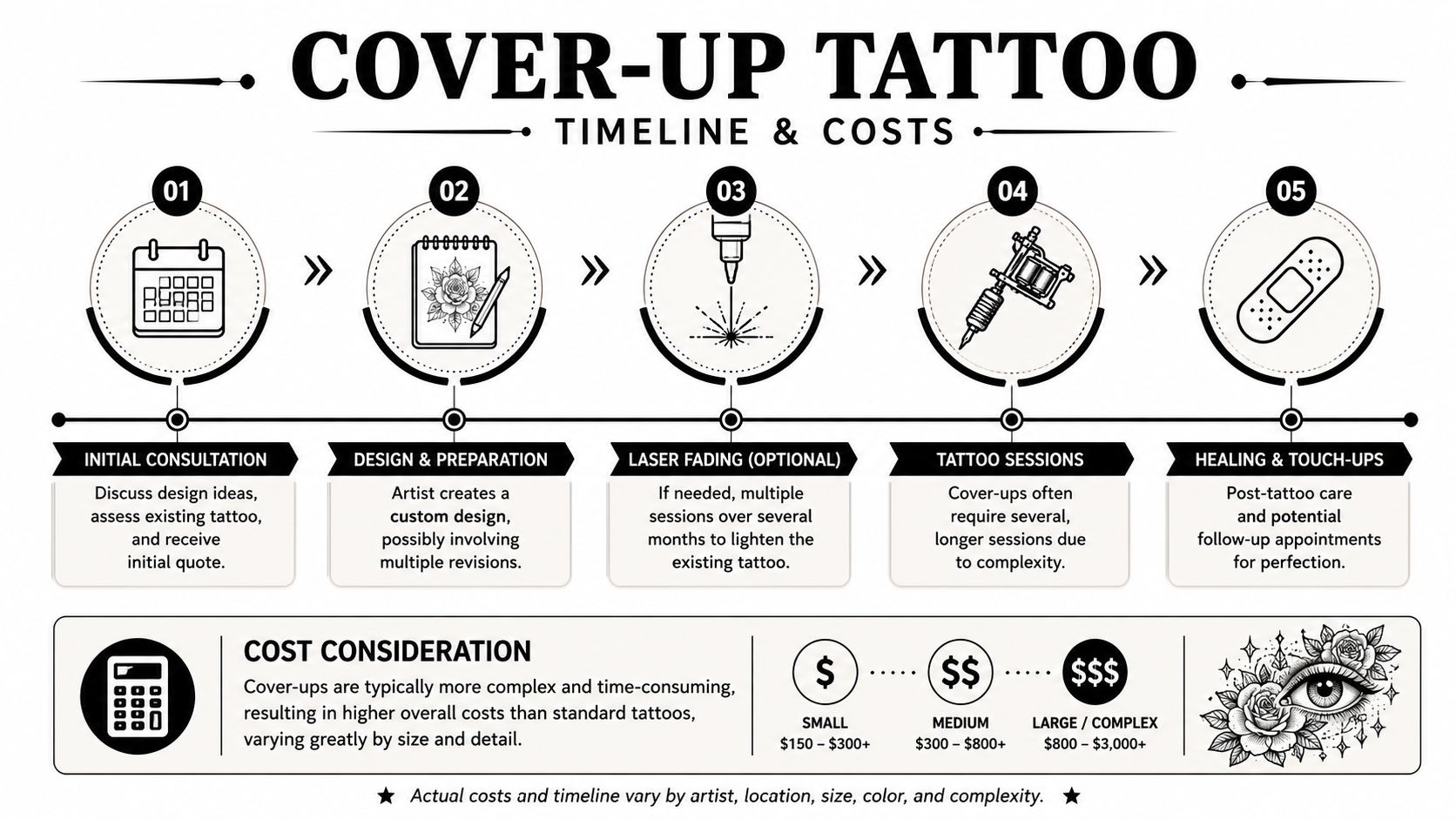
Fresh tattoos start with open space. Cover-ups do not. Old linework, dense black areas, scar tissue, and uneven pigment all change how an artist has to work. That slows the process down, even with a strong design.
As explained in Art n Soul's guide to how long cover-up tattoos take, cover-ups often take substantially longer than a same-size tattoo on untouched skin, and larger pieces are commonly split over multiple appointments. In practice, that extra time goes into decision-making as much as machine time.
The artist has to control several variables at once:
- Value control so old lines and shapes stop showing through
- Layering strategy so new ink heals with enough saturation to hold
- Skin response management on areas that may already be overworked or textured
- Design readability so the new tattoo looks intentional, not crowded
Laser fading can shorten the tattooing side of the project, even though it adds time upfront. I recommend clients look at the full sequence instead of only the tattoo appointment count. A few fading sessions can give the artist lighter material to work over, which often means better design options and fewer forced compromises. If you want a realistic sense of scheduling, this guide on how long tattoo removal can take before a cover-up lays out why fading and healing need room on the calendar.
How to budget without surprises
Price follows difficulty. A cover-up usually costs more than a fresh tattoo of the same dimensions because the artist is spending more time on design restraint, pigment control, and session pacing.
Rates vary by studio, region, and artist demand, so fixed numbers are less useful than a clear project plan. Ask how they charge, what is included, and what could change the quote. A fair estimate should account for the actual work, not just the final size on paper.
Build your budget around the full project:
- Consultation and redraw time
- Any laser fading sessions if the old tattoo is too dominant
- Tattoo appointments
- Healing intervals between sessions
- Possible finishing work after the main cover-up heals
This is the trade-off clients need to understand. Paying less upfront can leave you with a darker, larger tattoo that still struggles to hide the original. Spending more on preparation, especially fading when it is needed, often gives the artist more freedom and gives you a result that looks like a new piece instead of a rescue job.
Your Fresh Start Is a Project Worth Planning
You book a consultation hoping for a clean redesign, then hear the part many people are not prepared for. The old tattoo is too dark, too packed, or too large for the idea you want. At that point, the project is no longer just about finding a cover up tattoo artist. It is about giving that artist a workable surface.
A good cover-up replaces old ink with a design that sits well on the body and still reads clearly years later. That takes planning. If the original tattoo is left too heavy, the artist usually has to solve the problem with more saturation, more size, or both. Sometimes that is the right call. Often, it is purely the limit of what the skin allows.
This is why I treat cover-ups as a partnership between laser fading and tattoo design. Fading does not need to erase everything. It needs to lower the visual pressure of the old piece enough that the artist can build with shape, contrast, and negative space instead of forcing dark material over dark material.
That preparation also explains why strong artists turn some cover-ups down. They are not being difficult. They are protecting the result. If the client wants fine detail, lighter colors, or a smaller design than the old tattoo will permit, the honest answer may be to fade first or change the plan.
For many people, full removal is not the goal. They want a tattoo that feels intentional and current, not bare skin. A planned cover-up can get there faster, but only if the design stage starts with realistic conditions.
If you are weighing your options, EradiTatt Tattoo Removal is one provider that offers laser fading for clients preparing for a cover-up. Used selectively, fading can give the artist more freedom and reduce the compromises built into the final piece.
Patience matters here. The best cover-ups rarely come from urgency. They come from clear planning, honest consultation, and enough preparation to let the final tattoo look chosen rather than corrected.
If you're ready to explore fading before working with a cover up tattoo artist, EradiTatt Tattoo Removal offers consultations for people who want to lighten existing ink for a cleaner, more flexible cover-up plan.