You're staring at a choice that feels bigger than a class catalog. Maybe you've already seen someone go through tattoo removal, maybe you've got friends asking how the laser work is done, or maybe you're looking for a hands-on career that has a place in a clinic. Tattoo removal classes sit right at that crossroads, where technical skill, patient safety, and real-world demand meet.
The best programs don't just teach you how to push buttons on a device. They train you to read skin, think through risk, and understand why one client needs a different approach than another. If you're trying to figure out whether this is a practical career move, the answer starts with the curriculum, not the marketing.
Table of Contents
- Why People Choose Tattoo Removal Classes
- What Tattoo Removal Classes Actually Are
- Inside a Typical Tattoo Removal Curriculum
- Comparing Class Formats and Learning Models
- Florida Rules and Clinic Realities to Know
- Costs, Timeframes, and What to Budget
- How to Choose a Quality Program
- Career Paths and Next Steps After Class
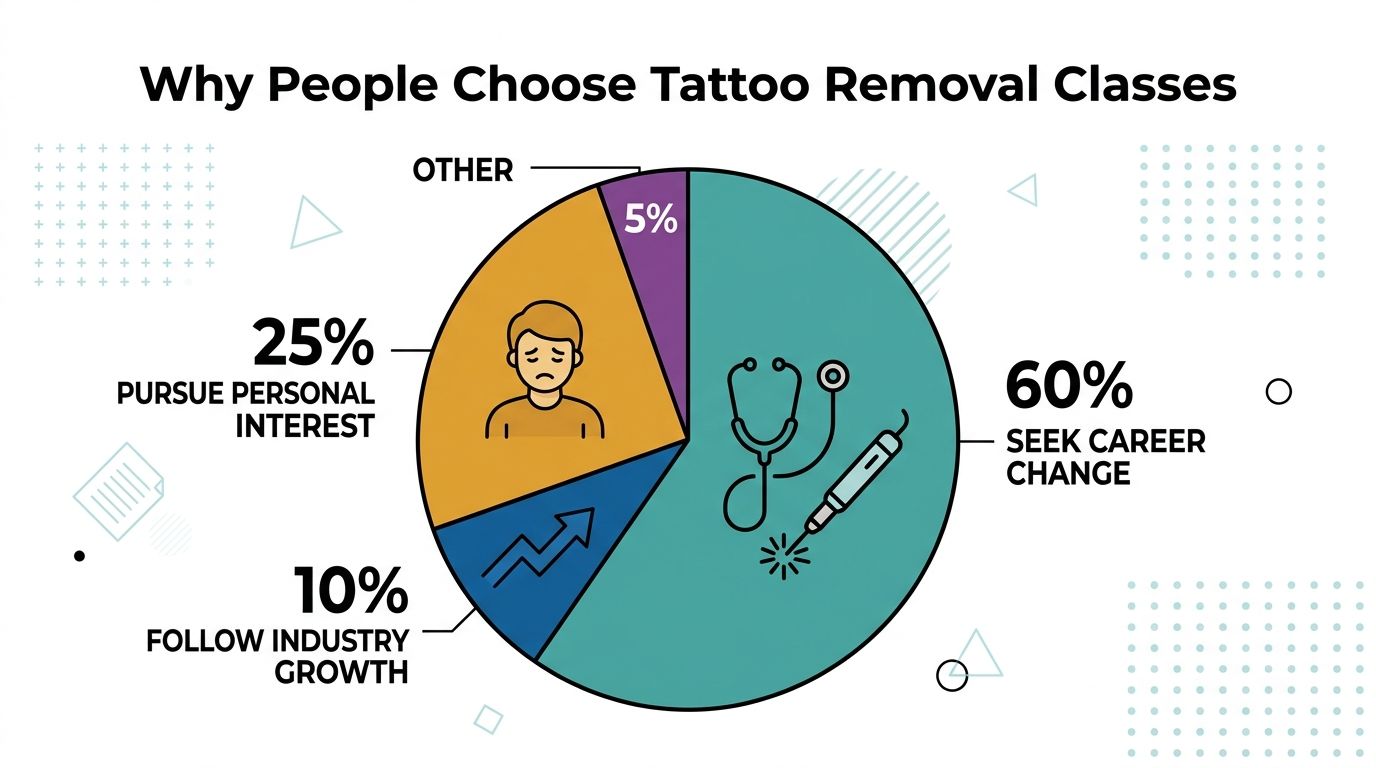
Why People Choose Tattoo Removal Classes
A client walks in asking how a tattoo can be removed, and the conversation can turn quickly from curiosity into career interest. Once people see the precision involved, they start to understand that tattoo removal is not a casual side skill. It depends on technical training, careful client communication, and consistent control of the equipment.
Demand exists because regret exists, and clinics feel that pressure in day-to-day scheduling. One industry estimate valued the tattoo removal market at about USD 1.2 billion in 2023 and projected 11.5% CAGR growth from 2024 to 2030 (source). The same report says roughly 23% of tattooed Americans ages 18 to 29 report regret and seek removal, which it translates into about 6 million potential patients in 2023. That does not mean every person books treatment, but it does explain why clinics keep looking for trained staff who can handle consultations, device use, and follow-up questions with confidence.
A career path with a clear floor, not a hobby course
People enter tattoo removal classes from different starting points. Some are estheticians who want to add a more specialized service to their menu. Some are licensed medical professionals who already know clinical workflow and want to build laser skill. Others are career changers looking for a procedure-based role where the results are visible and the work has a defined process.
The practical question is simple. Can the class show how a graduate fits into a real clinic day, or is it only teaching interest without readiness? A program that cannot answer that question is usually weak on implementation, even if the marketing sounds polished.
Practical rule: If a class cannot explain how its graduates fit into a clinic, it is probably selling interest, not readiness.
The work also reaches beyond standard beauty settings. Public-service and reentry programs use tattoo removal training to support free removal for justice-impacted adults, which changes the purpose of the skill from a revenue-only service to a tool that can help different kinds of clients. For many learners, that broader use is the draw, because it makes the training feel connected to a larger clinical and community need.
What Tattoo Removal Classes Actually Are
A tattoo removal class is a structured training program that teaches you how to help remove ink safely with laser technology. At the basic level, you learn how the device works, how to assess the skin in front of you, how to run a consultation, and how to manage expected side effects. A real class is less like a weekend demo and more like a technical onboarding process for a clinical service.
The biggest misconception is that all programs are the same. They aren't. Some are built for cosmetic professionals who want to add a treatment to an existing menu. Others are designed for medical-aesthetic settings where a physician oversees the work. A third, more emerging model focuses on service-learning, where students help provide free removal for justice-impacted adults in community settings.
Three common training models
A cosmetic track usually centers on workflow, client intake, and safe device handling in a medspa-style environment. A medical-aesthetic track goes deeper into supervision, documentation, and complication awareness because the clinic setting is more formal. Service-learning programs layer public-health goals on top of the technical training, which makes them attractive to learners who care about access and reentry support.
The point isn't to rank those models. The point is to match the program to your actual goal. If you want to work in a high-volume aesthetic clinic, you need a different emphasis than someone who wants to help with community-facing removal services.
“Choose the setting first, then the certificate.”
That advice sounds simple, but it saves people from buying the wrong course. If you know whether you want cosmetic work, supervised medical work, or mission-driven service, you'll read class brochures with a lot more clarity.
Inside a Typical Tattoo Removal Curriculum
A serious curriculum feels a lot like learning to cook in a professional kitchen. Laser physics is the heat source, skin anatomy is the ingredient you can't substitute, and treatment planning is the recipe that keeps the whole dish from burning. If any one of those parts is missing, the result can be sloppy, painful, or unsafe.
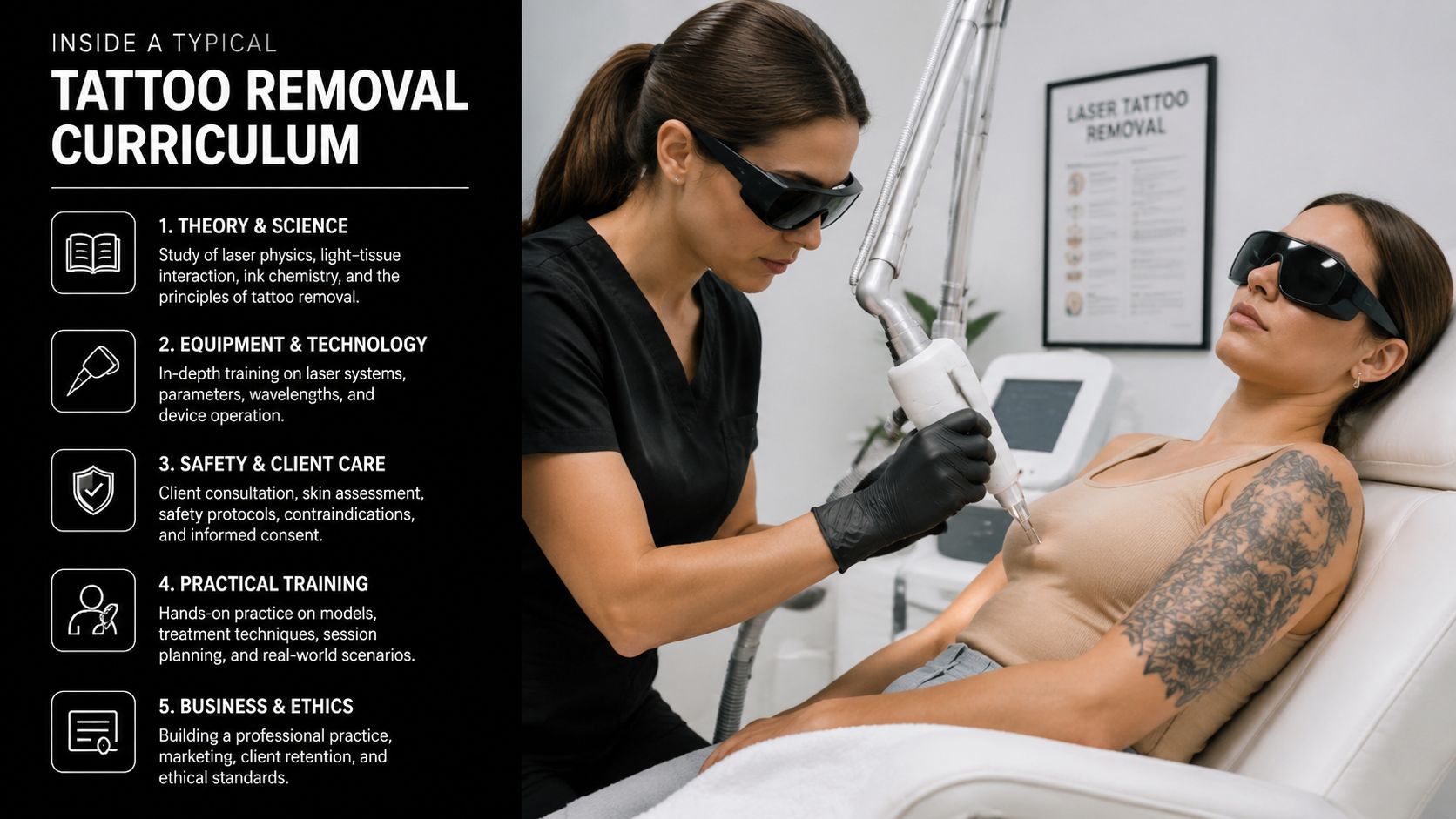
Most reputable programs start with Q-switched laser physics. The National Library of Medicine explains that these nanosecond pulses help fragment ink while limiting heat spread into surrounding skin, and that successful removal depends on matching wavelength to pigment while minimizing thermal injury. It also cites commonly used fluence ranges of about 4 to 8 J/cm² for QS ruby and 6 to 12 J/cm² for QS Nd:YAG systems (NCBI). In plain language, that means the beam has to be precise enough to hit the ink without cooking the tissue around it.
What should be inside the training block
A solid course usually covers these areas:
- Wavelength and pigment matching, because black ink, red ink, and mixed-color tattoos don't behave the same way.
- Skin typing and consultation, so you can spot when a client needs a more cautious plan.
- Fluence selection, which is the practical decision-making around energy settings.
- Aftercare and side-effect management, since the job doesn't end when the laser stops firing.
- Supervised hands-on practice, because device confidence only comes from doing the work with feedback.
One useful way to judge a program is to ask what a graduate can do on day one. Can they explain why one wavelength is chosen over another? Can they identify risk factors before treatment starts? Can they talk a client through expected redness, swelling, or incomplete clearance without sounding uncertain?
For a deeper look at how newer devices fit into current practice, the clinic perspective in this overview of newer tattoo removal technology is a helpful companion read.
Comparing Class Formats and Learning Models
Most buyers think in terms of convenience, but the better question is how much clinical confidence each format gives you. A class can be comfortable to attend and still leave you unprepared for a real treatment room. That's why format matters as much as content.
In-person, hybrid, and apprenticeship styles
A fully in-person course usually gives the most immediate exposure to the device, the room setup, and live practice. That's helpful if you're new to lasers and need your instructor close by while you build muscle memory. The tradeoff is scheduling, because you have to show up where the class is held.
Hybrid programs split theory and hands-on time. That works well if you want to learn the science at your own pace and reserve clinic days for the part that really needs supervision. The risk is that the online portion can become too passive if the course doesn't test understanding before you arrive.
Apprenticeship-style mentorship is the closest to day-to-day clinic work. You see how consultations flow, how a clinician handles nervous clients, and how the team reacts when a treatment plan needs to change. It's often the best fit for someone who already works in a clinic and wants to add a new service without getting blindsided on the first patient.
Practical rule: The right format is the one that matches your current experience, not the one with the flashiest brochure.
A nurse or other medically trained professional may care most about supervision structure and device protocols. A brand-new esthetician may need more time with skin typing and consultation scripts. Someone aiming for community or reentry work should ask about the program's patient population and service model, because that context changes everything.
Florida Rules and Clinic Realities to Know
Florida buyers need to think in two layers, legal authority and clinic practicality. The first question is who can legally operate a tattoo removal laser in the setting you want. The second is what a hiring clinic expects once you're in the door. Those are related, but they're not the same thing.
What clinics actually screen for
A strong resume in this field usually shows more than attendance. Clinics want evidence that you understand device familiarity, consultation flow, and complication handling. They also want to know you can communicate clearly with clients who are anxious, confused, or hoping for immediate results when the process is gradual.
That's where a well-run Florida clinic environment becomes a useful model. In a strong practice, intake is orderly, treatment plans are personalized, and post-treatment guidance is consistent. The point isn't to memorize one brand's workflow, it's to understand what professionalism looks like in a real room, from first question to follow-up.
How license and setting fit together
Florida job seekers should match their training to the role they want before they enroll. If your background is esthetics, you may need a program that keeps scope and supervision front and center. If you're coming from a healthcare background, you'll likely judge the course by how thoroughly it teaches clinical judgment, documentation, and patient safety.
A helpful cross-check is whether the program explains how laser training fits into broader healthcare-style credentialing. The Learniverse guide to healthcare certification is a good example of how structured certification paths can be evaluated, because it pushes readers to think about prerequisites, role expectations, and readiness instead of just the certificate itself.
If you're sorting through Florida options, the key question is simple. Does your current license, or the license you're planning to earn, line up with the environment where you want to work? If not, the class may teach skills you like, but not skills you can immediately use.
Costs, Timeframes, and What to Budget
The cheapest class is rarely the least expensive choice. If a program looks light on tuition, it may still cost more once you add travel, clinical days, model supplies, and retakes. The true budget is the full path from enrollment to first safe treatment.
What costs usually show up
Program length can range from a short intensive to a longer hybrid track, depending on how much live practice is built in. Tuition often reflects that structure, but the hidden costs matter just as much:
- Travel and lodging, if the hands-on portion isn't local.
- Model recruitment and session supplies, because practice depends on real human volunteers.
- Insurance and administrative setup, especially if you're planning early independent work.
- Retake or remedial fees, if a learner needs another attempt to demonstrate competence.
A buyer who only compares headline tuition is usually comparing the wrong number. The better question is how much supervised practice you get before you're expected to work on clients.
| Format | Typical Length | Tuition Range (USD) | Hands-On Hours |
|---|---|---|---|
| Intensive in-person | Varies by school | Varies by school | Higher concentration |
| Hybrid online plus clinic days | Varies by school | Varies by school | Moderate, scheduled |
| Apprenticeship-style mentorship | Varies by clinic | Varies by clinic | Highest on-the-job exposure |
For a broader look at why pricing in this field can feel uneven, this explanation of tattoo removal costs is a useful companion piece.
Budget rule: Don't price the class. Price the first six months of learning, practice, and setup.
That mindset keeps you from being surprised later. A course that looks more expensive up front can be cheaper if it includes enough supervised work to get you job-ready faster.
How to Choose a Quality Program
A good program tells you exactly what you'll be able to do when you finish. A weak one hides behind broad language like “training” or “industry recognized” without proving either point. That difference matters more than the logo on the certificate.
Questions that separate strong programs from weak ones
Look for a curriculum that names the devices used in training, spells out the skills you'll demonstrate, and identifies the instructor's clinical background. Ask how many live models are included, how feedback is delivered, and whether you get post-course mentorship after the classroom portion ends.
A strong program also talks openly about complications. If a school won't say how it handles pigment changes, incomplete clearance, or difficult skin types, that's a red flag. Fully online certification is another warning sign, because laser competence isn't built on slides alone.
The most useful admissions call is the one where you ask uncomfortable questions and listen to how cleanly they're answered. Try these:
- What exact devices are used in hands-on training?
- How many live models does each student treat?
- Who teaches the clinical portion, and what are their credentials?
- What does a graduate do if a treatment plan needs to change?
- Is there mentorship after class, or does the support end on day one?
For a broader look at the credential side of the field, this page on tattoo removal qualifications is a useful reference point.
Career Paths and Next Steps After Class
Good training doesn't end with a certificate. It should move you toward a clinic, a medspa, a dermatology practice, or a removal-only setting where you keep building speed and judgment. Some technicians later move into senior roles or training roles once they've proven they can handle real client complexity.
The field also keeps changing, so continuing education matters. Devices evolve, protocols shift, and clients come in with different skin tones, scar histories, and expectations. If you want to stay useful, you can't treat your first course like your last one.
For readers who like to see how people are matched to roles in other hands-on fields, the taap.bio trainer recommendations show a similar principle: choose a path that fits the kind of work you want to do. The same logic applies here.
Before you enroll, keep three questions in mind. Where will I practice? What license or supervision structure do I need? What level of hands-on training makes me feel safe, not just certified? If you can answer those clearly, you're ready to compare programs with a lot more confidence.
If you're ready to see how tattoo removal works in a real Florida clinic, EradiTatt Tattoo Removal can show you the treatment environment, explain the process, and help you decide whether this path fits your goals. A good next step is to visit a clinic, ask about the workflow, and watch the work up close before you commit to training.