
You’re probably here because you looked at a tattoo you no longer want, then looked at the price of removal and thought, “Why is tattoo removal so expensive?”
That reaction is normal.
For many people, the hard part isn’t deciding they want the tattoo gone. It’s trying to understand why removing ink can cost so much more than getting it in the first place. A small design may seem like it should be simple. A faded tattoo may look easy to erase. Then the estimate comes back, and the process suddenly feels more serious.
The important question isn’t just what tattoo removal costs. It’s what that price is paying for. In most cases, you’re not paying for a few flashes of light. You’re paying for specialized laser technology, careful treatment planning, safety protocols, skin protection, and the time it takes your body to clear broken-down ink properly.
That’s why “expensive” can be misleading. A lower price can look appealing at first and still cost more later if the treatment is poorly matched to your skin or tattoo. A higher upfront price can sometimes be the more economical choice when it helps you avoid complications and reach your goal with fewer setbacks.
Why We Ask About the Cost of Tattoo Removal
Price inquiries don't necessarily indicate cheapness. They ask because tattoo removal feels uncertain.
You can usually see the tattoo. You can usually name the reason you want it gone. But the process itself is less obvious. You may not know how many sessions you’ll need, how your skin will respond, or whether a quoted price reflects quality or just marketing.
The price question usually means something deeper
When someone asks, “Why is tattoo removal so expensive,” they’re often asking several questions at once:
- Will this work for my tattoo
- How long will this take
- Am I paying for quality or just overhead
- What happens if I choose the wrong place
- Is full removal even the right goal
That’s a smart way to think about it.
A tattoo isn’t like a stain sitting on top of the skin. The pigment sits in the skin at different depths, in different colors, with different densities. Removing it takes planning, not guesswork.
What people often miss at first
Many clients compare tattoo removal to getting tattooed. That makes sense emotionally, but it doesn’t work technically.
Getting a tattoo places pigment into the skin. Removal has to break that pigment into small enough fragments that your body can gradually clear them, while protecting the surrounding skin. That balance is why proper treatment takes time and why the cost is tied to much more than the few moments when the laser is firing.
A good consultation should make the price feel clearer, not more confusing.
When you understand the reasons behind the cost, you can judge the quote more intelligently. You can ask better questions. You can separate a realistic treatment plan from a risky shortcut.
The Investment Behind the Laser Technology and Expertise
The biggest part of the answer is simple. Good tattoo removal depends on expensive equipment and experienced hands.
A medical-grade tattoo removal laser isn’t a basic cosmetic device. It’s closer to a precision instrument. The laser has to deliver the right wavelength, the right energy, and the right pulse pattern for the ink being treated, while also accounting for skin tone, tattoo age, and the skin’s healing response.
Advanced lasers are a major business expense
According to this breakdown of tattoo removal laser equipment costs and maintenance, Q-switched lasers can cost clinics $100,000 to $300,000, while more advanced picosecond lasers cost even more. The same source notes that maintenance and calibration add 10-20% to annual overhead, and about $50-$150 of each session fee can come from amortizing the equipment itself.
That matters because the machine affects both safety and efficiency.
An older or limited laser platform may handle some tattoos reasonably well, especially simpler dark ink. But once you get into resistant ink, mixed colors, deeper pigment, or more complex skin considerations, the technology matters a lot more.
Why newer technology often costs more per visit
Picosecond systems usually charge more per treatment than older Q-switched systems. The reason isn’t arbitrary pricing. The machine itself is a larger investment, and it’s designed to break ink into smaller fragments more efficiently.
In the verified data, picosecond lasers are described as charging $300-$600 per session, while Q-switched Nd:YAG treatments are typically $200-$500 per session. The same data explains that picosecond technology can reduce sessions by 20-30% compared with older equipment when used appropriately for resistant or multicolored tattoos.
That’s why a session that costs more isn’t automatically a worse value.
Practical rule: Judge tattoo removal by the likely total path, not just the lowest single-session price.
If you want a useful outside perspective on the significant return on investment clinics expect from advanced laser technology, it helps explain why serious clinics invest heavily in better devices instead of treating laser equipment like a low-cost commodity.
Expertise is part of what you’re paying for
The laser doesn’t make decisions on its own.
Someone has to choose the settings, assess your skin, identify the ink challenges, time the sessions properly, and avoid aggressive treatment choices that can create injury. That’s where experience becomes part of the cost.
A provider has to think through questions like these:
| Decision area | Why it matters |
|---|---|
| Skin assessment | Skin tone and healing history affect how aggressively the tattoo can be treated |
| Ink evaluation | Dense black fill, layered cover-ups, and multicolor designs respond differently |
| Laser selection | Different inks respond better to different wavelengths and pulse characteristics |
| Session spacing | Treating too soon can interfere with healing and pigment clearance |
| Safety adjustments | Conservative settings may protect skin in situations where aggressive treatment would be risky |
Those decisions are why tattoo removal shouldn’t be treated like an interchangeable service.
If you want a plain-language look at how updated equipment changes treatment strategy, this article on new technology in tattoo removal is a helpful primer.
Cheap equipment can become expensive skin
A basic analogy helps. A high-performance vehicle and a budget car can both move, but they don’t handle difficult conditions the same way. In tattoo removal, difficult conditions include stubborn colors, darker skin tones, old scar tissue, and heavily saturated professional work.
When a clinic invests in stronger technology and proper calibration, you’re paying for control. That control can help your provider target ink more effectively while reducing the chance of avoidable skin damage.
That’s a large part of why tattoo removal is expensive. You’re buying access to precision.
How Your Tattoos Unique Profile Affects the Price
Even at the same clinic, two tattoos can have very different price ranges.
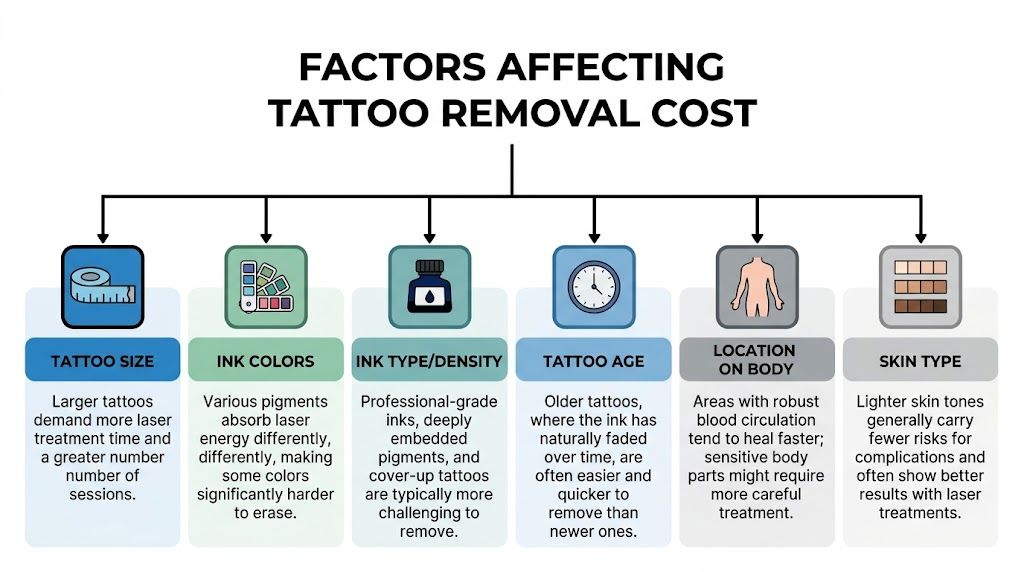
That’s because pricing doesn’t come from size alone. Your tattoo has its own profile. Color, density, location, depth, and age all influence how hard the ink is to break apart and how quickly your body can clear it.
Size changes treatment time fast
Larger tattoos need more laser coverage in each appointment. That usually means more pulses, more treatment time, and a higher session fee.
A tiny wrist symbol and a large sleeve aren’t remotely the same job. The larger tattoo doesn’t just take longer once. It often stays more demanding for the entire removal plan.
Color can make a tattoo much harder to clear
According to this review of the main factors that affect tattoo removal progress and cost, black ink is the easiest to remove, clearing 70-90% faster than greens, blues, and yellows. The same source says those tougher colors can add 2-4 extra sessions and increase total cost by 30-50%.
That surprises a lot of people.
From a client’s perspective, a colorful tattoo may look faded or light. From a laser perspective, some of those pigments are less cooperative. They may need more specialized wavelengths, more patience, or both.
Density and depth matter as much as color
Not all black tattoos are easy.
A lightly shaded older design is very different from dense, packed professional ink. If the pigment sits deeper in the skin or is heavily saturated, the provider may need more sessions and more careful settings to break it down safely.
The same verified source notes that embedded or dense ink may extend treatments to 8-15 sessions.
Dense ink often slows progress not because the provider is doing anything wrong, but because the skin needs repeated safe treatments to clear it without creating damage.
Body location affects fading
Some areas of the body tend to clear ink more slowly than others.
Tattoos on areas with poorer circulation, such as ankles or wrists, can take longer. Areas closer to the torso often respond more efficiently because your body is better able to process and clear the shattered pigment there.
This is one reason two tattoos of similar size and color can still move at different speeds.
Age and tattoo type can shift the plan
Older tattoos often fade more easily because the body has already broken down some pigment over time. Amateur tattoos can also behave differently from professional work, especially when the original ink placement was less dense or less uniform.
Professional tattoos usually have stronger saturation and more deliberate layering. Cover-ups can be especially tricky because there may be more than one layer of pigment interacting in the same space.
A quick comparison
Here’s a simple way to think about how tattoo profile changes cost:
| Tattoo trait | Usually lowers cost | Usually raises cost |
|---|---|---|
| Size | Small design | Large area or sleeve |
| Color | Mostly black | Green, blue, yellow, mixed colors |
| Density | Light shading | Heavy fill or layered ink |
| Placement | Torso or upper body | Ankles, wrists, hands, feet |
| Age | Older faded tattoo | Newer, saturated tattoo |
| Type | Simpler amateur work | Professional work or cover-up |
If you want a more detailed explanation of these variables, this guide to factors that can affect tattoo removal progress breaks them down clearly.
The True Price of Cheap Tattoo Removal
The cheapest quote can end up being the most expensive path.
That sounds dramatic, but in tattoo removal it’s often true. A low price may reflect older equipment, weaker treatment planning, rushed consultations, or a provider using settings that aren’t appropriate for your tattoo or skin.
The hidden risk isn’t just slower fading
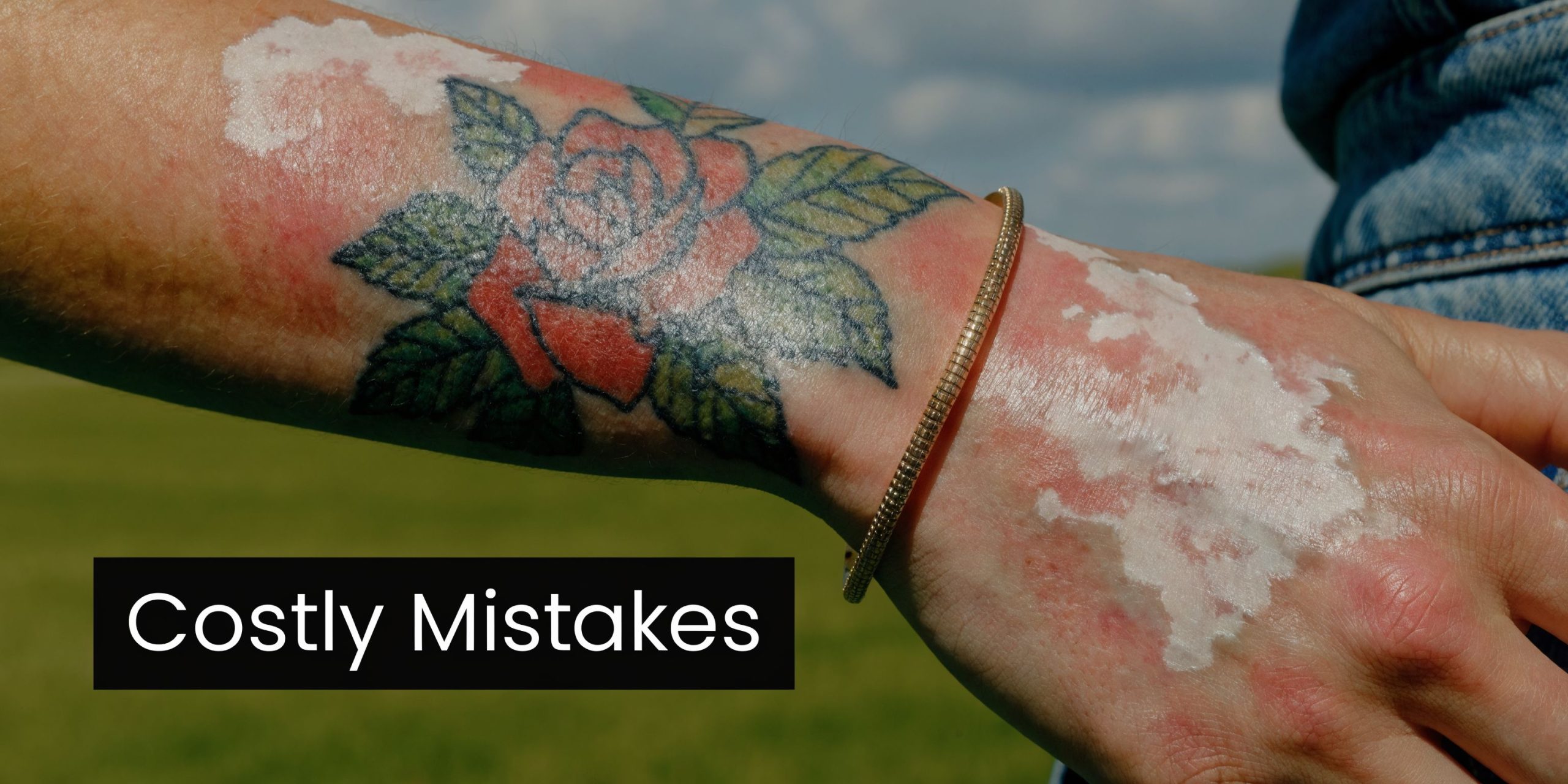
A lot of people assume the downside of a bargain treatment is that the tattoo won’t fade well. That can happen, but the bigger concern is skin injury.
When the wrong laser settings are used, or the wrong technology is chosen for the tattoo, the skin can develop scar tissue. Once that happens, the problem changes. You’re no longer dealing only with unwanted ink. You may also be dealing with a textural skin issue that is harder to correct.
According to this article on reducing tattoo removal costs by avoiding poor treatment choices, provider errors or suboptimal laser choices can cause scar tissue formation that traps ink, making it difficult to remove with standard lasers. The same source says this can push total cost to over $6,500 for a single tattoo once scar resurfacing treatments are added.
Why this happens
Tattoo removal is a balance between enough energy and too much energy.
If treatment is too weak, progress may stall. If treatment is too aggressive, skin can react badly. An experienced provider adjusts for skin tone, inflammation, tattoo depth, and pigment behavior rather than chasing a dramatic result in one visit.
That’s why a very low price should make you ask sharper questions, not relax.
Ask things like:
- What type of laser are you using
- How do you choose settings for my skin and ink colors
- What risks do you review before treatment
- What happens if the tattoo develops textural change or pigment change
- Are you planning full removal or fading for a cover-up
“Affordable” should include risk
A cheap session that causes complications isn’t affordable. It’s unfinished work plus corrective work.
Safe tattoo removal should leave you with less to fix, not more.
If you’re weighing low-cost alternatives, this article on the risks of alternative tattoo removal methods is worth reading before you commit.
The price of tattoo removal includes the condition of your skin at the end. That’s why quality matters so much.
Understanding Tattoo Removal Prices in Florida
Florida clients often want a practical answer. What do prices usually look like here?
The honest answer is that they vary, but there are still useful ranges. Geography, overhead, tattoo complexity, and treatment goals all affect the quote. A person in a busy metro area may see different pricing than someone in a smaller market, even for a similar tattoo.
A realistic budgeting range
A useful benchmark comes from this overview of average tattoo removal pricing and session ranges. It states that tattoo removal typically takes 4-12 sessions, with a single session averaging $200-$500 and total expenses often ranging from $1,000 to $10,000. The same source notes that the American Society of Aesthetic Plastic Surgery reported an average of $463 per session in 2023, and that a large, detailed piece can easily exceed $4,000.
Those numbers help frame the market, but they don’t replace an in-person assessment.
Why Florida quotes can differ
Florida isn’t one pricing environment.
A clinic in a high-demand urban area may have higher operating costs than one in a smaller community. Staffing, rent, equipment mix, and scheduling demand all influence what a provider charges.
A quote can also vary because the treatment goal changes the plan:
| Goal | What it often means for price |
|---|---|
| Full removal | More sessions and a higher total investment |
| Fading for a cover-up | Fewer sessions in many cases |
| Simple black tattoo | Often more straightforward to treat |
| Multicolor or dense tattoo | More complexity and usually more cost |
Session price is only part of the story
Many clients fixate on the per-session number because it’s easy to compare. But a treatment plan with a slightly higher session fee may still be the better budget choice if it’s better matched to your tattoo and avoids wasted visits.
That’s why the best estimate is personalized.
A useful consultation should tell you what’s driving the quote, not just state the quote.
If you’re in Florida, it makes sense to ask for clarity on what’s included, whether the goal is complete removal or fading, and how your tattoo’s color and density shape the likely plan.
Smart Strategies to Manage Your Tattoo Removal Budget
Tattoo removal can be a significant expense, but that doesn’t mean you’re stuck with one payment style or one treatment goal.
There are smart ways to manage the cost without lowering your standards. The key is to reduce waste, improve predictability, and choose a plan that fits what you need.

Consider packages and financing
One of the biggest changes in recent years has been the growth of structured payment options. According to this guide on financing and bundled tattoo removal packages, some providers now offer complete removal packages with fixed monthly payments instead of unpredictable pay-per-session pricing. The same source says bundled pricing can reduce overall cost by 20-40%.
That helps in two ways.
First, it makes budgeting easier. Second, it can protect you from the uncertainty that comes with paying one session at a time when you already know the tattoo will need a longer plan.
Match the goal to the reason you’re removing it
Not everyone needs complete removal.
If your real goal is to make room for a new tattoo, fading may be the smarter option. A cover-up artist often doesn’t need blank skin. They need a lighter, less dominant version of the old design.
That can change the economics of the whole process.
A few examples:
- Career policy change. If the tattoo is in a visible area and needs to be gone, full removal may make sense.
- Wedding or major life event. If your concern is appearance in the near term, targeted fading might achieve the goal faster.
- New tattoo plan. If you’re replacing the old design, cover-up fading can be far more efficient than chasing total clearance.
Ask better questions before you commit
Budget management starts before the first treatment.
Ask questions that reduce the chance of surprise costs later:
- Is this quote for full removal or fading
- What type of laser will be used for my tattoo
- How does my ink color affect the likely plan
- Are package rates available
- Do you offer financing or payment plans
These questions don’t just help your wallet. They help you avoid choosing a plan that doesn’t match your actual goal.
Think in total outcome, not monthly discomfort
People sometimes choose the smallest possible payment without thinking about the full path. That can backfire if it locks them into weak treatment choices or vague expectations.
A more useful way to compare options is:
| Question | Why it helps |
|---|---|
| Can I predict the monthly cost | Easier planning and less financial stress |
| Does the plan fit my deadline | Important for work changes or events |
| Do I need full removal | You may save money with fading |
| Is quality built into the plan | Prevents false savings from poor treatment |
One practical option in Florida is EradiTatt Tattoo Removal, which offers consultations for both complete removal and cover-up fading so clients can compare treatment goals before committing to a plan.
Paying in a smarter structure can make tattoo removal feel manageable, even when the total project is significant.
Choosing Value Over Price for Your Skins Future
By the time someone seriously considers removal, the tattoo already carries emotional weight. It may remind you of a job you’ve outgrown, a relationship that ended, an impulsive decision, or a version of yourself that no longer fits.
That’s why the decision shouldn’t rest on price alone.
Expensive compared to what
Tattoo removal can feel expensive if you compare it to the original tattoo session. It can feel reasonable if you compare it to the value of clear skin, a successful cover-up, or avoiding long-term complications.
That’s the shift that matters.
You’re not just paying for flashes from a laser. You’re paying for the combination of technology, judgment, restraint, and treatment planning that protects your skin while moving you toward your goal.
What a smart client looks for
A smart client doesn’t ask only, “How much is this session?”
A smart client also asks:
- What laser are you using for my tattoo
- How do you adjust for my skin type
- Do you think I’m a better candidate for fading or full removal
- What signs would tell you to change the treatment plan
- What risks should I understand before starting
Those questions move you toward value.
The long view usually costs less
The unique angle in all of this is that “expensive” is relative.
If a clinic invests in modern equipment, calibrates it properly, plans conservatively, and treats your tattoo with the right strategy, you may spend more upfront and still save money in the long run. You’re less likely to pay for wasted sessions, stalled progress, or corrective work for complications that should have been avoided.
That’s why quality treatment is often the more economical decision.
Your skin has to live with the result. Price matters, but so do texture, tone, healing, and confidence when the process is over.
If you’re comparing providers, use the quote as the start of the conversation, not the end of it. Ask what drives the number. Ask what technology is being used. Ask what your tattoo specifically needs.
Then choose the option that gives you the safest and clearest path forward.
If you want a personalized plan instead of a generic price guess, EradiTatt Tattoo Removal offers consultations across multiple Florida locations. A consultation can help you understand whether your tattoo is a better fit for full removal or fading, what factors are shaping your quote, and how to build a treatment plan that fits your skin, timeline, and budget.
2 Responses