The most common advice around a laser tattoo removal gun for sale is dead wrong. People start by shopping for equipment, when they should be asking whether buying a laser makes any sense at all. For most individuals, it doesn't, because real tattoo removal is a clinical service, not a gadget problem.
Professional tattoo removal sits inside a multibillion-dollar market that keeps growing, which tells you the demand is real, but it also tells you the equipment is serious business. One market report values the global tattoo removal market at USD 6.08 billion in 2024 and projects USD 26.28 billion by 2035 with a 14.2% CAGR, while another estimates USD 1.29 billion in 2025 rising to USD 4.87 billion by 2034 at 15.98% CAGR (market report). That kind of market growth doesn't point to a cheap handheld shortcut. It points to regulated, high-capex equipment, trained operators, and repeat clinical use.
Table of Contents
- Why Buying a Laser Tattoo Removal Gun Is Rarely the Shortcut It Looks Like
- How Laser Tattoo Removal Works
- Nanosecond vs Picosecond Lasers and Why the Specs Matter
- Certifications and Legal Status You Must Verify Before Buying
- A Practical Buyer's Checklist for Evaluating Any Listing
- Ownership Costs Beyond the Sticker Price
- Safety Risks and Liability Exposure of Nonclinical Use
- Why a Professional Clinic Is Usually the Smarter Choice
Why Buying a Laser Tattoo Removal Gun Is Rarely the Shortcut It Looks Like
People searching for a laser tattoo removal gun for sale usually want one of two things. They want to remove their own tattoo cheaply, or they want to bolt a new service onto a side business without building a real clinical operation. Both ideas sound practical until you price the machine, check the paperwork, and look at the liability.
The purchase price is not the real issue
Professional tattoo removal lasers are not consumer toys. One industry source says FDA-cleared tattoo removal lasers typically cost about $80,000 to $300,000, while another listing example lands around $39,950 to $34,950 for a laser tattoo removal machine (cost source). That is not remotely the same category as a personal device you buy and use on a weekend.
The commercial market history backs that up. Tattoo removal lasers have moved from niche equipment into a standard aesthetic-device segment, with one report placing the market at US$ 235.2 million in 2022 and forecasting US$ 328.5 million by 2028 at a 5.7% CAGR, and another estimating USD 128.6 million in 2021 rising to USD 289.6 million by 2030 at 9.6% CAGR (market history report). That scale is exactly why buyers run into professional-grade pricing, not hobby pricing.
Practical rule: If the listing price feels low enough to be an impulse buy, you're probably not looking at a legitimate clinical system.
Ownership only makes sense inside a real practice
The other mistake is thinking purchase price equals total cost. It doesn't. A machine that sits idle is just an expensive object. A machine that earns its keep needs rooms, training, insurance, service, calibration, and enough clients to justify the overhead.
That is why clinic ownership can work for established practices and usually fails for individuals. The better question is not, “Which laser should I buy?” It's, “Do I already have the licensing, workflow, and demand to operate one safely and legally?” If the answer is no, book treatment instead of chasing equipment.
How Laser Tattoo Removal Works
Tattoo removal works by breaking ink into smaller fragments the body can clear over time. The pigment sits in the dermis in particles that are too large for the immune system to remove on its own, so the laser delivers a very short burst of energy to shatter those particles without blasting the whole area with heat. That is why removal is a process, not a one-time shot.
The body still needs time between sessions. The FDA consumer update says results vary, multiple sessions are usually needed, and complete removal is not always possible, especially with brighter colors and deeper tattoos. Different pigments absorb different wavelengths, and ink placed deeper in the skin takes more than one visit to break down enough for the body to clear it.
That is why two machines that look nearly identical in a listing can perform very differently in a clinic. The wavelength, pulse length, spot size, and repetition rate all change how much energy reaches the pigment and how much of that energy spreads into nearby skin.
Why pulse length matters so much
Shorter pulses are the direction the field keeps moving because the energy hits the pigment fast enough to create stronger mechanical stress with less heat spread. Independent literature supports that shift, including a 2023 study on a 150 ps Nd:YAG system that found picosecond exposure disrupted pigment more efficiently than slower nanosecond delivery (Scientific Reports study). That is the reason picosecond platforms keep gaining ground.
The practical takeaway is plain. If a seller cannot explain how the ink breaks apart, they are selling hardware, not a treatment platform. If they promise instant removal, they are ignoring how skin, pigment, and recovery work.
For buyers trying to compare machine types, the specs matter far more than the marketing language. A useful reference is this comparison of nanosecond and picosecond tattoo removal systems, which makes the difference in pulse speed and equipment positioning easier to see.
Nanosecond vs Picosecond Lasers and Why the Specs Matter
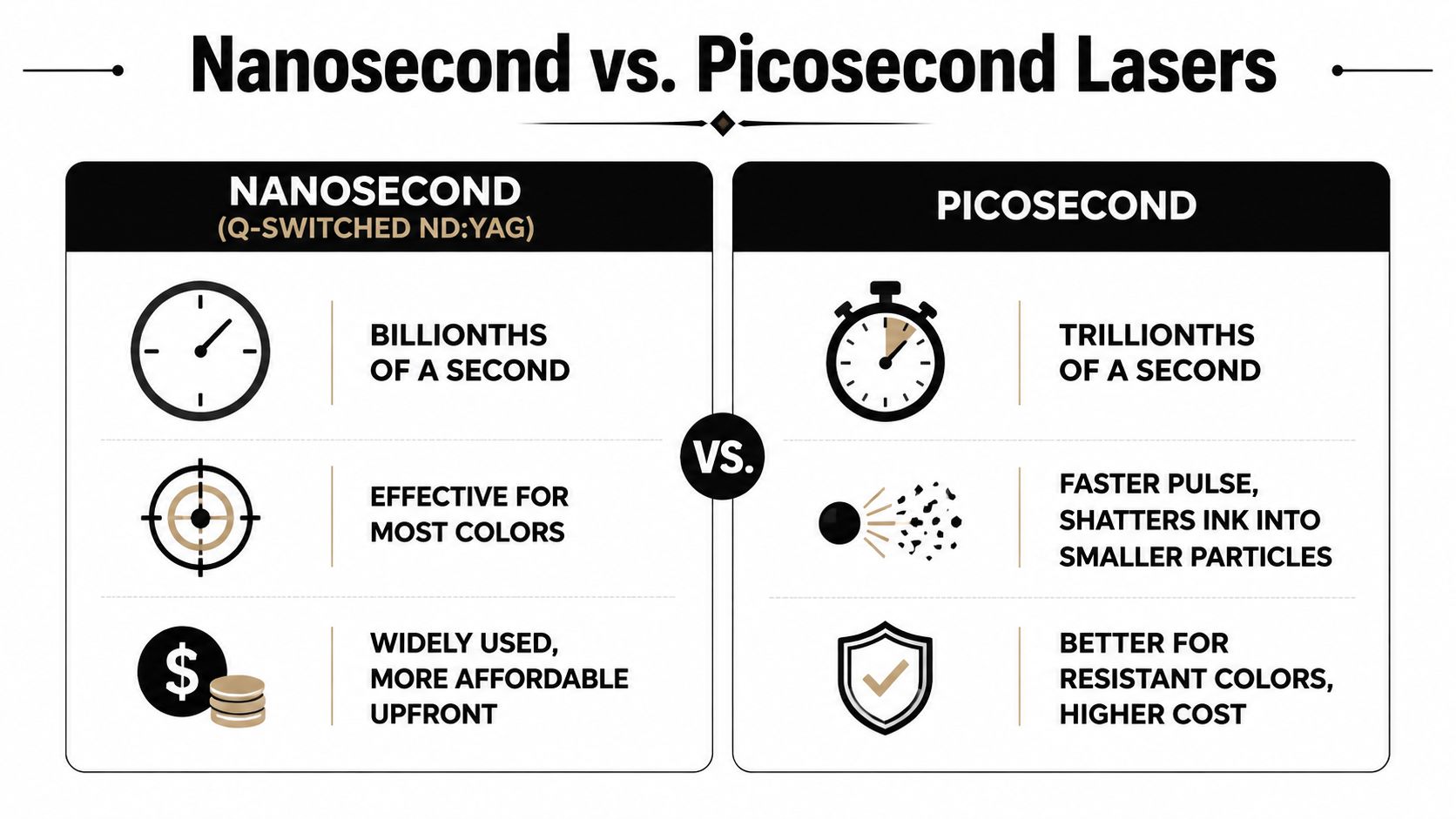
If you're comparing listings, start with pulse class. Nanosecond Q-switched Nd:YAG systems use billionths-of-a-second pulses and are the long-standing workhorse for dark ink. Picosecond systems use trillionths-of-a-second pulses and are built for tougher pigment disruption, especially when the goal is fewer sessions or better response on resistant colors.
The pulse difference isn't cosmetic. It changes how the ink breaks apart. Shorter pulses create a stronger photoacoustic effect, which is why picosecond platforms are often positioned as faster-clearing and gentler on surrounding tissue. That engineering logic is why clinics buying for multicolor work often move to picosecond or combined platforms.
The wavelength detail matters just as much. For major-market systems, 1064 nm is commonly used for black and dark blue ink, while 532 nm is used for red and orange pigments (device specification example). Spot sizes around 1 to 10 mm, pulse widths around 6 to 10 ns, and repetition rates up to 10 Hz are also standard commercial specs. Those are the numbers that tell you whether the machine is built for real treatment or just a glossy listing.
Practical rule: If a device can't clearly state its wavelength and pulse width, don't treat it as a serious purchase.
You can also see how serious buyers think about this in a clinic-first context, which is why the comparison on new technology tattoo removal is a better starting point than a marketplace ad. A legitimate buyer isn't just choosing “fast” versus “cheap.” They're choosing between a mature nanosecond platform and a more expensive picosecond platform based on ink type, skin type, and expected session count.
Certifications and Legal Status You Must Verify Before Buying
The worst listings are the ones that hide behind vague language. “FDA” on a brochure doesn't tell you enough. A legitimate purchase needs verification, not marketing. And operating the device needs more than ownership, because the law treats device clearance and operator authority as separate questions.
Clearance doesn't equal permission to use it
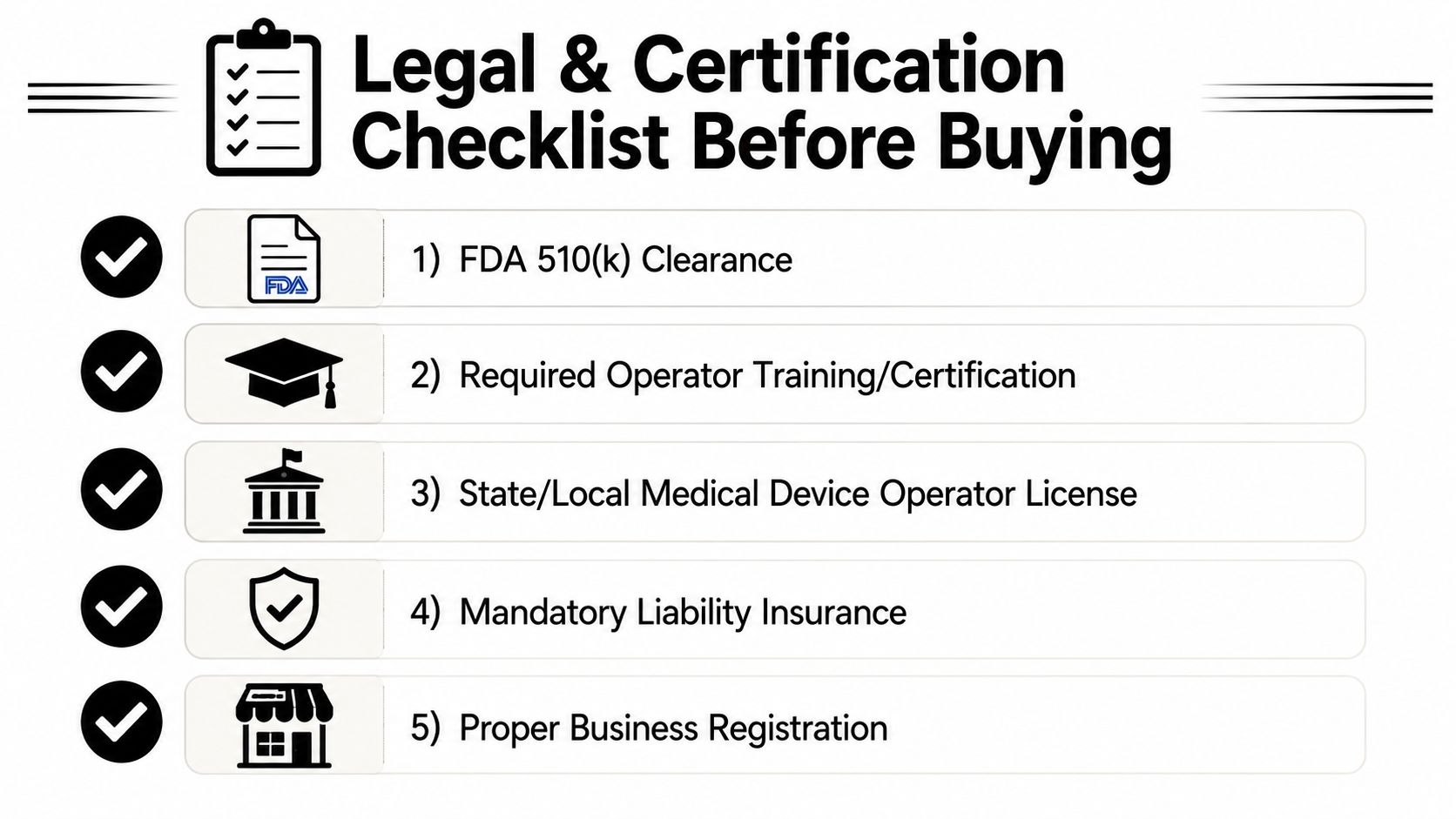
FDA clearance is the starting point, not the finish line. A buyer should ask for the specific 510(k) number and verify that it matches the exact model being sold. A missing or mismatched clearance number is a red flag, plain and simple.
State rules add another layer. Cosmetology boards, medical boards, and electrolysis boards each regulate who can fire a laser on a paying client, and those rules vary by jurisdiction. If the seller can't explain operator requirements in your state, they're not helping you buy a clinical device, they're helping you buy risk.
Training and insurance are part of the device, in practice
A real operator needs documented training, and insurers will care about that documentation. If you're unlicensed or operating outside the scope of your credentials, you can expect trouble from the carrier, from the board, and from the client if something goes wrong. The device doesn't protect you from that.
Use this as a hard filter for any listing:
- 510(k) paperwork: The exact clearance number should match the model, not just the brand.
- Operator training proof: You need a real training record, not a PDF manual.
- State authorization: Check whether your state lets you operate the laser on clients.
- Liability coverage: Confirm the insurer will cover the specific use case.
- Business registration: If it's a service business, the business needs to exist legally.
For a tighter credential framework, the tattoo removal qualifications guide is the kind of material buyers should read before calling a seller. That is the dividing line between a compliant clinical purchase and a risky impulse buy.
A Practical Buyer's Checklist for Evaluating Any Listing
A polished listing can still be a waste of time. The quickest way to sort a real clinical machine from a flashy imitation is to read the listing the way an operator would use the device in a room, under pressure, with a client waiting. Start with what the system can do, then demand proof from the seller.
What to check first
- FDA clearance number: The model should have a verifiable 510(k), not just a logo.
- Wavelengths offered: Make sure the device covers the ink colors you plan to treat.
- Pulse width: Nanosecond and picosecond units are not interchangeable.
- Spot size range: The beam should fit both small tattoos and larger coverage areas.
- Repetition rate: You want a device that can maintain practical workflow, not stall between shots.
- Calibration history: Ask for service records and energy stability documentation.
- Flashlamp hours or consumable wear: Used machines can be cheap for a reason.
- Training and installation support: A seller who disappears after payment is a bad sign.
- Software lockouts: Unlicensed use should not be possible on a legitimate clinical system.
- Shipping and protection: Crated, insured shipping is what you want for expensive medical hardware.
Here's the blunt version. If the seller cannot produce paperwork, service history, and training details, the listing is not ready for serious consideration.
| Specification | Clinical-Grade Expectation | Red Flag on Listing |
|---|---|---|
| FDA status | Clear 510(k) tied to the exact model | Generic FDA wording only |
| Wavelengths | Matches black, red, or multicolor treatment goals | No wavelengths listed |
| Pulse width | Listed clearly as nanosecond or picosecond | “Fast pulse” with no number |
| Service history | Calibration and maintenance records available | No records, no engineer contact |
| Training | Included, documented, and role-specific | “Easy to use” as the only promise |
The same practical mindset shows up in clinic operations, including the treatment flow at EradiTatt Tattoo Removal, where the work is built around real service delivery, not a one-off sale. That is the standard buyers should apply before spending anything on equipment.
Ownership Costs Beyond the Sticker Price
The sticker price is the smallest line item in ownership. That is the part people miss when they search for a laser tattoo removal gun for sale and assume the machine itself is the whole investment. It is not. Real ownership starts after the purchase, and that is where the budget gets real.
What the machine does not include
A professional laser needs a proper treatment room, the right electrical setup, consumables, service, maintenance, and staff training. It also needs a client pipeline, because idle equipment never pays itself off. That is why the economics only work when a clinic can keep the chair full.
The client side of the market shows why. Public pricing discussions on why tattoo removal is so expensive make the point clearly, removal is usually sold session by session, and the machine has to support steady paid volume to justify itself. If you are not already in that business, the math gets ugly fast.
The hidden costs stack up quickly
The ownership bill does not stop at the purchase order. You are paying for maintenance, replacement parts, calibration, training courses, and the risk buffer that comes with any medical device. If the machine fails or is misused, the cost is not just repair. It can be lost appointments, claims, and downtime.
A buyer who focuses only on the listing price is making the wrong decision. The equipment can look manageable at the start and become a drain once service calls, staffing, and compliance work begin. Small studios and individuals usually underestimate that burden.
| Cost Item | What It Means |
|---|---|
| Purchase price | High initial capex for a clinical device |
| Maintenance | Regular service and calibration |
| Parts | Flashlamps, optics, handpiece wear |
| Training | Operator education and competency checks |
| Insurance | Coverage tied to legal, licensed use |
If you want a cleaner view of clinic economics, compare the listed price with the ongoing obligations first. The blunt truth is that ownership only makes sense when utilization is high, compliance is already in place, and the business can absorb the overhead.
Safety Risks and Liability Exposure of Nonclinical Use
A tattoo removal laser is not a consumer gadget, and treating it like one is how people get hurt. As noted earlier, tattoo removal can cause temporary swelling, blistering, and scarring even in proper clinical care, which is exactly why a nonclinical setup makes the risk much worse.
What can go wrong outside a clinic
Outside a clinic, the failure points are obvious and unforgiving. Burns, pigment loss, permanent scarring, and eye injury from scattered laser energy are all realistic outcomes when a Class IV laser is used without the controls, training, and supervision that professional settings require. The tattoo is not the only thing at risk. Skin, vision, and your legal position are on the line too.
The liability exposure gets ugly fast because it is not limited to the injury itself. An unlicensed operator can lose insurance coverage, face board discipline, and in some cases be accused of practicing medicine without a license. If you personally own the device, the exposure sits with you personally as soon as something goes wrong.
The insurance problem is a deal-breaker
Insurance carriers do not like gray areas. If the use falls outside your license or outside the policy language, the carrier can deny coverage when a claim lands. Then the injury cost, legal defense, and settlement pressure all sit on your side of the table.
State medical board guidance on laser procedures makes the same basic point, use must stay inside the provider's training, authority, and scope of practice. That is the standard buyers ignore when they focus only on the machine listing and assume the rest will sort itself out.
Practical rule: If you cannot explain your licensing and coverage in one clean sentence, do not use the device on a paying client.
That is why the DIY angle is a bad bet. The machine may look self-contained, but the medical, insurance, and legal consequences are not. For anyone outside a compliant practice, ownership is usually the wrong move.
Why a Professional Clinic Is Usually the Smarter Choice
A clinic removes the guesswork. A multi-wavelength system can treat different ink colors more intelligently, trained technicians know how to adjust pulse settings, and the patient gets documented care instead of a one-off purchase with no support. That is the path that solves the problem.
Clinical treatment also fits real-world timing. Sessions are spaced so the body can clear fragmented pigment between visits, and the clinic controls the aftercare, follow-up, and documentation if the skin reacts. That paper trail matters when outcomes vary, which they often do.
For people pursuing full removal, cover-up fading, appearance-policy compliance, or a clean slate for a major life event, clinic-based treatment is the safer and smarter move. If you're not already running a compliant aesthetics practice, buying the laser is usually the expensive mistake.
EradiTatt Tattoo Removal uses laser tattoo removal services with a PiQo4 laser system, so the service model is built around treatment rather than ownership. If you're comparing options and want a direct path to evaluation, visit EradiTatt Tattoo Removal and book a consultation instead of guessing at equipment.