
Most medical professionals and lactation experts recommend postponing laser tattoo removal while breastfeeding until weaning is complete. That caution is about the lack of specific safety research, not proven harm.
A new tattoo decision often shows up at the exact moment you're already making a hundred other choices for your baby. If you're looking at an old design and wondering whether you can finally start removing it, the short answer is that the safest recommendation is usually to wait, then plan the treatment properly for after nursing. The reason is simple, there's no direct clinical data showing how tattoo ink fragments behave during removal in the breastfeeding period, so experts take the cautious route Australian Breastfeeding Association guidance.
Table of Contents
- Your Guide to Tattoo Removal as a New Parent
- How Laser Removal Interacts with Your Body
- Understanding the Primary Concerns for Nursing Mothers
- What Medical Experts and Lactation Consultants Recommend
- Planning Your Tattoo Removal for After Weaning
- Frequently Asked Questions for Nursing Parents
Your Guide to Tattoo Removal as a New Parent
You might be sitting with a sleeping baby on your chest, staring at a tattoo that no longer feels like you. That feeling is real, and it doesn't make you vain or impatient. It makes you human.
For a breastfeeding parent, though, the safest recommendation is still to postpone laser tattoo removal until after weaning is complete. That advice comes from caution, not from evidence of proven harm. The key issue is that the breastfeeding period has a thin evidence base, so clinicians and lactation groups tend to avoid elective procedures when the infant's exposure can't be well studied Australian Breastfeeding Association guidance.
Practical rule: If a procedure is optional and the milk-transfer question hasn't been studied, the conservative choice is to wait.
That doesn't mean your plan has to stall forever. It means you can use this time to decide whether you want complete removal, light fading for a cover-up, or a later treatment plan that fits your family schedule. If the emotional side of this decision is weighing on you, compassionate mental health care for single moms can be a meaningful support while you sort through postpartum changes and body-image stress.
For a broader understanding of the process itself, many parents also like to review the technical side before they book anything. A clear breakdown of treatment mechanics can help you feel less uncertain when the time does come to move forward.
How Laser Removal Interacts with Your Body
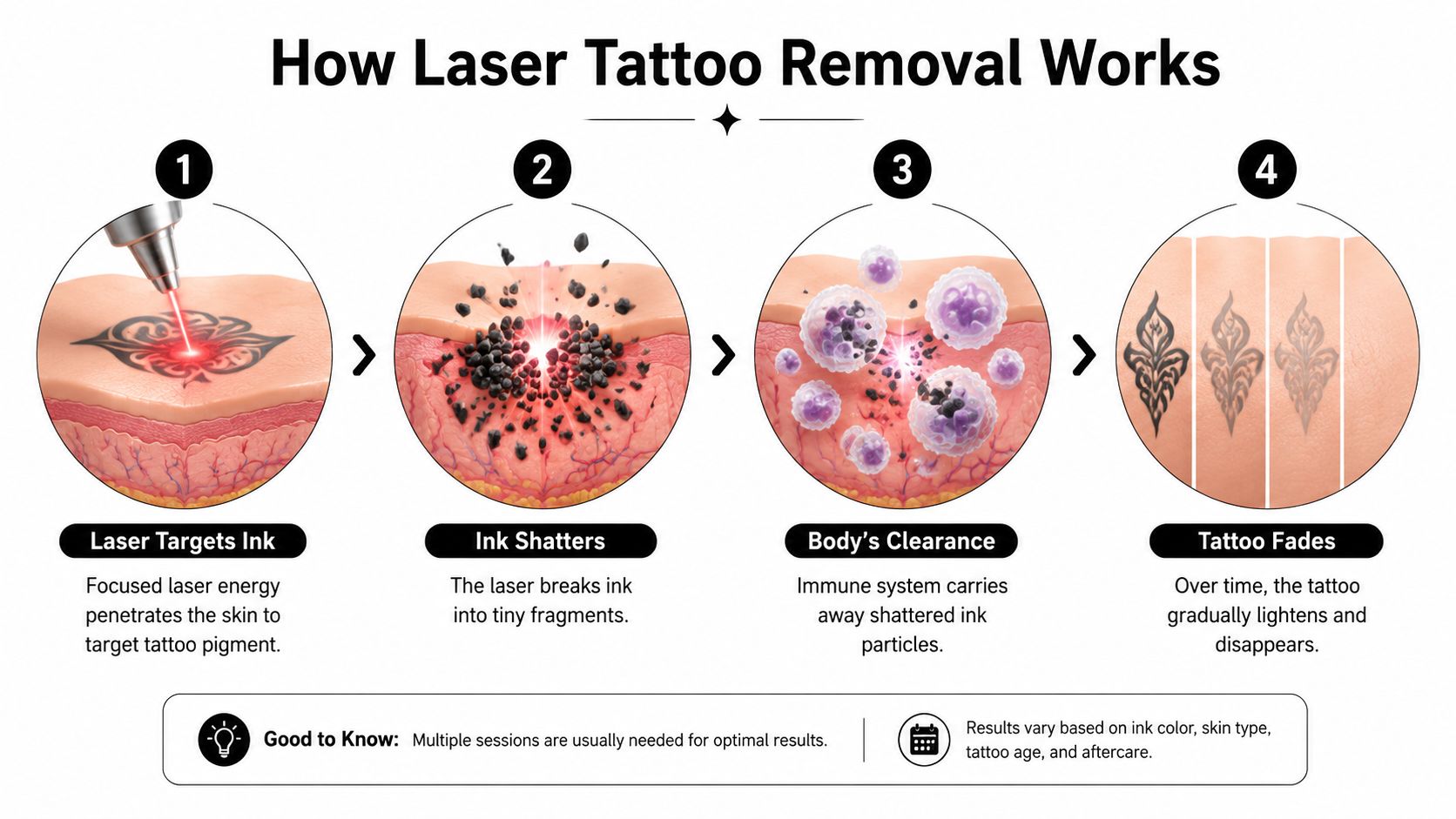
Laser tattoo removal does not pull ink out of the skin. It breaks tattoo pigment into smaller particles, and your body then clears those particles over time through the immune and lymphatic systems, with filtration through the liver. That is the basic biology behind the treatment, and it is also why the milk-safety question is about what happens after the pigment has been fragmented, not about the laser beam itself.
The body's clearance pathway
The key clinical point is that laser tattoo removal is a localized procedure, not a systemic drug. The energy stays focused in the skin, but the cleanup process relies on the rest of the body. For anyone breastfeeding, that distinction matters because the concern is whether the fragmented pigment could enter circulation and then reach breast milk after treatment.
The process works like a controlled breakdown of the tattoo inside the skin, followed by gradual removal by the body's own clearance systems. If you want a fuller explanation of the treatment mechanics, how tattoo removal works in detail gives a clear look at what happens during a session and why the ink does not just vanish at the surface.
That is also why cold laser discussions can cause confusion. how cold laser therapy aids recovery refers to a different use of light-based treatment, while tattoo removal uses pigment-targeting energy to break ink apart. The clinical caution in nursing parents comes from the pigment breakdown itself, since that is the step that raises the unanswered milk-transfer question.
Understanding the Primary Concerns for Nursing Mothers

A nursing parent usually wants a direct answer, and the honest one is that the main concern is the lack of breastfeeding-specific safety data. The issue is not that laser tattoo removal has been shown to harm milk supply or infant health. The problem is that no one has studied the exact milk-transfer question well enough to turn that uncertainty into a clean safety claim.
A peer-reviewed review in PMC says that most cosmetic procedures, including lasers, are generally considered low concern during lactation because major systemic absorption is unlikely, but it also makes clear that laser tattoo removal remains a cautious exception because direct studies on ink transfer during breastfeeding are missing PMC review.
Why tattoo removal is treated differently
Tattoo removal is handled differently because the procedure is designed to fragment ink particles inside the skin. Once the pigment is broken down, the practical question is whether any of that material could enter circulation and then reach breast milk. No direct study has answered that for the breastfeeding period, which is why the recommendation stays conservative rather than definitive Australian Breastfeeding Association guidance.
That uncertainty matters more than the laser beam itself. The treatment is local, but the body's cleanup process is not. Lactation resources consistently note that there are no studies measuring ink-particle transfer into milk during removal, and that gap is the reason many clinicians advise waiting until weaning is complete Breastfeeding Support. The same caution appears in advice from La Leche League International, because absence of evidence is not the same thing as evidence of safety.
Skin reaction is another part of the conversation. Even when treatment is technically localized, poor technique or an aggressive setting can leave prolonged redness, blistering, or laser tattoo removal scars, which is a separate reason to choose the timing and the provider carefully. The goal is not to create avoidable healing problems while you are already managing the physical demands of nursing.
For parents who are trying to sort through the decision, a practical breast-feeding question may be easier to answer than the laser question itself. If your milk supply is already fragile, expert tips to increase milk supply may be more immediately useful than trying to force cosmetic treatment into an already demanding routine.
The most accurate summary is simple. The procedure is localized, but the uncertainty sits in the body's systemic cleanup biology. That is why clinicians focus on transfer risk, healing, and the lack of direct data instead of treating the laser handpiece as the main issue.
No direct breastfeeding study means no direct safety claim.
If you are weighing this during a stressful stage of early parenting, it helps to separate the wish to solve the tattoo now from the medical question of whether now is the safest time. The treatment can wait. Your child's feeding routine and your recovery deserve the lower-risk choice.
What Medical Experts and Lactation Consultants Recommend
A new parent who is trying to make a decision about laser tattoo removal while breastfeeding usually gets the same clinical answer from lactation specialists and medical reviewers. They advise waiting until breastfeeding has ended. The reason is practical, not dramatic. There is very little direct safety data on laser tattoo removal during lactation, so experts are not willing to call it milk-safe on the basis of assumption alone.
The precautionary principle in practice
That is the precautionary principle at work. When a procedure is elective and the evidence is thin, clinicians usually recommend postponing it so the baby is not exposed to an avoidable unknown. The concern is not that harm has been proven. The concern is that the field has not shown enough direct evidence to rule out transfer risk with confidence, including the possibility of broken-down ink particles entering breast milk, as discussed by La Leche League International.
The same cautious pattern appears in broader cosmetic guidance. The PMC review notes that many cosmetic procedures are generally treated as low concern during lactation, yet tattoo removal remains a special case because the direct ink-transfer question has not been answered well enough. That distinction matters. A procedure can sit in a generally reassuring category and still deserve delay when the specific safety data are missing.
Parents also have to think about the rest of their recovery, not just the tattoo itself. Feeding demands, sleep loss, and skin healing can all compete for attention at once, which is why some families focus on expert tips to increase milk supply while they sort out elective care decisions. That does not change the tattoo guidance. It does keep the decision grounded in day-to-day reality.
A clinic should be able to explain its position clearly. If you are comparing readiness with provider standards, tattoo removal qualifications is a useful place to start. The right response from a provider is not pressure. It is a careful explanation of why waiting is recommended and what they would want to see before treatment begins.
If a procedure can wait without harming the parent or child, lactation guidance usually favors waiting.
The most accurate takeaway is simple. Experts have not proven that laser tattoo removal harms breastfeeding. They have also not gathered enough direct evidence to say the procedure is safe for milk-fed infants, so they recommend caution until nursing is over.
Planning Your Tattoo Removal for After Weaning
Waiting doesn't have to feel passive. It can be the point where you build a clear plan, choose the result you want, and avoid rushing into a decision that doesn't fit your current life. If you know you want the tattoo gone eventually, the smartest move is to map out your future treatment now and leave the actual laser sessions for after nursing has ended.
What to do while you wait
Start with the result you want. Full removal and fading for a cover-up are different goals, and they can affect how many sessions you'll want and what kind of timeline makes sense. A consultation can also help you understand whether your design is a good candidate for complete removal or whether gradual fading is the more realistic route.
You can also use this time to find a clinic that works with your schedule and skin type. EradiTatt Tattoo Removal provides laser tattoo removal in Florida, and a no-obligation consultation can give you a practical treatment plan to revisit after weaning. That way, you're not starting from zero when the timing opens up.
A few planning steps help most parents stay organized:
- Write down your weaning target: Having a rough endpoint makes it easier to decide when to revisit treatment.
- Save photos of the tattoo: Good baseline images help a clinician assess ink density and color later.
- Ask about future aftercare: Knowing what products and downtime are involved makes post-weaning scheduling smoother.
- Confirm your clinic's timing policy: A careful provider should explain when they're comfortable starting.
The most helpful consultations aren't the ones that push you to book right away. They're the ones that give you a clear path and let you return when your body and baby are both in a better place.
Frequently Asked Questions for Nursing Parents
Is it safe during nursing
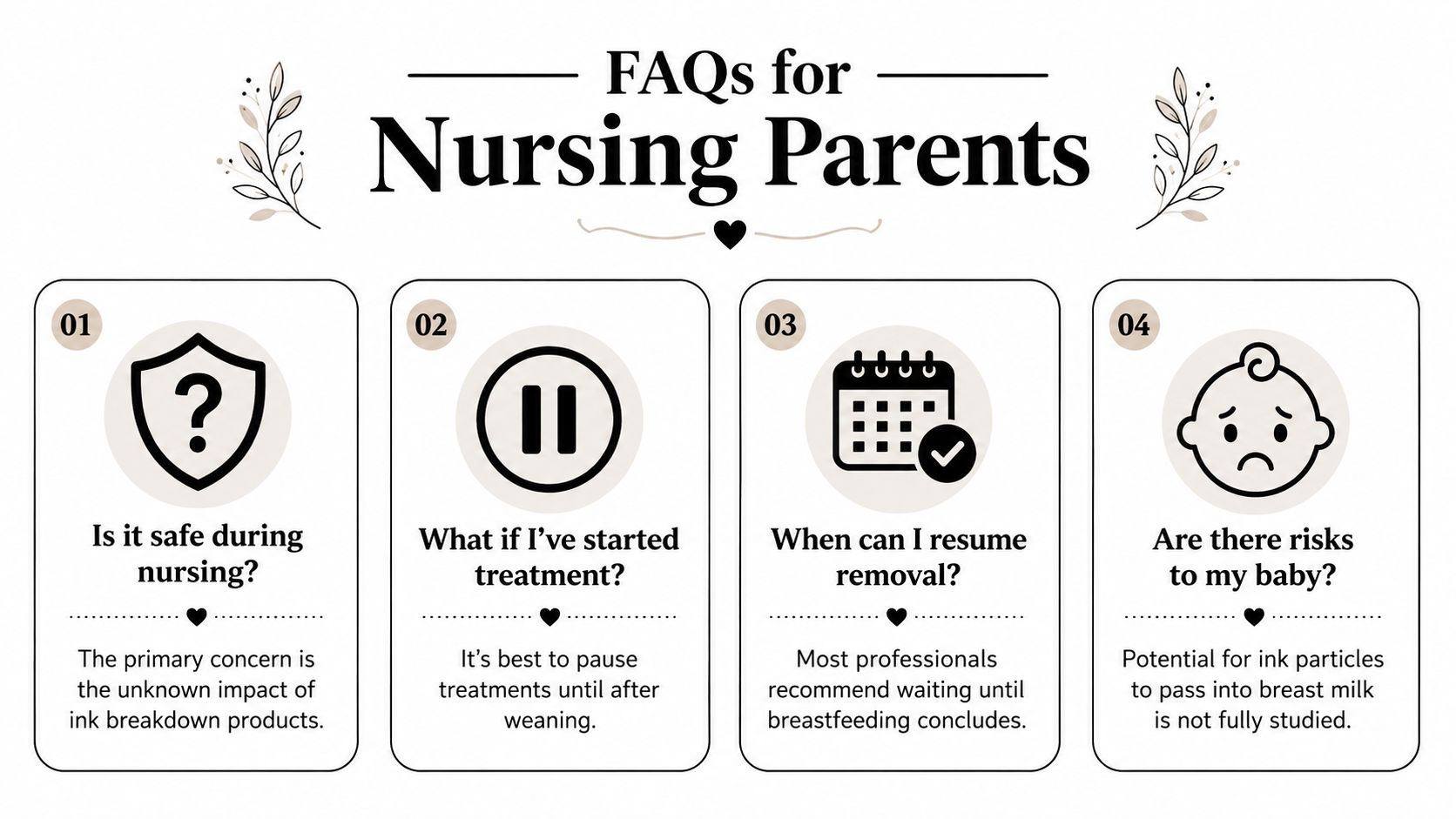
The cautious answer is no, not enough is known to call it safe. Lactation groups recommend postponing laser tattoo removal until breastfeeding has ended because there's no direct research on ink-particle transfer into milk Australian Breastfeeding Association guidance.
What if I've already started treatment
It's generally best to pause until after weaning. Because the concern is tied to the breastfeeding period itself, finishing the course later is usually the safer plan than trying to push through now. If you've already had one session, ask your provider to help you time the rest of the series after nursing is complete.
When can I resume removal
Most medical and lactation sources point to after weaning is complete as the appropriate time. Since the procedure's milk-transfer question hasn't been studied, the timeline is based on caution rather than a fixed scientific threshold La Leche League International.
Are there risks to my baby
The concern is theoretical, not proven. The issue is whether fragmented ink particles could enter milk after treatment, and that specific pathway hasn't been measured in breastfeeding parents Breastfeeding Support.
Do aftercare creams matter
They can. Aftercare products should be reviewed carefully, especially if they contain active ingredients you'd rather avoid while nursing. A clinic should tell you exactly what it uses and why, instead of assuming every postpartum parent has the same needs.
What's the most practical next step
If you want the tattoo gone, book a future consultation and plan around weaning instead of against it. That gives you a realistic path forward, keeps the focus on your baby's well-being, and lets you start treatment when the guidance is much clearer.
If you're ready to map out a future treatment plan, contact EradiTatt Tattoo Removal for a consultation and talk through your timeline, your skin type, and the kind of fading or full removal you want after weaning.