
You're probably here because a tattoo that once made sense doesn't fit the life you're building now. Maybe it shows under work clothes. Maybe your wedding date is on the calendar. Maybe you're thinking about enlistment, a career change, or getting rid of ink that no longer feels like you.
That moment is common in Orlando. The important part is knowing that laser tattoo removal in Orlando, FL is a real medical process with a realistic timeline, not a quick fix squeezed in a few weeks before a major event. One practical point is more significant than commonly realized: many professional tattoos need 6 to 12 sessions spaced 6 to 8 weeks apart, which can make the full process roughly 9 to 18 months according to a review discussed in this overview of laser tattoo removal timelines. If you have a deadline, planning early matters.
Table of Contents
- Your Fresh Start A Guide to Tattoo Removal in Orlando
- How Laser Technology Erases Unwanted Ink
- The Tattoo Removal Journey in Orlando What to Expect
- How Many Sessions Will I Need An Honest Timeline
- Key Factors That Influence Your Removal Results
- Choosing the Right Clinic for Tattoo Removal in Orlando
- Common Questions About Laser Tattoo Removal
Your Fresh Start A Guide to Tattoo Removal in Orlando
A lot of people make the first tattoo removal inquiry during a transition. A teacher wants a forearm tattoo faded before interviews. A bride notices old ink in every sleeveless dress fitting. A recruit realizes body art may complicate a uniform standard. The tattoo isn't suddenly “bad.” It just no longer supports the next chapter.
That's the right way to think about removal. It isn't only cosmetic. It's often a project with a deadline, and deadlines change how you should plan. If you need fading for a cover-up, your path may look different from someone aiming for complete clearance. If your goal is to look polished for photographs or meet a workplace appearance policy, partial fading may be enough.
Why timing changes everything
People often ask whether they can start “soon” and be done by a specific date. Sometimes the answer is yes for visible fading. Sometimes the honest answer is that full removal won't happen on that schedule. Starting with a clear calendar view prevents frustration later.
Practical rule: If your tattoo needs to look meaningfully lighter for a life event, start the conversation early rather than waiting until the deadline is close.
In Orlando, that matters for obvious reasons. Warm weather means more skin is visible year-round, which can make tattoo placement feel more relevant for professional clothing, weddings, vacations, and formal events. Sun exposure also affects how carefully you need to handle the area during the process, so a removal plan has to fit real life, not just an ideal schedule on paper.
A better way to approach the decision
Instead of asking only, “Can this be removed?” ask these questions:
- What's the goal: Complete removal, enough fading for a cover-up, or reducing visibility for a specific event?
- What's the deadline: Wedding, job search, enlistment, or no hard date at all?
- What matters most: Speed, skin safety, color response, or minimizing downtime in a busy workweek?
When clients approach laser tattoo removal in Orlando, FL this way, the process becomes less overwhelming. It turns into a sequence of decisions: evaluate the tattoo, choose the right laser approach, space sessions correctly, protect the skin, and track fading with patience.
That's when people stop feeling stuck. They start feeling like they have a plan.
How Laser Technology Erases Unwanted Ink
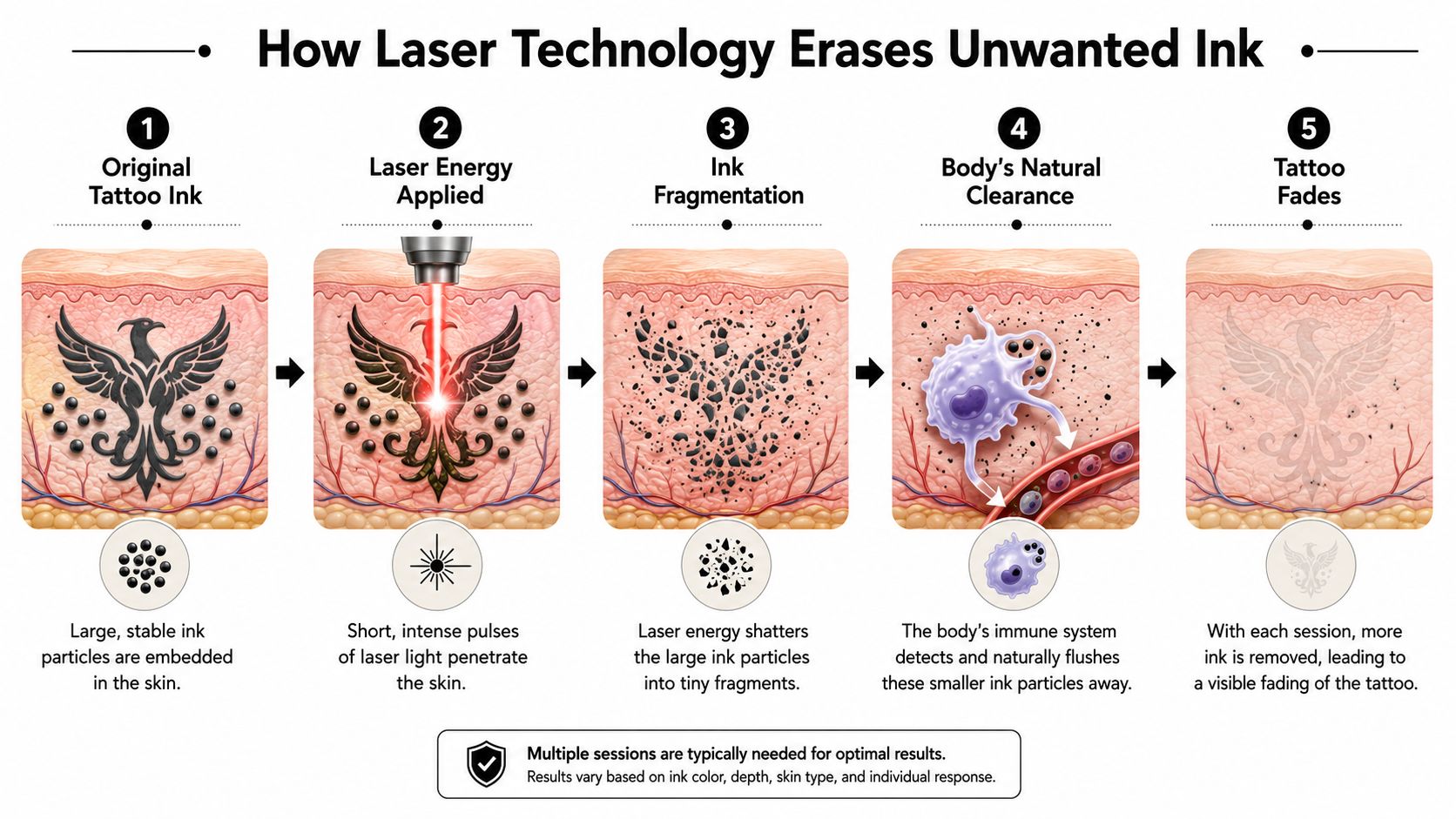
Laser tattoo removal works best when you understand one basic idea. The ink particles in a tattoo are too large and too stable for your body to clear on its own. The laser's job is to break those particles apart so your immune system can gradually carry them away.
Think of the tattoo pigment like a boulder buried in the skin. Your body can't move the boulder. A laser pulse acts more like a precision hammer than a heat lamp. It hits the pigment fast enough to shatter that boulder into much smaller fragments, and those smaller pieces are far easier for the body to process.
What the laser is actually doing
Modern systems don't scrape ink out of the skin. They send short, concentrated pulses of light into the tattoo. Different wavelengths are chosen to match different pigment colors. In practical terms, that means the operator is trying to target the ink while limiting unnecessary effect on surrounding skin.
The removal process has two separate phases:
- Laser fragmentation during the appointment.
- Immune clearance in the weeks after the appointment.
That second phase is why spacing matters so much. The visible improvement doesn't happen all at once when you leave the treatment room. The body continues doing the cleanup after the session is over.
The laser breaks the ink. Your body finishes the job.
Why picosecond technology changed the process
Older tattoo removal systems commonly used Q-switched technology in the nanosecond range. Modern picosecond lasers fire in even shorter pulses. That shorter pulse duration changes how the energy interacts with ink.
Modern picosecond lasers deliver energy in ultra-short pulses, measured in trillionths of a second, creating a photomechanical effect that shatters ink into sub-micron fragments and can improve clearance efficiency, especially for stubborn blue and green pigments according to this review of current tattoo removal technology.
For clients, the practical differences usually come down to a few things:
- Better response with difficult colors: Blues and greens often need a precise approach.
- More efficient fragmentation: Smaller shattered particles are easier for the body to clear.
- Less collateral heat: That matters for skin safety and reducing unwanted tissue injury.
If you want a deeper explanation of how the PiQo4 platform is used in real treatment planning, this PiQo4 laser tattoo removal guide gives a useful equipment-specific overview.
The technology matters, but settings and judgment matter just as much. A strong laser in inexperienced hands isn't a shortcut. Safe removal depends on matching wavelength, pulse behavior, skin tone, and tattoo characteristics to the person in front of you.
The Tattoo Removal Journey in Orlando What to Expect
The first appointment usually feels more straightforward than people expect. Most of the work at the beginning isn't the laser itself. It's deciding what success looks like for your tattoo and building a treatment plan around that goal.
Your consultation and treatment plan
A proper consultation should look closely at the tattoo's color mix, density, layering, age, and location on the body. Skin tone matters too, because laser settings have to respect how much competing pigment is present in the skin. Understanding these elements helps build realistic expectations.
If someone wants complete removal, the discussion is different from someone who only wants enough fading for a cover-up. If they have a wedding or job deadline, timing becomes part of the treatment design. The best plans aren't generic. They're customized.
What treatment day feels like
On treatment day, the area is cleaned and prepared first. Then the laser passes are delivered over the tattoo methodically, not randomly.
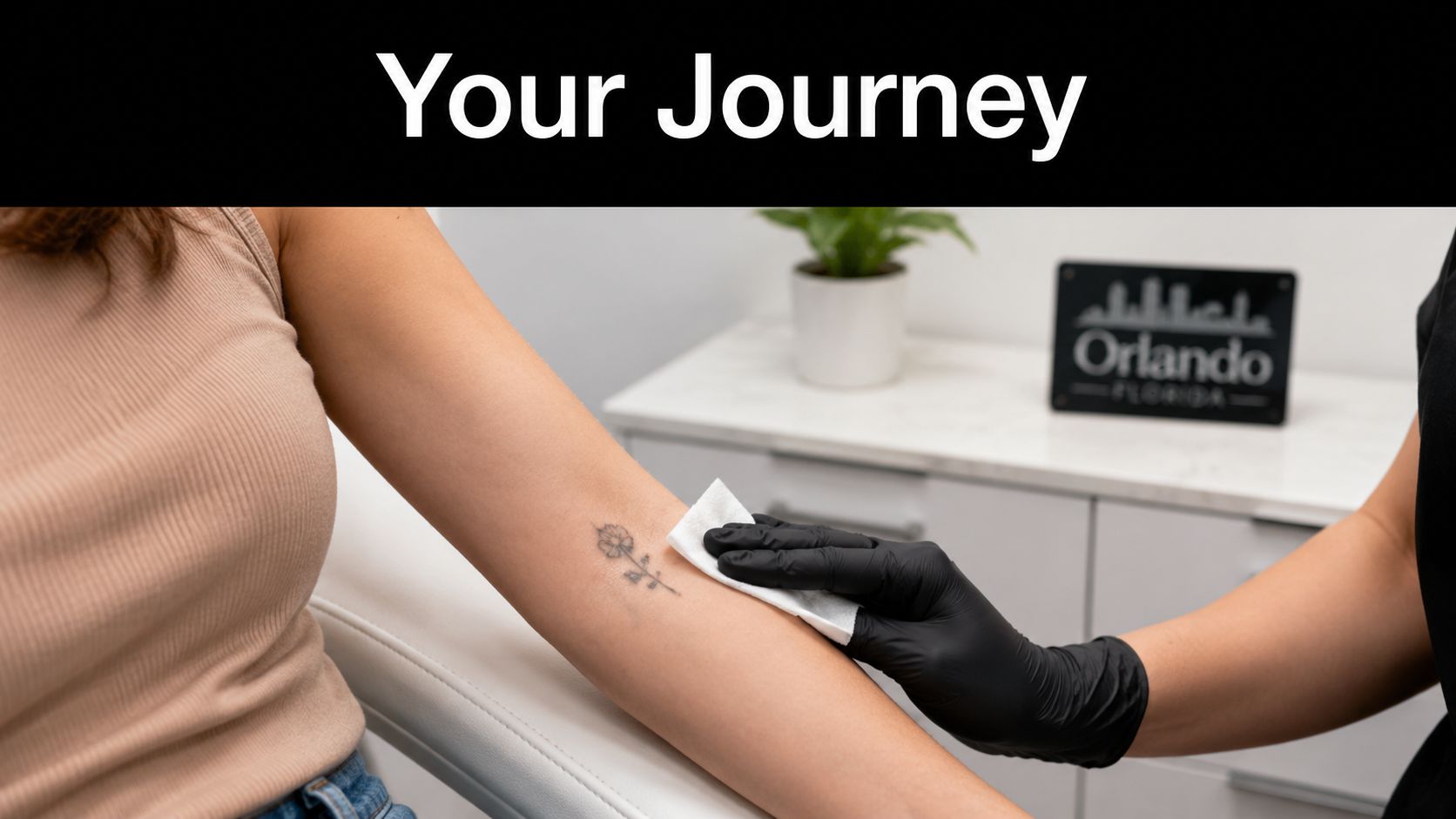
Most clients describe the sensation in simple terms. It's sharp and quick. The intensity depends on placement, tattoo size, and personal tolerance. Areas over bone or thinner skin usually feel more reactive than fleshier areas.
You may notice an immediate whitening or “frosting” effect on the tattoo right after treatment. That early visual change doesn't mean the tattoo is gone. It's a short-term tissue response that often appears as the energy interacts with the pigment and skin surface.
Some of the most important progress happens after you leave the clinic, not while you're in the chair.
What happens after the session
The treated area can feel warm, tender, or irritated for a period afterward. Mild redness and swelling are common reactions. The skin may feel similar to a superficial burn or abrasion for a short time, and the area needs to be protected while it settles.
Aftercare usually focuses on basic principles:
- Keep the area clean: Follow the cleaning instructions you're given and avoid unnecessary friction.
- Protect healing skin: Don't pick at flaking or irritated tissue.
- Avoid extra irritation: Tight clothing, heavy rubbing, and careless sun exposure can make recovery rougher.
The biggest expectation to manage is speed. People sometimes think each session should produce dramatic immediate disappearance. That's not how this works. The appointment starts the process. The body then spends the next stretch of time clearing fragmented pigment, and that's why the tattoo tends to fade gradually, not overnight.
In practical terms, successful removal is usually less about pushing harder and more about treating consistently, healing well, and giving the skin enough time to recover between appointments.
How Many Sessions Will I Need An Honest Timeline
This is the question almost everyone asks first, and it deserves a straight answer. Most professional tattoos are not removed in two or three visits. Anyone giving a fixed session count without examining the tattoo is guessing.
The benchmark most people should know
A useful clinical benchmark comes from a 2015 clinical review that found an average of 7 to 10 laser treatments, spaced about every 8 weeks, were needed for substantial tattoo clearance in professional black or multicolor tattoos, as described in the PubMed Central review of laser tattoo removal outcomes.
That number gives people a grounded starting point. It doesn't mean your tattoo will land exactly in that range. It means that removal should be planned in months, not weeks.
If you want a practical breakdown of how that timeline plays out in real scheduling, this guide on how long tattoo removal takes is a helpful next read.
Why fixed promises are a red flag
A tattoo can look simple and still be stubborn. Another can look dense and fade steadily. Session count changes because tattoos are made of variables, not formulas.
A realistic estimate depends on things like:
- Ink profile: Black often behaves differently than mixed-color work.
- Tattoo build: Professional saturation and cover-ups can hold more ink.
- Placement: The body doesn't clear every area at the same pace.
- Skin response: Healing patterns and inflammation tolerance differ from person to person.
One common mistake is assuming more frequent treatment means faster clearance. It usually doesn't. If the body hasn't had enough time to process fragmented pigment and restore the skin barrier, pressing ahead too quickly can create more irritation without creating better fading.
If you need removal for a deadline, count backward from the event date and build in margin. Tattoo removal rarely rewards last-minute planning.
An honest timeline should leave room for healing, scheduling changes, and the possibility that one color or one section of the tattoo lingers longer than the rest. That's normal. It's also why transparent planning matters more than optimistic promises.
Key Factors That Influence Your Removal Results
Two tattoos can be the same size and still behave very differently under the laser. The reason is simple. Results depend on the tattoo, the body, and how the treatment plan fits both.
Ink and tattoo characteristics
Dense professional tattoos usually take more work than lighter pieces. Layered tattoos and cover-ups can be more demanding because there may be pigment at different depths and in different colors. Cosmetic tattoos can behave differently too, especially when pigment composition is less predictable.
Color matters, but not in a neat, one-line way for every person. Some pigments respond quickly. Others fade unevenly and need a more patient approach. That's why a consultation should look at the actual tattoo rather than rely on a general internet estimate.
Body location and circulation
Placement on the body changes removal speed more than many people realize. Tattoos on areas with better circulation, such as the trunk or upper arms, often clear faster than tattoos on distal extremities like ankles or wrists because stronger blood flow supports macrophages that carry away fragmented pigment, as explained in this clinical overview of tattoo removal variables.
In everyday terms, a tattoo closer to the body's central circulation often has a logistical advantage. A tattoo on the ankle may take longer to look the way you want, even with solid treatment.
Skin tone and healing response
Skin tone matters because the laser must distinguish tattoo pigment from naturally occurring skin pigment. On darker skin tones, careful wavelength selection and conservative settings are important for reducing the risk of unwanted pigment change. That doesn't mean removal isn't possible. It means the plan should be more deliberate.
Healing response matters too. Some clients' skin settles quickly and predictably. Others need a gentler pace. Good outcomes usually come from respecting that difference rather than forcing a one-size-fits-all protocol.
Here's a simple comparison to keep in mind:
| Factor | Generally Fewer Sessions | Generally More Sessions |
|---|---|---|
| Tattoo density | Lighter saturation | Dense professional packing |
| Ink layers | Single-layer tattoo | Cover-ups or layered work |
| Color complexity | Simpler pigment profile | Multiple stubborn colors |
| Body location | Trunk or upper arm | Wrist, ankle, lower leg |
| Skin response | Predictable healing | Reactive or slower-settling skin |
A table like this doesn't replace an in-person assessment, but it helps explain why two friends can start removal at the same time and finish on very different schedules.
Choosing the Right Clinic for Tattoo Removal in Orlando
The safest way to choose a provider is to think like a careful buyer, not a rushed shopper. A tattoo removal clinic should be able to explain the technology it uses, why a specific laser setting may fit your skin and ink, and what trade-offs come with your goal. Vague promises are a warning sign.
What to look for before you book
Start with the basics. Ask what laser platform is used, who performs treatment, how the consultation works, and whether the clinic discusses fading versus full removal openly. Look for a clean medical-style environment, clear aftercare instructions, and communication that sounds measured instead of sales-heavy.
A few practical checks help:
- Technology fit: Advanced picosecond systems such as PiQo4 can matter when tattoos contain difficult pigment mixes.
- Plan clarity: You should hear a realistic timeline, not an instant result pitch.
- Skin safety: The provider should discuss skin tone, placement, and healing behavior.
- Pricing transparency: Exact quotes require an assessment, but the pricing approach shouldn't feel hidden.
If you're evaluating local businesses online, it also helps to understand how strong local search visibility works. This overview of Polaris Marketing Solutions on Orlando SEO is useful for learning why reputable local service providers show up consistently in map results and organic search when their business information is clear and well maintained.
For readers comparing options, this Orlando tattoo removal clinic guide covers what to review before scheduling a consultation.
Orlando contact details and next steps

If you're ready to move from research to an actual plan, EradiTatt Tattoo Removal offers laser tattoo removal consultations in Orlando along with support for complete removal or fading for cover-ups. The practical next step is simple: book a consultation, bring your deadline if you have one, and ask for a treatment plan that matches your tattoo and your calendar.
For Orlando-area scheduling, use the clinic's local contact details and the central 844 number listed through the main site. Bring photos if the tattoo is hard to show during an initial call, and be specific about whether your goal is wedding-ready skin, workplace visibility reduction, enlistment preparation, or complete clearance over time.
The right clinic won't rush that conversation. It will turn your goal into a workable sequence of appointments, healing time, and skin-safe decisions.
Common Questions About Laser Tattoo Removal
Does laser tattoo removal hurt?
It is often described as a fast snapping sensation. Some areas are easier than others. Placement, tattoo density, and personal tolerance all affect how it feels. The good news is that sessions are controlled and brief compared with living indefinitely with a tattoo you want gone.
Will it leave a scar?
Modern removal is designed to target ink while limiting unnecessary skin injury. Scarring risk goes down when the provider uses appropriate settings, respects treatment spacing, and the client follows aftercare carefully. Problems are more likely when skin is overtreated, irritated between sessions, or not protected during healing.
Can I fade a tattoo for a cover-up instead of removing it completely?
Yes. That's a common and practical goal. Many people don't need total clearance. They need enough fading for a tattoo artist to work with cleaner visual space. If that's your goal, say it at the consultation because the treatment strategy may be different.
How is cost determined?
Cost is typically based on the tattoo itself and the treatment plan, not a one-price-fits-all model. Size, location, color complexity, and whether you want fading or full removal all affect the quote. The only accurate way to price it is with an actual assessment.
How early should I start before a wedding, job search, or enlistment?
Earlier than you think. If the tattoo matters for a deadline, treat the process like a calendar-based project. Build in time for consultation, multiple sessions if needed, healing, and the possibility that one section fades slower than another.
If you're ready to turn uncertainty into a plan, schedule a consultation with EradiTatt Tattoo Removal. A clear assessment can tell you whether your tattoo is a candidate for full removal or strategic fading, how to time sessions around your event, and what safe progress is likely to look like for your skin and ink.