Individuals seeking eyebrow tattoo removal in Orlando often look at their brows every morning and think the same thing: this shape isn't you anymore. Sometimes the color has shifted. Sometimes the strokes blurred together. Sometimes the original plan was soft, natural brows, and what healed months or years later feels too dark, too flat, or too hard for your face.
That frustration is common, and it's fixable. Eyebrow tattoos sit in one of the most noticeable spots on the face, so even a small change in color or shape can feel big. The good news is that removal doesn't have to mean guessing. With cosmetic brows, the smartest path starts by figuring out what kind of ink was used, how deep it sits, and whether your real goal is a full reset or just enough fading to make room for a better brow design.
Table of Contents
- Why Consider Eyebrow Tattoo Removal in Orlando
- Tattoo Studios vs Tattoo Removal Clinics
- The Science of Erasing Unwanted Brow Ink
- Deciding Your End Goal Removal vs Fading
- What to Expect from Your Treatment Plan
- How to Start Your Removal Journey with EradiTatt
Why Consider Eyebrow Tattoo Removal in Orlando
A lot of clients don't come in because they hate tattoos. They come in because they wanted better brows, and the result no longer matches their face, style, or routine. A once-crisp microbladed shape can soften into a block. A color that looked balanced at first can heal warmer, cooler, or duller than expected. A brow that made sense years ago may feel too sharp now.
That matters more with brows than almost anywhere else because you see them every day, and everyone else does too. In a global analysis summarized in 2025, people ages 18 to 39 made up two-thirds of tattoo removal seekers, and 46% of treated tattoos were on highly visible areas. Brows are one of the most visible cosmetic areas on the face, so it makes sense that people act quickly when they're unhappy with them.
Common reasons people finally decide to remove brow ink
- The shape feels dated: Brow trends change, but a tattoo stays put until you do something about it.
- The color no longer looks natural: Cosmetic pigment can heal unevenly or look off against your skin tone over time.
- You want a correction, not necessarily a blank slate: Many people don't want bare skin. They want enough fading to let a better artist rebuild the brows cleanly.
- You're planning for something specific: Weddings, photos, job changes, and cover-up appointments often create a real deadline.
Brow removal usually isn't about vanity. It's about getting your face back in sync with how you want to look now.
For eyebrow tattoo removal in Orlando, that's the practical starting point. Not “Can this be done?” but “What outcome do I want, and what's the safest way to get there?”
Tattoo Studios vs Tattoo Removal Clinics
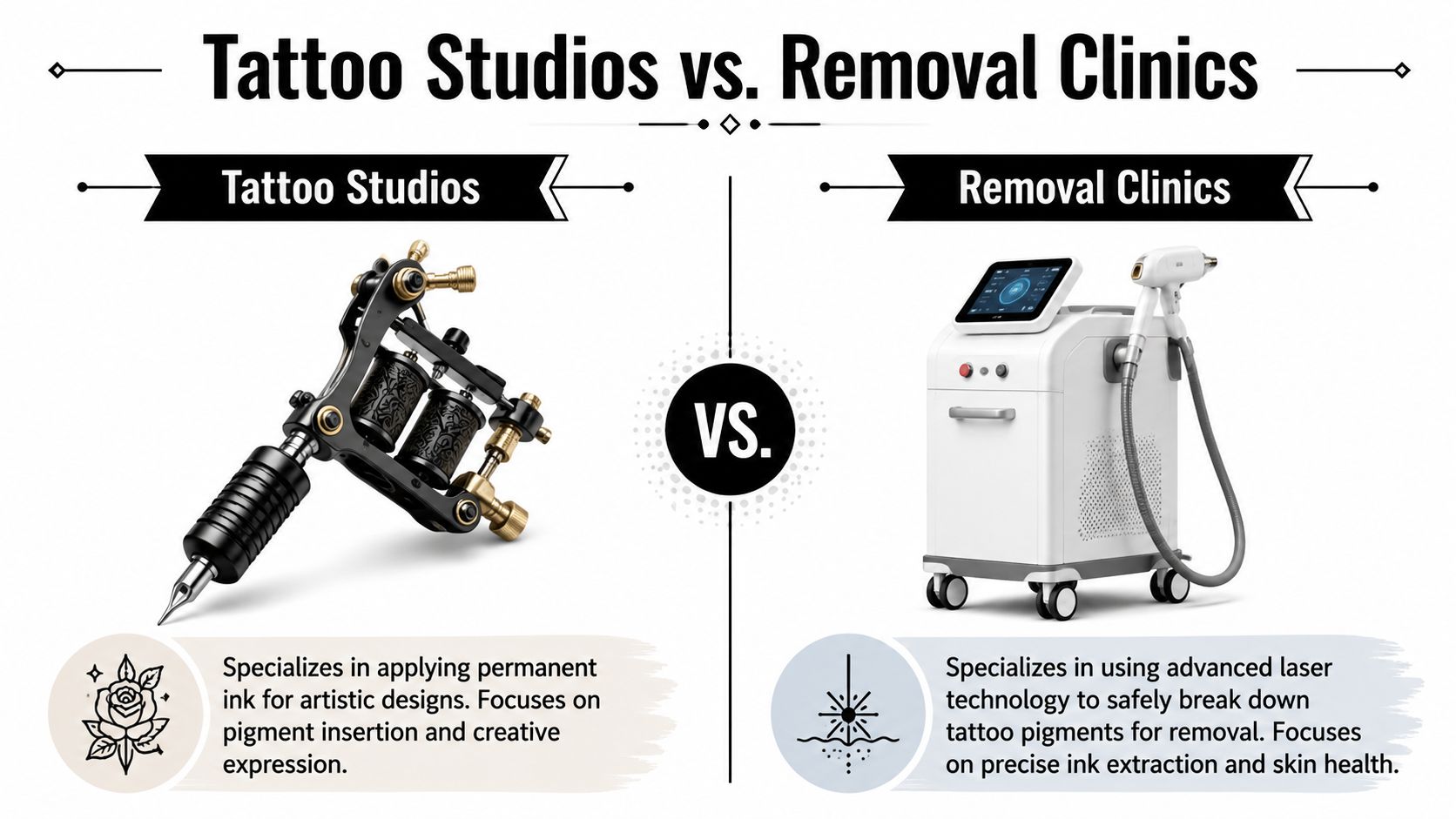
Applying pigment and removing pigment are different skill sets. That sounds obvious, but it's where many people get mixed messages. A cosmetic tattoo studio is built around placement, symmetry, pigment choice, and healed aesthetic outcome. A removal clinic is built around breaking down existing pigment while protecting skin quality, brow hair, and your options for what comes next.
What tattoo studios usually handle
Some brow studios offer saline removal, especially for recent work or small cosmetic corrections. That can be a valid option in select cases, but it isn't the same thing as laser treatment. According to this discussion of saline tattoo removal for cosmetic brows, some studios price saline removal around $250 to $299 per session, while many specialized clinics focus on laser because different pigment types and depths often require that approach.
Studios are often a reasonable place to ask early questions about old microblading or permanent makeup. They're not automatically the right place for every removal case, especially when the pigment is older, layered, mixed, or cosmetically unpredictable.
What removal clinics are built to do
A dedicated removal clinic evaluates the tattoo from a different angle:
- Pigment behavior: How the ink may respond based on shade, saturation, and cosmetic formulation.
- Skin response: Whether the area looks delicate, reactive, or previously overworked.
- End goal: Whether you want complete clearance or strategic fading.
- Risk control: How to proceed without chasing aggressive results that create texture issues.
If you run a studio, or you're comparing how artists handle scheduling and client intake, it's also useful to see how other shops streamline your tattoo deposit process. Clear booking systems don't remove ink, but they do show the difference between an application business and a treatment-based service where timing, prep, and follow-up matter.
Practical rule: If the question is “How do I put in better pigment?” ask an artist. If the question is “How do I safely take this pigment out or fade it?” ask a removal specialist.
For eyebrow tattoo removal in Orlando, method choice shouldn't be based on whoever talks about brows most confidently. It should be based on the kind of pigment in your skin and the result you need.
The Science of Erasing Unwanted Brow Ink
Laser removal works by breaking large pigment deposits into much smaller fragments that the body can gradually clear away. The easiest way to think about it is this: a laser doesn't pull ink out in one piece. It turns a solid target into tiny particles that your body can process over time.
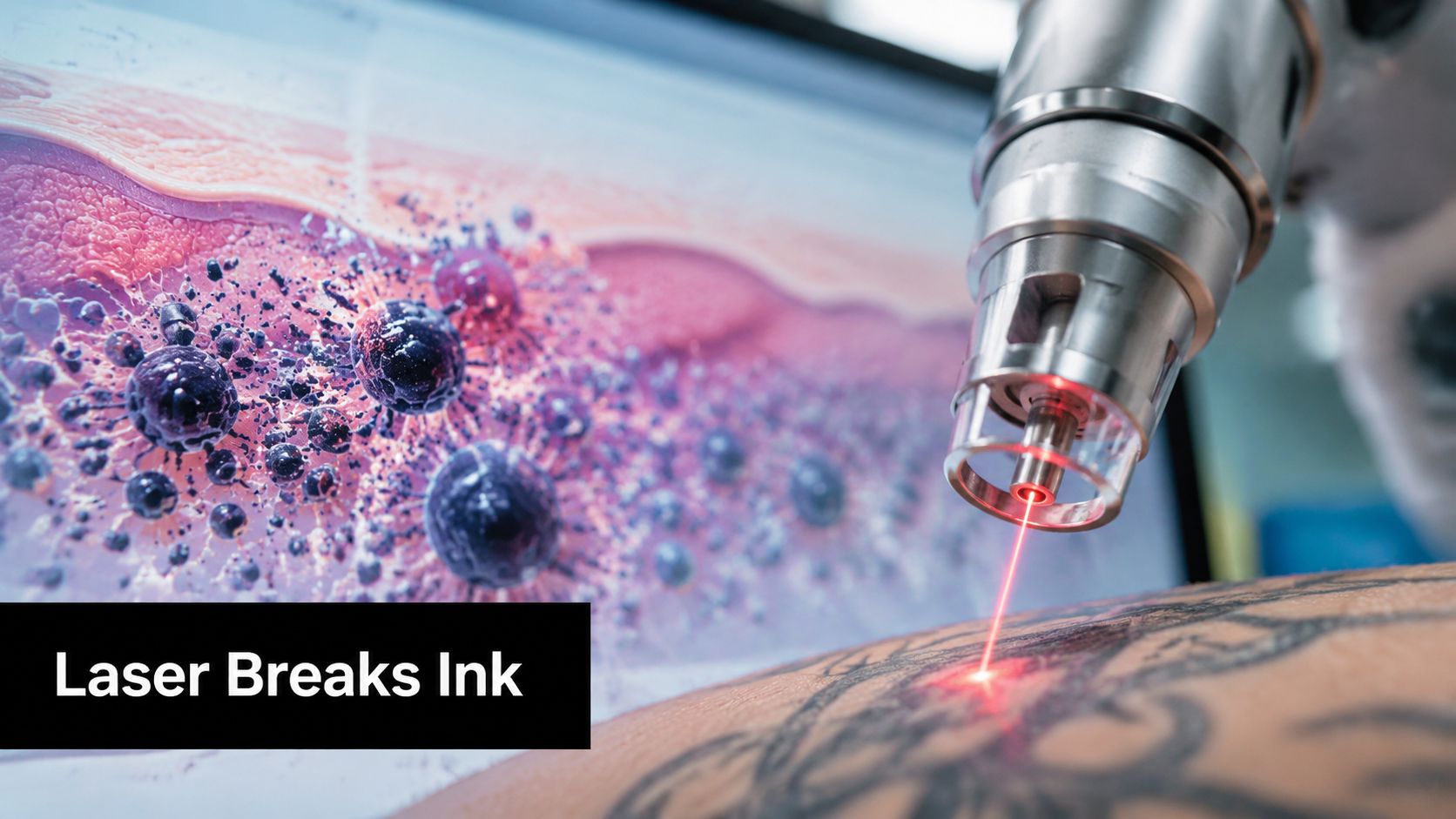
That's why spacing matters, and it's why brow removal isn't just “blast it harder.” The skin around the eyebrows is cosmetically sensitive. The right treatment aims at pigment while respecting the surrounding skin and brow hairs.
Why modern laser protocols matter
For cosmetic brows, technique matters as much as technology. Pigment can sit shallow or uneven. Some brows contain older permanent makeup. Others combine microblading strokes with shading or later touch-ups. Those details change how a technician approaches treatment.
A 2024 review of 76 patients found that 55.3% of cases involved eyebrow tattoos, making brows the majority in that sample. The same review reported a mean of 2.8 treatments overall and found no documented adverse events such as scarring, burns, necrosis, prolonged swelling, or permanent hair loss. That supports the safety of modern laser protocols when the work is done appropriately.
What clients usually worry about most
Most concern centers on three things:
- Will it damage my brow hair?
- Will it leave texture changes?
- Will the pigment respond evenly?
Those are the right questions. They're more useful than asking for a fast promise.
If you've also been reading about pigment-focused facial treatments more broadly, resources on effective melasma laser solutions can help you understand how laser selection and skin response are assessed differently across facial concerns. It's not the same treatment, but it's a useful reminder that facial skin needs a more customized plan than generic device marketing suggests.
For people comparing cosmetic brow options specifically, this guide on microblading and eyebrow tattoo removal gives more context on how different brow tattoos can respond.
Good removal work protects future choices. Even if your end goal is a new set of brows later, the skin has to come first.
Deciding Your End Goal Removal vs Fading
Not everyone needs complete removal. In fact, many brow clients get better cosmetic results by stopping once the old shape is faint enough for a correction artist to work over it cleanly. The mistake is assuming “full removal” is always the right answer.
Your best endpoint depends on what bothers you most. If the current brows are too dark, too wide, or sitting outside the shape you want, partial fading may be enough. If the pigment is scattered, muddy, or still visible far beyond the future brow design, full removal may be worth the longer path.
When fading makes more sense
Fading is usually the practical choice when the old tattoo is still mostly in the right neighborhood, but it needs to be softened so a new design can take over.
Typical signs that fading may be enough:
- The shape is close, but not clean enough
- The color is too heavy for a fresh pass
- You already plan to rework the brows with another cosmetic service
- You have a near-term event and need improvement faster than a full reset
This is often the fastest route to a brow correction because you're not chasing every last trace of pigment. You're aiming for a workable canvas.
When full removal is the better call
Complete removal makes more sense when the old tattoo creates a structural problem. That might mean the tails sit too low, the fronts are too square, or multiple old layers make the brow area look dense and flat even without makeup.
Full removal is also more appropriate when:
- You want your natural brows back without future tattooing
- The pigment extends well outside a flattering shape
- You don't trust a cover-up to hide the old work
- The old color would interfere with any new design
Some clients save time by choosing fading. Others waste time by fading when the old brow really needs a full reset. The right goal is the one that matches the skin, the pigment, and the next step.
Fading for a Cover-Up vs Complete Removal
| Factor | Fading for a Cover-Up | Complete Removal |
|---|---|---|
| Primary goal | Lighten existing pigment so a new brow design can cover it | Clear as much visible pigment as possible |
| Best for | Shapes that are close to usable but too dark, blurry, or uneven | Outdated shapes, migrated pigment, or clients wanting no tattoo left |
| Timeline feel | Shorter because you stop once the pigment is workable | Longer because you keep treating toward maximum clearance |
| Planning for events | Often easier if you need brows improved on a shorter calendar | Requires more patience and usually a longer planning window |
| Future brow work | Usually followed by new microblading or permanent makeup | May end with natural brows only, or a later redesign after full healing |
| Risk of over-treating | Lower if the endpoint is clear and conservative | Higher if someone keeps chasing minimal remaining pigment without a strong reason |
A consultation should leave you with a defined endpoint, not just a session recommendation. That's where a provider like EradiTatt Tattoo Removal can assess whether you're a better candidate for strategic fading or a more complete removal plan based on the ink that's in your brows.
What to Expect from Your Treatment Plan
The hardest part for many clients isn't the treatment itself. It's the calendar. Brows are small, but removal still takes time because the body needs time between sessions to clear fragmented pigment.
A typical laser tattoo removal plan involves 2 to 10 sessions spaced 6 to 8 weeks apart, and for black ink the average is around 6 sessions, according to this removal timeline overview. For eyebrow tattoos, the exact path can be different from body ink, but the key point is the same. Full removal can take many months.

What happens between sessions
After treatment, the work isn't “done” that day. Your body is processing the fragmented ink over the following weeks. That's one reason rushing appointments usually doesn't help.
You may also need to think carefully about aftercare products and skin healing habits. If you're comparing gentle skin-support options, this overview of aloe vera for scars is a useful general resource for understanding where soothing products may fit into recovery conversations.
Planning around real life
If you need your brows improved before a wedding, job change, trip, or cover-up appointment, count backward from the event date. Don't just ask how many sessions. Ask how much total calendar time the process may require.
For a broader explanation of timing variables, this article on how long tattoo removal takes is helpful.
The best brow removal timeline is rarely the fastest one. It's the one that gives the skin time to recover and the pigment time to clear.
How to Start Your Removal Journey with EradiTatt
The first step is a consultation, not a commitment to a full package. That visit should answer the questions that matter most: what kind of brow tattoo you have, whether laser is the right method, whether fading is enough, and what a realistic session plan looks like for your goals.
What happens at the consultation
A solid brow removal consult should cover:
- Your tattoo history: Was it microblading, powder brow, ombré, permanent makeup, or layered touch-ups?
- Visible pigment traits: Is the ink dense, faded, patchy, or uneven across the brow?
- Your endpoint: Do you want a clean slate, or do you just need enough fading for a correction?
- Session-based cost expectations: Orlando pricing references cited in the earlier analysis place small tattoo removal around $100 to $300 per session, with other broader Orlando marketing estimates around $100 to $375 per session or $200 to $500 in some cases, showing that treatment is generally priced per session rather than as a one-time fee, as noted in the earlier section's source.
What to bring and ask
Bring old brow photos if you have them. If you know when the tattoo was done, what style it was, or whether there were multiple touch-ups, that helps. Ask direct questions about likely fading behavior, hair preservation, downtime expectations, and what endpoint would make the most sense before any future brow work.
If you want to compare local service details and book a consult path, this page on tattoo removal options in Orlando is a useful starting point.
The best consultations are practical. You should leave knowing what's possible, what isn't, and what timeline fits your life.
If you're ready to talk through your options for EradiTatt Tattoo Removal, start with a consultation and bring your real goal with you, whether that's complete eyebrow tattoo removal in Orlando or just enough fading for a clean correction plan.