
From Ink to Blank Canvas: Real Bradenton Tattoo Removal Stories
Considering tattoo removal? You're probably focused on the finish line. You want to know when the tattoo will look light enough for work, clean enough for a life event, or faded enough for a cover-up. That's the core question behind most searches for tattoo removal results Bradenton.
At EradiTatt, clients walk into our Bradenton clinic with very different reasons for starting. Some want full removal. Some want strategic fading. Some are trying to undo a decision from years ago, and some just need a visible tattoo to stop being the first thing people notice. What they all need is the same thing: a realistic plan.
That's what this gallery-style breakdown is for. These are seven real treatment journeys from our Bradenton clinic, explained the way a practitioner would explain them in the consult room. You'll see what kind of tattoo we treated, what slowed it down or helped it along, and what the PiQo4 laser was able to do in each situation.
Table of Contents
- 1. Case Study #1 Full Removal of a Black Linework Forearm Tattoo
- 2. Case Study #2 Fading a Large Dense Back Piece for a Cover-Up
- 2. Case Study #2 Fading a Large Dense Back Piece for a Cover-Up
- 3. Case Study #3 Tackling Stubborn Blue and Green Ink on an Ankle
- 4. Case Study #4 Safe Removal on a Darker Skin Tone Fitzpatrick V
- 5. Case Study #5 Erasing an Old Amateur Stick-and-Poke Tattoo
- 6. Case Study #6 Removing a Small but Visible Hand Tattoo
- 7. Case Study #7 Full Removal of a Red and Black Heart Tattoo
- Bradenton Tattoo Removal: 7 Case Results Comparison
- Your Tattoo Removal Questions Answered
1. Case Study #1 Full Removal of a Black Linework Forearm Tattoo
A forearm tattoo becomes a daily concern because it is hard to hide in scrubs, office wear, or short sleeves. This Bradenton client came to us with a 10-year-old black script tattoo on the inner forearm and a clear goal: full removal for professional reasons.
We treated the tattoo with the PiQo4 and reached full removal in 8 sessions. The biggest visible change came after session 3, once the upper concentration of black pigment started to fragment and the lettering lost its sharp edges. After that, progress continued, but the work changed. The later sessions focused on clearing the residual ink that sits deeper and fades more slowly.
Why this one moved predictably
Black ink usually gives us the clearest treatment path because it responds well to the 1064 nm wavelength. In this case, the color helped, but so did the tattoo style and placement. Fine linework on the inner forearm often clears more steadily than dense packing on areas with poorer circulation, such as the ankle or foot.
Session timing mattered too.
This client stayed consistent with spacing, which gave the body time to process the shattered pigment between visits without dragging the timeline out unnecessarily. That kind of consistency does not make every tattoo easy, but it often makes the results more orderly and easier to predict. This aligns with our clinical observations.
Another advantage here was the goal itself. Full removal of black linework is different from partial fading for redesign work. If a client plans to rework the area instead of clearing it completely, we may stop earlier once the ink is light enough for the artist. For clients considering that route, our guide on how to fade a tattoo properly for a cover-up explains how we set the target.
What slowed this case down? Mostly the final stretch. That is common. Early sessions remove the visual weight of the tattoo, while later sessions deal with the faint remnants that only show in certain lighting or at close range. That last 10 to 15 percent often takes patience, even when a tattoo is responding well.
2. Case Study #2 Fading a Large Dense Back Piece for a Cover-Up
A client walks into our Bradenton clinic with a heavy upper-back tribal piece and a clear goal. They do not want full removal. They want enough fade to give their tattoo artist better options.
That distinction matters. Cover-up prep is a different job than complete clearance. In this case, the tattoo covered a broad area and had dense black packing through the central shapes, so we treated it strategically with the PiQo4 instead of chasing every last fragment of ink. After 4 targeted sessions, the darkest sections had dropped enough to give the new artist more room for contrast, cleaner line placement, and a design that did not have to fight through a solid black base.
Why this case responded well
Large back pieces can look intimidating, but the upper back is often a workable treatment area. Circulation is usually better there than in the hands, feet, or ankles, and that can help the body clear fragmented pigment more steadily between sessions.
Ink density was the primary challenge here. Dense professional saturation usually needs more energy over more than one pass through the treatment plan, especially when the goal is even fading rather than patchy clearing. A clinical study on tattoo removal session predictors and tattoo location reported fewer average sessions for upper-trunk tattoos than for tattoos on the hands and fingers, which matches what we see in practice at EradiTatt. Placement helps, but packing still slows things down.
There is also a trade-off clients do not always expect. Aggressive fading can create uneven light spots that make a cover-up harder, not easier. For this client, controlled reduction was the better path. We focused on softening the visual weight of the old design so the cover-up artist could build over it cleanly.
Clients planning redesign work usually do better with a target, not an all-or-nothing mindset. Our guide on how to fade a tattoo properly for a cover-up explains how we set that endpoint before treatment starts.
2. Case Study #2 Fading a Large Dense Back Piece for a Cover-Up
Not every client wants blank skin. This Bradenton client wanted a large tribal-style upper back tattoo lightened enough for a better cover-up, not erased completely.
We focused on the darkest sections and completed 4 targeted sessions with the PiQo4. That reduced the density enough to open design options for the new tattoo artist. Instead of fighting a heavy black foundation, the artist had room to work with shape, contrast, and detail.
What worked for cover-up prep
Back pieces can be dense, but the upper back is also a helpful treatment zone because it generally clears better than areas farther from the body's core. In the same clinical study on session predictors and tattoo location, upper-trunk tattoos averaged 4.3 sessions, while hand and finger tattoos averaged 7.8 sessions. The lesson for clients is simple. Placement matters.
For cover-up preparation, full removal is often unnecessary. Selective fading is faster, more cost-efficient, and more strategic when the old tattoo is blocking a new concept. If that's your goal, our guide on how to fade a tattoo before a cover-up explains how to plan that transition.
A few practical truths matter here:
- Darkest zones first: We usually get the most design freedom by reducing the heaviest areas, not by trying to make every part equally faint.
- Cover-up success depends on collaboration: The laser plan works best when it matches what the future tattoo artist needs.
- Perfectly gone isn't the benchmark: For many clients, “light enough” is the actual win.
The best cover-up fades aren't accidental. They're treated with the next tattoo in mind.
3. Case Study #3 Tackling Stubborn Blue and Green Ink on an Ankle
This was a floral ankle tattoo with black outlines and strong blue and green petals. It was only about 5 years old, which often means the pigment still looks fresh and compact in the skin.
We treated it in 11 sessions. The PiQo4 let us work across multiple wavelengths so we could address the black, blue, and green components in the same treatment plan instead of treating the tattoo as if all pigment behaved the same.
Why the ankle changed the timeline
Color was one challenge. Location was the other.
Lower-leg tattoos often clear more slowly because circulation and lymphatic clearance aren't as efficient there as they are closer to the torso. Bradenton-area treatment guidance commonly notes that extremity tattoos, especially on the ankle, wrist, and foot, can take longer, and a Bradenton-area overview of tattoo removal timing and treatment spacing describes sessions as a progressive process typically spaced 6 to 8 weeks apart, with some tattoos fading in as few as 3 treatments and others needing 8 to 10 or more depending on the ink.
This client needed longer healing intervals than a torso tattoo would have needed. That wasn't a setback. It was part of getting the skin through the process safely and letting the body do the clearing work between visits.
What doesn't work with ankle tattoos is impatience. More energy isn't always better. Shorter spacing isn't always smarter. On colorful ankle work, the fastest route is usually steady, disciplined treatment, not aggressive treatment.
4. Case Study #4 Safe Removal on a Darker Skin Tone Fitzpatrick V
A lot of clients with melanin-rich skin ask the same question first. Not “Will it fade?” but “Will my skin still look even afterward?” That's the right question.
This client had a small black symbol on the shoulder and Fitzpatrick V skin. We used a conservative treatment approach with 9 total sessions and longer spacing between visits. The focus was controlled progress with close skin observation, not rushing toward the fastest visible fade possible.
How we approached safety first
When treating darker skin tones, the clinical challenge isn't only the tattoo ink. It's protecting surrounding pigment. That means choosing settings carefully, watching response closely, and avoiding the mindset that every client should be pushed through the same pace.
A review of darker-skin tattoo removal risks and pigment change concerns highlights an important gap in local education. Tattoo removal can lead to temporary or permanent pigment changes, and darker skin tones may carry higher risk of hyperpigmentation or hypopigmentation. That doesn't mean treatment is off the table. It means planning matters more.
If you have deeper skin tone and want a more detailed explanation, our article on tattoo removal on dark skin walks through how we think about safety, settings, and pacing.
Clinical priority: Even skin tone is part of the result. Removing the ink but creating obvious pigment contrast is not a good cosmetic outcome.
The PiQo4 helps because it gives us flexibility in how we treat. But the machine alone isn't the whole answer. Careful judgment is what keeps treatment both effective and respectful of the skin.
5. Case Study #5 Erasing an Old Amateur Stick-and-Poke Tattoo
Old amateur tattoos often surprise people. They look messy, faded, and uneven, but from a removal standpoint, that can work in your favor.
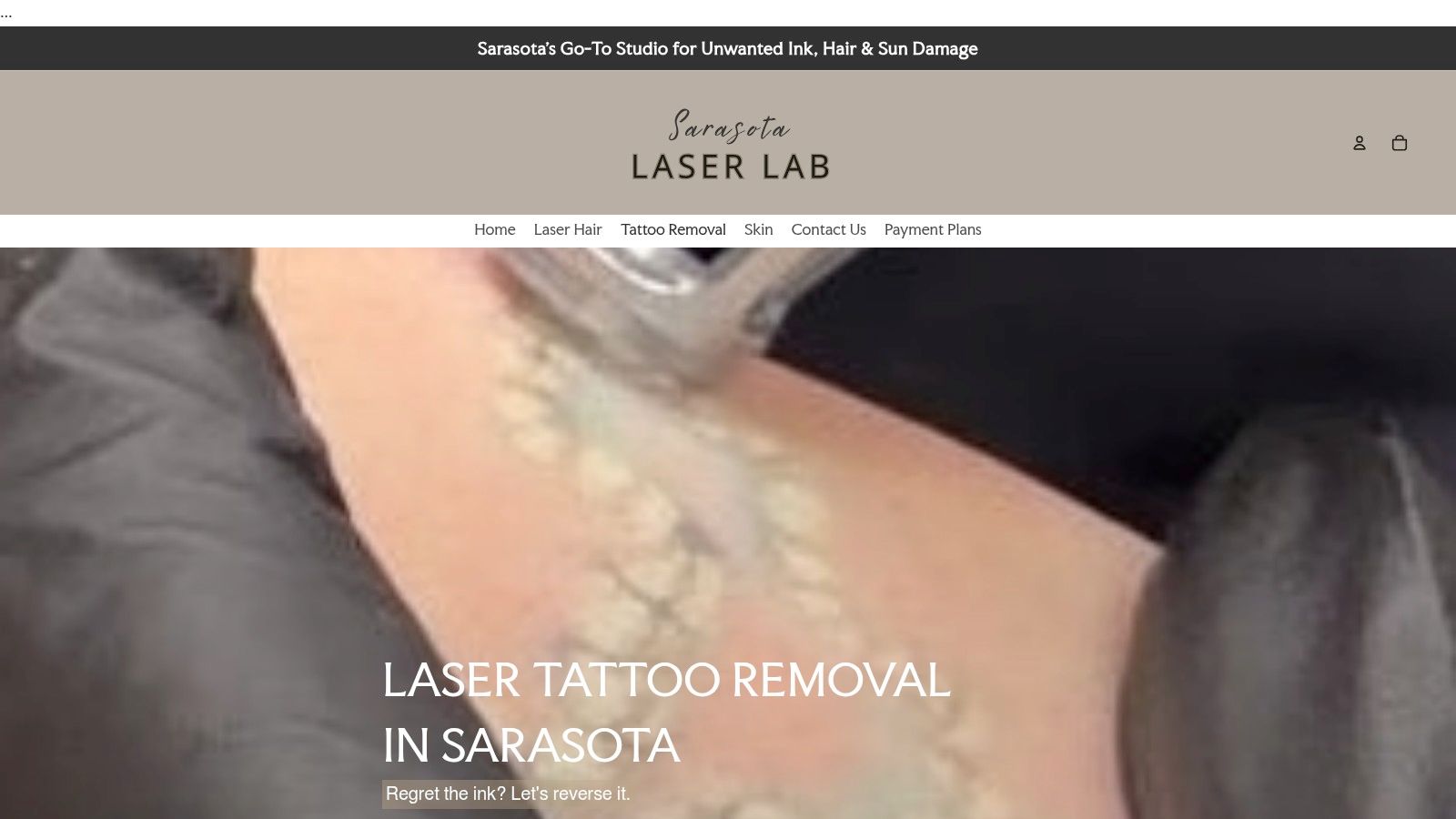
This client wanted to remove a 20-year-old black amateur tattoo on the hip. We reached near-complete removal in 6 sessions. The fading came on faster than the client expected because the ink load was relatively light and inconsistent compared with a professionally packed tattoo.
Why amateur ink often behaves differently
Amateur tattoos do not always sit at a uniform depth. That can create odd pockets of residual pigment, but it also often means there is less ink to remove overall. In practice, that usually matters more than the inconsistency.
The hip location helped too. It's not an extremity, so we usually expect better clearance there than on the hand, foot, or ankle. Older ink can also be easier to work with when the body has already broken down some of the pigment over time.
If you're dealing with DIY ink, our post on getting rid of a stick-and-poke tattoo explains why these tattoos often respond differently than professional work.
A few patterns show up again and again with old amateur tattoos:
- Lighter ink load: Less pigment often means fewer sessions than clients fear.
- Uneven response: Some spots vanish quickly while isolated specks linger.
- Better than expected finish: Once the faded haze is gone, the skin often looks cleaner than the tattoo ever looked.
For tattoo removal results Bradenton clients can use, this is one of the most encouraging categories. The tattoo may feel embarrassing, but it often isn't the hardest thing we treat.
6. Case Study #6 Removing a Small but Visible Hand Tattoo
Small tattoos create a lot of false confidence. Clients see a tiny symbol on the side of the hand and assume it should disappear quickly because there isn't much surface area.
This one took 12 sessions. The tattoo itself was small, black, and simple. The location made it difficult.
Why small does not mean easy
Hands are part of a group we treat cautiously because they don't clear like upper-arm, shoulder, or torso tattoos. They're exposed to friction, sunlight, and frequent use. In addition, they're on the edge of the body's circulation pattern, which can slow visible progress.
This is also where expectation-setting matters most. Some local pages give broad ranges such as multiple sessions spaced several weeks apart and note that healing and scabbing can last for weeks after treatment, but many still don't answer the practical question people care about most: when will the tattoo look gone enough for daily life or work? A Bradenton-focused discussion of that results-timeline gap points out how often clients are left with marketing promises instead of a usable calendar.
A hand tattoo can be tiny and still be a long project.
For this client, longer intervals and careful aftercare were essential. We emphasized protecting the area, avoiding unnecessary irritation, and accepting that hand tattoos tend to reward patience more than intensity. The end result was strong, but it required commitment.
7. Case Study #7 Full Removal of a Red and Black Heart Tattoo
This client had an 8-year-old heart tattoo on the bicep with a black banner and red fill. It's a classic example of why color-specific treatment matters.
We achieved full removal in 9 sessions using the PiQo4. The black portions responded to the 1064nm wavelength, while the red pigment responded to the 532nm wavelength. Because the tattoo sat on the bicep, the body had a good location for post-treatment clearance compared with lower-circulation zones.
Why color-specific treatment mattered
A single-color black tattoo and a mixed-color tattoo should never be treated as if they're the same job. Red ink can respond well when the right wavelength is available. Without that flexibility, you may see uneven fading where one part of the tattoo clears and another part lingers.
This is also where realistic counseling matters. Local tattoo removal guidance and broader skin-focused education note that some colors, especially green, blue, and yellow, can be more stubborn, and results vary by ink color, skin type, and treatment strategy. That's why consultation quality matters so much. The result depends on matching the laser plan to the tattoo in front of you.
What worked well in this case:
- Dual-wavelength planning: Black and red required different treatment logic.
- Good placement: The bicep tends to clear more cooperatively than hands or ankles.
- Complete-removal mindset: We treated to an endpoint, not just visible softening.
When clients ask whether colorful tattoos can be fully removed, the honest answer is yes, many can. But the path is more technical, and the result depends on the colors involved, the skin type, and how disciplined the treatment plan is.
Bradenton Tattoo Removal: 7 Case Results Comparison
| Case Study | Implementation Complexity 🔄 | Resource & Time Requirements ⚡ | Expected Outcome 📊 | Ideal Use Case 💡 | Key Advantages ⭐ |
|---|---|---|---|---|---|
| Case Study #1: Full Removal of a Black Linework Forearm Tattoo | Moderate, predictable protocol, standard spot size/energy | 8 sessions, 8–10 weeks apart | High likelihood of complete removal | Visible professional-area tattoos needing full erasure | Black ink highly responsive to 1064nm; predictable results |
| Case Study #2: Fading a Large, Dense Back Piece for a Cover-Up | Low–Moderate, targeted rather than exhaustive treatment | 4 targeted sessions (faster than full removal) | Significant fading suitable for cover-up (high impact) | Preparing large dark tattoos for a new design | Faster, cost-effective way to create a clean canvas |
| Case Study #3: Tackling Stubborn Blue & Green Ink on an Ankle | High, multi-wavelength strategy and careful tuning | 11 sessions, longer healing intervals due to ankle location | Good to excellent but longer timeline | Multi-color tattoos with blues/greens on low-circulation sites | PiQo4 multi-wavelength capability handles varied pigments |
| Case Study #4: Safe Removal on a Darker Skin Tone (Fitzpatrick V) | High, conservative energy and cautious protocol | 9 sessions, 10–12 week intervals, lower energies | Safe fading/removal with minimized pigment risk | Tattoos on melanin-rich skin where safety is priority | 'Low and slow' approach reduces hyper-/hypopigmentation risk |
| Case Study #5: Erasing an Old, Amateur 'Stick-and-Poke' Tattoo | Low, uneven depth but generally fast response | 6 sessions, relatively short course | Near-complete removal often achievable quickly | Faded, amateur or DIY tattoos with shallow ink | Less dense/shallow ink typically requires fewer sessions |
| Case Study #6: Removing a Small but Visible Hand Tattoo | High, location-related challenges and expectation management | 12 sessions, 10–12 week intervals for extremity clearance | Good outcome achievable but longer commitment | Small visible extremity tattoos (hands/feet/ankles) | Success possible despite low circulation; strict aftercare important |
| Case Study #7: Full Removal of a Red and Black Heart Tattoo | Moderate, requires color-specific wavelengths in same session | 9 sessions, uses 1064nm and 532nm wavelengths | Full removal achievable with proper wavelengths | Tattoos containing red, orange, or yellow pigments | Multi-wavelength system (532nm + 1064nm) effectively targets red and black |
Your Tattoo Removal Questions Answered
These Bradenton case studies show what we explain every day in clinic. Good tattoo removal isn't random, and it isn't one-size-fits-all. The best outcomes come from matching the treatment plan to the tattoo's color, density, age, placement, and the client's skin.
How Does the Process Start
It starts with a free consultation at EradiTatt. We examine the tattoo, talk through whether you want full removal or cover-up fading, and build a realistic plan around what your skin and ink are likely to do. That conversation matters because size alone doesn't tell the story. Density, color, and location often matter more.
Does Tattoo Removal Hurt
Most clients describe it as a quick snapping sensation. It isn't comfortable, but it's fast, and we use the Zimmer Cryo cooling device to blow chilled air over the treatment area during the session. That helps reduce discomfort without slowing the appointment down.
How Many Sessions Will I Need
There isn't one universal number. Across the examples above, you've seen faster-clearing amateur ink, longer projects on the hand and ankle, and strategic short-run fading for a cover-up. That's exactly how tattoo removal works in real life.
If you're comparing tattoo removal results Bradenton clinics talk about online, pay attention to whether they explain why a tattoo might take longer, not just whether they promise results. A clinic should be able to tell you what may slow your progress, what kind of fading usually comes first, and how long you'll likely need between treatments.
Ready to Start Your Journey in Bradenton
If you're ready to move from guesswork to an actual plan, come in for a consultation. We'll give you an honest assessment based on your tattoo, not a generic sales script. If aftercare is on your mind, some clients also like reading about skin support topics such as the benefits of aloe vera on scars, though your post-treatment guidance should always follow the instructions given for your specific laser session.
EradiTatt Tattoo Removal is one option for clients who want full removal or fading for a cover-up in the Bradenton area.
Book your free, no-obligation consultation today!
- Call Us: (941) 254-4774
- Visit Our Bradenton Clinic: 5245 Office Park Blvd, Suite 103, Bradenton, FL 34203
- Get a Free Estimate Online: Upload a photo of your tattoo on our website for a quick quote.
If you're ready to start, book a consultation with EradiTatt Tattoo Removal. We'll assess your tattoo, explain the likely treatment path, and help you decide whether full removal or cover-up fading makes more sense for your goals.