
You're probably asking this because a tattoo that once felt right now feels out of step with your life. Maybe it shows in work clothes, maybe it reminds you of a version of yourself you've moved past, or maybe you do not want to explain it anymore. That question, is laser tattoo removal worth it, usually isn't just about money. It's about whether the time, discomfort, and effort lead to a result that gives you real relief.
That's a reasonable question. Tattoo regret is common enough that it shouldn't feel isolating. Statistics show 23% of the 30% of Americans with tattoos, about 24 million people, seek removal, and surveys indicate 28.6% of women and 29.7% of men want to erase their ink according to clinical research on tattoo removal demand. In practice, the reasons are usually straightforward. Career changes, relationship changes, major life events, or just a shift in taste.
The answer isn't the same for everyone. For some people, removal is worth it because clear skin matters more than the commitment. For others, fading for a cover-up is the smarter goal. The useful way to think about it is as a personal cost-benefit decision, not a yes-or-no trend question.
Table of Contents
- The Real Question Behind Tattoo Regret
- How Laser Technology Erases Unwanted Ink
- Setting Realistic Expectations for Results and Timelines
- Calculating the True Investment of Tattoo Removal
- The Patient Experience Pain Healing and Aftercare
- Determining If You Are a Good Candidate
- Your Final Verdict and Your First Step with EradiTatt
The Real Question Behind Tattoo Regret

A lot of people think they should have a dramatic reason before they consider removal. They don't. If you're tired of seeing the tattoo, tired of dressing around it, or tired of feeling like it doesn't represent you anymore, that's enough.
The bigger issue is usually not regret itself. It's the daily friction regret creates. Some people feel it when they get dressed for work. Others feel it in family photos, at formal events, or every time someone asks about a tattoo they no longer want to discuss.
Why this question matters more than people admit
When clients ask whether removal is worth it, they're often balancing several things at once:
- Visible change: They want to know whether the tattoo can fade enough to meet their goal.
- Emotional relief: They want the mental burden gone, not just the ink reduced.
- Practical fit: They need to know whether treatments can fit around work, parenting, travel, or training.
- Confidence: They want to stop managing the tattoo with sleeves, makeup, or explanation.
Sometimes the value of removal isn't that you hated the tattoo. It's that you're ready to stop organizing parts of your life around it.
There's also a difference between wanting a tattoo gone and wanting a fresh start. Removal often sits in that second category. It's less about correcting a bad decision and more about aligning your skin with who you are now.
Regret can take different forms
Not every client walks in saying, “I regret this.” Many say something softer and more accurate. They say the tattoo feels outdated, too visible, too dark, too tied to a past relationship, or wrong for the next chapter of life.
That same practical thinking applies beyond standard body tattoos. If your concern involves pigment in a different setting, My Transformation's advice on SMP removal is a useful example of how removal decisions also depend on placement, goals, and realistic expectations.
Here's the decision lens I recommend. Don't ask only, “Can this be removed?” Ask these instead:
| Question | Why it matters |
|---|---|
| What bothers me most about this tattoo | The answer tells you whether full removal or partial fading makes more sense. |
| What would a good outcome look like | Some people want clean skin. Others only need enough fading for a cover-up. |
| What am I willing to trade | Removal takes commitment, so the process has to match your priorities. |
| What changes if I do nothing | If the tattoo keeps affecting confidence or daily choices, that cost is real too. |
If the tattoo is costing you peace of mind, removal may be worth more than the price of treatment alone.
How Laser Technology Erases Unwanted Ink
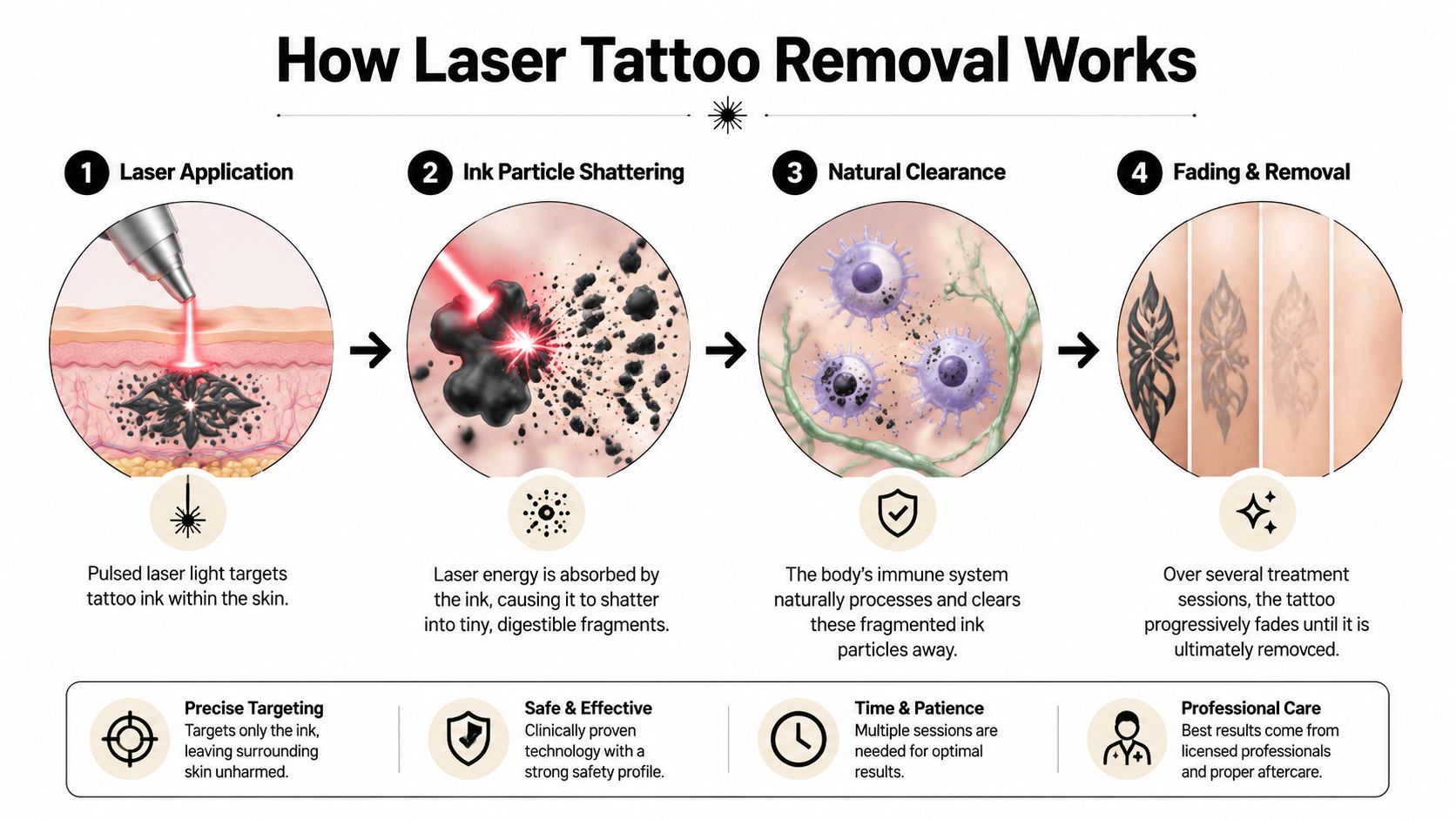
The simplest way to understand laser tattoo removal is this. The ink particles in your skin are too large for your body to clear efficiently on their own. The laser's job is to break those larger particles into much smaller fragments so your body can gradually remove them.
The process resembles breaking a boulder into pebbles. A large rock remains stationary, whereas pebbles can be moved. This illustrates the partnership at the core of tattoo removal. The laser performs the breaking, and your immune system manages the clearing.
What the laser is actually doing
A treatment session doesn't “scrape” ink out of the skin. It delivers light energy that tattoo pigment absorbs. That energy disrupts the pigment into smaller pieces. Over time, your body processes those fragments and the tattoo lightens between sessions.
This is why tattoo removal is gradual. You don't leave one appointment with the final result. You leave with the process started.
Why picosecond technology changed the experience
Older nanosecond systems can still remove tattoos, but modern picosecond lasers achieve greater clearance in fewer sessions with fewer side effects than older nanosecond lasers, and a study found they required 20% to 30% fewer treatments for pre-treated tattoos while reducing burning and blistering in this comparative picosecond laser study.
That matters because efficiency changes the whole experience. Better fragmentation can mean fewer visits, a smoother recovery window, and a more predictable path to fading.
Why your body matters as much as the device
Laser technology gets a lot of attention, but removal isn't only about the machine. Two people with similar tattoos can progress differently because healing and immune response are part of the result.
A few factors affect how smoothly the process goes:
- Circulation: Areas with better circulation often clear more efficiently.
- General health habits: Healing tends to go better when skin isn't under constant stress.
- Tattoo depth and density: More concentrated ink can be slower to clear.
- Consistency: Showing up for treatment and aftercare matters more than people expect.
Practical rule: The laser session is only one part of removal. The weeks after treatment are when your body does the quiet work that creates visible fading.
What works and what doesn't
It helps to be blunt here. Professional laser treatment works. It has a real mechanism, a controlled treatment plan, and measurable progress over time. What doesn't work well is expecting instant removal, comparing your tattoo to someone else's progress photo, or assuming every color and every body area will respond the same way.
At a consultation, a provider should explain the likely pattern of fading, not promise a fantasy result. That includes whether your goal is total clearance or preparing the area for a cover-up. EradiTatt Tattoo Removal offers treatment plans built around those two paths, which is how laser removal should be approached in practice: by goal, not guesswork.
Setting Realistic Expectations for Results and Timelines
Results depend on the tattoo in front of you, not on a generic average pulled from the internet. Some tattoos respond quickly. Some fade steadily but slowly. Some clear very well but leave the process feeling longer than clients expected because they assumed the hardest part would be the treatment itself, not the waiting between sessions.
The good news is that outcomes can be strong, especially for certain inks. Clinical data shows black ink tattoos have up to a 90% complete removal success rate, and advanced picosecond lasers can achieve 75% clearance of black pigments in 2 to 4 sessions, though the average for full removal is about 6 sessions according to this tattoo removal analysis and clinical summary.
What usually fades best
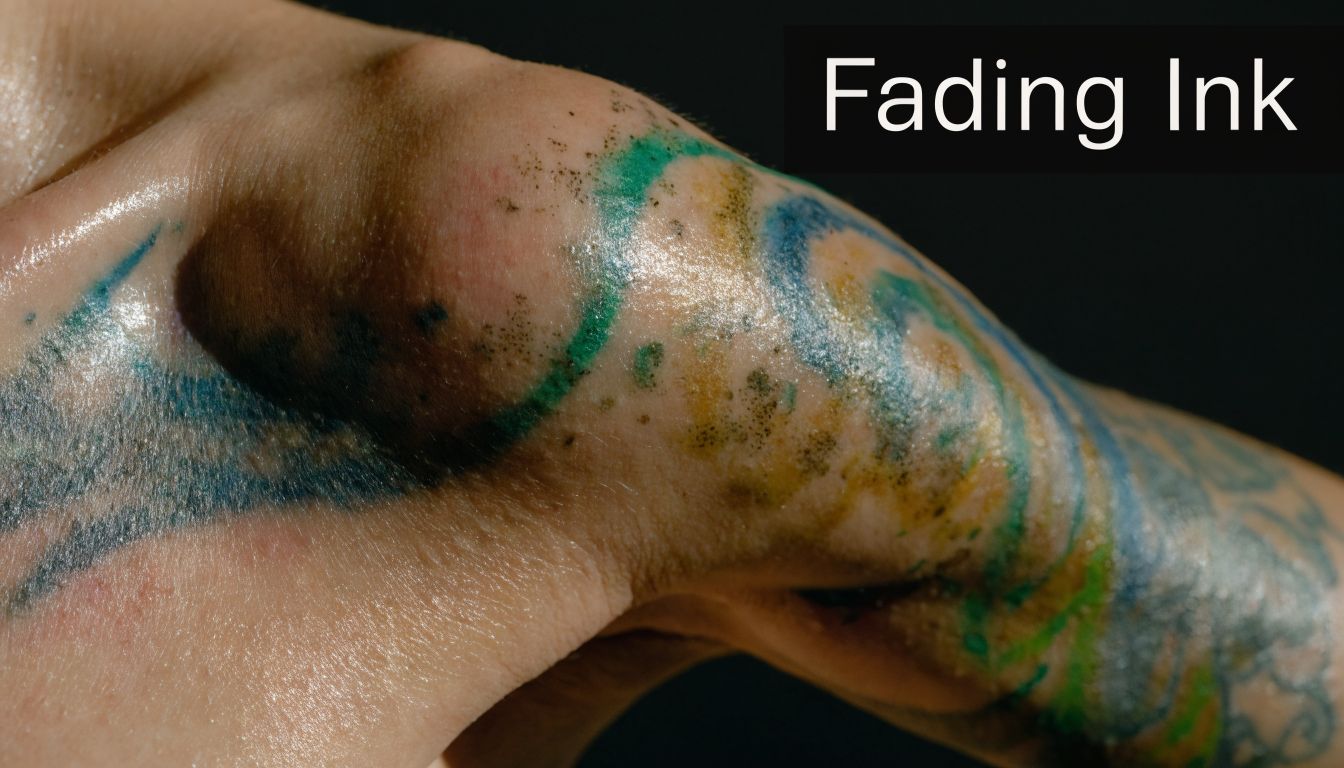
Black ink is typically the easiest to treat. That's one reason many people see meaningful progress earlier than they expected when the tattoo is mostly black and not overly dense.
Colored tattoos can also respond well, but they're less uniform. Some shades break up more readily than others. That doesn't mean color can't be treated. It means timelines and endpoints may be less straightforward.
The factors that change your timeline
A realistic estimate comes from several variables working together, not one single predictor.
| Factor | What it often means in practice |
|---|---|
| Ink color | Black is usually the most responsive. Some bright or mixed colors can take a more patient approach. |
| Ink density | Heavier professional saturation often takes more work than lighter amateur work. |
| Tattoo age | Older tattoos often fade more readily than fresh, heavily packed ink. |
| Body location | Areas with stronger circulation may respond faster than areas that heal more slowly. |
| Goal | Fading for a cover-up usually takes less than complete removal. |
Many clients make the same mistake early. They judge the entire process after one session. That's too soon. The first visible change may be subtle, especially on dense tattoos. Progress often becomes easier to appreciate over a sequence of sessions, not after a single appointment.
Full removal versus enough removal
This is where “worth it” becomes personal. If your goal is complete removal, patience matters. If your goal is to lighten the tattoo enough for a cover-up, your stopping point may come much sooner.
That distinction changes expectations in a good way. A person aiming for a cover-up often doesn't need the skin to look untouched. They need the old ink reduced enough that a tattoo artist has room to work cleanly.
For a clearer sense of what steady fading can look like over time, review tattoo laser removal results from EradiTatt. Looking at progress in stages is usually more helpful than hunting for one dramatic final image.
What realistic success looks like
Realistic doesn't mean discouraging. It means specific.
- Best-case situations: Smaller, older, black tattoos in favorable locations tend to give the clearest path.
- More demanding cases: Dense professional work, layered ink, and mixed colors often require more patience.
- Skin response matters: A safe treatment plan respects your skin first, because aggressive settings don't guarantee better long-term results.
- Progress is uneven: One section of a tattoo may fade faster than another, especially if the artist packed ink differently.
A good consultation should leave you informed, not dazzled. If someone talks like every tattoo clears the same way, they're skipping the hard part of the truth.
The practical takeaway is simple. Laser tattoo removal can be highly effective, but it's a process. If you value a realistic plan more than a fast sales pitch, you're much more likely to feel that it was worth it.
Calculating the True Investment of Tattoo Removal
A common starting point is asking what a session costs. That matters, but it's only one line item. The better question is what the tattoo is costing you now, and what changes if it's gone or faded enough to stop affecting your decisions.
There is a direct treatment cost, and there's also the less visible cost of keeping a tattoo you no longer want. That might be daily irritation, covering it for work, choosing clothes around it, or feeling less comfortable in professional or social settings.
Financial cost is only part of the math
Tattoo removal is usually priced per session, and the final total depends on things like size, color complexity, and your goal. Full removal and cover-up prep are different projects, so they shouldn't be priced in your mind as if they're the same outcome.
If you want a useful breakdown of why pricing can vary from one tattoo to another, this explanation of why tattoo removal is so expensive lays out the practical factors that shape the total investment.
Where the return often shows up
This is the part people tend to underestimate. A Harris Poll found 45% of employers view visible tattoos negatively for client-facing roles, and 76% of patients reported boosted confidence and career advancement after removal according to CareCredit's tattoo removal cost and financing overview.
That doesn't mean every tattoo blocks opportunity. It means visible ink can still affect how some people are perceived in specific settings, and removal can change that experience.
Consider the return in a few categories:
- Career flexibility: If you work in a role where appearance policies matter, removal can reduce friction.
- Confidence: People often feel the benefit before the tattoo is fully gone because they can see progress and feel momentum.
- Social ease: You stop spending energy on hiding, explaining, or second-guessing.
- Personal alignment: Looking in the mirror and seeing less of something you've outgrown has value, even if it doesn't fit neatly in a spreadsheet.
A practical way to decide
Ask yourself these questions:
- Does this tattoo affect how I dress, work, or show up socially
- Would partial fading solve the actual problem
- Will I resent the cost more than I resent keeping the tattoo
- If I do nothing for another year, will I be relieved or frustrated
If the tattoo keeps taking up mental space, that's part of the investment calculation. People often focus so hard on the invoice that they forget to price their own daily discomfort.
The Patient Experience Pain Healing and Aftercare
Most clients are less worried about the science than the session itself. They want to know what it feels like, what their skin will look like afterward, and whether healing is manageable. That's the right focus, because the treatment day is only one part of the experience.
The sensation is brief but sharp. People often compare it to repeated snaps against the skin. Some areas are easier than others. Places with thinner skin or more sensitivity usually feel more intense, while fleshy areas are often more tolerable.
What a session usually feels like
A typical visit moves quickly. The area is assessed, prepared, and treated. During the laser pass, many clients notice a whitening or “frosting” effect on the tattoo. That immediate change is expected and temporary.
Afterward, the area can feel warm, sensitive, and irritated. Redness and swelling are common short-term reactions. Some people also see blistering, which can be part of normal healing when it's managed properly.
For a local, practical breakdown of pain expectations, this guide on whether laser tattoo removal hurts in Tampa gives a useful view of what clients usually notice before, during, and after treatment.
What healing usually looks like
Healing isn't dramatic most of the time, but it does require attention. The skin needs time to settle. Rushing back into friction, heat, picking, or sun exposure is where people create preventable problems.
A simple healing pattern often looks like this:
- Right after treatment: The area may look raised, pale, or irritated.
- Early recovery: Redness, tenderness, and swelling can linger for a bit.
- Skin response: Some tattoos blister or scab lightly. That doesn't automatically mean something went wrong.
- Settling phase: The surface calms down, and the fading continues more subtly underneath.
Leave blisters and scabs alone. Most of the scarring risk I warn clients about comes from picking, rubbing, or trying to speed healing up.
Aftercare is where good results are protected
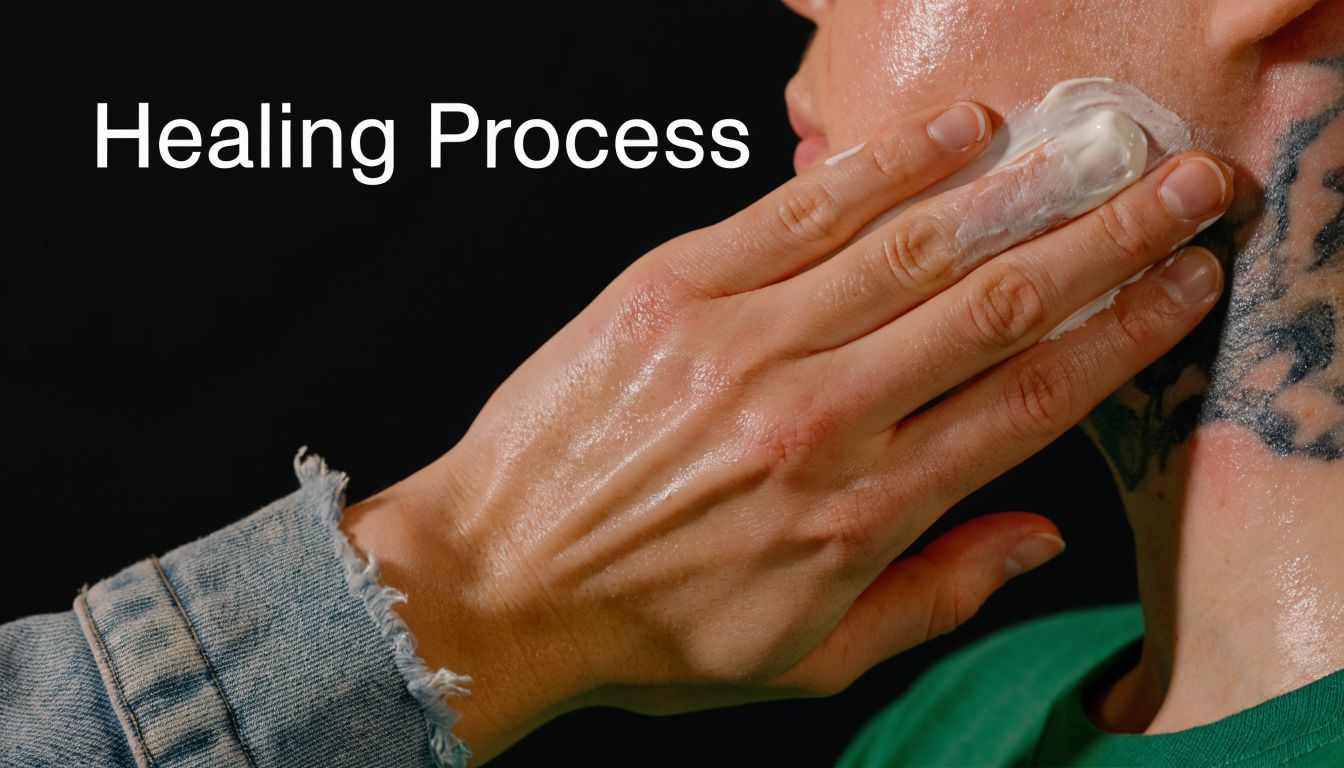
Aftercare doesn't have to be complicated. It does have to be followed. The treated area should be kept clean, protected, and left alone to recover. Friction, sun, and unnecessary irritation work against both healing and cosmetic outcome.
Here's what matters most:
- Keep it clean: Follow your provider's cleaning instructions closely.
- Protect the area: Avoid unnecessary rubbing from tight clothing or straps.
- Respect healing skin: Don't pick at blisters, scabs, or peeling areas.
- Limit stress on the area: Heat, intense activity, and sun exposure can make recovery harder.
Some clients also look for general strategies that support post-treatment comfort in other settings. Resources on professional recovery support for athletic injury can be useful for understanding broader recovery principles such as reducing irritation and supporting tissue comfort, even though tattoo aftercare should always follow the instructions given for your specific procedure.
What doesn't help
Trying to “tough out” aftercare usually backfires. So does layering random products on the skin because someone online recommended them. Laser-treated skin does better with consistency than experimentation.
If you are worried about discomfort, keep this in mind. Many clients find the process manageable because the session is not unbearable. They typically encounter difficulty only if they expect no sensation at all. The experience is quite sustainable when you understand what is normal and view the healing process as part of the final result.
Determining If You Are a Good Candidate
Not everyone starts in the same place, but more people qualify for treatment now than they would have with older technology. The right question isn't whether your tattoo is “perfect” for removal. It's whether your goals, skin, ink, and timeline line up with what laser treatment can realistically achieve.
One of the biggest changes in recent years is that candidacy has broadened. Emerging laser technologies are expanding candidacy, and 2025 to 2026 advancements in hybrid pico and nano lasers are achieving 95% clearance in 40% fewer sessions for diverse inks, making removal viable for more people than before, as described in this overview of newer laser tattoo removal technology. Since those are future-dated advancements, they should be treated as emerging developments rather than assumptions for every current treatment plan.
Signs you may be a strong candidate
You're usually in a good position for laser tattoo removal if your expectations are grounded and your goal is clear.
- You want removal or strategic fading: Both are valid goals, but they require different treatment planning.
- You can commit to the process: Good results come from patience and follow-through, not one rushed visit.
- You understand that progress is gradual: If you expect a reset overnight, you'll likely feel disappointed.
- You're open to an individualized plan: Tattoo color, density, and location all shape the approach.
Some tattoos are excellent candidates for full clearance. Others are better suited for lightening before a cover-up. Neither option is second best. The right one is the one that matches your actual goal.
When a cover-up may make more sense
If your main issue is the current design, not the fact that you have a tattoo at all, fading can be the smarter path. A tattoo artist often has more flexibility when old ink is softened first. That can lead to a cleaner redesign than trying to work over a dark, intact tattoo.
A few situations often point toward fading instead of total removal:
| Situation | Better fit |
|---|---|
| You still want body art in that area | Fading for a cover-up |
| You want the fastest path to a design change | Fading may be more practical |
| You want bare skin again | Complete removal |
| You feel unsure about your end goal | Start with consultation and clarify before treating |
Questions to ask at your consultation
A good consultation should feel like a discussion, not a pitch. Ask direct questions and pay attention to whether the answers are clear.
- What result is realistic for my specific tattoo
- Is complete removal realistic, or is fading the better target
- What factors in my tattoo make it easier or harder to treat
- How should I care for the area after each session
- What skin reactions should I expect, and what would count as a problem
The right provider won't get annoyed by detailed questions. Good tattoo removal depends on matching treatment to the tattoo, and that starts with honest answers.
If you leave a consultation understanding the likely trade-offs, you're talking to someone who takes outcomes seriously.
Your Final Verdict and Your First Step with EradiTatt
So, is laser tattoo removal worth it?
For many people, yes. But not because it's quick or effortless. It's worth it when the benefit of removing or fading the tattoo outweighs the cost, the time, and the temporary discomfort. If the tattoo affects your confidence, your professional presentation, or your sense of personal alignment, that value can be substantial.
The people happiest with the process usually have two things in common. They know their real goal, and they understand that removal is a series of informed steps rather than one dramatic event. That mindset makes it much easier to judge progress fairly and stick with the plan.
If you're in Florida and you're ready to get a realistic assessment, a consultation is the right first move. EradiTatt serves clients across Orlando, Bradenton/Sarasota, St. Petersburg, Palm Harbor, and Tampa, with scheduling support through a central 844 number. Bring your questions, your timeline, and your actual goal. Whether you want full removal or enough fading for a cover-up, the decision gets much easier once you have a treatment plan built around your tattoo rather than a generic promise.
If you want a practical next step, contact EradiTatt Tattoo Removal to schedule a consultation and get a realistic plan for your tattoo, your skin, and your goal.