
You glance at the tattoo you got years ago and feel a split second of hesitation. Maybe it doesn't fit your job anymore. Maybe it ties you to a version of yourself you've outgrown. Maybe you're planning a cover-up, getting ready for enlistment, or just tired of explaining it every time someone notices it.
That feeling is common. Approximately 23% of tattooed Americans express regret, which means millions of people end up looking for a real solution, and laser treatment has become the gold standard for that process according to tattoo removal statistics collected here.
Results matter more than marketing. People want honest answers. Will the tattoo fade? How many sessions will it take? Why do some tattoos disappear cleanly while others linger in patches? And in Florida, how much do sun and sweat complicate healing?
Your Journey from Tattoo Regret to a Clean Slate
Most clients start in the same place. They aren't asking for a miracle. They're asking for a plan they can trust.
A typical first conversation goes like this. Someone comes in with a forearm tattoo they liked at the time, but now it feels too visible for work. Another person has a name tattoo they want gone before a wedding. Someone else doesn't need full removal at all. They just want enough fading to give their tattoo artist a better canvas.
That difference matters because tattoo laser removal results depend on the goal as much as the tattoo itself. A clean slate and a cover-up fade are not the same project. The laser settings, spacing between sessions, and endpoint look different.
Most disappointment in tattoo removal starts with a bad estimate, not a bad laser.
Good removal work begins with a realistic read of the tattoo in front of you. Black ink on the upper arm behaves differently from multicolor ink on the ankle. Fresh dense linework behaves differently from older, softened pigment. Skin tone, sun exposure, and aftercare all shape the outcome.
In Florida, people also bring in a lifestyle factor that can't be ignored. Beach days, pool time, outdoor jobs, and year-round UV exposure affect how carefully the treated skin has to be protected. That doesn't make removal impossible. It means planning has to be tighter.
Clients usually feel better once they understand that the process is progressive, not random. The tattoo doesn't vanish in one dramatic moment. It lightens in stages. Lines soften. Dense areas break apart. Stubborn ink gives way after repeated healing cycles.
What a good plan should answer
- Your likely endpoint: full removal, major lightening, or prep for a cover-up
- Your likely obstacles: difficult colors, difficult placement, heavy sun exposure, or layered ink
- Your healing responsibilities: especially keeping treated skin protected in Florida's climate
- Your treatment rhythm: enough time between sessions for the body to do its part
When those pieces are clear from day one, the process feels much less overwhelming.
How Lasers and Your Body Work Together to Erase Ink
A laser doesn't "scrub" tattoo ink out of the skin. It breaks the ink into much smaller fragments so your body can clear it over time.
The simplest way to picture it is this. Think of tattoo ink like a pile of rocks trapped in the skin. The laser hits those rocks and shatters them into pebbles. Once the pieces are small enough, your immune system can start carrying them away.
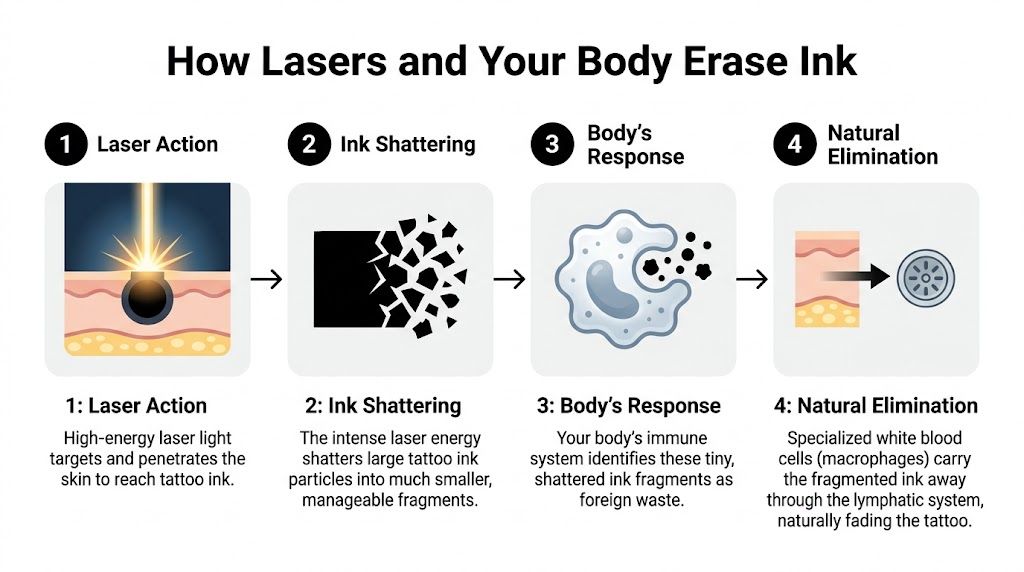
What happens during treatment
The laser sends controlled pulses of light into the skin. Those pulses are absorbed by tattoo pigment, not by the tattoo as a whole. Different colors respond to different wavelengths, which is why color matters so much in removal.
Black and dark blue usually respond best because they absorb laser energy well. Reds, oranges, and browns need a different wavelength. Greens and certain bright tones tend to be more stubborn, which is why multicolor tattoos often need a more customized approach.
Why picosecond technology changed results
Modern picosecond lasers work differently from older nanosecond systems. Their pulse duration is shorter, so they rely more on a photomechanical effect. In plain terms, they create shockwaves that shatter pigment more efficiently instead of depending mostly on heat. Some studies cited in this discussion of picosecond laser performance report an 80% intensity drop per picosecond session versus 20% with nanosecond technology.
That doesn't mean every session on every tattoo will look dramatic. It means the technology is better at fragmenting ink, especially when used correctly and matched to the tattoo's color profile.
Practical rule: Better fragmentation usually means better fading, but only if the body gets enough time to clear what the laser has broken apart.
Why multiple sessions are necessary
This is the part many people underestimate. The laser starts the process. Your body finishes it.
After treatment, immune cells begin dealing with the fragmented ink. That clearing takes time. If sessions are stacked too close together, you can irritate the skin without giving the body enough room to remove the debris created by the previous treatment.
A useful way to think about each session:
- The laser targets pigment
- Ink particles break into smaller fragments
- The skin heals
- Your immune system clears part of that shattered pigment
- The next session targets what's left
That's why tattoos often look unchanged for a short period and then begin to fade gradually during healing.
What modern wavelength matching looks like
A strong treatment plan uses the right wavelength for the right color.
- 1064nm: often used for black and dark blue tones
- 532nm: often used for reds, oranges, and some browns
- 755nm: useful for greens and some blue-green shades
At a practical level, this is why one machine isn't enough for every tattoo type. Some clinics use a combination approach for multicolor work. For example, EradiTatt Tattoo Removal uses the PiQo4 platform as part of treatment planning for tattoos that need picosecond-based fragmentation across different colors.
What doesn't work well is treating every tattoo with the same settings, the same spacing, and the same expectations. Removal is predictable when it's individualized.
The Key Factors That Determine Your Removal Success
Two people can have tattoos that look similar at first glance and get very different outcomes. The reason is simple. Laser tattoo removal is not just about the machine. It's about how the tattoo, the skin, and the healing response all interact.
Factors influencing tattoo removal speed
| Factor | Easier / Faster Removal | More Challenging / Slower Removal |
|---|---|---|
| Ink color | Black and darker tones that absorb laser energy well | Green, yellow, and mixed bright colors that need more precise wavelength matching |
| Tattoo location | Areas closer to the body's center with better circulation | Hands, feet, lower legs, and other extremities |
| Ink density | Lighter shading and less saturated work | Dense packing, heavy linework, and layered pigment |
| Skin response | Skin that heals consistently and tolerates spacing well | Skin under regular irritation, friction, or heavy sun exposure |
| Tattoo history | Older tattoos that have already softened over time | Retouched, covered, or layered tattoos |
Color decides a lot
Black ink usually clears faster because it absorbs a broad range of laser energy. That's why old black script and simple linework can respond very well. Brighter colors aren't impossible, but they can be slower and more selective.
Certain pale inks also need caution. White or flesh-toned pigments can react unpredictably. When those shades are present, a test spot is often the safest way to see how the ink behaves before treating the whole piece.
Placement changes the timeline
Tattoo location isn't a small detail. It's one of the biggest drivers of how fast fading happens.
Areas like hands, feet, and ankles often clear more slowly because they're farther from the body's central lymphatic system. That means the body may process shattered pigment less efficiently there. This location issue is discussed clearly in this overview of factors that affect tattoo removal success, which notes that extremities can require more sessions and that modern picosecond technology can improve difficult-area results.
For Florida clients, extremities also face more day-to-day exposure. Sandals, sun, and outdoor activity create more opportunities for irritation and UV stress.
Tattoos on the ankle or hand often test patience more than tattoos on the upper arm or back.
Skin type matters because safety matters
A good provider isn't just chasing fast fading. They're balancing fading with skin protection.
Darker skin tones can absolutely be treated, but the plan has to respect how melanin interacts with laser energy. That's one reason wavelength choice and conservative progression matter. Overaggressive treatment can create pigment changes that become more frustrating than the tattoo itself.
In this context, experienced settings and observation matter more than promises. The safest route is often a steady route.
Ink density and layering slow things down
Dense tattoos contain more pigment. Layered tattoos contain pigment at different depths and may include ink from multiple sessions done years apart. Cover-up tattoos can be especially stubborn because one design may sit over another.
When a tattoo is heavily saturated, the laser has more material to break apart and the body has more debris to clear after each session. That usually translates into a longer course of treatment.
Florida-specific habits that affect results
The climate doesn't change the science of removal, but it does affect healing behavior.
Common issues include:
- Sun exposure: Freshly treated skin doesn't do well with UV. In Florida, this is the biggest lifestyle issue.
- Sweat and friction: Tight clothing, gym activity, and humid conditions can irritate the area.
- Skipped aftercare: People feel fine after a session and go right back to normal routines too quickly.
What usually helps most
A tattoo tends to respond better when these conditions line up:
- The color is favorable
- The placement has decent circulation
- The sessions are properly spaced
- The skin is protected from sun
- The client doesn't rush the process
Removal results improve when the plan fits the tattoo in front of you, not a generic timeline.
Your Removal Timeline From First Session to Final Result
The first appointment usually answers the question clients care about most. What's realistic for this tattoo?
That starts with a close look at color, density, placement, and skin type. A clinician may also use the Kirby-Desai scale to estimate difficulty. In the clinical data summarized by The PMFA Journal's review of laser tattoo removal results and issues, scores of 6 or below predict excellent clearance in 4 or fewer sessions, scores from 7 to 13 suggest 5 to 10 sessions, and scores above 13 point to more challenging tattoos that may need more than 10 sessions. That same review reports that, with the right technology and 60 to 90 day intervals, 74.3% of patients achieved complete tattoo pigment disappearance.
Right after session one
An immediate whitening effect called frosting is commonly noticed. That's a normal short-term skin response. Then the area settles down.
Over the next days, you might see redness, swelling, and sometimes blistering or crusting. None of that means the treatment failed. It means the skin is moving through the healing stage that has to happen before visible fading appears.
Weeks after the first treatment
Patience pays off. The first visible change is often subtle. Dense dark lines can look softer or slightly broken up. Some tattoos get a faded, dusty look before they get lighter.
The body is doing invisible work during this phase. That's why spacing matters so much. The treatment isn't just what happens in the room. It's also what happens during the weeks after.
A fuller breakdown of timing helps if you're trying to map removal around work, travel, or an event. This guide on how long tattoo removal takes is useful for understanding how the schedule unfolds.
Midway through the process
By the middle sessions, the tattoo often looks uneven. Clients sometimes worry at this stage because the ink doesn't fade uniformly.
That patchiness is normal. Some pigment sits deeper. Some colors respond faster. Some parts of the tattoo have better circulation and clear faster than others. Mid-process tattoos often look worse before they look finished because the remaining ink stands out more once the easy portions have faded.
Uneven fading is usually a sign that removal is progressing, not stalling.
The final stretch
The last sessions are often the least dramatic visually, even though they matter a lot. At that point, you're usually targeting stubborn residual pigment rather than broad dark areas.
Realistic expectations matter most. Some tattoos clear to a clean finish. Others may leave a faint shadow or a subtle textural reminder, especially if the original tattooing caused scar tissue. Good planning accounts for that possibility from the start instead of pretending every tattoo ends exactly the same way.
A Gallery of Real Florida Tattoo Removal Results
Before-and-after images help, but they only tell part of the story. The more useful question is what kind of tattoo each person started with and what goal they were chasing.

A hand tattoo that clears well says something different from a shoulder tattoo that lightens for a cover-up. Hand skin takes more daily wear, gets more sun, and often heals slower. So when you look at a result, the location matters as much as the image.
What to look for in real results
When reviewing a gallery, focus on these details:
- Original ink profile: Was it black only, multicolor, dense, faded, or layered?
- Goal of treatment: Full removal and cover-up prep should not be judged by the same standard.
- Skin condition: Look for healthy healed skin, not just disappearing pigment.
- Progression: Good results usually happen in stages, not all at once.
A realistic Florida gallery will usually include visible differences in body area, sun exposure habits, and tattoo age.
Common result patterns clients recognize
Some patterns show up again and again in practice:
- Old black script on the arm: often fades cleanly and progressively
- Dense professional tattoo on the lower leg: often needs more patience because the location works against fast clearance
- Colorful shoulder piece for a cover-up: usually doesn't need full erasure, just enough opening for new design work
- Finger or hand ink: can improve well, but clients need very disciplined aftercare because those areas are exposed constantly
If you want examples that match tattoos commonly treated in this region, this set of tattoo removal before and after examples from Tampa gives a better visual reference than generic stock galleries.
What these galleries don't show on their own
Photos rarely capture the decision-making behind a result. They don't show why one tattoo was treated conservatively to protect the skin, why another was faded instead of fully removed, or why spacing was stretched because the client had a beach vacation in the middle of the process.
That's why galleries should support a consultation, not replace one. A useful image tells you what's possible. A good assessment tells you what's likely for your skin and tattoo.
Full Removal vs Fading for a Cover-Up What Is Your Goal
Not every tattoo needs to disappear completely. A lot of strong outcomes come from stopping well before full clearance.
When full removal makes sense
Full removal is usually the right path when the tattoo itself is the problem and you don't want new ink in its place. That includes career requirements, life transitions, relationship tattoos, and visible pieces that no longer fit who you are.
In those cases, the endpoint is simple. You want the skin as clear as possible. That can take longer, especially if the tattoo is dense or colorful, but the benefit is control. You're not designing around old ink. You're removing it.
When fading is the smarter move
Cover-up prep has a different goal. You don't need a blank canvas. You need a lighter one.
That changes the strategy. Instead of chasing every last trace of pigment, the laser breaks up enough darkness and softens enough linework that a tattoo artist has room to create something better. This approach is often more efficient and less emotionally exhausting because the progress becomes useful sooner.
A cover-up fade can be especially practical when the old tattoo is dark but not very large, or when the new design will be bigger and more saturated anyway.
A successful fade isn't incomplete removal. It's targeted preparation.
The emotional side is real
People often talk about removal as if it's only cosmetic. It isn't. For some clients, it's about personal comfort. For others, it's about safety, credibility, or access to a different life.
That broader impact shows up clearly in research. A study on tattoo removal and gang-related identity found that 94% of individuals seeking to leave gang affiliation reported tattoo removal was successful in helping them achieve that goal, as noted in this study on social reintegration through tattoo removal.
That finding matters because it reminds people that removal isn't vanity by default. Sometimes it's a reset. Sometimes it's a practical step toward work, family life, or moving without carrying an old label.
A simple way to choose
Ask one question first. Do you want empty skin, or do you want better skin for new ink?
If you want empty skin, the plan should be built for complete removal. If you want a better base for new artwork, fading may be the better investment of time, money, and healing energy.
Aftercare The Secret to Achieving the Best Results
A strong laser session can be undermined by weak aftercare. Aftercare frequently dictates whether tattoo laser removal results are protected or compromised.
Florida makes aftercare harder because the environment pushes against restraint. It's hot. People sweat. People swim. People spend time outside year-round. Treated skin doesn't care that it's beach season.
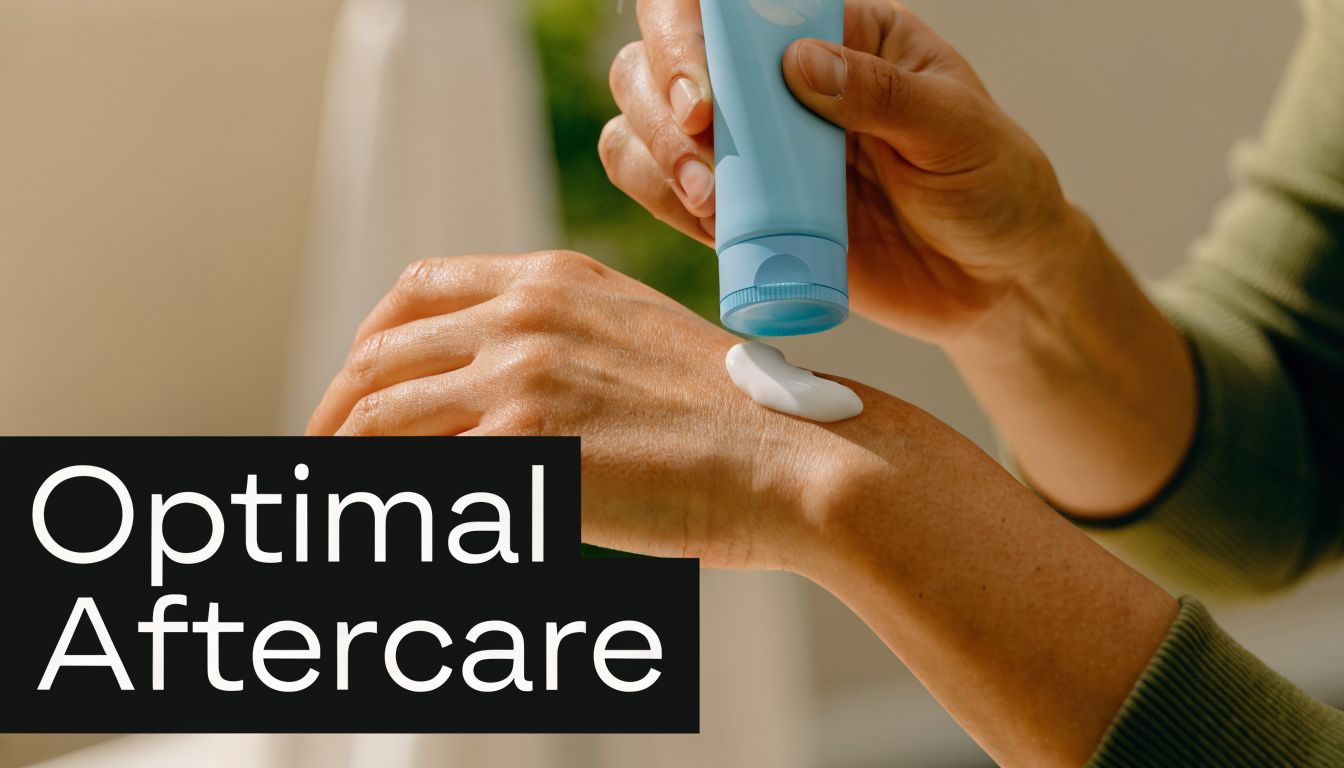
The first couple of days
Right after treatment, think protection first.
- Keep it clean: Use gentle cleansing as instructed and avoid unnecessary rubbing.
- Leave blisters alone: If blistering appears, don't pick, pop, or peel.
- Reduce friction: Loose clothing helps, especially on legs, ribs, and shoulders.
- Use the recommended topical care: Follow the clinic's directions instead of improvising with random products.
The goal during this phase is simple. Let the skin calm down without extra trauma.
The weeks between sessions
Once the surface settles, the long game starts.
- Protect from sun: This is the big one in Florida. Treated skin exposed to UV is more likely to develop unwanted pigment changes.
- Avoid soaking and unnecessary irritation: Pools, hot tubs, long beach days, and abrasive activity can all complicate healing if resumed too soon.
- Don't rush your next session: The skin may look fine before the deeper recovery work is done.
- Watch for signs that need attention: If something seems off, contact the clinic instead of guessing.
A more detailed breakdown of these steps is available in this guide on why aftercare is important after laser tattoo removal.
Florida-specific advice that matters
In this state, aftercare usually fails in predictable ways.
People forget that a short walk outside adds up. They wear sandals after treating a foot tattoo. They go back to the gym in tight compression gear. They spend a weekend on the water after treating exposed skin and assume one outing won't matter.
It does matter. Freshly treated skin is vulnerable.
One warning worth remembering: the session may last minutes, but the result depends on the healing choices you make for weeks.
What not to do
A short don't-do-this list prevents a lot of trouble:
- Don't pick scabs or peeling skin
- Don't force heavy activity onto a freshly treated area
- Don't tan treated skin
- Don't assume redness means you should self-treat with harsh products
- Don't compare your healing day-by-day to someone else's
The best results usually come from boring behavior. Clean care, less friction, less sun, and enough time.
Begin Your Tattoo Removal Journey in Florida Today
Good tattoo removal is methodical. The laser breaks up pigment. The body clears it over time. Results depend on color, location, skin response, treatment spacing, and aftercare. None of that is guesswork when the tattoo is assessed accurately at the beginning.
That honesty matters more in Florida because lifestyle affects healing. Sun protection isn't an extra suggestion here. It's part of the treatment plan. The same goes for spacing sessions properly and choosing whether you're aiming for total removal or a cover-up fade.
If you're in Central or West Florida, the most useful next step is a consultation where the tattoo can be evaluated in person. A hand tattoo, a dense calf piece, and an old black forearm script all require different expectations. Once that is clear, the process usually feels much more manageable.
EradiTatt has Florida locations in Tampa, Orlando, St. Petersburg, Bradenton/Sarasota, and Palm Harbor. If you're ready to talk through your tattoo, your timeline, and your goal, call the central scheduling team at 844-239-1879 to set up a consultation.
If you're ready to take the next step, schedule a consultation with EradiTatt Tattoo Removal and get a realistic plan for your tattoo, your skin, and your timeline.