
Laser tattoo removal on colored tattoos usually takes 6 to 12 sessions spaced 6 to 8 weeks apart, and it works best when the laser wavelength matches the ink color. 532 nm is strongest for red, orange, and warm tones, while green and yellow are typically the hardest colors to fully clear.
If you're reading this with a bright tattoo on your arm, ankle, shoulder, or wrist and wondering why the internet keeps talking about black ink, you're not alone. Most removal content makes colored work sound like a minor variation of black tattoo removal. In real treatment rooms, it isn't.
A red flower, a green leaf, a blue border, and a yellow highlight do not behave the same way under laser. Some shades break apart steadily. Others stall, lighten unevenly, or fade only so far before progress slows down. That doesn't mean colored ink can't be treated. It means your plan has to match the actual pigment in your skin, not a generic idea of tattoo removal.
Table of Contents
- Why Colored Tattoos Are Different from Black Ink
- How Laser Wavelengths Target Different Ink Colors
- Color-by-Color Removal Effectiveness Guide
- What to Expect During Each Treatment Session
- Safety Considerations for Different Skin Tones
- Session Count Timeline and Pricing Factors
- When to Consult a Professional Removal Specialist
Why Colored Tattoos Are Different from Black Ink
Someone comes in with a multicolored piece after spending weeks reading about black ink removal. They expect the whole tattoo to fade at the same pace. Then the first few sessions show what usually happens. The black outline starts changing early, the red softens, and the green hangs on.
That gap between expectation and reality is where most frustration starts.
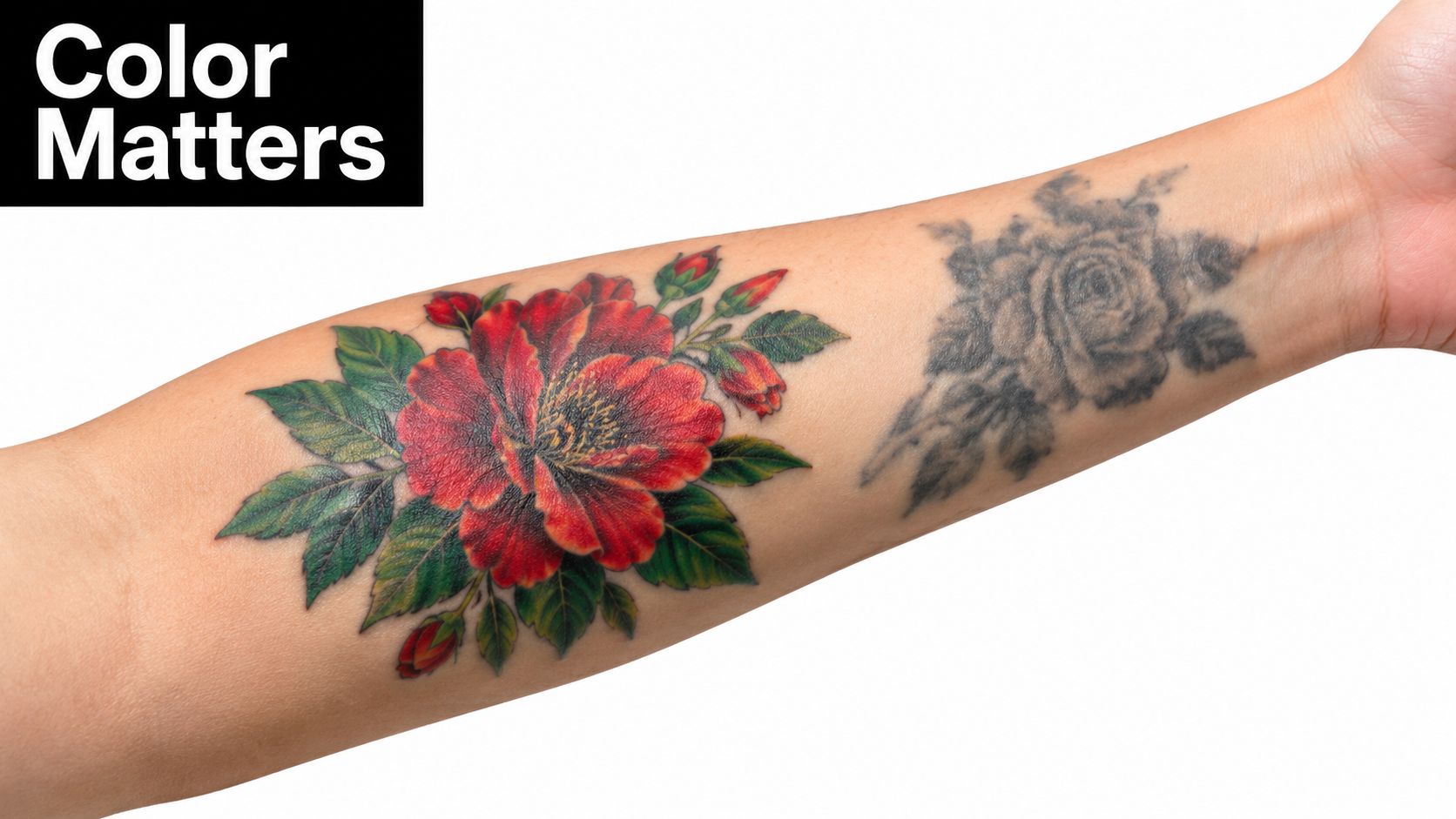
Pigment decides what the laser can affect
Colored ink responds differently because pigment color determines which laser light gets absorbed and which gets reflected. A clinical review notes that 532 nm is most effective for red, orange, and rose inks, while 755 nm alexandrite or 694 nm ruby are used for green tattoos. The same review also notes that 1064 nm Nd:YAG is ideal for blue-black ink and is often used first in mixed-color tattoos because it penetrates and is safer for darker skin types, as described in this clinical review of laser treatment for tattoos.
Some colors absorb more heat. Others reflect it. Tattoo pigment does something similar with laser light. If the wavelength doesn't line up with what that pigment absorbs, treatment gets less efficient.
Why one-size-fits-all treatment fails
A single-wavelength approach can still work on simple black designs. It breaks down fast on complex color.
With multicolored tattoos, the operator often has to treat different areas with different settings, and sometimes different wavelengths in separate passes or separate sessions. That's why two tattoos that look similar in size can have very different removal paths.
Practical rule: If a tattoo contains red, green, blue, yellow, and black, don't expect one pass with one setting to remove all of it evenly.
A few practical factors also change how fast color moves:
- Tattoo age matters: Older tattoos often look softer because the body has already done some of the clearing work.
- Ink density matters more than people expect: Heavy professional packing usually takes longer than a lighter amateur tattoo.
- Layering changes the response: Cover-ups and reworked pieces can trap multiple pigments at different depths.
The key point is simple. Laser tattoo removal on colored tattoos is a matching process, not a one-laser shortcut. When patients understand that early, they're usually much more comfortable with the pace of treatment.
How Laser Wavelengths Target Different Ink Colors
A patient comes in with a rose tattoo that has black linework, red petals, and green leaves. If all three areas get treated the same way, the black may lift, the red may partially respond, and the green can sit there looking almost unchanged. That is why colored tattoo removal starts with wavelength choice, not just energy settings.
The main wavelengths that matter
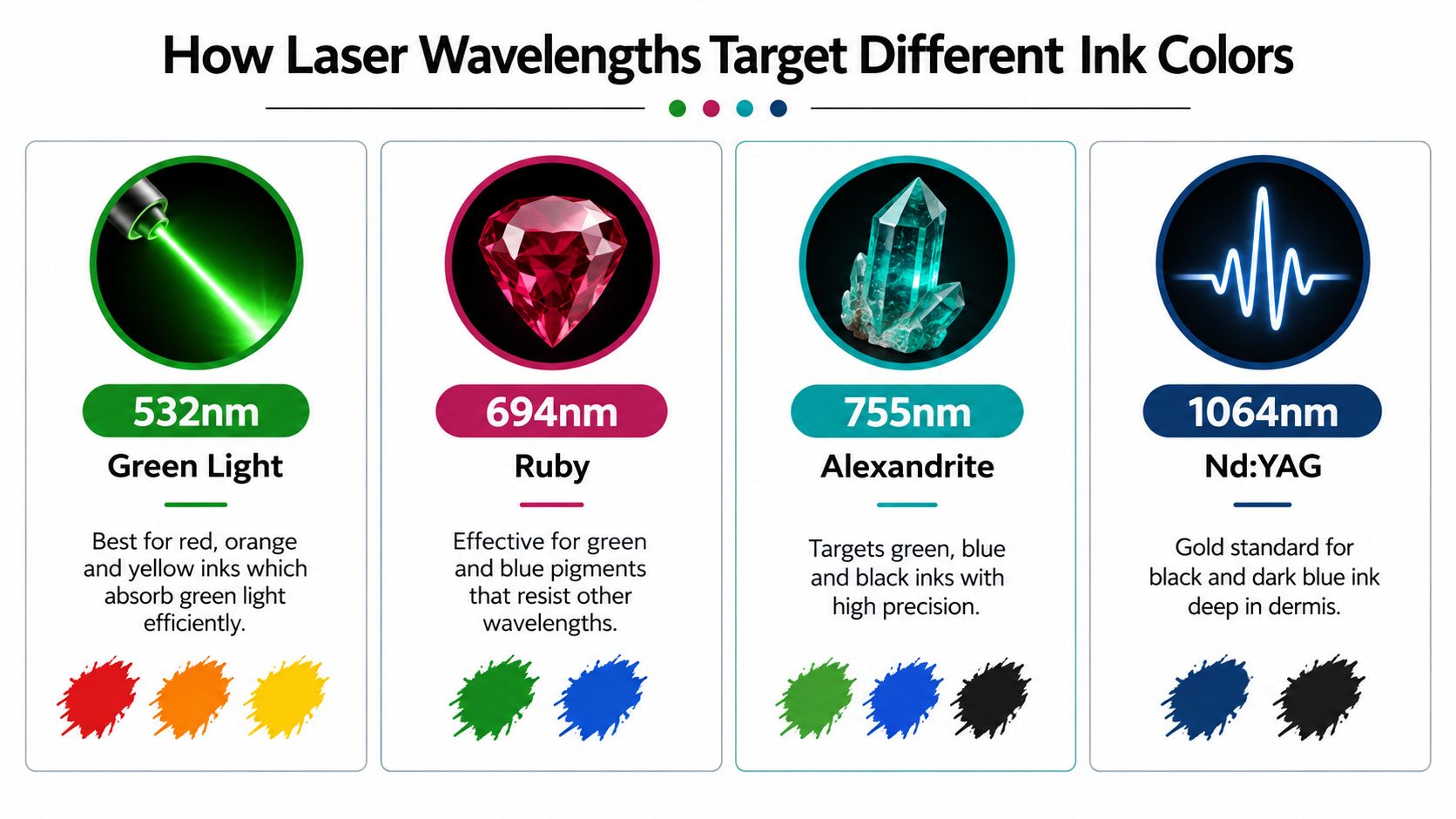
Each ink color absorbs a different part of the light spectrum. The closer the match, the more efficiently the pigment particles fracture. In practical clinic terms, the wavelengths that matter most are:
- 1064 nm for black, charcoal, and many dark blue inks
- 532 nm for red, orange, and some purple or pink tones
- 755 nm for green and blue-green pigments
- 694 nm for certain green shades, especially stubborn ones that do not respond well to other options
This is why two tattoos with the same size can behave completely differently. A black script piece often follows a cleaner treatment path than a color tattoo with several pigment families packed at different depths.
Why wavelength choice changes the outcome
Changing the wavelength changes which pigment is being targeted. It is not just a stronger or weaker version of the same treatment.
I explain it to patients this way in the room. If the wavelength is well matched, the session usually produces more useful frosting or immediate tissue response in that color zone, and the fading over the next several weeks tends to be more noticeable. If the wavelength is poorly matched, the skin can still react, but the ink breakup is less efficient and the session gives less value.
For multicolored work, a platform that can switch between wavelengths gives the operator better control over mixed tattoos. This Discovery Pico laser overview shows the kind of multi-wavelength setup clinics use when a tattoo has dark outlines, warm colors, and resistant green sections in the same piece.
What 532 nm actually means in treatment
Many patients hear “Nd:YAG” and assume that means one fixed beam. In practice, 1064 nm and 532 nm often come from the same system, with 532 nm created by frequency-doubling the 1064 nm beam. A British Journal of Dermatology article on Q-switched Nd:YAG systems discusses that setup and why 532 nm is used for lighter tattoo colors and melanin-containing targets.
That detail matters because 532 nm can be very effective on warm inks, but it also demands more caution on darker skin tones due to competing epidermal melanin absorption. In real treatment planning, that means the “best” wavelength for the ink is not always the safest starting point for the skin.
A good color-removal plan usually looks like this:
- Black and very dark sections are commonly treated with 1064 nm
- Red and orange areas usually respond best to 532 nm
- Green areas often need 755 nm or 694 nm
- Mixed-color tattoos may need different wavelengths across separate passes or separate sessions
When settings, handpieces, or treatment order change during a colored tattoo session, that is color mapping based on the ink present, the skin tone in front of us, and the fading pattern from earlier visits.
Color-by-Color Removal Effectiveness Guide
Not all tattoo colors sit in the same removability tier. Some respond predictably. Some fade but rarely cooperate on a straight timeline. A few need a blunt conversation before treatment starts.
Which colors usually respond best
Warm tones tend to be the most straightforward among colored inks when the wavelength is correct. A review of colored tattoo removal notes that 532 nm is generally strongest for red, orange, and yellow, 755 nm for green and blue, and 1064 nm mainly for black, while also stressing that outcomes still vary by tattoo age, density, and whether the tattoo was professionally or amateurly applied in this review on picosecond-domain treatment of colored tattoos.
In practice, I'd place common colors into broad buckets like this:
| Ink Color | Removal Difficulty | Best Wavelength |
|---|---|---|
| Red | Easier | 532 nm |
| Orange | Easier | 532 nm |
| Purple | Moderate | 532 nm can be very effective |
| Blue | Moderate | Depends on shade, often 1064 nm or 755 nm |
| Dark blue | Moderate to easier | 1064 nm |
| Green | Hard | 755 nm or 694 nm |
| Teal and turquoise | Hard | Usually treated like green-blue blends |
| Yellow | Very hard | 532 nm offers the best practical chance |
| Black mixed into color | Easier than the color portions | 1064 nm |
For readers focused on one stubborn shade, this guide on laser tattoo removal for green ink is useful because green behaves very differently from red or black.
What matching the wavelength changes
Benchmarks from tattoo studies show that proper wavelength matching can reduce the fluence needed for visible lightening. In those studies, red, orange, and rose inks were lightened at 532 nm with 0.6 J/cm², brown at 1064 nm with 0.3 J/cm², yellow and green at 448 nm with 2.6 J/cm², and blue at 600 nm with 0.9 J/cm². The reason is stronger spectral overlap between the laser output and the ink absorption profile, which improves selective photothermolysis and supports more efficient pigment fragmentation with less off-target tissue injury, as described in this JAMA Dermatology study PDF.
That doesn't mean every clinic uses those exact wavelengths for every tattoo. It does show why color matching matters so much. Better overlap usually means cleaner work.
Some colors are realistically removable. Others are more honestly described as fadeable.
The colors that need the most patience
Green and yellow create the most disappointment when people expect black-ink results. Green can improve, but it often takes persistence and precise wavelength selection. Yellow may lighten, but it commonly reaches a point where further progress slows down.
Purple sits in the middle. Recent evidence on multicolored tattoos reports 532 nm as the most effective wavelength for red, orange, yellow, and also purple tattoos, with optimal tattoo-clearance-to-safety ratios for blue, green, red, and yellow tattoos at 532 nm in the range of 0.96 to 2.39 J/cm² in this multicolored tattoo study on picosecond treatment.
If you want the practical version, here it is. Red and orange usually reward treatment. Blue depends on the shade. Green takes work. Yellow is the color I never overpromise.
What to Expect During Each Treatment Session
The first session is usually less dramatic than patients expect. The biggest surprise isn't the machine. It's how methodical the process is when it's done properly.
What happens before the laser starts
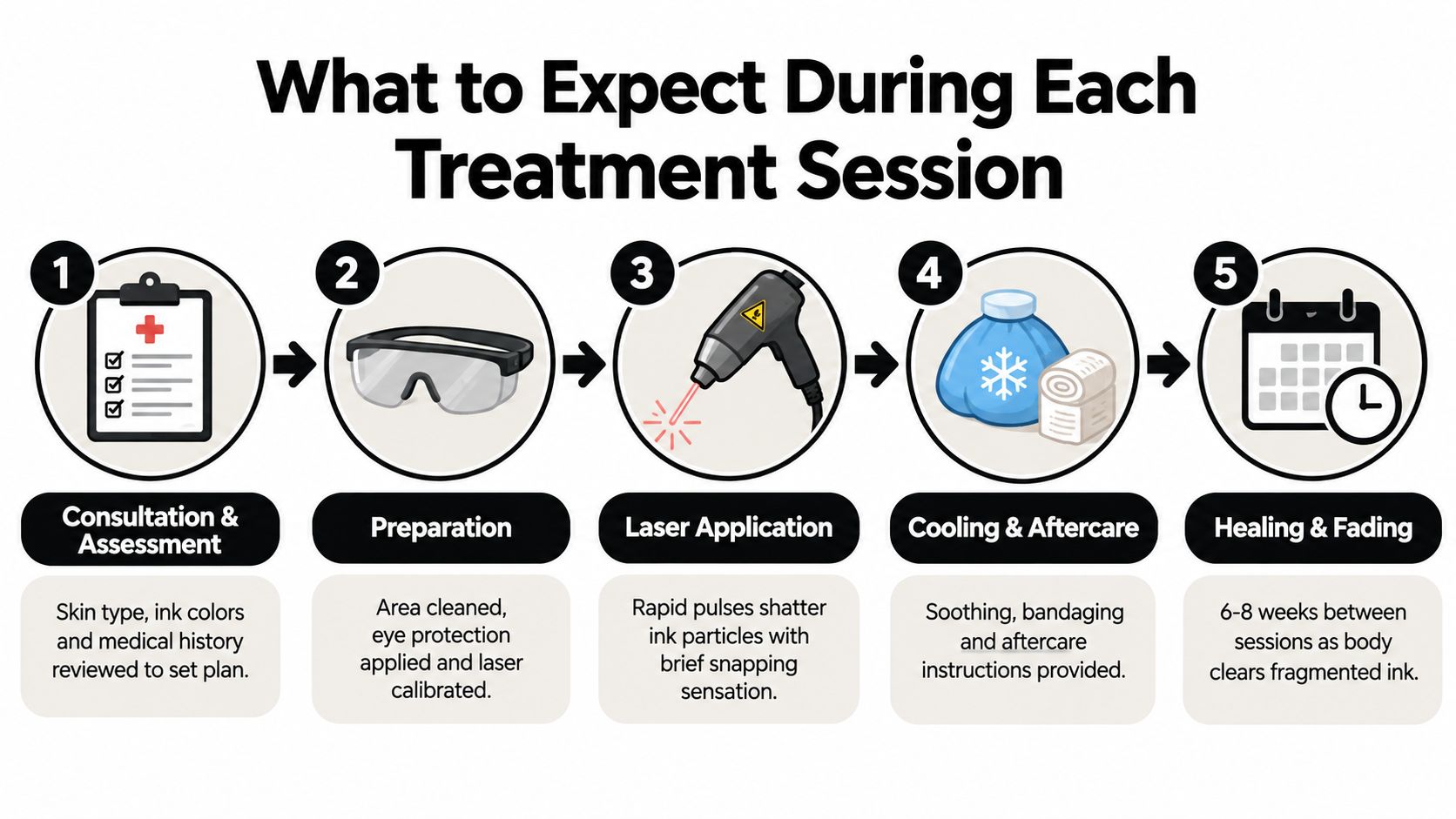
At consultation, the provider studies four things first: your skin tone, the tattoo colors, how saturated the ink looks, and whether the tattoo appears layered or reworked. Colored pieces need more planning than black work because the treatment sequence matters.
Then the area is cleaned, eye protection goes on, and the laser is set to the wavelength chosen for the section being treated. On multicolored tattoos, that can mean more than one setup in a single appointment.
What treatment feels like
Most patients describe the sensation as quick snapping or heat with very fast pulses. Colored areas can feel different from dark sections because the laser parameters may change with the pigment.
Right after treatment, it's common to see frosting, which is that temporary white cast on the tattoo surface. It doesn't mean the tattoo vanished instantly. It means the skin had an immediate response to the laser energy.
A typical visit moves through these stages:
- Assessment and photography so progress is documented consistently.
- Skin prep and protection with shielding and cooling as needed.
- Laser passes by color zone rather than treating the entire tattoo identically.
- Immediate cooling and dressing to calm the area.
- Aftercare review so healing doesn't get sabotaged at home.
If the aftercare is sloppy, the results usually are too.
What happens between appointments
The fading happens after you leave. The laser breaks pigment into smaller fragments. Your body then has to process and clear that fragmented ink over time.
That's why spacing matters. Colored tattoo removal is usually done with 6 to 8 weeks between sessions so the skin can recover and your body has time to work through the disrupted pigment. You may notice one color fading quickly while another looks unchanged for a while. That's normal with mixed-color pieces.
A few practical aftercare habits make a difference:
- Keep the area clean: Dirty, irritated skin heals slower.
- Don't pick at blisters or flaking skin: That creates avoidable texture problems.
- Protect it from sun exposure: Freshly treated skin doesn't need extra stress.
- Watch for uneven fading: It isn't always a problem, but it's worth tracking with photos.
The treatment room part is short. The healing phase is where most of the visible progress develops.
Safety Considerations for Different Skin Tones
A medium-brown skin tone with red and yellow ink should not be treated the same way as pale skin with black linework. I change the plan before I ever fire the first pulse. The color matters, but skin tone often decides how aggressive we can safely be.
The practical issue is melanin competition. Some wavelengths that work well on bright tattoo pigments also interact more with surface pigment in the skin. That raises the chance of post-inflammatory hyperpigmentation, hypopigmentation, or excess heat injury, especially if someone tries to push settings too fast for the sake of quicker fading.
For darker skin tones, I usually build the plan around the safest wavelength first, then decide whether the brighter colors are worth treating now, later, or with more conservative expectations. As noted earlier, device labeling has historically been more permissive with 1064 nm across a wider range of skin types than with 532 nm. In real practice, that matches what many technicians see. Black and very dark ink are usually more straightforward on deeper skin tones than red, orange, or yellow.
How responsible providers reduce risk
Good results come from restraint early on. Colored tattoo removal can tempt providers to chase every shade in one session. That is where avoidable pigment problems start.
A safer treatment plan often includes:
- Conservative settings at the start: Especially if the tattoo includes warm colors or the patient has a history of pigment change.
- Test spots for uncertain colors: Helpful when green, teal, peach, or cosmetic-style pigments do not have a predictable response.
- Longer spacing if the skin stays reactive: Fading can wait. Barrier recovery cannot.
- Strict sun avoidance before and after treatment: Tanned or recently sun-exposed skin is easier to injure.
- Clear stop points during the session: Frosting is not a reason to keep stacking energy if the skin already looks stressed.
I tell patients this plainly. Fast is not the goal. Clearer ink with stable skin color is the goal.
For a closer look at treatment planning on deeper skin tones, this guide to tattoo removal on dark skin covers the risks and decision points in more detail.
A practical Fitzpatrick view
Lighter skin usually gives us more flexibility with wavelength choice, especially for red and orange pigments. Medium skin tones can often still treat those colors, but settings and endpoint judgment matter more. Deeper skin tones usually call for a narrower margin of safety, and some bright colors may fade only partially without raising the risk of visible pigment change in the skin.
That trade-off should be discussed before treatment starts, not after the third session.
Patients usually do better when they hear the honest version up front. A tattoo can be removable and still not be a candidate for aggressive multi-color treatment on day one. That is sound laser practice, and it leads to fewer complications.
Session Count Timeline and Pricing Factors
Colored tattoos ask for patience. They also ask for planning. The biggest mistake I see is people budgeting for one or two visits when their tattoo clearly needs a full course.
How long the process usually takes
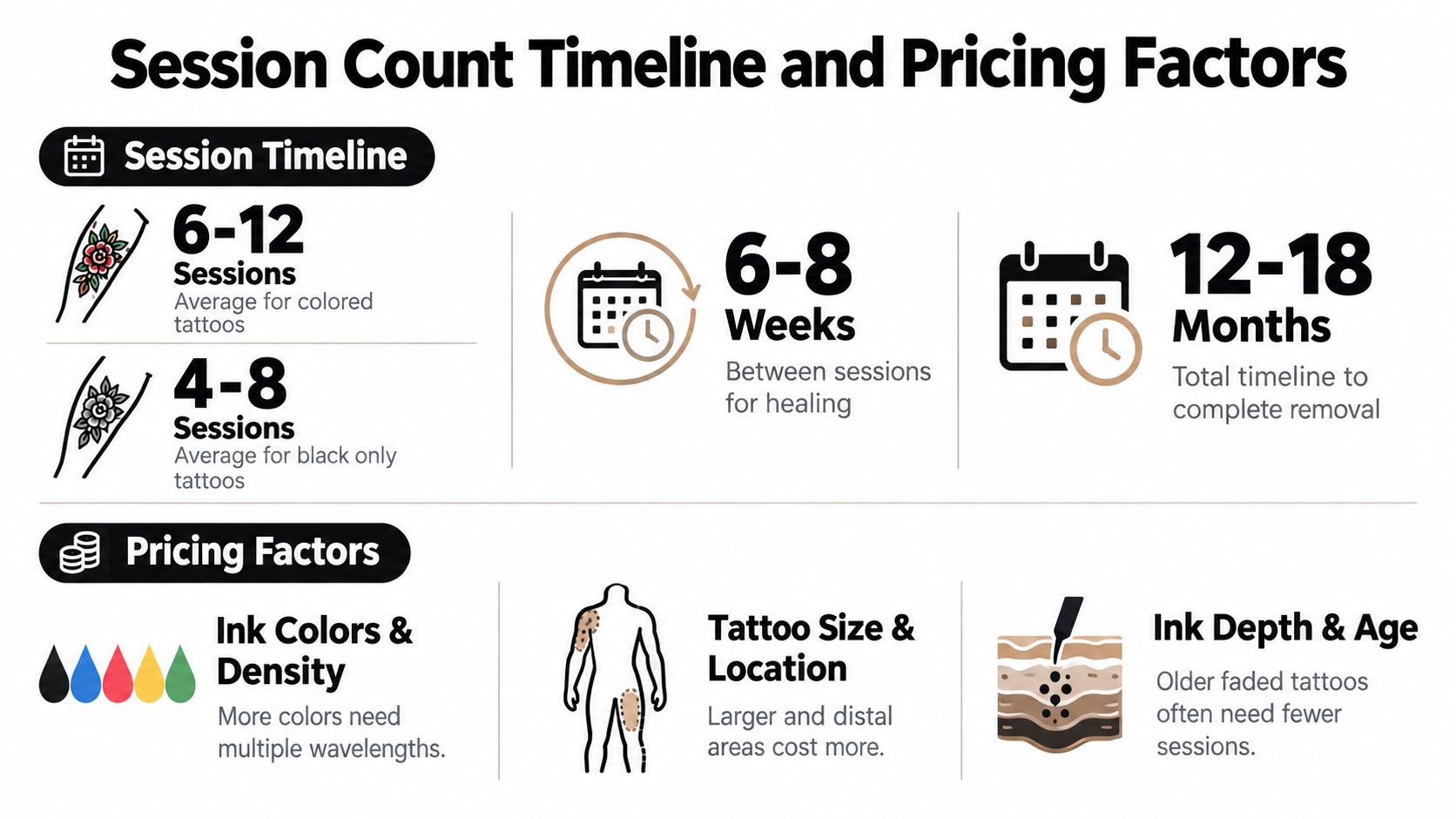
For colored work, a realistic expectation is 6 to 12 sessions spaced 6 to 8 weeks apart. That spacing gives the skin time to settle and gives the body time to clear fragmented pigment. The full timeline often stretches well beyond the first few months because fading isn't linear.
Some tattoos show clear changes early. Others don't look dramatically different until several sessions in. That's especially true when the easy color clears first and the stubborn shades are left behind.
What pushes session count up
A tattoo doesn't become harder to remove just because it's large. Color complexity is often the bigger factor.
The most common reasons a colored tattoo needs more time are:
- More colors in one piece: Different pigments often need different treatment strategies.
- Dense professional saturation: Heavier packing usually means slower clearing.
- Stubborn shades: Green and yellow commonly extend the treatment course.
- Body placement: Areas with slower circulation can lag behind.
- Cover-up history: Multiple generations of ink rarely behave.
Pricing usually follows that same logic. Clinics often base treatment costs on the amount of skin being treated, how much color complexity is involved, and whether multiple wavelengths are needed across the course.
What people should budget for mentally
Most patients do better when they plan for a process, not a miracle session. If your tattoo is small and mostly red, the path may be simpler. If it's a large multicolored sleeve with black shading, green sections, and yellow highlights, the treatment plan is naturally more involved.
Insurance generally doesn't cover cosmetic tattoo removal. So the practical questions become:
- How many visits can you commit to?
- Are you aiming for full removal or fade for a cover-up?
- Can you follow aftercare and spacing consistently?
That last point matters more than people think. Missed intervals, heavy sun exposure, and poor healing habits can stretch out the course even when the laser plan is solid.
When to Consult a Professional Removal Specialist
There are a few situations where online research stops being useful and a real consultation becomes the right next step.
If your tattoo is multicolored, layered, or partially covered up, you need somebody to evaluate the actual pigment map. If you've already tried creams, home tools, or other shortcuts, and the ink still looks the same, it's time to stop experimenting on your skin. If you're preparing for a cover-up, a job change, military requirements, or a life event, timing matters enough that a proper treatment plan is worth getting.
Clear signs it's time to book
Some cases are especially worth bringing to a specialist:
- Your tattoo includes green, yellow, or multiple bright colors: These need more precise wavelength selection.
- You've got darker skin and want to avoid pigment complications: Safety planning matters as much as fading.
- The tattoo needs partial fading, not full removal: Cover-up prep is a different goal than total clearance.
- You've stopped seeing progress elsewhere: Resistant pigment often needs a more disciplined approach.
EradiTatt Tattoo Removal operates in Tampa, Orlando, Saint Petersburg, Bradenton, and Palm Harbor, which makes in-person assessment practical for clients across Central and West Florida. For colored pieces, that matters because treatment planning is easier when the provider can inspect saturation, undertones, and layering directly instead of guessing from a phone photo.
A professional consultation should give you more than a price. It should tell you which colors are likely to respond well, which areas may only fade, how your skin tone affects wavelength choice, and what kind of timeline fits your goal.
Laser tattoo removal on colored tattoos is a medical-grade procedure. It isn't something to hand over to trial and error.
If you're dealing with bright, stubborn, or mixed-color ink, EradiTatt Tattoo Removal can assess the pigment, skin tone, and removal goal before building a realistic treatment plan. To see what your tattoo is likely to do under the right wavelengths, visit EradiTatt Tattoo Removal and schedule a consultation with a Florida location that works for you.