You just walked out of the clinic, glanced at the mirror in your car, and thought, that looks a little harsher than I expected. The brows are warm, swollen, maybe a bit frosted, and you're trying to decide whether this is a normal first hour or a reason to call someone right now. That uneasy gap between “I had laser eyebrow tattoo removal” and “what's supposed to happen next” is exactly where recovery needs to be explained clearly.
The good news is that the laser eyebrow tattoo removal healing process has a pattern. The visible reaction is short, while the deeper pigment-clearing work keeps going long after the skin stops looking dramatic. If you know which stage you're in, you can protect the result, avoid common mistakes, and stop treating every change like a problem.
Table of Contents
- Walking Out of the Clinic With Treated Brows
- How Lasers Actually Clear Eyebrow Ink
- Your Day-by-Day Healing Timeline
- Why Brows Can Look Healed but Still Be Recovering
- Aftercare Do's and Don'ts That Actually Matter
- Factors That Change How You Heal
- Planning Sessions Around Real Life
- Red Flags and Questions Worth Asking
Walking Out of the Clinic With Treated Brows
The first few minutes after treatment are usually the hardest emotionally, because your brows don't just look “done,” they look worked on. The skin can show frosting, a pale or white powdery look, along with warmth, swelling, and tenderness, which is a normal immediate response after laser eyebrow tattoo removal as described in a neutral review of eyebrow and eyelid tattoo laser treatment. If you're standing in the parking lot wondering whether your brows are supposed to look like that, the answer is yes, they often do.
What the first hour really feels like
The surface reaction is usually the loudest part of the day. Some people feel a sunburn-like sting, others mostly notice puffiness and tightness, and the mirror can make everything seem more intense than it feels in motion. A careful clinic should send you out with a printed aftercare sheet, not a vague “just keep it clean” message, because the first decisions you make at home matter more than how dramatic the brows look in the car.
Practical rule: if the area looks irritated but the discomfort is easing, that fits the expected pattern. If pain ramps up instead of settling, that deserves attention.
The bigger mindset shift is this, the healing process has two tracks. The skin starts its surface repair quickly, but the pigment fragments still need time to clear. The broader tattoo-removal literature shows why patience matters, because removal often takes 7 to 10 treatments on average and some series report 95% pigment removal after an average of 8.9 sessions PMC review. That doesn't mean your brows will look raw for months, it means the visible calm you see early isn't the full story.
If you've just had your first session, keep the rest of today simple. Clean hands, a calm routine, and no panic scrolling.
What to expect after first session of laser tattoo removal with PiQo4
How Lasers Actually Clear Eyebrow Ink
Laser eyebrow tattoo removal works because the beam doesn't “wipe” ink out of the skin in one pass. It delivers energy into pigment that sits in the dermis, breaking larger particles into smaller fragments that the body can clear over time. A useful way to think about it is like smashing a boulder into sand, the cleanup crew can move sand much more easily than a boulder.
Why eyebrow ink behaves differently
Eyebrow tattoos are a little stubborn because cosmetic pigments often include mixed tones and can behave differently from body art. Warm pigments, especially red and orange components, can paradoxically darken in about 25% of cases before they fade, and that temporary shift is typically handled with later 1064 nm laser sessions review of eyebrow and eyelid tattoo laser treatment. That's one reason the process can look strange before it looks better.
Picosecond and nanosecond devices both aim to fragment ink, but the skin's recovery and the body's pigment clearance are separate jobs. The laser session creates the change, while your immune system and normal tissue turnover do the cleanup. That's why the healing timeline isn't a single flat line, it's a layered process with different clocks running at once.
The laser can fracture the pigment in seconds, but the body still needs days, weeks, and sometimes longer to finish the work.
For first-timers, this is the most important concept to understand. The brow can look settled on the outside while deeper pigment debris is still moving out. That's also why follow-up spacing matters. If sessions are stacked too closely, you can irritate skin that hasn't finished repairing and you can make it harder for the body to clear the previous round of fragmented ink.
How tattoo removal works, a complete breakdown for first timers
Your Day-by-Day Healing Timeline
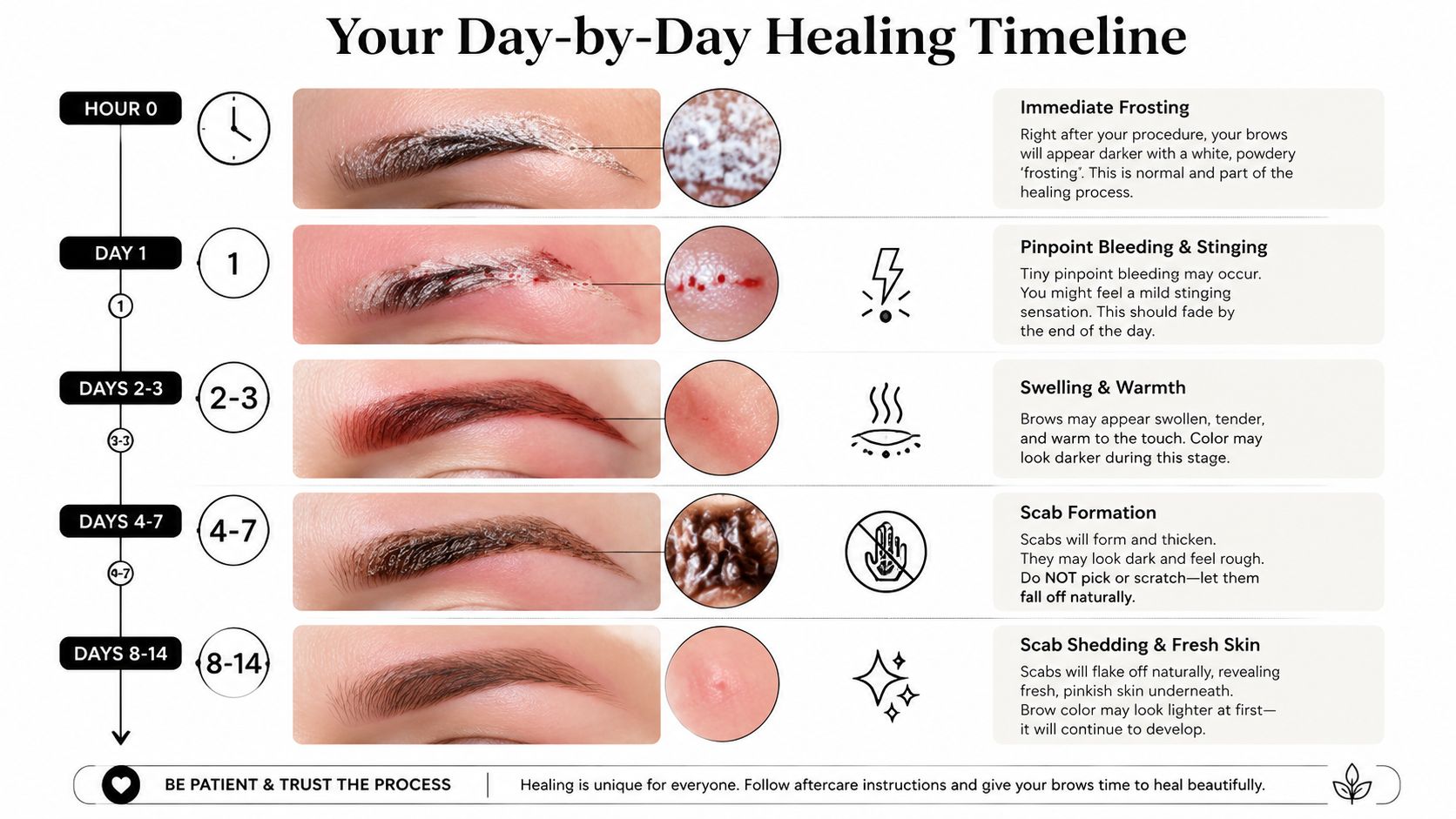
The first 24 hours usually feel more obvious than they look. Redness, swelling, warmth, and a tight or sunburn-like feeling are common right after treatment, and mild pinpoint bleeding can happen in some cases as described in a day-by-day healing guide. If you're checking the mirror every ten minutes, that's normal too, but the changes you want to watch for are directional, not dramatic.
Days 1 to 3
This is the acute inflammation window. Brows may look puffy, feel tender, and show a pink or red halo around the treated area. If there's tiny spotting or the surface seems overly warm, that can still fit the expected pattern, especially early on day-by-day guidance.
Days 4 to 10
Scabbing usually starts here, and crusting for 3 to 5 days is documented in cosmetic eyebrow tattoo treatment series Houston Methodist clinical series. The surface can look flaky, dry, or uneven, and that doesn't mean the laser “missed.” It means the skin is sealing itself while pigment is being processed underneath.
Blistering can show up in a window of 8 to 72 hours and may last up to 2 weeks or more in some cases Removery healing process guide. That's not the norm for everyone, but it's a real part of the wound-healing spectrum, and it's why picking, rubbing, or hot yoga right away is a bad trade.
Days 8 to 14
The scab stage should start loosening on its own. What many people call peeling is often just controlled sloughing, not damage, as long as the skin isn't being forced. The treated area may look patchy or pink underneath, which is part of surface renewal rather than proof that healing has stalled.
If the area is getting less angry day by day, you're usually on track. If it's getting more swollen, more painful, or more red after day three, call the clinic.
By the end of the second week, the brows often look much calmer. That's the point where many people assume the job is finished, but it isn't, because pigment clearance and tissue repair keep moving long after the visible drama has faded.
Why Brows Can Look Healed but Still Be Recovering
Consumer advice often gets sloppy here. Redness and scabbing can settle within days to two weeks, yet that doesn't mean the skin and pigment are fully done. A staged medical-style timeline separates 1 to 3 months of pigment depletion from 3 to 6 months of full tissue repair, which is a much better reflection of what's happening under the surface staged recovery timeline.
Surface calm is not full recovery
The outside can look presentable while the deeper work is still underway. The barrier function of the skin keeps rebuilding, and the tissue remodels over time after the initial inflammation fades. That's why a brow that looks “fine” at two weeks can still be too early for another pass, especially if the goal is clean fading rather than a rushed finish.
A different source frames the same idea in more consumer-friendly terms, saying the visible recovery is short, but the biologic healing and pigment-clearing phase is much longer neutral review on eyebrow and eyelid tattoo laser treatment. That separation matters because it explains why repeating sessions too early can be counterproductive. Skin that looks settled may still be remodeling, and the pigment fragments still need time to move.
The practical takeaway is simple. Don't judge readiness by appearance alone. Give the brow time to finish the invisible part of recovery before scheduling the next session, and treat “looks healed” and “is healed enough for another laser pass” as two different questions.
Aftercare Do's and Don'ts That Actually Matter
The scab stage is where most preventable mistakes happen. The surface feels itchy, dry, or tight, and that's exactly when people are tempted to rub, scratch, or test whether the flakes are ready to come off. They're usually not, and forced removal is how you turn a clean recovery into a messy one.
The routine that protects the result
Use a gentle, fragrance-free cleanser if your provider okays washing, then pat the area dry with clean hands or a fresh towel. Cool compresses can help with early warmth and swelling, and any ointment should be the one your provider specifically approved for your skin and laser settings. Sleep on a clean pillowcase the first night, because friction and bacteria are an unnecessary combination when the skin barrier is open.
- Do keep the area clean and dry: Moisture control helps the surface close without soaking or softening scabs too early.
- Do avoid picking or scratching: Picking is the fastest route to scarring and uneven healing.
- Do skip makeup on the brows until the skin barrier has closed: Product in a healing wound invites irritation.
- Do stay out of strong sun, heavy sweat, and soaking: Heat and water exposure can disrupt fragile scabs and raise the risk of irritation.
The trade-off is that a few days of caution buy you much better cosmetic results later. Sun exposure can also darken healing skin, and hot workouts can soften scabs before they're ready to release. Even a nice-looking brow can be trickier to protect than it seems, because the skin on the face is thin and the area gets touched constantly.
For readers who want a broader skin-care perspective, understanding dermatologists and acne care is a useful reminder that healed skin depends on barrier care, not just active treatment. The principle is the same here, less irritation now usually means a cleaner finish later.
Factors That Change How You Heal
Two people can get the same treatment and recover at different speeds. That's not random, it usually comes down to skin type, ink color, tattoo age, depth, and whether the goal is full removal or just enough fading for a cover-up.
What matters most in real life
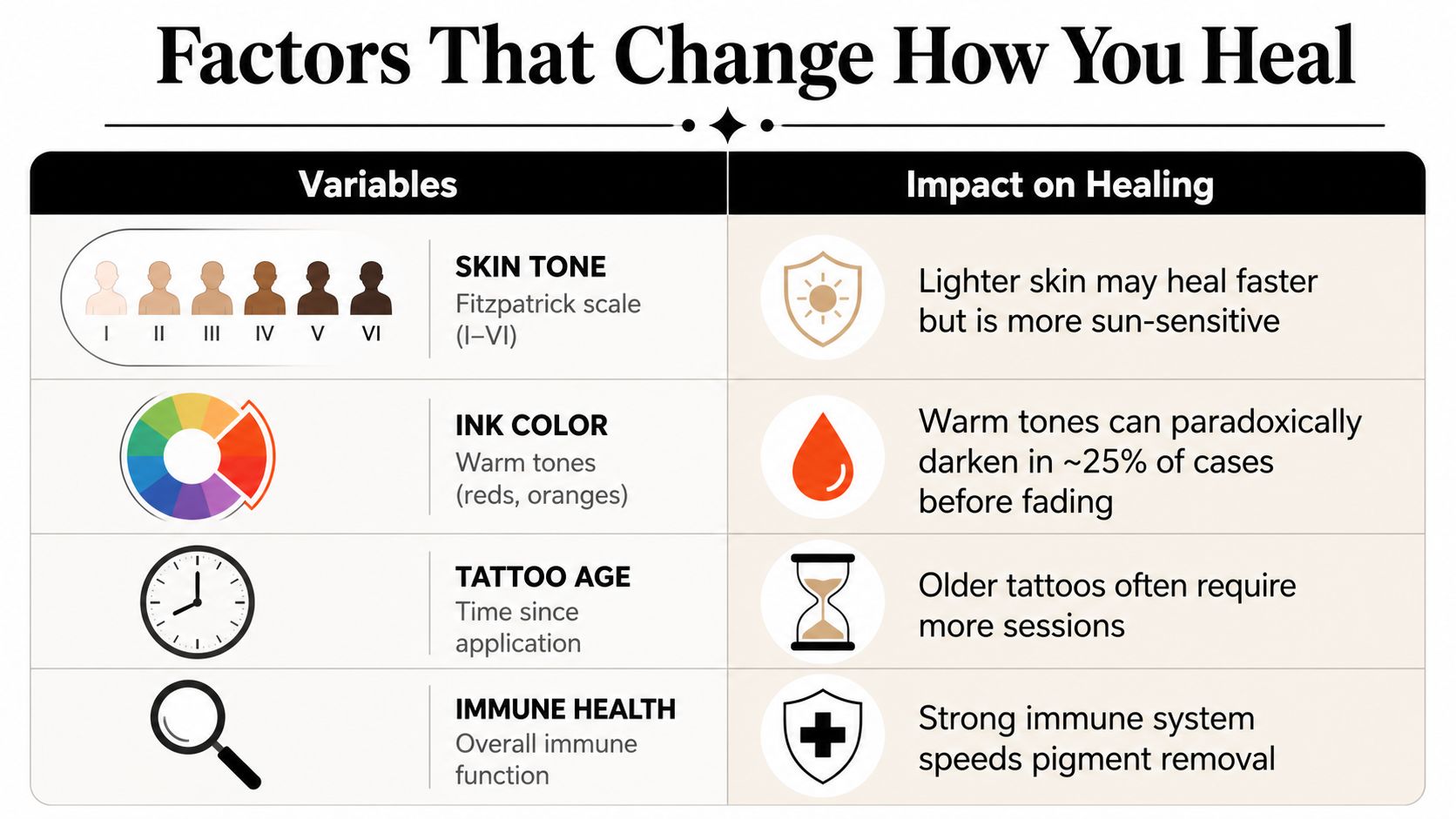
Skin tone on the Fitzpatrick scale affects how aggressively a provider can work. Lighter skin often tolerates faster clearing, but it's also more sun-sensitive while healing. Darker or more reactive skin may need a more conservative plan so the brow can recover without unnecessary post-treatment color changes.
Ink color matters too, especially with cosmetic brows that contain warm tones. As noted earlier, those warmer pigments can paradoxically darken in about 25% of cases before fading eyebrow and eyelid tattoo laser review. Older tattoos and layered corrections tend to need more sessions because the pigment has had longer to settle and can sit at different depths.
If you're deciding between fading and full removal, fading is often the smarter target when a new brow design is coming next. You don't always need a blank slate to get a good result, and chasing absolute clearance can take longer than necessary. That's the kind of planning difference that makes a real consultation worth the time.
For a practical treatment path, EradiTatt Tattoo Removal offers laser tattoo removal with a PiQo4 laser system, which is relevant when a provider is deciding how to approach cosmetic ink and follow-up spacing. The machine matters less than the plan, though, because the plan has to match the brow's ink, skin, and your actual goal.
The safest schedule is the one built around your skin and pigment, not somebody else's before-and-after post.
Planning Sessions Around Real Life
If you've got a wedding, interview, enlistment date, or cover-up appointment coming up, the recovery clock has to fit your calendar. That's where the difference between visible healing and deeper healing really matters, because you can't schedule by how normal the brows look in the mirror alone.
Benchmarks you can actually use
For full removal, the broader clinical literature shows tattoo removal often takes 7 to 10 treatments on average, and one cited series reported 95% pigment removal after an average of 8.9 sessions clinical review. For cosmetic eyebrow tattoos specifically, some patients reached 75% clearance after 1 to 3 treatments over 2.5 months with no eyebrow-hair loss or adverse events reported in that series Houston Methodist clinical series.
The spacing rule is the part people want to rush, but the literature supports waiting several weeks between sessions, and one cohort spaced treatments at least 8 weeks apart PMC review. That buffer gives the skin time to settle and gives your body time to clear fragmented pigment before the next pass.
| Goal | Typical Sessions | Spacing | Realistic Timeline |
|---|---|---|---|
| Full removal | Often 7 to 10 on average | Several weeks between sessions, commonly around 8 weeks or more | Months, sometimes longer |
| Cosmetic eyebrow fading for cover-up | Often fewer than full removal, sometimes 3 to 6 in clinical series | Several weeks between sessions | Weeks to a few months, depending on pigment and skin |
Use that table as a planning frame, not a promise. If your target date is close, the safest move is to start early and leave room for the skin to recover between visits. A rushed schedule usually creates more waiting later, not less.
Red Flags and Questions Worth Asking
Normal healing gets less dramatic after the first few days. Pain should generally ease, redness should shrink, and the treated area should look less inflamed over time. If the opposite is happening, that's when you stop guessing.
When to call the clinic
Call if pain increases after day three, redness spreads instead of shrinking, yellow discharge appears, fever develops, or the pigment change looks like a bruise spreading rather than controlled fading. Those signs can point to infection or another complication, and they shouldn't be brushed off as routine healing infection warning guide.
The other questions matter too. In proper hands, eyebrow hair follicles are usually preserved because the laser is aimed at pigment, not the follicle, and one cosmetic eyebrow series reported no eyebrow-hair loss Houston Methodist series. Makeup is safer once the skin barrier has closed, not while it's still scabbing. And if you're planning microblading or a re-tattoo later, wait until the area has stabilized, not just until it looks better in daylight.
If you're choosing between fading and full removal, bring that question to the consult before the first laser pulse, not after. Ask how many sessions your pigment type usually needs, what spacing they recommend, and what aftercare they expect you to follow at home.
EradiTatt Tattoo Removal helps people who want to remove unwanted ink or fade it for a cover-up, including sensitive areas that need a careful plan. If you're sorting out the laser eyebrow tattoo removal healing process and want a provider that can walk you through the timing, the follow-up spacing, and the practical aftercare, visit EradiTatt Tattoo Removal to schedule a consultation and get a plan that fits your skin and your timeline.