
47.2% of patients achieved successful tattoo removal after 10 sessions, and that climbed to 74.8% only after 15 sessions. If your tattoo still looks stubborn after a few visits, that can be normal, because laser tattoo removal often clears slowly and unevenly rather than in a clean, dramatic sweep.
You're not alone if you expected the ink to vanish by now. A lot of people book a third or fourth session, look at the same patch of color, and wonder whether the laser is broken, the provider missed something, or their body just isn't cooperating.
Table of Contents
- Why Your Tattoo Removal Seems Stuck
- How Laser Removal Clears Ink
- Six Common Reasons Removal Fails to Deliver
- Understanding the Plateau Effect
- Troubleshooting Options and Adjustments
- Questions to Ask Your Removal Provider
- When to Continue, Adjust, or Accept Results
Why Your Tattoo Removal Seems Stuck
The most frustrating part of laser tattoo removal not working is that it can look like nothing is happening, even when the treatment is doing something under the skin. A client comes in after session three, checks the tattoo in the mirror, and sees faint fading in one edge but almost no change in the center. That mismatch between effort and visible progress is what makes people assume the process has stalled.
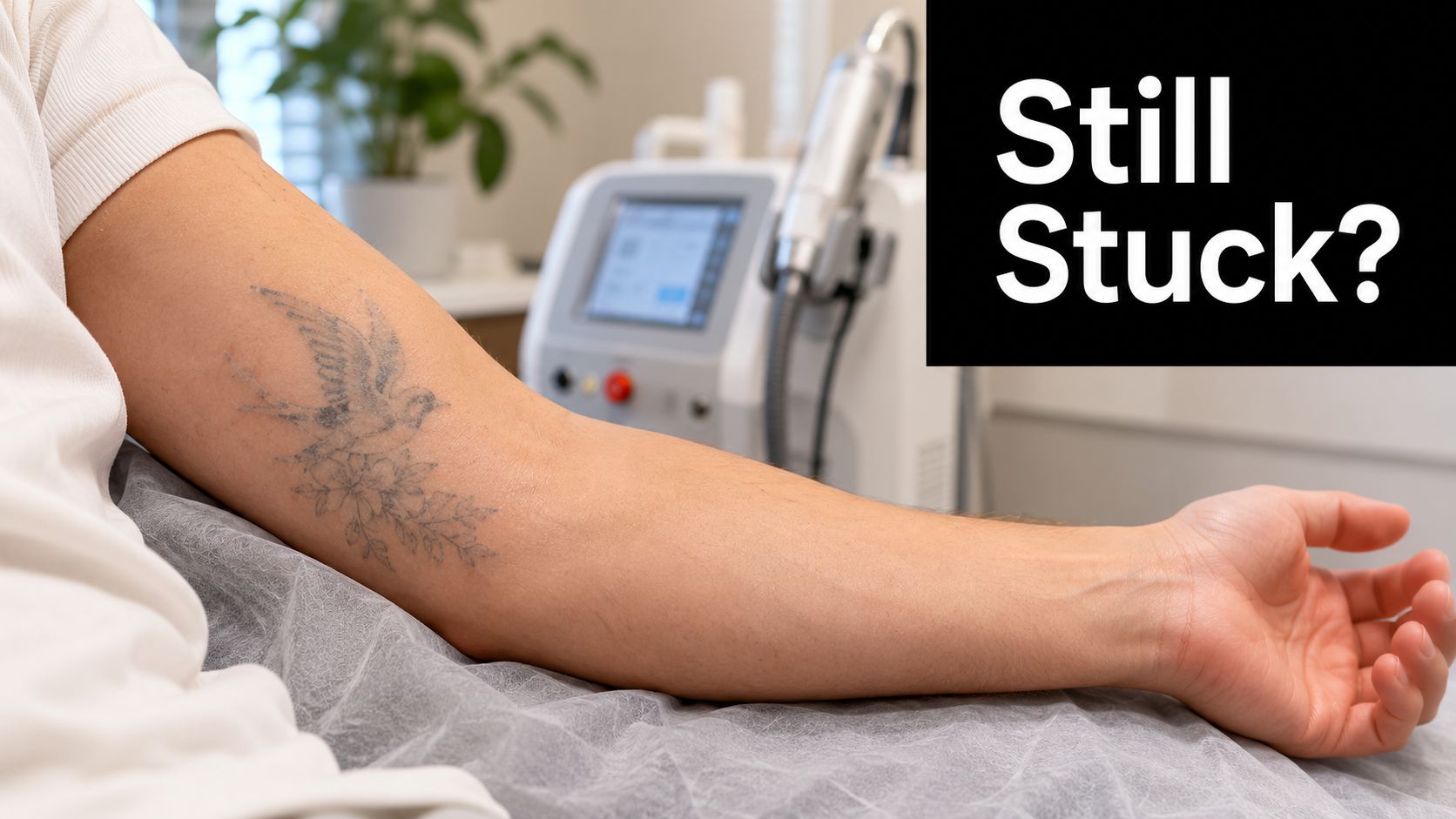
Clinical research helps reset expectations. In a large cohort study of Q-switched laser tattoo removal, only 47.2% of patients had successful removal after 10 sessions, and that rose to 74.8% only after 15 sessions (JAMA Dermatology review and cohort summary). That's why many tattoos need far more visits than people expect, especially when the goal is full clearance instead of lighter skin for a cover-up.
What “stuck” usually means
Sometimes a tattoo is resistant. Other times it's in a normal slow phase, where early fading has already happened and the remaining pigment is harder to reach. A useful comparison is skincare routines that seem to stop working after the first obvious improvement, not because the product vanished, but because the easy wins are already gone. A practical discussion of that kind of slowdown appears in designer skincare routine fix guidance, and the same general pattern shows up in tattoo removal.
That's why a plateau doesn't automatically mean failure. It often means the remaining ink is behaving differently than the ink removed in the first few sessions. The body, the tattoo, and the laser all have to line up for the next stage of fading.
For a broader breakdown of what affects progress, this internal guide on 6 factors that can affect tattoo removal progress is a useful companion.
Practical rule: if a tattoo has changed a little, the treatment is probably doing something. If it hasn't changed at all across several properly spaced sessions, the issue deserves a closer look rather than just more of the same.
How Laser Removal Clears Ink
Laser removal works in three basic stages, and each one has to happen in the right order. First, the laser energy breaks tattoo pigment into much smaller fragments. Then the body's immune system clears those fragments over time. Finally, the skin heals between sessions so the next pass can work on what is left.
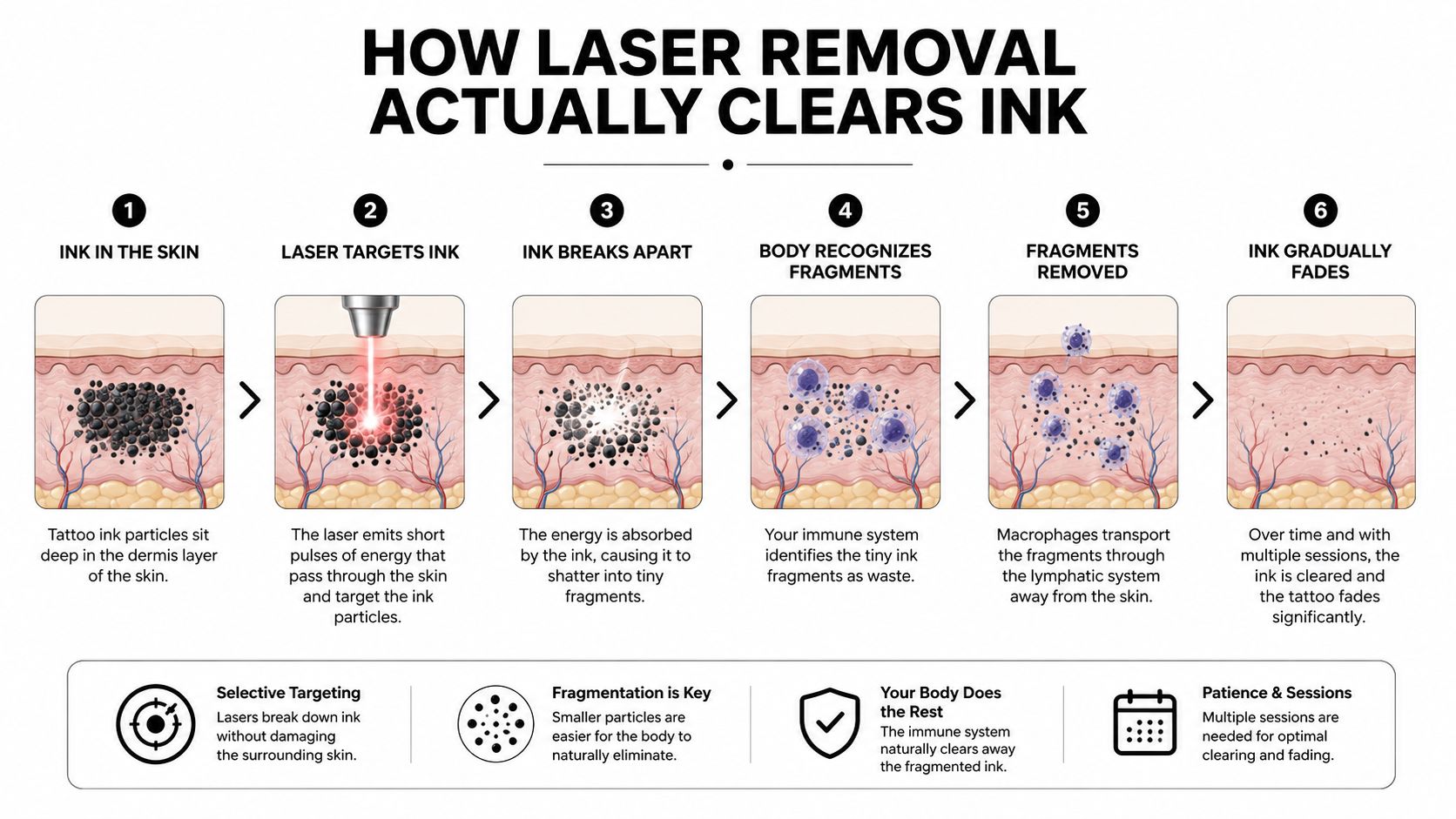
The laser does the breaking, not the clearing
Tattoo pigment sits in the skin like a boulder buried in soil. The laser does not pull that boulder out in one shot. It cracks the pigment into smaller and smaller pieces, and the body handles the cleanup after that. Clinical literature points to that cleanup phase as one reason session timing matters, because rushing back too early can work against the process (clinical review on session timing).
Visible fading is only part of the picture. When the tattoo looks lighter after a session, the laser has likely turned some pigment into particles your body can transport away. If the area is treated again before that cleanup finishes, the next session is trying to work on ink that has not yet been cleared.
Why the immune system matters
The lymphatic system helps move those tiny fragments out of the area. That means clearance depends on both the laser and the person in the chair. The same tattoo can respond differently on different people, even when the device and settings look identical.
An NIH clinical chapter notes that efficacy depends heavily on ink color, skin color, wavelength, and pulse duration, and that complete clearance is only in the 50% range overall in many settings (NCBI clinical chapter). Removal is a biological process, not just a machine setting.
The skin does not erase ink on command. It needs time to break fragments down, transport them away, and recover before the next session.
For a deeper first-time explanation, this breakdown of how tattoo removal works covers the process in plain language, and the same biology is why Think Tank Tattoo cover-ups can sometimes be a practical alternative when full clearance is not realistic.
Six Common Reasons Removal Fails to Deliver
A tattoo that stops changing can feel like the laser has quit. In practice, the problem is usually more ordinary. The ink may be deeper than expected, the pigment may be a poor match for the device, or the body may be in the slower part of the clearance process.
Ink, depth, and tattoo type
Color matters. A systematic review found that picosecond lasers outperformed older nanosecond systems mainly for blue, green, and yellow pigments, while both were considered effective for black tattoos (systematic review). Earlier clinical literature also showed a wide gap between amateur tattoos and professional tattoos, with substantial removal in 78% of amateur tattoos but only 23% of professional tattoos in older data from the same body of research.
That difference fits what clinicians see in practice. Professional work is often packed more densely and placed deeper in the skin, so the laser has to break apart more pigment before the body can carry it away. Black ink usually responds better than stubborn color blends, but the result is still usually gradual, not immediate.
The device has to match the target
The laser is not universal. Wavelength, pulse duration, and fluence all need to match the pigment and how deep it sits in the skin. The NIH review notes that choosing the wrong device can leave ink behind and raise the chance of scarring.
Host factors quietly change the outcome
Lifestyle and health matter more than many people expect. Smoking can slow clearance, and medical reviews also note that autoimmune disease, diabetes, and compromised immune function can leave a tattoo only partly removed. Scar tissue can block pigment from responding evenly, too.
For a practical example of how providers talk through stubborn ink, the discussion at Think Tank Tattoo cover-ups is useful context, especially for people deciding whether to keep fading or move toward a cover-up.
Sessions too close together
Short intervals can make progress look worse than it is. The FDA says tattoo removal requires multiple sessions spaced a few weeks apart to let skin heal (FDA consumer update), and clinical reviews often recommend about 6 to 8 weeks between treatments or longer for better clearance (clinical review). If the body has not finished clearing fragments, another pass can feel like starting over.
Understanding the Plateau Effect
The plateau effect is the part of tattoo removal that confuses people most. Early on, the tattoo fades fast, then it seems to freeze. That doesn't always mean the laser stopped working, it can mean the remaining pigment is the hardest part to remove.
Why the easy fading happens first
The first sessions usually hit the most accessible pigment. That ink is often more superficial, less shielded, and easier for the immune system to clear once the laser has broken it apart. After that, the tattoo can shift into a slower phase where only the deeper or more protected pigment is left.
Residual pigmentation, ghost images, and incomplete clearance are common, especially with multicolored professional tattoos. An independent medical discussion of this plateau problem notes that the issue is often deeper structure or fragmented particles that are too small for efficient clearance, not bad technique (plateau discussion).
When a plateau is normal, and when it isn't
A normal plateau still shows some change over time. The tattoo may lose contrast, edges may soften, or the shaded parts may lighten unevenly. A true treatment problem looks different, with no visible change after properly spaced sessions and the right laser for the ink.
A simple way to judge it is to ask whether the remaining pigment is still realistically removable. If the tattoo is fading, even slowly, the protocol may just need more time or a better match. If the ink is left in dense pockets, trapped in scar tissue, or composed of colors that respond poorly, more of the same can turn into wasted sessions.
Rule of thumb: a plateau is not the same as a dead end. It's a signal to reassess the tattoo, not just the calendar.
Troubleshooting Options and Adjustments
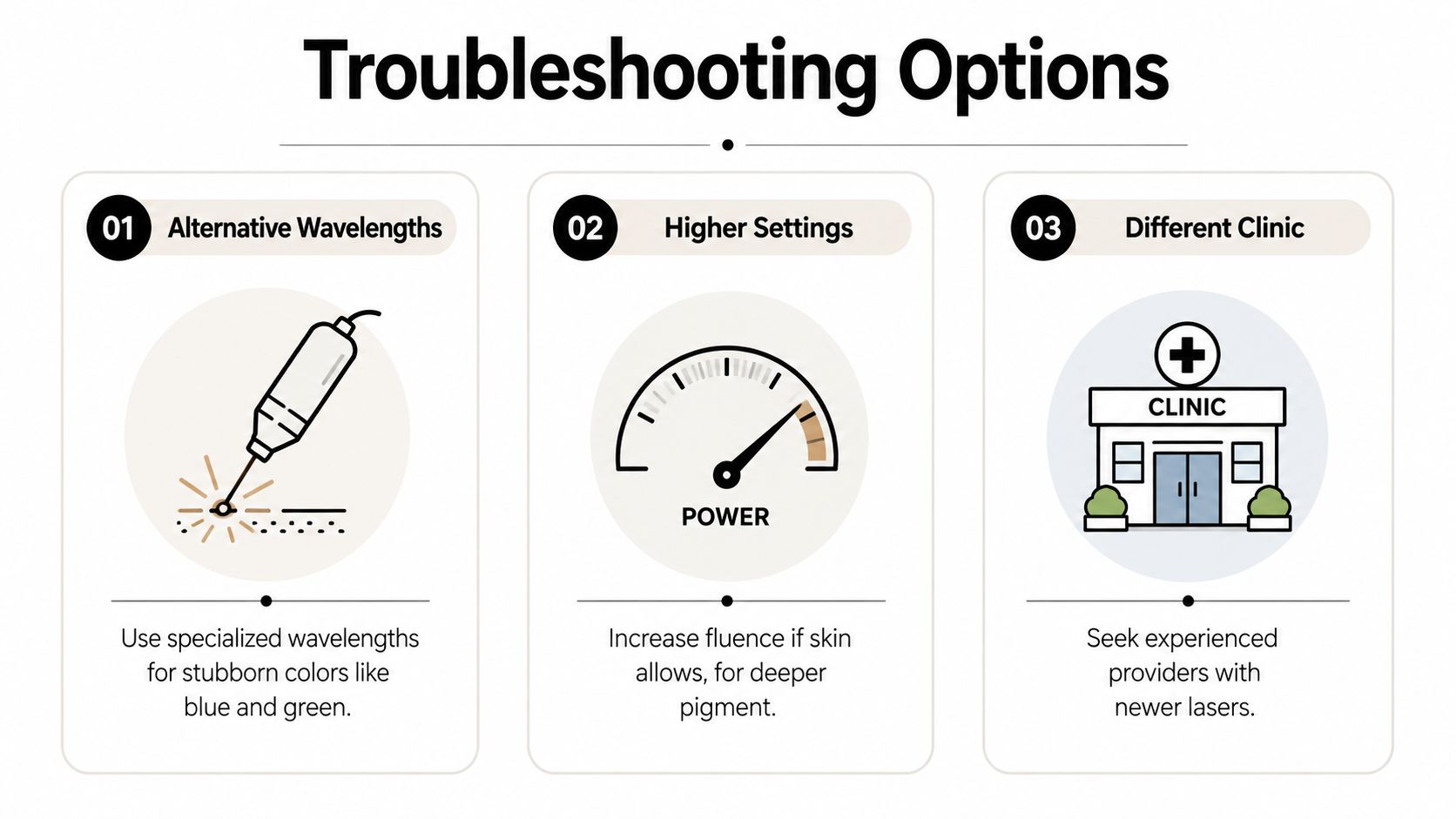
When progress slows, the answer isn't always “keep doing exactly what you're doing.” Sometimes the tattoo needs a different wavelength. Sometimes the skin needs more healing time. Sometimes the goal needs to shift from full removal to meaningful fading for a cover-up.
What can change the outcome
Some tattoos respond better when the wavelength matches the color more closely. Others improve when the provider adjusts fluence carefully instead of forcing the same settings over and over. The internal guide on how to speed up tattoo removal is a practical follow-up for people who want the logic behind those adjustments.
A useful next step is to compare options rather than assume one more identical session will fix everything. In practice, that might mean a different laser platform, a new treatment interval, or a second opinion from someone who sees a lot of multicolor or densely packed work.
Lifestyle changes can help, but they're not magic
Stopping smoking is one of the clearest changes a person can make if they want better clearance. Hydration, sleep, and general health also matter because the body has to do the fragment cleanup. That said, no lifestyle change can fully override a tattoo that was built with difficult ink, deep saturation, or heavy scar tissue.
EradiTatt Tattoo Removal offers a free consultation for people who want a fresh assessment of tattoos that aren't responding well. Its PiQo4 laser system uses ultra-short picosecond pulses, which is relevant when stubborn pigment hasn't responded well to prior treatment. That still doesn't guarantee full clearance, but it can change the conversation from guesswork to a more targeted plan.
Three practical paths
- Alternative wavelengths: useful when color is the main barrier, especially for stubborn blue or green ink.
- Better spacing: useful when the skin is healing slowly and the fragments need more time to clear.
- A new provider review: useful when the equipment, settings, or experience level may not match the tattoo.
Questions to Ask Your Removal Provider
A good consultation should leave you with a clear plan, not just more uncertainty. If your tattoo is plateauing, ask direct questions and listen for specific answers. If the answers stay vague, that's a sign you may need a second opinion.
Ask about the mechanics
- Which laser and wavelength are you using for this tattoo?
- Why is that setup a match for my ink color and depth?
- How long do you want between sessions, and why?
- What change should I expect to see before the next visit?
Those questions matter because the wrong laser choice or rushed timing can make a tattoo look resistant when the issue is technical or biological. The provider should be able to explain the plan in plain language, not hide behind brand names or broad promises.
Ask about the goal
- Are we aiming for full removal or cover-up lightening?
- What does success look like for my specific tattoo?
- At what point would you call this a plateau instead of normal slow progress?
- What would make you switch settings, wavelength, or strategy?
Red flags are easy to spot. A provider who guarantees complete removal, pushes sessions too close together, or dismisses a flat plateau without assessing the tattoo is giving you weak guidance. If the explanation doesn't fit what you're seeing on your skin, it's reasonable to pause and compare opinions.
If a clinic can't explain the next step in one or two clear sentences, they may not be ready to guide a stubborn tattoo through the slow part of the process.
When to Continue, Adjust, or Accept Results
The right decision depends on what the tattoo is doing now, not what it looked like after the first session. If the ink is still fading, even slowly, continuing can make sense, especially when the sessions are spaced properly and the laser matches the pigment. If the tattoo has flatlined, changing the approach is usually smarter than repeating the same plan.
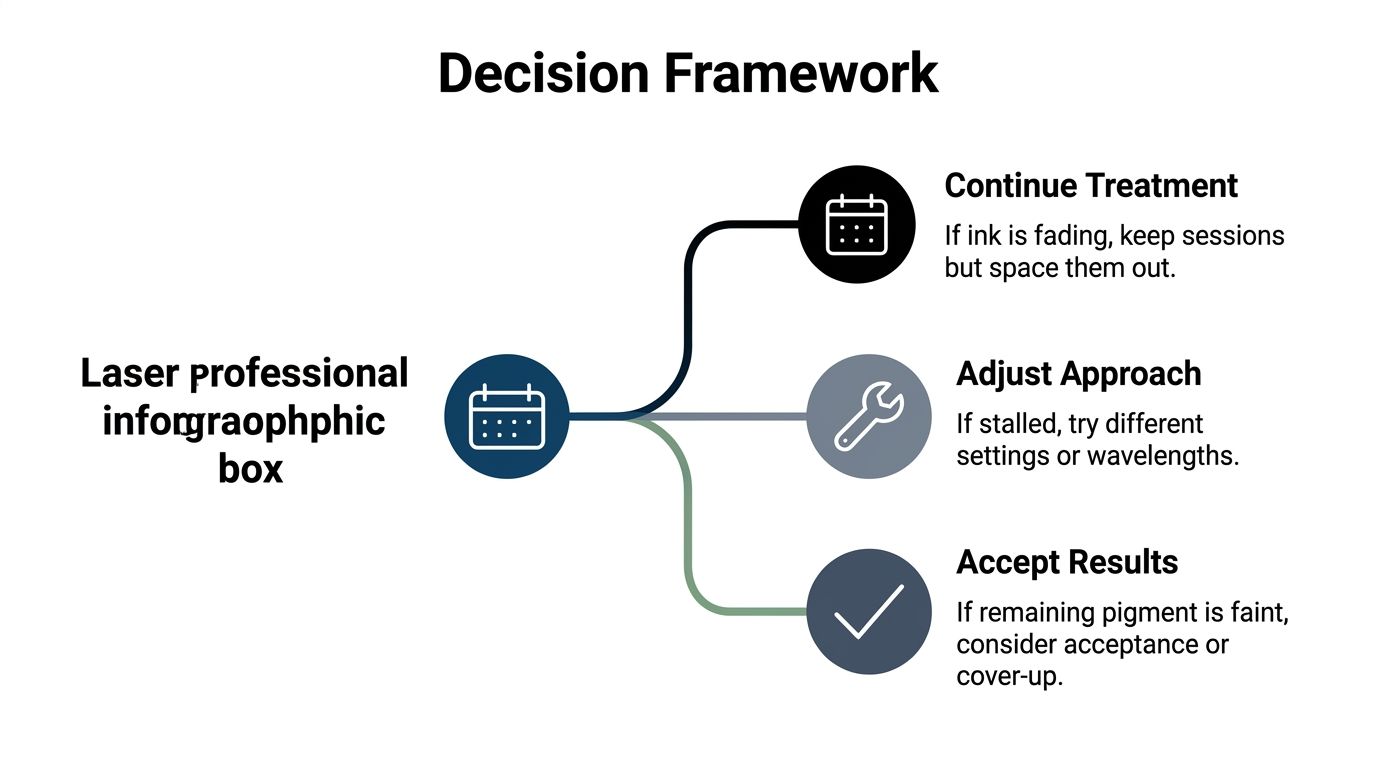
Use the tattoo's behavior as the guide
Continue treatment when there's a clear trend, even if it's slow. Adjust the approach when the tattoo is stuck because of color, depth, scar tissue, or session timing. Accept the result when the remaining pigment is faint, the cost and time no longer match the goal, or the tattoo is already light enough for a cover-up.
That last point matters more than people admit. Full clearance is not the only successful outcome. A tattoo that becomes light enough for a new design, a job requirement, or personal comfort has still moved you toward your goal.
Keep the decision practical
The best choice isn't always the most aggressive one. Sometimes that means more time between sessions. Sometimes it means a new wavelength. Sometimes it means choosing partial fading and moving on.
If you're evaluating a stubborn tattoo in Florida, EradiTatt Tattoo Removal offers consultations in multiple locations and builds treatment plans around tattoo size, color complexity, and skin type. If your removal has stalled, visit EradiTatt Tattoo Removal to book a consultation and get a direct assessment of whether your tattoo should keep fading, change strategy, or move toward a cover-up plan.