
You're probably here because something on your face no longer feels like you.
Maybe your brows started soft and flattering, then faded into a tone that looks off in natural light. Maybe your eyeliner has softened into a shadow you didn't ask for. Maybe your lip blush healed into a color that fights every lipstick you own. By the time someone seeks permanent makeup removal, they've already spent months trying to convince themselves it's “not that bad.”
It's okay to want it gone, faded, corrected, or lightened enough for a redo. That isn't vanity, and it isn't a failure. It's course correction.
Table of Contents
- Fading Ink and Fresh Starts
- What Is Permanent Makeup Removal and How Is It Different
- Your Permanent Makeup Removal Options Explained
- The Removal Journey Timeline and Sessions
- Is Permanent Makeup Removal Safe Risks and Candidacy
- Aftercare The Key to Great Results and Safe Healing
- Choosing a Clinic in Florida and Your Next Step
- Frequently Asked Questions About Permanent Makeup Removal
Fading Ink and Fresh Starts
A common story goes like this. Someone gets microblading when fuller, sharper brows are the goal. At first, they're relieved to skip pencils and powders. Then the shape starts to feel heavy, or the color shifts, or one tail heals a little differently than the other. Months later, they're brushing their bangs down in photos and angling their face in the mirror to make the old work look less obvious.
That moment matters. It's usually when frustration turns into action.
Permanent makeup removal gives people a way back to choice. Some want complete removal. Some only need enough fading to reshape the area. Some are dealing with migrated eyeliner, uneven lip blush, or brows that no longer match their face. The reason doesn't have to be dramatic for it to be valid.
Why people seek a reset
The most important thing to understand is that removal isn't punishment for getting PMU in the first place. Styles change. Pigments age. Skin changes. Sun exposure in a place like Florida can make old facial pigment look even less predictable over time.
What works on paper also doesn't always work on a real face years later.
Permanent makeup can be improved, lightened, or removed. Regret isn't the end of the story.
Modern removal methods are far more refined than many people realize. Skilled providers can work selectively, taking into account the area treated, the color behavior of the pigment, and the healing limits of facial skin. That matters because eyebrows, eyelids, and lips don't tolerate aggressive treatment the same way a shoulder or calf might.
A fresh start looks different for each person
For one client, success means clearing enough old brow pigment to allow a cleaner, softer new design. For another, success means backing off a lip tone that healed too cool. For someone with eyeliner, success may be removing a blurred edge that makes the eyes look tired.
Those are all good outcomes.
The right mindset is practical, not perfectionist. Removal is a process. It often takes patience, careful spacing, and a plan that respects the skin first. When clients understand that early, they tend to heal better, choose better, and feel less anxious at every stage.
What Is Permanent Makeup Removal and How Is It Different
Permanent makeup is cosmetic tattooing placed in facial areas such as brows, eyeliner, and lips. Even when it's marketed as semi-permanent, pigment is still implanted into the skin and may linger long after the original look has faded.
Removing it is not the same as removing a body tattoo.
Why facial ink needs a different plan
The face has thinner, more visible, more reactive skin than many body areas. Brows sit over hair-bearing skin. Eyeliner sits near the eye, where treatment planning has to be far more controlled. Lips have vascular tissue, color variability, and a healing pattern that can look dramatic before it settles.
That changes everything about removal.
A technician who removes body tattoos all day may still need a very different skill set for PMU. Facial cosmetic tattoo removal requires more restraint, more pigment knowledge, and more respect for visible healing. On the face, “stronger” isn't always better. Better is better.
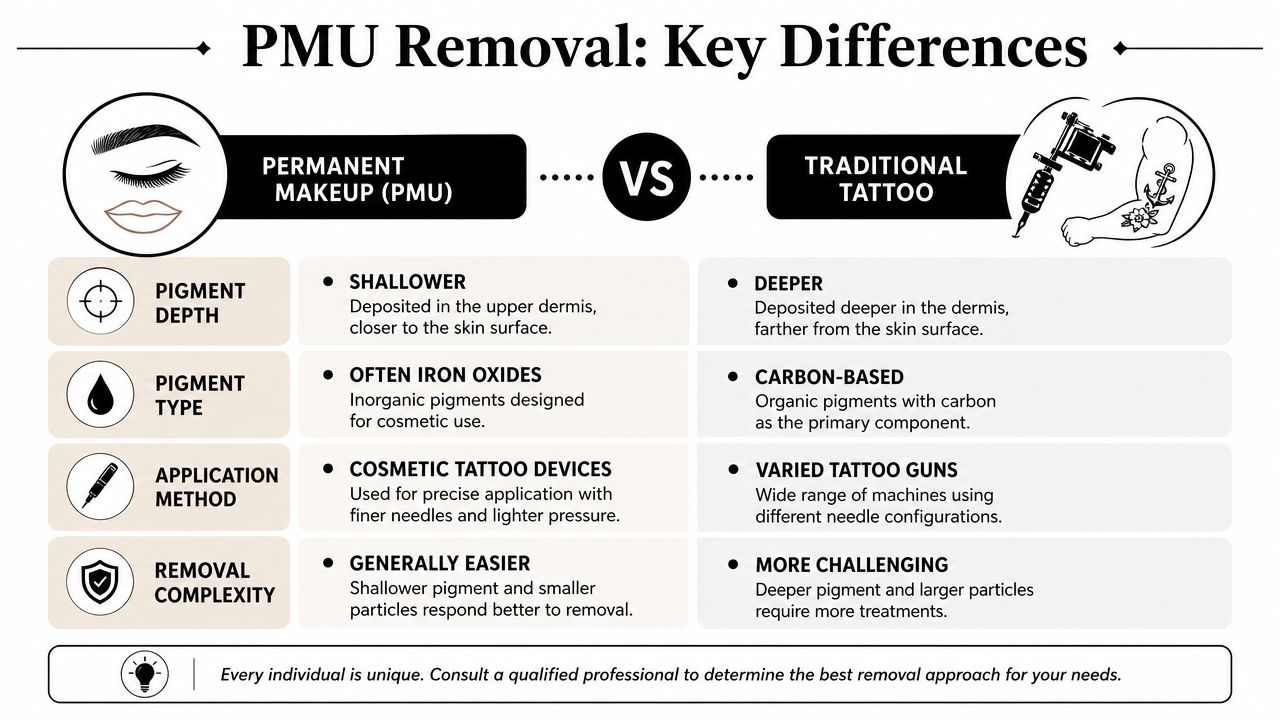
The pigment question matters
Traditional tattoos often use ink profiles that behave differently from cosmetic pigments. In PMU, pigments may include iron oxides or other blends that can react in ways body tattoo clients don't expect. Some shades fade unevenly. Some warm up. Some cool down. Some lighter tones can be more complicated than dark ones.
That's why a consultation should include a careful pigment history when possible.
Here's the practical comparison:
| Feature | Permanent Makeup | Traditional Tattoo |
|---|---|---|
| Placement area | Brows, lips, eyelids, facial features | Arms, legs, back, chest, other body areas |
| Depth tendency | Usually more shallow | Often deeper |
| Common pigment behavior | Can shift tone as it ages | Often more straightforward in response pattern |
| Skin considerations | Delicate, visible, sometimes hair-bearing | Usually thicker and less cosmetically sensitive |
| Removal planning | More selective and conservative | Often broader treatment approach |
Practical rule: If the pigment is on the face, choose a provider who treats facial tattoo removal as its own specialty.
Florida clients also face one extra issue. Sun is not a side note here. Facial skin that's recently treated is more vulnerable to irritation and discoloration when UV exposure is part of everyday life. That doesn't make removal impossible, but it does make timing, aftercare, and sun avoidance more important than many online guides admit.
Your Permanent Makeup Removal Options Explained
Three main methods are often discussed: laser removal, saline removal, and glycolic acid removal. None is automatically the right answer for every brow, lip, or eyeliner case. The best choice depends on pigment color, placement, age of the work, skin response, and whether the goal is full removal or strategic fading.
Laser removal
Laser works by delivering light energy into the pigment so the particles can break apart and gradually clear through the body's natural processes. For many darker cosmetic pigments, this can be a very effective option.
Laser is often the first method discussed for old microblading, powder brows, and other eyebrow work. If you want a closer look at how a modern system is used for brow pigment, this guide to microblading eyebrow tattoo removal with PiQo4 is useful background.
Where laser shines:
- Darker brow pigment: Black and deeper brown shades often respond better than very light tones.
- Clients wanting progressive fading: Laser can be a strong option when the goal is to lighten old work for a future correction.
- Cases where skin preservation is the top priority: When used properly, it can target pigment without physically abrading the area.
Where caution matters:
- Light or flesh-toned pigment: Some shades can behave unpredictably.
- Eyeliner and certain lip cases: These areas demand more specialized planning.
- Clients expecting instant disappearance: Laser removal is gradual, not immediate.
Saline removal
Saline removal uses a tattoo-style application method to introduce a specialized salt-based solution into the skin. The goal is to draw pigment upward as the area heals.
This method can be especially useful when color behavior makes laser a poor fit, or when a small correction is needed rather than broad fading. It's also part of many technicians' toolkit for fresh mistakes, especially in brows.
Saline tends to make sense for:
- Selective corrections: Small shape issues or compact areas
- Pigments that aren't ideal laser candidates
- Clients who need a non-laser option
Trade-offs with saline:
- Healing can be more visibly “wound-like” during the crusting phase.
- Aftercare compliance matters a lot.
- Overworking facial skin is a real risk in inexperienced hands.
Glycolic acid removal
Glycolic acid removal is a more niche approach. It uses an acid-based solution introduced into the skin with the aim of encouraging pigment to lift and shed as the area heals.
It can work in the right hands, but it isn't a method I'd treat casually on delicate facial skin. Precision matters. Skin response matters. The provider's depth control matters.
Main considerations:
- Potential use case: Older, faded PMU in carefully selected situations
- Potential downside: Higher concern for irritation and texture changes if technique is poor
- Best mindset: Consider only after a full candidacy review
Here's the side-by-side view most clients need:
| Method | How It Works | Best For | Pros | Cons |
|---|---|---|---|---|
| Laser | Breaks pigment into smaller particles using light energy | Darker pigments, broader fading, many brow cases | Precise, no scraping, often effective for old brow work | Some colors are tricky, multiple visits are common |
| Saline | Encourages pigment to lift upward during healing | Small corrections, certain color issues, some fresh PMU | Color-flexible, useful when laser isn't ideal | Healing looks more intense, aftercare is strict |
| Glycolic Acid | Uses controlled chemical action to help lift pigment | Selected cases only | Another option in experienced hands | Greater caution needed for irritation and skin changes |
The method should fit the pigment and the skin, not the other way around.
One practical note. EradiTatt Tattoo Removal offers eyebrow tattoo removal using the PiQo4 laser platform, which is one option for clients whose brow pigment is suited to laser treatment. That doesn't mean every PMU case should be lasered. It means the method should be matched carefully to the face in front of you.
The Removal Journey Timeline and Sessions
Clients usually want to know two things right away. How many sessions will this take, and how long until I look normal again?
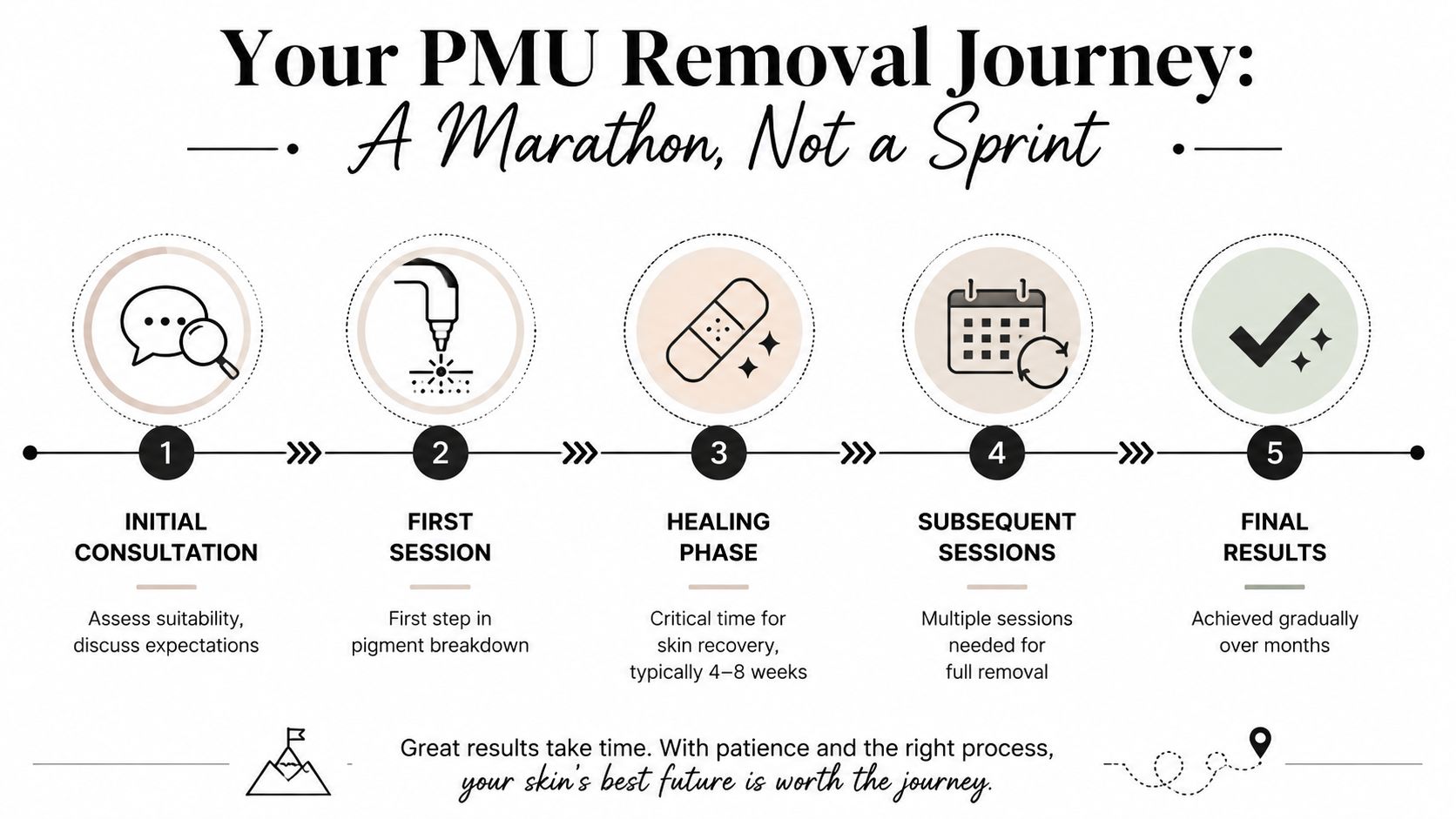
The honest answer is that permanent makeup removal is a staged process. The skin needs time. The body needs time. Rushing either usually creates worse outcomes, not faster ones.
What happens first
The process starts with assessment. The technician looks at the placement, density, likely pigment family, skin condition, and your goal. Full removal and “fade it enough for a better redo” are not the same plan.
Then comes the first treatment. That session gives useful information beyond the visible fading. It shows how your skin reacts, how the pigment responds, and whether the initial strategy still looks right after healing.
Why spacing matters
Sessions are commonly spaced 6 to 8 weeks apart. That timing matters because skin doesn't finish its visible healing the same day it finishes internal recovery. Even when redness fades early, the tissue may still be rebuilding beneath the surface.
With laser, the body also needs time to process fragmented pigment. With saline or acid-based methods, the skin barrier needs calm, complete healing before another pass is considered.
Factors that shape the timeline include:
- Pigment composition: Some colors are cooperative. Some resist.
- Saturation: Heavier cosmetic work usually takes longer to clear than lighter deposits.
- Depth: Deeper or repeatedly refreshed PMU often needs more patience.
- Area treated: Brows, lips, and eyeliner don't heal identically.
- Skin behavior: Sensitive or reactive skin may require a slower pace.
- Client habits: Sun exposure, picking, friction, and poor aftercare can delay progress.
If a provider promises a fast facial removal without a careful healing window, that's a red flag.
In Florida, the timeline can also be affected by lifestyle. Beach days, outdoor workouts, heat, and UV exposure can complicate healing if you schedule treatment right before events or travel. Smart planning helps. Many clients do best when they treat removal like any other visible facial procedure and give themselves protected downtime between visits.
Is Permanent Makeup Removal Safe Risks and Candidacy
Permanent makeup removal can be safe when it's done by a trained professional who understands facial anatomy, pigment behavior, and wound care. It isn't risk-free. No honest provider should pretend otherwise.
Safety comes from proper screening, method selection, conservative technique, and disciplined aftercare.
Real risks without scare tactics
The risks clients most often ask about are scarring, infection, and pigment changes in the skin. Those concerns are valid. They're also exactly why PMU removal shouldn't be treated like a casual beauty service.
Potential complications can include:
- Scarring: More likely when skin is overtreated, repeatedly disturbed, or picked during healing
- Infection: More likely when aftercare is ignored or treatment conditions aren't clean
- Hyperpigmentation or hypopigmentation: Especially important for facial skin and for clients with recent sun exposure
- Texture changes: Usually tied to aggressive technique or poor healing habits
- Unexpected pigment shifts: Certain PMU shades can darken, warm, or otherwise change during the process
A careful provider lowers those risks by refusing unsafe cases, choosing the right removal method, and not overtreating.
Who may need to wait or avoid treatment
Not everyone is a same-day candidate. A strong consultation should include health history, medications, active skin issues, and recent cosmetic procedures in the treatment area.
People may need to postpone or avoid treatment if they have:
- Pregnancy or breastfeeding
- Active skin infection or irritation
- Open wounds in the treatment area
- Certain autoimmune conditions or healing disorders
- Recent intense sun exposure or sunburn
- A recent facial treatment that leaves the skin compromised
Some clients also need a patch test or a more conservative first session if their pigment history is unclear.
Good clinics don't try to talk every person into treatment. They screen people out when safety says wait.
That's especially important in Florida, where facial skin often comes in warm, flushed, or UV-exposed without clients realizing how much that affects treatment planning. If you've been in the sun, on the water, or exercising outdoors heavily, say so. It changes how and when a responsible technician should proceed.
Aftercare The Key to Great Results and Safe Healing
The treatment itself matters. What you do after it matters just as much.
Most poor healing stories don't begin with a terrible machine. They begin with friction, sun, sweat, makeup too soon, picking at crusting, or clients assuming the area is “fine” before the skin barrier is ready.
What to do right away
For the first part of healing, keep the area clean and follow the exact instructions you were given for that specific method. Laser, saline, and glycolic acid aftercare can overlap, but they are not identical.
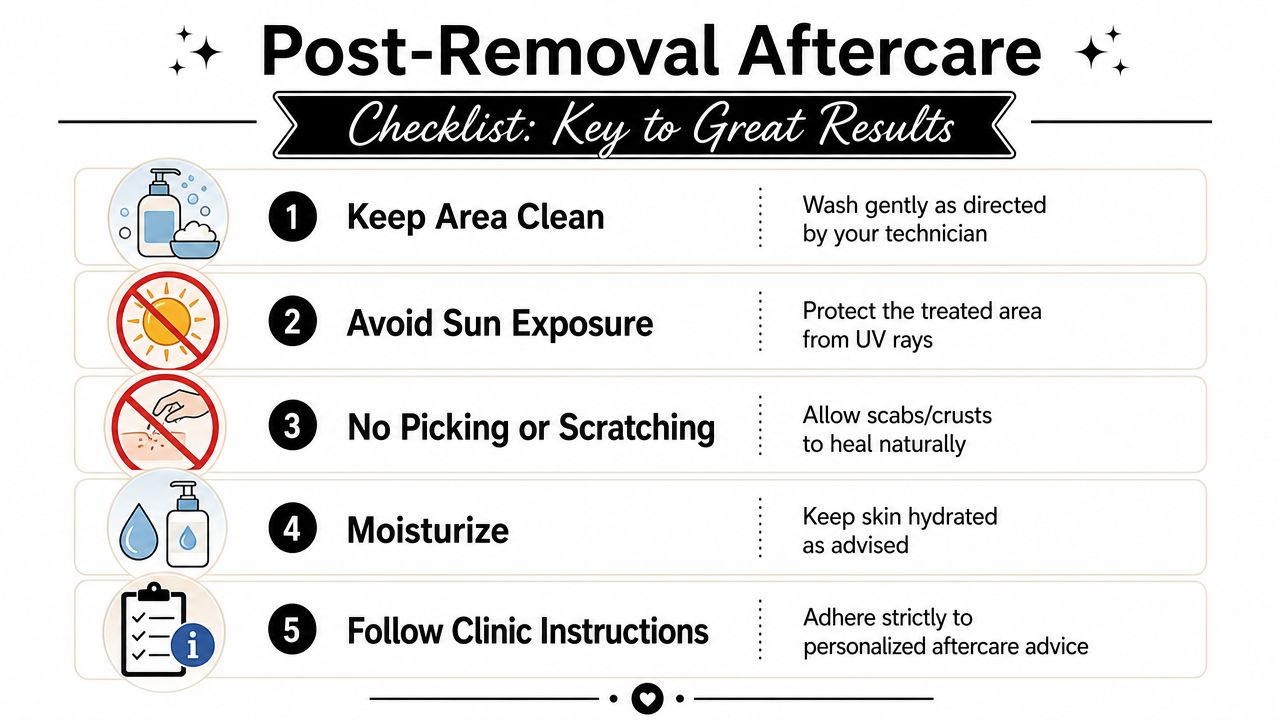
Use this as your baseline checklist:
- Clean gently: Wash only as directed, with clean hands and a gentle approach.
- Protect from sun: UV exposure can worsen discoloration and irritate fresh skin.
- Let crusting heal on its own: Picking can increase the chance of marks and uneven healing.
- Use only approved products: Don't layer random skincare over a treated area.
- Watch for signs that don't look right: If healing seems off, contact the clinic promptly.
Some clients like to keep a simple soothing product on hand for surrounding skin comfort, as long as it doesn't conflict with their technician's instructions. A practical example is AloeCure's skin comfort solutions, which can help people think more carefully about gentle skin support rather than overloading the area with active ingredients.
What to avoid while skin is recovering
Florida habits, for instance, can get in the way. Heat, humidity, pools, beach time, and outdoor workouts all sound normal. Right after facial removal, they can become healing problems.
Avoid:
- Direct sun exposure
- Heavy sweating
- Swimming and soaking
- Makeup on the treated area until cleared
- Scrubs, acids, retinoids, or exfoliants nearby
- Touching the area throughout the day
If you're unsure whether your healing is normal, review these signs of infection after tattoo removal so you know when normal irritation may be crossing into something that needs professional attention.
A calm healing period gives you the best shot at a cleaner fade and healthier skin. The face usually rewards patience.
Choosing a Clinic in Florida and Your Next Step
Choosing a clinic for permanent makeup removal in Florida isn't just about who offers the service. It's about who understands facial work, manages expectations transparently, and treats heat, sun, and visible healing as real parts of the plan.
That standard eliminates a lot of options quickly.
What to look for in a Florida clinic
Start with the provider's actual removal experience, not just their general tattoo experience. Ask what methods they use for brows, lips, and eyeliner. Ask how they decide between laser and non-laser approaches. Ask to see healed results, not only same-day photos.
A strong clinic should offer:
- Method-specific reasoning: They should explain why they chose laser, saline, or another route for your case.
- Facial area judgment: Brows are not lips. Lips are not eyeliner.
- Clear aftercare guidance: If aftercare sounds vague, the planning probably is too.
- Transparent consultation process: You should leave knowing the likely trade-offs.
- Realistic pricing discussion: Not a hard sell, and not a mystery either.
If you want to understand what shapes pricing before you book, this page on permanent makeup removal cost gives useful context.

Why Florida clients need extra caution with sun and heat
In Florida, a clinic's advice has to match real life. If they don't ask about beach weekends, outdoor jobs, boating, golf, sweating, or whether you can stay out of direct sun, they're missing a major part of healing strategy.
That same principle shows up in other service businesses. Good operators don't just market well. They qualify, educate, and set expectations clearly. Even outside aesthetics, you can see that mindset in LeadBlaze's comprehensive playbook for dentists, which highlights how strong client communication shapes better-fit appointments. The same idea applies here. Better screening usually leads to safer treatment.
EradiTatt serves clients across Florida, including Orlando, Tampa, St. Petersburg, Bradenton/Sarasota, and Palm Harbor. For many people, the next step isn't booking a treatment blindly. It's booking a consultation, bringing clear photos if needed, sharing your complete pigment history, and getting a plan that fits your skin, your schedule, and your actual goal.
Frequently Asked Questions About Permanent Makeup Removal
Can it be partially removed instead of fully removed
Yes. Partial fading is often the smartest choice when the goal is correction rather than complete erasure. Many clients don't need a blank canvas. They need enough old pigment reduced so a new artist can rebuild shape or color more cleanly.
That's especially common with brows.
Will removal affect eyebrow hair or natural skin texture
When treatment is appropriate and healing is managed well, natural brow hair usually remains intact. The bigger threats to skin texture are aggressive technique, repeated overtreatment, and picking during healing. That's why conservative planning matters so much on the face.
If a client already has fragile skin or previous trauma in the area, the provider should take that into account before proceeding.
How soon can you remove fresh permanent makeup
Some fresh PMU mistakes may qualify for early correction, but timing matters and not every case is appropriate. This is not something to experiment with at home. Fresh removal decisions should be made quickly and professionally, based on the area, the method used, and the condition of the skin.
If you've just had PMU done and know it's wrong, contact a qualified removal provider right away instead of waiting for internet advice.
How uncomfortable is it really
Most clients describe permanent makeup removal as uncomfortable but manageable. The feeling depends on the method and the area being treated. Eyebrows, lips, and eyeliner all feel different.
A few practical truths help:
- Brows are usually easier to tolerate than people expect
- Lips can feel more intense because the tissue is sensitive
- Eyeliner requires the most careful planning because of location
- Good numbing and a calm technique make a difference
The goal isn't to prove you're tough. The goal is to remove pigment safely without pushing facial skin past what it can handle.
Can old permanent makeup always be completely removed
Not always. Many cases can be lightened significantly, and some can be removed to the point that little to no visible pigment remains. But “complete” depends on the pigment, the area, prior sessions, and how the skin responds.
The better standard is this: aim for the safest outcome that gets you closest to your real goal.
Can you get new permanent makeup after removal
Often, yes. But the area needs enough fading and enough healing first. Rushing into a redo too soon can stack trauma on tissue that hasn't fully recovered.
A responsible provider should tell you when the skin is ready, not when you're impatient.
If old brows, eyeliner, or lip pigment no longer fits your face, EradiTatt Tattoo Removal is a practical place to start. Book a consultation, get your pigment assessed professionally, and leave with a removal plan based on skin safety, realistic fading, and what you want next.