
Permanent makeup removal cost typically ranges from $200 to $450 per session, and multiple sessions are often necessary. The final price depends on a few key factors, including the pigment, the area being treated, the removal method, and how many visits it takes to reach your goal.
If you're reading this, there's a good chance you're staring at brows that turned too ashy, lip blush that no longer fits your look, or old eyeliner that feels heavier than it used to. That moment is common. So is the frustration of trying to find a straight answer on pricing and getting nothing but vague ranges.
Permanent makeup removal isn't priced like a haircut or a facial. It's a treatment plan. What you pay depends on what was implanted, how your skin is holding it, and whether you want complete removal or just enough fading for a correction or cover-up.
A realistic estimate starts with understanding what drives the bill. Once you know that, the numbers make sense and the process feels much less intimidating.
Table of Contents
- Understanding the Investment in Removing Permanent Makeup
- What Drives the Price of Permanent Makeup Removal
- Laser vs Saline Removal A Cost and Effectiveness Comparison
- Mapping Your Removal Journey Timeline and Results
- Getting a Personalized Quote at EradiTatt in Florida
- Answering Your Top Questions About Removal Costs
Understanding the Investment in Removing Permanent Makeup
Most clients start in the same place. They want to know what permanent makeup removal costs before they commit to a consult. The clearest starting point is this: the national average for permanent makeup removal cost is $200 to $450 per session, and the total process usually takes multiple visits, as outlined in this permanent makeup removal pricing overview.
That range helps, but it doesn't tell you what your removal will cost. A faded set of brows behaves differently from dense lip pigment. Old pigment behaves differently from fresh corrective work. Sensitive facial areas also require a more careful treatment plan.
Practical rule: Think in terms of cost per session plus number of sessions, not one flat price.
In clinic settings, that's why providers usually assess the area first and then quote a treatment path rather than throwing out a single number on the phone. If you want a useful example of how providers present treatment options for cosmetic tattoo work, Skinsation Aesthetics Hws removal shows the kind of service-specific framing clients should look for.
Another reason pricing can feel inconsistent is that removal isn't just about the device. It's about judgment. Choosing the wrong method for the wrong pigment can waste sessions, prolong healing, and raise your total spend. That's a big reason tattoo removal pricing often feels higher than people expect, and this breakdown of why tattoo removal can be expensive gives helpful context on where those costs come from.
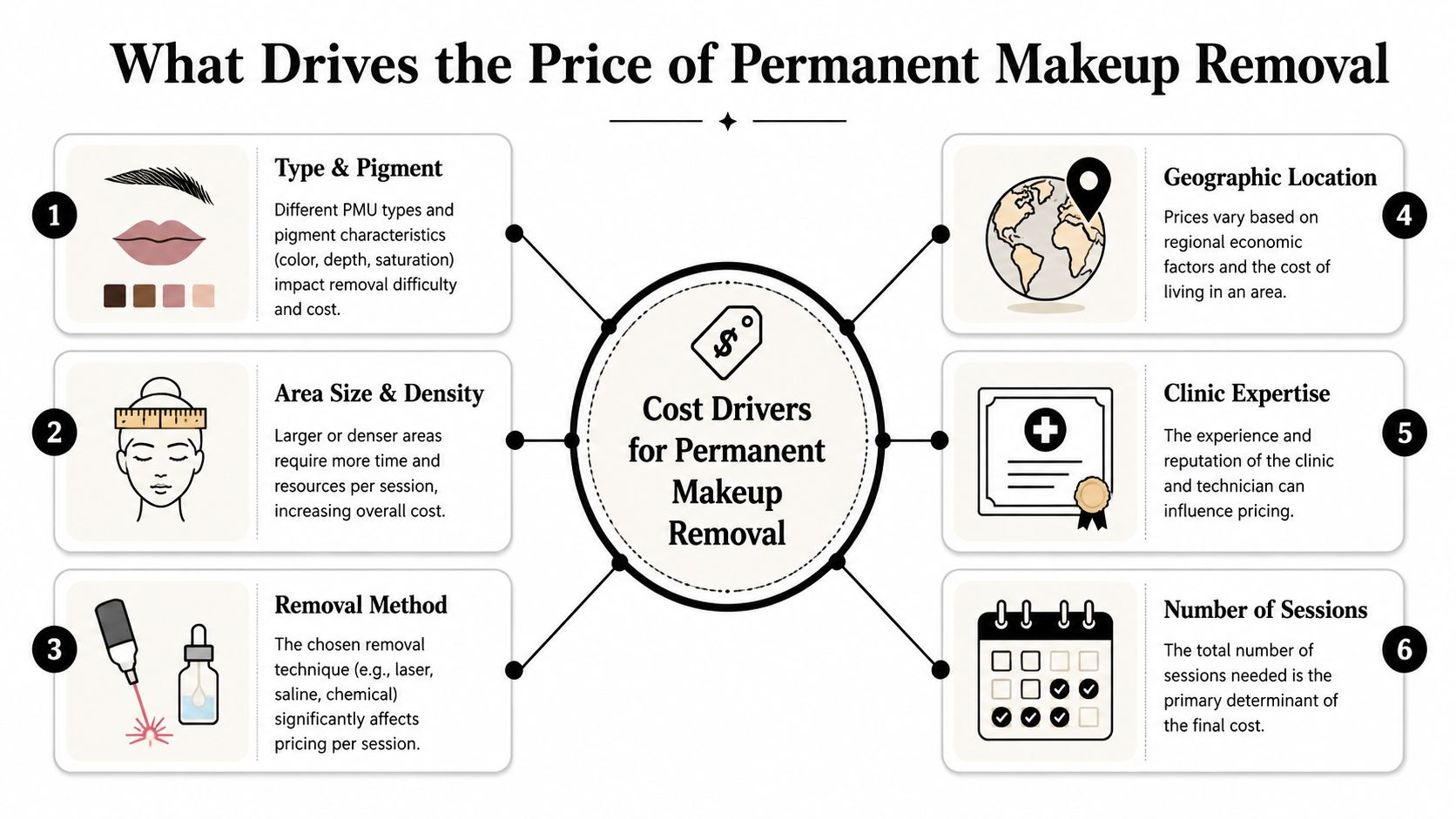
What Drives the Price of Permanent Makeup Removal
Some permanent makeup removals are straightforward. Others require a slower, more cautious plan because the area is small, visible, and unforgiving. That's why two people can both ask about brow removal and receive very different quotes.
Procedure area changes the baseline
The treatment area affects price immediately. According to CareCredit's permanent makeup removal cost guide, eyebrow removal averages around $398 per session, while lip tattoo removal averages $303 per session. More complex work can climb much higher, and hairline restoration can be significantly higher than smaller facial areas.
That difference isn't random. Brows, lips, eyeliner, areola work, and scalp pigmentation all sit in different tissue environments and require different risk management.
A few examples:
- Brows: Often small in size, but pigment depth and prior correction work can make them stubborn.
- Lips: Color complexity can change the removal plan even when the area isn't large.
- Hairline restoration: Larger treatment zones raise labor, time, and planning demands.
Method changes both price and strategy
The method matters because it changes the treatment mechanics, the pace, and sometimes the number of sessions. Laser, saline, and other niche approaches don't solve the same problems equally well.
In practice, the lowest per-session price doesn't always produce the lowest total cost. A method that costs less each visit can still cost more overall if progress is slower.
Removal gets expensive when clients chase the wrong method for their pigment instead of the right method for their goal.
That applies especially to clients who only need fading for a correction. If the objective is to lighten enough for a new design, the smartest plan may be shorter and more selective than a full erasure plan.
Pigment behavior matters more than people expect
Online price calculators often fall short. They can't see what an experienced technician sees.
A few things change treatment difficulty:
- Color composition: Dark pigment often behaves differently from warm or mixed tones.
- Density: Saturated cosmetic tattooing usually takes more work than soft, aged pigment.
- Depth: Pigment placed unevenly can fade unevenly.
- Correction history: Cover-ups and previous touch-ups often create layered removal problems.
A simple black eyeliner can be a very different case from multi-toned lip blush. Even when both look light on the surface, the underlying pigment story may not be the same.
Clinic location and technician judgment affect the quote
Geography changes pricing because operating costs change. So does expertise.
A technician isn't just charging for a machine pass. They're charging for treatment selection, facial-area safety, pigment assessment, and adjusting the plan when the skin or color response shifts. In permanent makeup removal, that judgment is part of the service.
When people compare prices, I always recommend comparing what's included, not just the session fee. Ask whether the quote reflects area size, method, aftercare support, and whether the provider is planning for fading or complete removal.
Laser vs Saline Removal A Cost and Effectiveness Comparison
This is the comparison often prioritized first, and for good reason. Laser and saline are the two methods clients ask about most often. They work differently, recover differently, and fit different pigment situations.
How laser removal works
Laser removal targets implanted pigment with light energy. In permanent makeup work, that means the device is chosen and used with extra caution because the treatment zone is on the face and often close to sensitive structures.
Per-session pricing for laser permanent makeup removal typically falls within a higher range than saline, but laser often moves faster on the right pigment. If you want a technical overview of newer laser platforms and why device choice matters, this look at new tattoo removal technology is a useful reference.
Laser is often a strong fit when the pigment and skin response line up with the technology being used. It may be less suitable when certain cosmetic pigments are likely to shift unpredictably.
How saline removal works
Saline removal uses a different mechanism. Instead of breaking pigment apart with light, it works through a lifting process in the skin. That makes it a practical option in cases where heat-based treatment isn't the first choice or where the provider wants a more controlled approach for specific cosmetic pigments.
Saline can be helpful, but it's not automatically the gentler or cheaper path in total. If progress is slower, the session count can rise.
Comparison of Permanent Makeup Removal Methods
The clearest pricing distinction is that laser permanent makeup removal sessions typically range from $150 to $500, while saline removal usually ranges from $150 to $300 per session, with laser sometimes requiring fewer total sessions overall, as summarized in the verified industry data above.
| Feature | Laser Removal | Saline Removal |
|---|---|---|
| Typical session cost | $150 to $500 per session | $150 to $300 per session |
| How it works | Breaks pigment into smaller particles so the body can clear them | Lifts pigment through a saline-based extraction process |
| Best fit | Often preferred when pigment responds well to laser energy | Often considered when certain pigments or skin concerns make a non-laser route more appropriate |
| Speed of each appointment | Usually faster in the treatment room | More manual and technique-dependent |
| Total number of sessions | Can be fewer overall in the right case | May require more sessions in some cases |
| Main trade-off | Higher per-session cost, but may reduce total session count | Lower per-session price, but not always lower total spend |
Clients often assume the cheaper session is the better deal. Sometimes it is. Sometimes it isn't.
Here are the trade-offs I want people to understand before they choose:
- Choose by pigment behavior, not by headline price. A lower session fee doesn't help if the method isn't a good match.
- Choose by end goal. Full removal and cover-up fading aren't priced mentally the same way because the finish line is different.
- Choose by facial safety. Cosmetic tattoo removal isn't body tattoo removal. The margin for error is smaller.
If a provider recommends one method over another, ask why that method fits your pigment, not just what it costs.
That's the right question. It usually reveals whether you're getting a thoughtful plan or just a generic package.
Mapping Your Removal Journey Timeline and Results
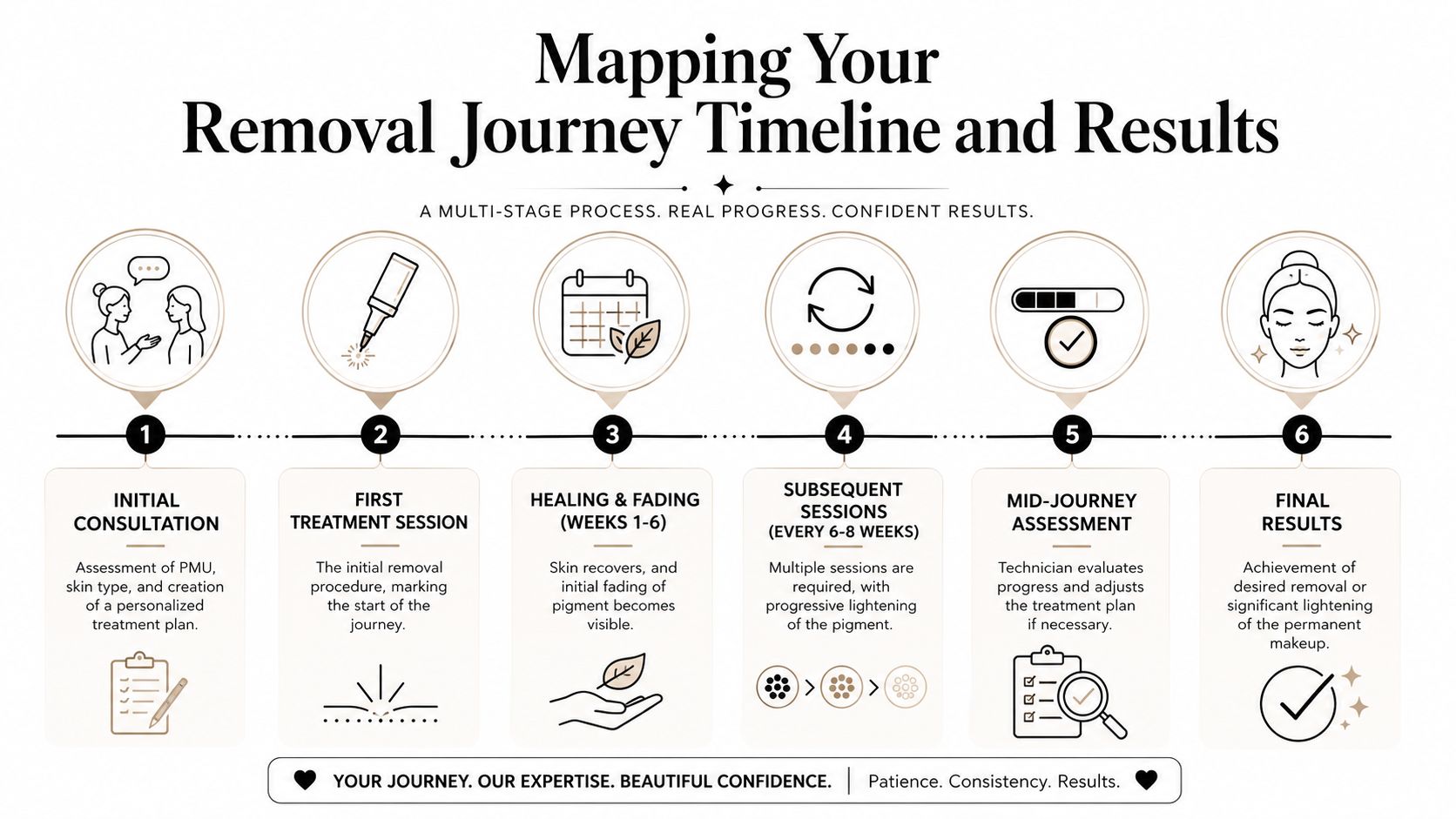
Most permanent makeup removal doesn't look dramatic in one visit. It looks progressive. That's normal, and it's usually the safer way to work on the face.
What the first session usually tells us
The first treatment is often diagnostic as much as corrective. It shows how the pigment responds, how the skin heals, and whether the initial plan needs adjustment.
With advanced Pico Laser technology, optimal results for permanent makeup removal are typically achieved in 3 to 6 sessions, because the ultra-short energy pulses break pigment into smaller particles that the body can clear more efficiently, according to this Pico laser overview.
That doesn't mean everyone will finish in the same window. It means a good-quality laser can improve efficiency when the case is suitable for that approach.
Why spacing matters
Clients sometimes want to speed the process up by treating too aggressively or too often. That's not how good removal works.
Skin needs time to settle. Pigment needs time to declare its response. The body also needs time to process what the treatment disrupts. When sessions are stacked too quickly, you don't create better outcomes. You create more inflammation and less clarity.
A careful timeline usually includes:
- Consultation and assessment to evaluate pigment, placement, and end goal.
- First session to begin fading and observe response.
- Healing period while the skin calms and visible change develops.
- Reassessment to decide whether to continue, change settings, or change method.
What results usually look like over time
Progress often starts unevenly. One section of a brow may lift faster than the tail. Lip borders may change before the body of the color does. That's common in cosmetic tattoo work because implantation is rarely perfectly uniform.
Slow, even fading is often a better sign than an aggressive early reaction.
The clients who do best are usually the ones who treat removal as a process, not an event. They follow aftercare, protect the area, and let each session reveal what the skin and pigment are doing.
If your goal is a cover-up, the "finished" result may arrive well before full disappearance. If your goal is a clean slate, patience matters even more.
Getting a Personalized Quote at EradiTatt in Florida
A real quote for permanent makeup removal should come from an actual assessment, not a guess over text. Brows that look similar in a selfie can have different depth, different undertones, and different correction history. Those details change pricing.

What a real quote should account for
A precise quote should factor in:
- Your treatment goal: Full removal costs differently from strategic fading for a new design.
- Your pigment history: Touch-ups, corrections, and older work can change the plan.
- The treatment area: Facial zones differ in sensitivity and technical risk.
- Method selection: The right method affects both the session fee and the likely session count.
For Florida clients comparing local options, this Florida laser tattoo removal pricing page is a practical starting point because it reflects how area size and treatment planning affect cost in real-world scheduling.
How Florida clients can take the next step
For readers in Orlando, Tampa, St. Petersburg, Bradenton/Sarasota, or Palm Harbor, the next step is simple. Book a consultation with a provider who regularly handles facial pigment and cosmetic tattoo work.
EradiTatt Tattoo Removal offers laser tattoo removal services in multiple Florida locations, including treatment options for permanent makeup and cosmetic eyebrow pigment. That's useful if you want a quote based on area size, pigment behavior, and whether you're aiming for fading or complete removal.
Bring clear photos if you're starting virtually. If you've had touch-ups, corrections, or prior removal, mention that upfront. Those details save time and usually lead to a more accurate estimate.
Answering Your Top Questions About Removal Costs
Is fading for a cover-up cheaper than full removal
Usually, yes in total. The key point is that the cost per session stays the same, but fading often takes fewer sessions than complete removal. Verified data from this RealSelf discussion on partial versus full tattoo removal cost notes that fading for a cover-up may take 3 to 5 sessions, while full removal of the same tattoo could require 8 to 10 sessions, which can significantly reduce the total investment.
If your goal is to make room for better brows rather than erase every trace of pigment, say that clearly during the consultation. It changes the endpoint.
Does insurance ever cover permanent makeup removal
Most of the time, no. Cosmetic tattoo removal is usually treated as an elective aesthetic expense, not a covered medical service. If you're trying to understand the broader logic insurers use for exclusions, Pounds Health explains what's not covered in a way many clients find helpful.
There can be exceptions tied to reconstructive circumstances, but routine cosmetic removal generally remains out of pocket.
Are there hidden costs like numbing fees
Sometimes there are add-on fees, and sometimes clinics bundle them. That's why the right question isn't just "How much is a session?" Ask what the session includes.
A clear quote should tell you whether consultation, numbing, aftercare guidance, and area-based pricing are part of the listed fee. If a provider can't explain that cleanly, keep asking until they can.
If you're ready to price out your own case instead of guessing from averages, contact EradiTatt Tattoo Removal. A consultation can narrow your likely method, session path, and treatment goal so you know what you're budgeting for.