
You're probably here because a tattoo that once felt right doesn't fit the same way now. Maybe it's a name, a style you outgrew, a piece that blurred over time, or ink that gets in the way of work, a cover-up plan, or a major life event. That feeling is common, and it doesn't mean you made a bad choice. It means your life changed.
The best way to remove tattoos isn't always about chasing perfect, total erasure. For some people, their goal is a clean slate. For others, it's fading the ink enough to make it less noticeable or to create a better canvas for a new design. That difference matters, because realistic goals lead to better decisions and less disappointment.
A lot of tattoo removal content skips that honesty. It talks as if every tattoo disappears completely. But WebMD notes that complete removal may not be possible in some cases. Sometimes the smartest goal is strategic fading, not perfection.
Table of Contents
- Considering a Change Your Tattoo Removal Journey
- Tattoo Removal Methods That Don't Work
- How Laser Tattoo Removal Safely Erases Ink
- What to Expect During Your Laser Removal Process
- Key Factors That Influence Your Tattoo Removal Results
- How to Prepare for Your First Treatment
- Begin Your Journey with EradiTatt Today
Considering a Change Your Tattoo Removal Journey
A common first conversation goes like this. Someone says, “I don't hate my tattoo. I just don't want it there anymore.” That's different from panic or regret. It's usually quieter than that. A person changes jobs, tastes change, relationships end, or an old design no longer matches who they are now.
Another person might love tattoos in general and still want one specific piece gone. Script can spread. Fine details can soften. A once-meaningful design can start to feel like clutter. In those moments, tattoo removal isn't about erasing the past. It's about choosing what stays visible on your skin going forward.
Your goal matters more than the marketing
People often get confused. They search for the best way to remove tattoos and expect one universal answer. There isn't one. The right plan depends on what success looks like to you.
For some clients, success means:
- Full removal: They want the tattoo as invisible as possible.
- Targeted fading: They want enough lightening for a tattoo artist to cover it cleanly.
- Social fading: They just want it to draw less attention in daily life.
Sometimes the best outcome isn't “gone.” It's “no longer a problem.”
That mindset helps you make better treatment decisions. It also protects you from false promises. As noted earlier, complete removal may not happen in every case. Some people are left with a faint shadow, texture change, or a patch that looks lighter or darker than the surrounding skin.
A fresh start can look different for different people
Think of tattoo removal like clearing a wall. One person wants bare paint. Another person just needs the old color light enough to repaint over it. Both are valid outcomes.
That's why the best way to remove tattoos starts with an honest question. Are you trying to erase, soften, or prepare? Once that answer is clear, the rest of the process makes much more sense.
Tattoo Removal Methods That Don't Work
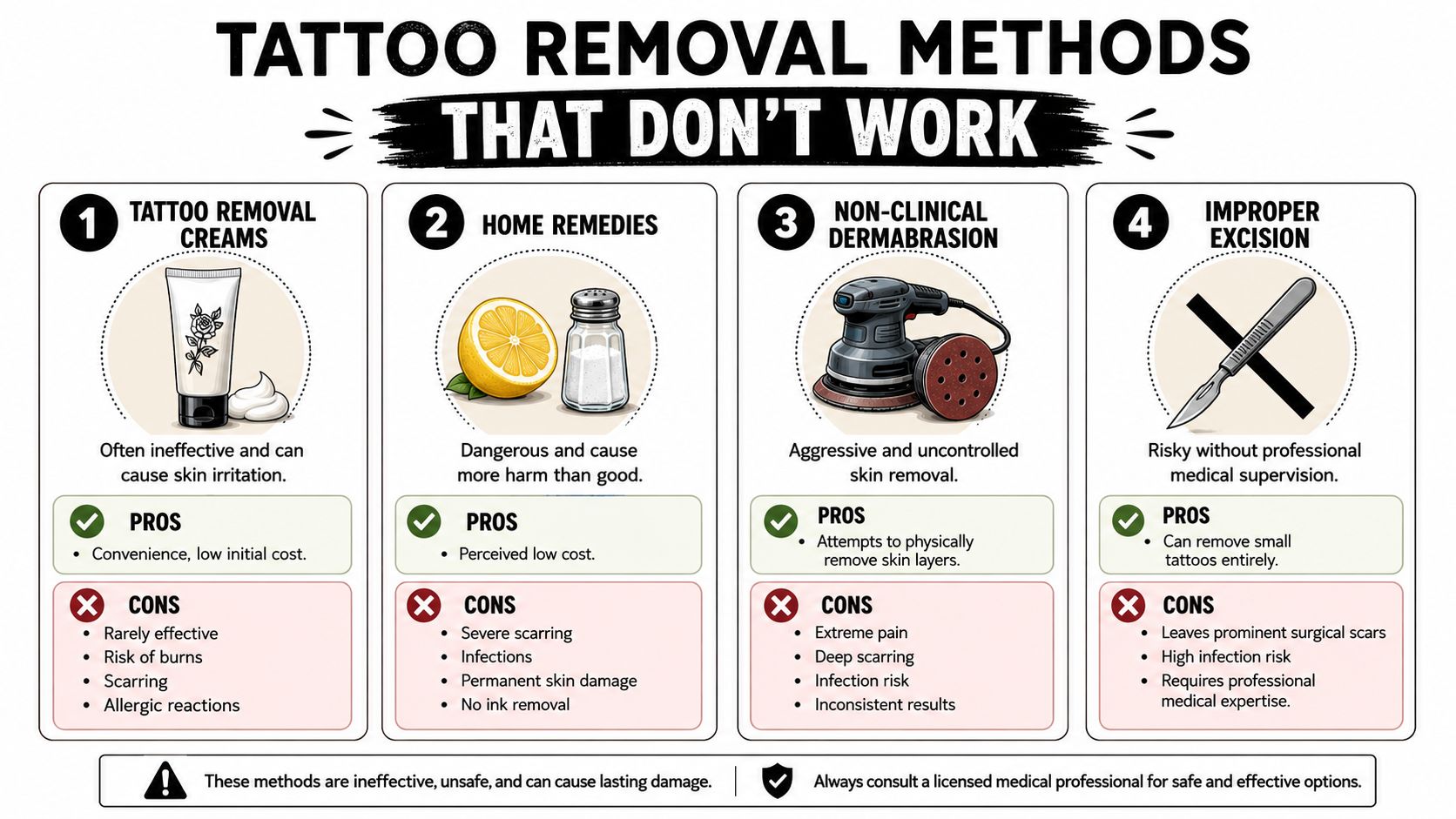
Before booking a consultation, many people test the options that look simpler on the surface. A cream feels less intimidating than a laser. A home kit sounds cheaper. An acid peel can sound fast.
The problem is that tattoo ink is not sitting on top of the skin like marker on a countertop. It sits deeper, in the dermis. So products that burn, bleach, scrub, or peel the surface usually affect skin more than ink.
Why creams and home kits fall short
The FDA has warned consumers about tattoo removal creams and similar products marketed online, noting that many are unapproved and can cause skin injury such as redness, blistering, scarring, and changes in skin color, according to the American Academy of Dermatology's overview of tattoo removal safety. The underlying issue is straightforward. These products do not reliably reach and clear the pigment lodged deeper in the skin.
If you are hoping a cream will fade your tattoo enough to avoid professional treatment, set that expectation aside early. You will save time, money, and irritation. For a plain-language explanation, read this guide on whether tattoo removal creams work.
Common methods people still try
A few options come up again and again, usually because they promise control at home.
- Tattoo removal creams: They may irritate or lighten the surface, but surface change is not the same as ink removal.
- Home remedies: Salt, lemon juice, abrasive scrubs, and similar mixtures can injure skin without producing meaningful fading.
- Non-clinical dermabrasion: Sanding the skin can remove tissue unevenly and increase the risk of scarring.
- Improper excision attempts: Cutting tattooed skin is a medical procedure, not a home fix.
The real downside of DIY removal
DIY methods often leave people with the same tattoo and more skin damage. That matters because your end goal may be full removal, partial fading, or preparing the area for a cover-up. In all three cases, healthy skin gives you better options.
A simple rule helps here. If a method works by scraping, burning, or peeling the top layer of skin, it is working in the wrong place.
Older approaches such as dermabrasion and surgical removal can have a role in limited medical settings, but they are not the preferred starting point for achieving a cosmetic result. For clients who want the best chance of reaching a specific goal with less uncontrolled skin injury, laser treatment remains the method professionals return to most often.
How Laser Tattoo Removal Safely Erases Ink
A lot of first-time clients come in expecting the laser to scrape, burn, or melt the tattoo away in one visit. What happens is more controlled than that. The laser sends very short pulses of light into the skin, and tattoo pigment absorbs that energy far more readily than the surrounding tissue.
The goal is fragmentation. Tattoo ink sits in the skin as clusters of pigment that are too large for the body to clear efficiently. Laser treatment breaks those clusters into much smaller pieces. Once the pieces are smaller, your immune system can gradually remove them over the weeks that follow.
A simple comparison helps here. A large pile of debris is hard to haul away all at once. Break it into smaller, manageable pieces, and cleanup becomes realistic. Laser removal follows that same principle, which is why fading happens in stages instead of all at once.
That gradual process is also why the "best way to remove tattoos" depends on your goal. Some clients want the tattoo gone as completely as their skin and ink type allow. Others want enough fading to create a cleaner canvas for a cover-up. In both cases, the laser is being used to move the tattoo toward a specific outcome, not to promise identical results for every person.
What your body does after the laser does its part
After treatment, the body takes over the slower half of the job. Immune cells respond to the disrupted pigment and begin carrying away the smaller ink fragments over time. This is why you may leave an appointment with the tattoo still very visible, then notice more fading later as the skin recovers and the body processes the ink.
Patience matters here.
The session starts the process. Your body continues it between sessions, which is one reason treatments are spaced out instead of stacked close together.
Several variables affect how efficiently that fading shows up:
- Ink color: Black and other darker pigments often respond more predictably, while some bright or pastel tones can be more stubborn.
- Ink depth and density: Heavily packed or deeper ink usually takes longer to break down.
- Your immune response: Two people with similar tattoos can fade at different rates because their bodies clear fragmented pigment differently.
Why laser type matters
You may hear terms such as Q-switched ruby, alexandrite, and Nd:YAG during a consultation. Those names refer to different laser systems, each with strengths for certain ink colors and skin considerations. Newer picosecond platforms are also part of the conversation in some clinics because they can improve how certain pigments are fragmented. If you want a clearer overview of new tattoo removal technology, it helps to see these tools as different instruments in the same toolkit.
The right choice is not one machine that claims to do everything. It is a treatment approach matched to your tattoo, your skin, and the result you want.
What to Expect During Your Laser Removal Process
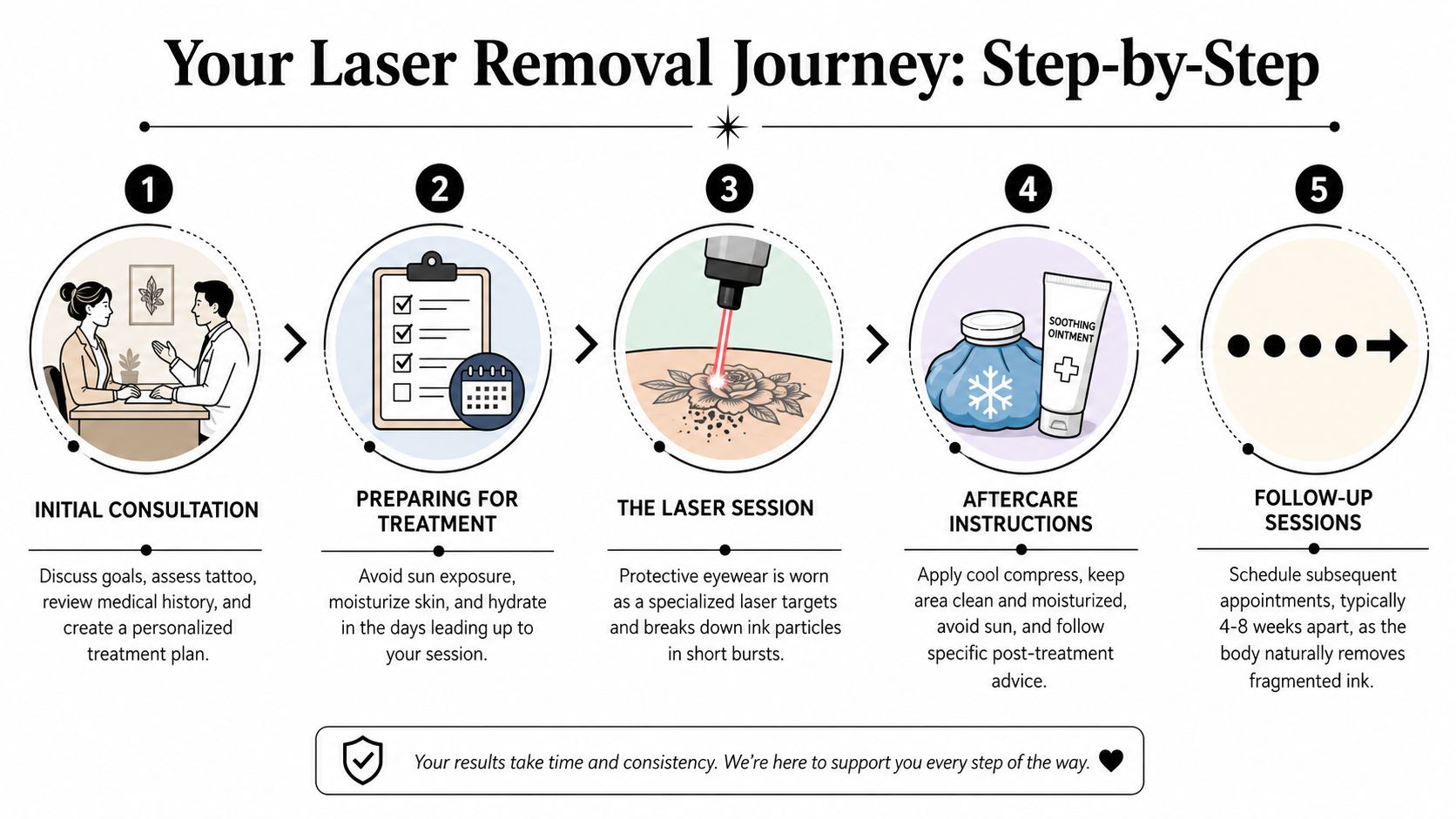
Your first appointment is primarily a consultation, not just a procedure. The goal is to understand what success looks like for you before anyone talks about how many sessions you might need.
That matters because the best outcome is not always the same for every person. One client wants a clean slate. Another wants enough fading to give a cover-up artist more room to work. Those are different finish lines, so the treatment plan should match the result you want.
A clinician will examine the tattoo up close and ask about your health history, skin type, and any past reactions to lasers or skin treatments. They are also checking practical details such as color variation, ink density, placement on the body, and whether the tattoo appears lightly placed or heavily saturated. This step works like a map before a road trip. It helps set a route, estimate the time, and avoid false promises.
The consultation and first treatment day
If treatment happens that same day, the process is straightforward. You wear protective eyewear, the skin is cleaned, and the laser is passed over the tattoo in short pulses.
Clients often ask about pain first. A common description is a fast rubber band snap with some heat. It is uncomfortable, but the sensation comes in brief bursts rather than one long stretch. Smaller tattoos can be treated fairly quickly.
Right after the laser passes over the ink, the area may turn white for a few minutes. This is called frosting. It is a normal skin response after treatment, not a sign that the tattoo has disappeared on the spot.
What happens after the laser session
The appointment is the active treatment part. The fading happens mostly afterward.
A laser session breaks larger ink particles into smaller fragments. Your body then clears those fragments gradually over time, which is why removal works more like a series of clean-up cycles than a single erasing event. If you leave the office and the tattoo still looks obvious, that is normal. The change often becomes easier to notice over the following weeks.
The American Society for Dermatologic Surgery explains that laser tattoo removal usually requires multiple sessions spaced several weeks apart, with the exact number depending on the tattoo and the person's response to treatment. You can review that guidance in their overview of laser tattoo removal expectations.
What healing can look like between visits
The treated area may feel warm, tender, or slightly swollen soon after the appointment. Redness is common. Some people also notice minor surface changes while the skin settles.
A typical healing pattern looks like this:
- Right after treatment: Frosting may appear first, followed by redness and sensitivity.
- First few days: The skin begins to calm down and repair the surface.
- Following weeks: Gradual fading can become more noticeable as the body clears broken-up pigment.
- Next visit: The tattoo is checked again, and the next step is based on how your skin and ink responded.
This slower rhythm surprises many new clients. They expect the laser room to do all the work. In reality, the appointment starts the process, and your body finishes much of it between sessions.
How progress usually feels over time
Tattoo removal rarely follows a perfectly straight line. One section may lighten early while another area seems to lag behind. A stubborn color may hang on longer than black outlines. That unevenness can still fit a normal response pattern.
The better way to judge progress is by asking a simple question. Are you getting closer to your goal?
If your goal is full removal, steady fading over a series of sessions is the sign to watch for. If your goal is a cover-up, the tattoo may only need to lighten enough for new artwork to sit cleanly over it. That is why a good consultation focuses on realistic milestones instead of promising perfection.
Key Factors That Influence Your Tattoo Removal Results
Two people can follow the same treatment schedule and still get different results. That's normal. Tattoo removal depends on the tattoo itself and on the person wearing it.
Some of those variables are outside your control. Others are things you can improve before and during treatment. That's good news, because it means you're not just sitting back and hoping for the best.
Tattoo factors you can't change
A professionally applied tattoo is often harder to remove than an amateur one because it usually contains denser, pigment placed at a greater depth.
A clinical study found that professional tattoos required an average of 8.5 Q-switched laser sessions for total removal, while amateur tattoos required an average of 4.6 sessions. That doesn't mean professional work won't respond. It means the removal plan often needs more time.
Other tattoo-related factors include:
| Factor | Why it matters |
|---|---|
| Ink color | Dark inks usually respond better than lighter colors like yellow or green |
| Ink density | Heavier saturation can take longer to break down |
| Body location | Some areas may clear more slowly than others |
| Age of tattoo | Older tattoos may already have some natural fading |
Personal factors you can influence
This is the part many people miss. Laser treatment doesn't remove the ink all by itself. Your immune system does the cleanup after the laser breaks the particles apart. That means daily habits matter.
According to a community analysis of tattoo removal experiences, people who engage in regular exercise and maintain healthy habits tend to have more successful removals. The same discussion highlights the value of staying hydrated, eating well, and avoiding smoking because strong immune function supports ink clearance.
That doesn't mean there's a magic routine. It means basic health habits can support the process.
Consider these as practical advantages:
- Regular exercise: Supports circulation and general immune function.
- Hydration: Helps your body function well during healing.
- Balanced nutrition: Supports recovery after each session.
- Avoiding smoking: Smoking can work against efficient healing and clearance.
You can't change your tattoo's starting point. You can improve the conditions your body works under.
What this means for setting expectations
If your tattoo is dense, colorful, and professionally done, your timeline may be longer. If it's simpler and more lightly applied, fading may happen more easily. Neither outcome is a failure. They're just different starting points.
The best way to remove tattoos is to match your expectations to your actual tattoo, then support the process with habits that help your body do its share of the work.
How to Prepare for Your First Treatment
Good preparation makes treatment smoother and healing easier. While the laser itself is often the focus, what you do before and after the appointment can shape how your skin responds.
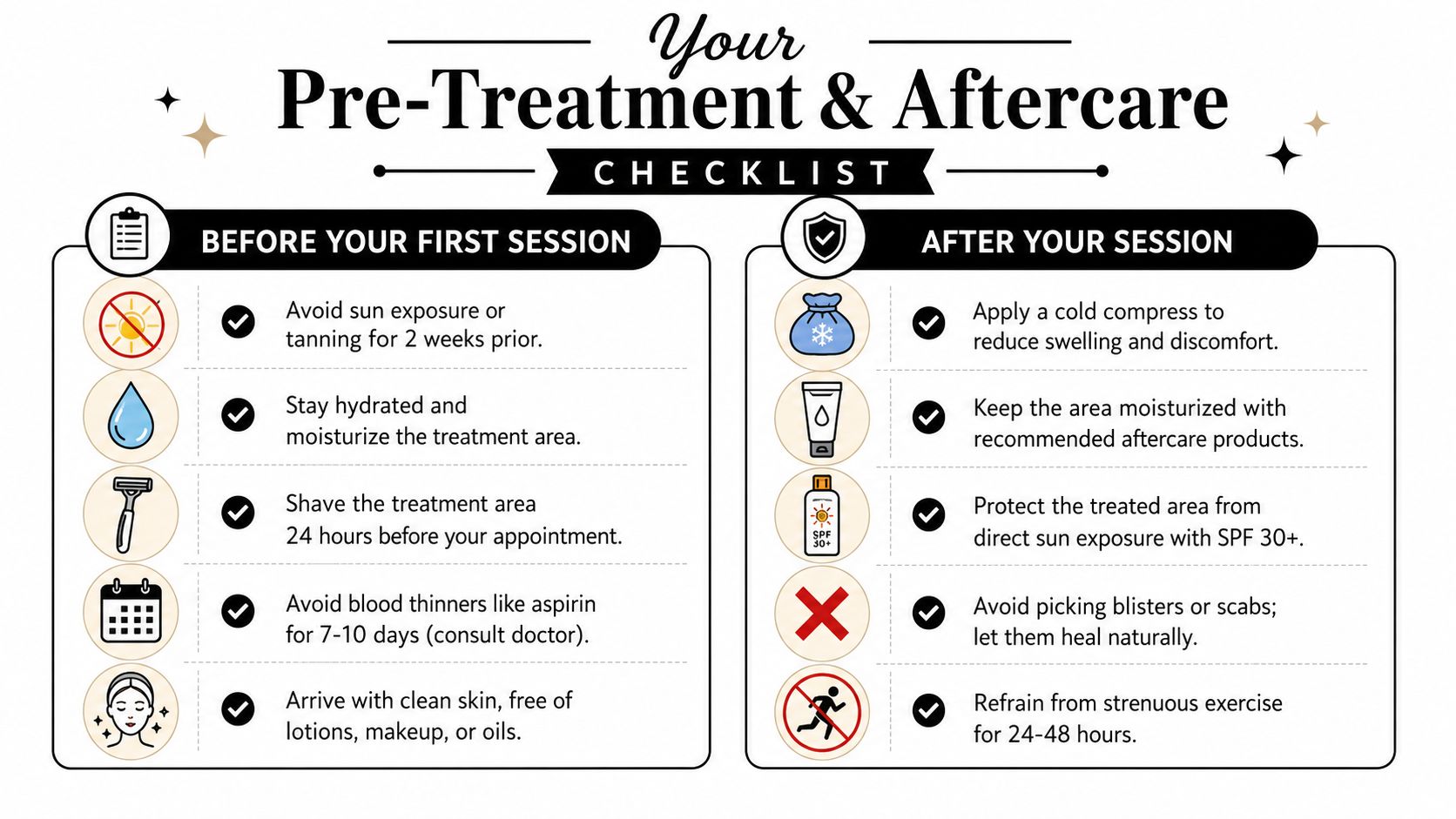
The single most important habit is sun protection. According to the American Academy of Dermatology's laser tattoo removal guidance, protecting treated skin from the sun for 3 months after a laser session is critical because sun exposure can increase inflammation and reverse clearance progress. Protective clothing that blocks light completely is the recommended defense.
Before your first session
A few simple habits can set you up well:
- Protect the area from sun exposure: Tanned or recently sun-exposed skin is harder to treat safely.
- Keep your skin in good condition: Clean, calm skin is easier to assess and treat.
- Hydrate and eat normally: Your body heals better when you're taking care of yourself.
- Ask about medications: If you take anything that may affect healing, ask your clinician in advance.
If you want a more detailed walkthrough, this guide on how to prepare for tattoo removal is a useful place to start.
After your appointment
Aftercare doesn't need to be complicated, but it does need to be consistent.
Focus on the basics:
- Keep the area clean: Follow the clinic's cleaning instructions closely.
- Don't pick or scratch: Let the skin heal on its own timetable.
- Use only recommended products: Don't improvise with harsh creams or home remedies.
- Cover the area from sun exposure: Clothing is often more reliable than trying to depend on sunscreen alone.
Skin that heals quietly tends to respond better over the long run than skin that's repeatedly irritated.
A simple way to think about aftercare
Treat the area like healing skin, not like a stain you need to scrub away. The laser session has already done its part. Your job is to protect the skin while your body handles the fading phase.
That approach reduces avoidable setbacks and gives you a better chance at the kind of result you're aiming for.
Begin Your Journey with EradiTatt Today
If you've made it this far, you already know the most important truth. The best way to remove tattoos is the one that matches your goal, your skin, and your tattoo. Sometimes that means working toward full removal. Sometimes it means fading the ink enough for a cleaner look or a future cover-up.
Laser treatment remains the clearest professional option because it targets the pigment under the skin instead of damaging the surface and hoping for the best. At a provider like EradiTatt Tattoo Removal, treatment plans can be shaped around complete removal or fading for a cover-up using laser technology and in-person consultation to assess the tattoo directly.
For people in Florida, convenience matters too. EradiTatt serves multiple locations including Orlando, Bradenton/Sarasota, St. Petersburg, Palm Harbor, and Tampa, which makes follow-up appointments easier to manage over time.

If you want clear answers about your tattoo, your likely endpoint, and what kind of fading is realistic, the next step is simple. Schedule a consultation and get a plan built around your actual skin and ink, not a generic promise.
If you're ready to talk through your options, EradiTatt Tattoo Removal can help you explore whether full removal or strategic fading makes more sense for your tattoo and your goals.