
Tattoo removal creams don't work for complete removal because they can't reach the tattoo ink, and they carry real risks of skin damage. If you want to understand do tattoo removal creams work, the short answer is no for true removal, and the science makes it clear why.
A lot of popular advice treats tattoo removal cream like a simple shortcut. Apply a product, wait, and let the ink fade away. That sounds appealing, especially if you're worried about cost, privacy, or discomfort. But tattoo permanence isn't a marketing problem. It's a skin biology problem.
When a tattoo is placed correctly, the ink sits below the skin surface where creams act. That single fact explains almost everything. A cream can irritate, bleach, peel, or inflame the top layer of skin, but it can't travel down to where the ink is stored and selectively remove it. In practice, that means people often trade false hope for burns, discoloration, and scarring.
Table of Contents
- The Hard Truth About At-Home Tattoo Removal Creams
- How Tattoo Removal Creams Claim to Work
- The Science Why Creams Cant Reach Your Tattoo
- Beyond Ineffectiveness The Dangers of At-Home Creams
- Professional Removal A Comparison That Matters
- Fading a Tattoo for a Cover-Up The Right Way
- Frequently Asked Questions About Tattoo Removal
The Hard Truth About At-Home Tattoo Removal Creams
At-home tattoo removal creams sell a promise people want to believe. They seem easy, private, and cheaper up front than professional treatment. That's exactly why so many people ask about them before they ask about anything else.
The hard truth is simple. Tattoo removal creams do not remove tattoos as advertised. At best, a product may irritate or lighten the surface skin around the tattoo enough to create the impression of change. It doesn't remove the ink itself.
Why the quick-fix idea falls apart
A tattoo isn't sitting on top of your skin like marker on a countertop. It's placed into a deeper layer on purpose. That's why a shower doesn't wash it off, a scrub doesn't sand it away, and a cream can't dissolve it from above.
Practical rule: If a product sits on the skin surface, judge it by what it can reach. For tattoo ink, that reach is the problem.
People often assume that if a cream is strong enough to sting, peel, or bleach, it must be strong enough to remove a tattoo. That logic sounds reasonable until you think about what the product is touching. It's touching your skin first, and mostly your skin only.
What works and what doesn't
Here's the practical breakdown:
- What doesn't work: Creams marketed to "erase" tattoo ink from home.
- What may happen instead: Temporary irritation, patchy lightening of the skin, or a duller look caused by inflammation.
- What addresses tattoo ink: Professional treatment that can target pigment below the surface.
That's the distinction clients need. A cream may change the way the skin looks. That isn't the same as removing the tattoo.
How Tattoo Removal Creams Claim to Work
Most tattoo removal creams rely on one of two ideas. They either claim to lighten the skin over the tattoo, or they claim to peel away layers of skin until the tattoo fades.
The two main types of cream claims
The first group uses bleaching or brightening ingredients. Products in this category often talk about fading pigment, evening tone, or reducing darkness. The implied promise is that if the skin gets lighter, the tattoo will somehow disappear with it. But that approach targets skin color, not embedded tattoo pigment.
The second group uses chemical exfoliants or peel-style ingredients. These formulas are marketed like controlled skin stripping. The idea is that repeated peeling removes enough upper skin to make the tattoo fade from view. That's a surface-level strategy aimed at skin turnover, not ink fragmentation.
Some formulas combine both approaches. They brighten the skin while also irritating or peeling it. That can make the product feel active, which many people mistake for proof that it's working.
Why the marketing sounds believable
These claims sound convincing because they borrow language from real skincare. Exfoliation is real. Pigment control is real. Cell turnover is real. If you want a plain-English primer on how topical ingredients behave on skin, this article on explaining key skincare actives is useful context.
But skincare language gets stretched when it's applied to tattoos. A cream can affect the skin's surface appearance. It can sometimes make skin look drier, lighter, inflamed, smoother, rougher, or uneven. None of those changes mean it has reached the tattoo ink.
The product may feel strong because it is damaging the barrier. Strength on the surface isn't evidence of action at tattoo depth.
That gap between what's claimed and what's biologically possible is where people get misled. If a cream causes peeling, users may think the tattoo is being "lifted out." If it causes whitening, they may think the ink is fading. In reality, they're often watching the skin react while the tattoo remains where it was placed.
The Science Why Creams Cant Reach Your Tattoo
The easiest way to understand this is to think of your skin like a house. The epidermis is the main floor. It's the outer layer you can touch, wash, moisturize, and exfoliate. The dermis is the foundation or basement. That's where tattoo ink is placed.
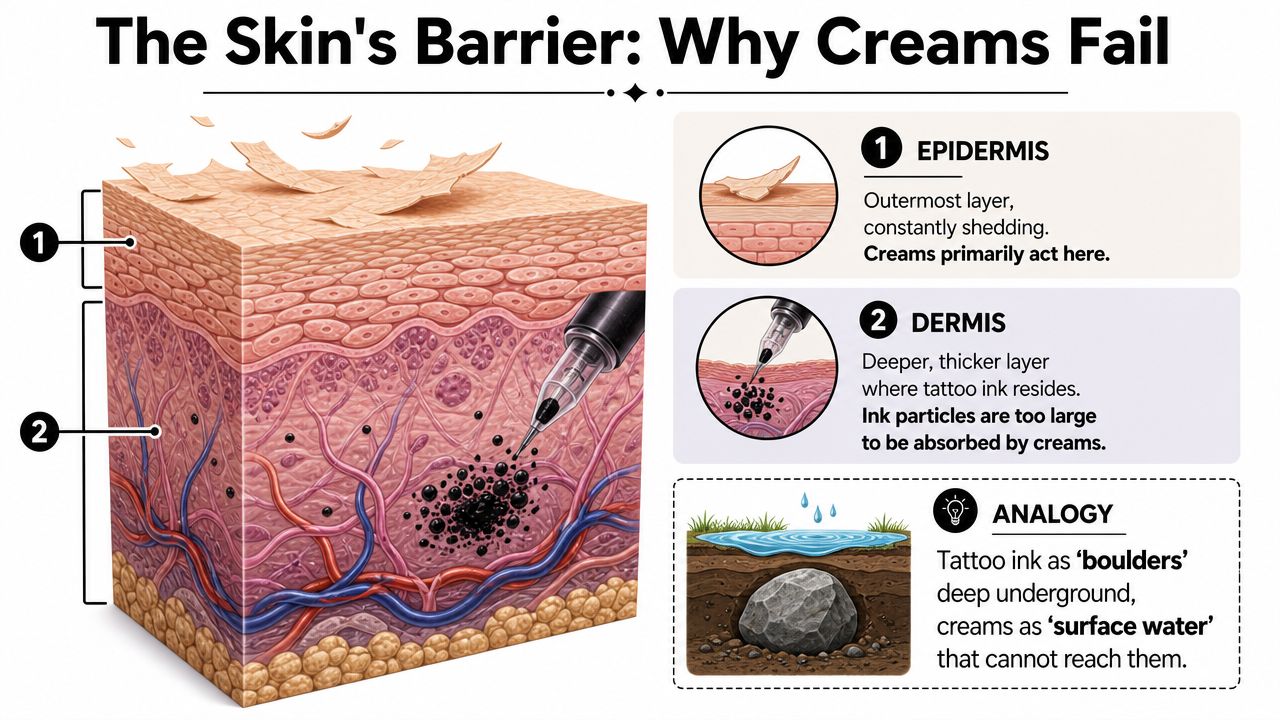
Your tattoo lives deeper than the cream can go
A topical cream is like pouring water on the front porch and expecting it to wash out boulders stored in the basement. It doesn't matter how often you apply it. The route is wrong.
The epidermis is designed to act as a barrier. It keeps many outside substances from moving deeper into the body. That's a good thing for health, but it's bad news for any cream claiming it can travel down through intact skin, reach tattoo particles in the dermis, and selectively remove them without harming everything in between.
Tattoo ink is intentionally implanted beneath that barrier. Once healed, the ink isn't sitting loose on the surface. It's embedded in a deeper structural layer of the skin.
Why permanence works against topical products
Tattoo permanence exists because the body treats those ink particles differently than surface stains. They aren't like makeup or self-tanner. They sit in the dermis, where normal skin shedding from the epidermis doesn't carry them away.
That matters because creams mostly act where skin naturally renews itself. They may speed exfoliation or disrupt pigment at the surface, but tattoo pigment isn't participating in that same surface turnover cycle.
Think of the ink particles as boulders underground and a cream as rain on the lawn. Rain changes the surface. It may soften the topsoil. It doesn't remove the boulders buried far below.
Here is the practical biology in plain terms:
- Epidermis: The outer barrier. Creams mainly act here.
- Dermis: The deeper layer where tattoo ink sits.
- Tattoo ink: Particles placed below the reach of ordinary topical products.
- Result: Surface treatments can't do deep-pigment removal.
When a client says, "Maybe the cream just needs more time," my answer is that time doesn't fix a route problem. If the product can't reach the ink, more weeks won't change the mechanism.
This is also why real removal methods work differently. They don't try to scrub or bleach ink from above. They use energy that can pass through the upper layer and interact with pigment below it. That's a completely different process from applying a cream to the surface.
Beyond Ineffectiveness The Dangers of At-Home Creams
The biggest problem with these creams isn't only that they fail. It's that they can leave you with the original tattoo plus injured skin.
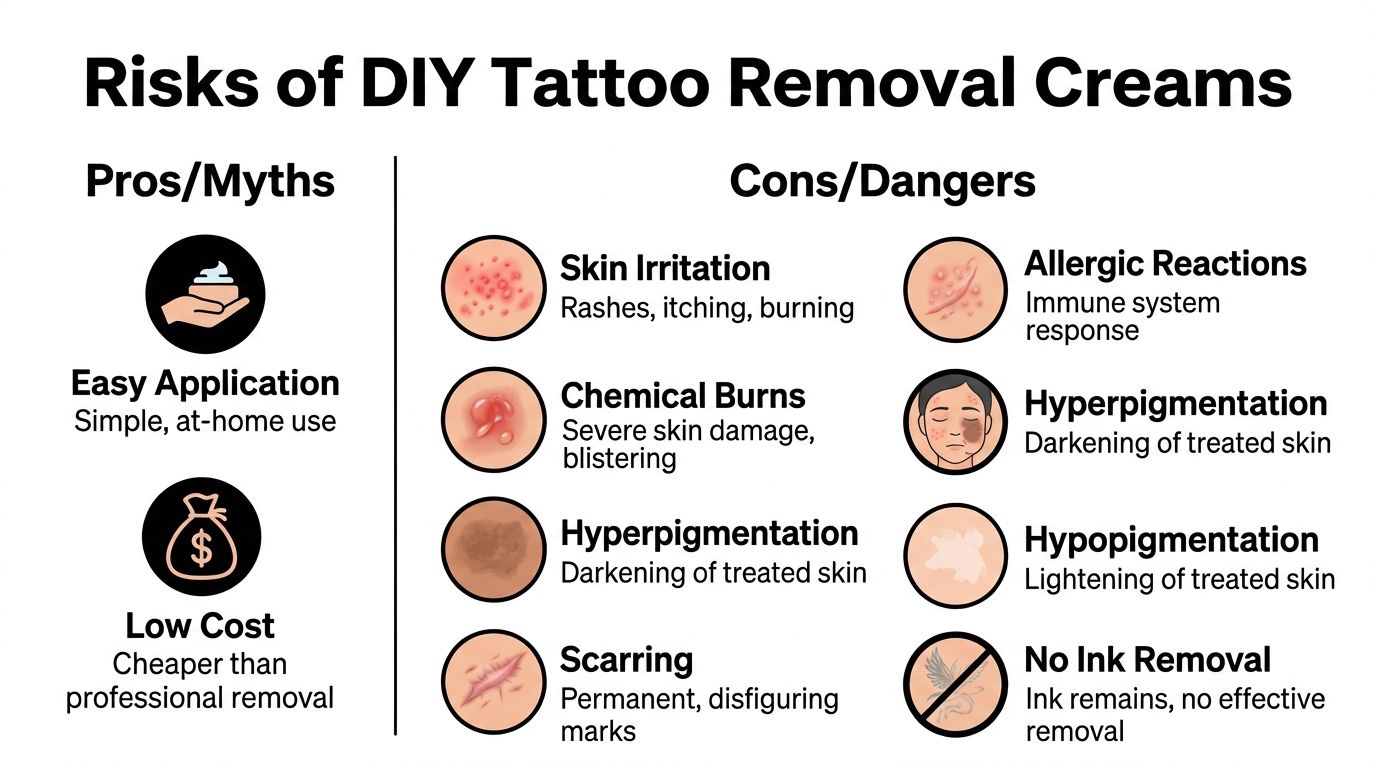
What can go wrong on the skin surface
When a product relies on bleaching, peeling, or caustic irritation, the skin pays the price first. That can mean redness, rawness, itching, burning, blistering, and prolonged inflammation. Some people also develop allergic reactions or lingering sensitivity in the treated area.
More serious outcomes are the ones that concern removal professionals most:
- Chemical burns: The skin gets overexposed to harsh ingredients and breaks down.
- Scarring: Damaged tissue heals with textural change instead of smooth skin.
- Hyperpigmentation: The area becomes darker after inflammation.
- Hypopigmentation: The area loses pigment and heals lighter than the surrounding skin.
Those results don't just look bad. They can be stubborn, emotionally stressful, and difficult to correct.
Why damage today can limit removal later
Healthy skin is easier to treat than compromised skin. When someone injures the tattooed area with an at-home cream, future professional removal becomes less straightforward. Scar tissue can change how the skin responds. Irregular texture can make treatment planning more cautious. Uneven pigment can complicate expectations.
A safer overview of these concerns appears in this article on the risks of alternative tattoo removal.
Here's the trade-off many individuals don't see at the start:
| Risk area | What the cream may do | Why it matters later |
|---|---|---|
| Skin barrier | Cause irritation or peeling | Healing takes time and may alter treatment readiness |
| Pigment | Trigger dark or light patches | The area may look more uneven than the tattoo did |
| Texture | Create scar tissue | Smooth removal outcomes become harder to pursue |
A blotchy tattoo on healthy skin is easier to work with than a blotchy tattoo on scarred skin.
The "cheap fix" often becomes expensive in another way. You may spend time trying to avoid professional care, then need more careful management because the skin was injured during the experiment.
Professional Removal A Comparison That Matters
If creams fail because they stay on the surface, professional removal works because it addresses the tattoo where it lives. That's the core difference.
How laser removal targets the real problem
Professional laser tattoo removal sends energy through the upper skin and targets pigment in the deeper layer. The goal isn't to bleach the skin. It's to break up tattoo ink so the body can gradually clear the fragmented particles.
That mechanism matches tattoo biology. Instead of fighting the epidermis from above, the treatment is designed around the actual location of the pigment. That's why laser removal is the standard method people turn to when they want real progress.
Different laser platforms handle pigment in different ways, and treatment planning depends on factors like color, density, depth, skin tone, and whether the tattoo was professionally placed or amateur. If you want a plain-language overview of laser platform differences, Cape Cod Plastic Surgery's laser guide is a helpful starting point.
Some tattoos are also treated with other professional methods in specific situations. Surgical excision can remove a small tattoo by cutting it out, but it leaves a surgical scar and isn't the right fit for many pieces. That's not a home remedy. It's a medical decision.
For a broader first-timer explanation of the process, this guide on how tattoo removal works covers the treatment basics clearly.
Tattoo Removal Creams vs. Professional Laser Removal
| Factor | Tattoo Removal Creams | Professional Laser Removal |
|---|---|---|
| Target | Surface skin | Ink below the surface |
| How it works | Bleaching, peeling, or irritating the top layer | Delivering energy to pigment in the deeper layer |
| Effect on ink | Doesn't reliably affect embedded tattoo particles | Designed to break up pigment for gradual clearance |
| Skin risk | Can cause burns, scarring, and discoloration | Managed by trained professionals with skin assessment and aftercare |
| Result quality | Unpredictable, often patchy | Structured treatment plan based on the tattoo and skin |
| Use for cover-ups | Poor choice because it can damage the canvas | Useful for controlled fading when planned properly |
| Overall value | Low if the product fails and injures skin | Higher because the method matches the biology of tattoo placement |
People sometimes ask whether laser removal is worth it if a cream is cheaper at checkout. That's the wrong comparison. The better question is whether the method is capable of reaching the problem you want solved. Creams usually aren't.
Fading a Tattoo for a Cover-Up The Right Way
Some people aren't trying to erase a tattoo completely. They just want it light enough for a new design. That leads to a common mistake. They assume a cream might be "good enough" for fading.
It usually isn't.
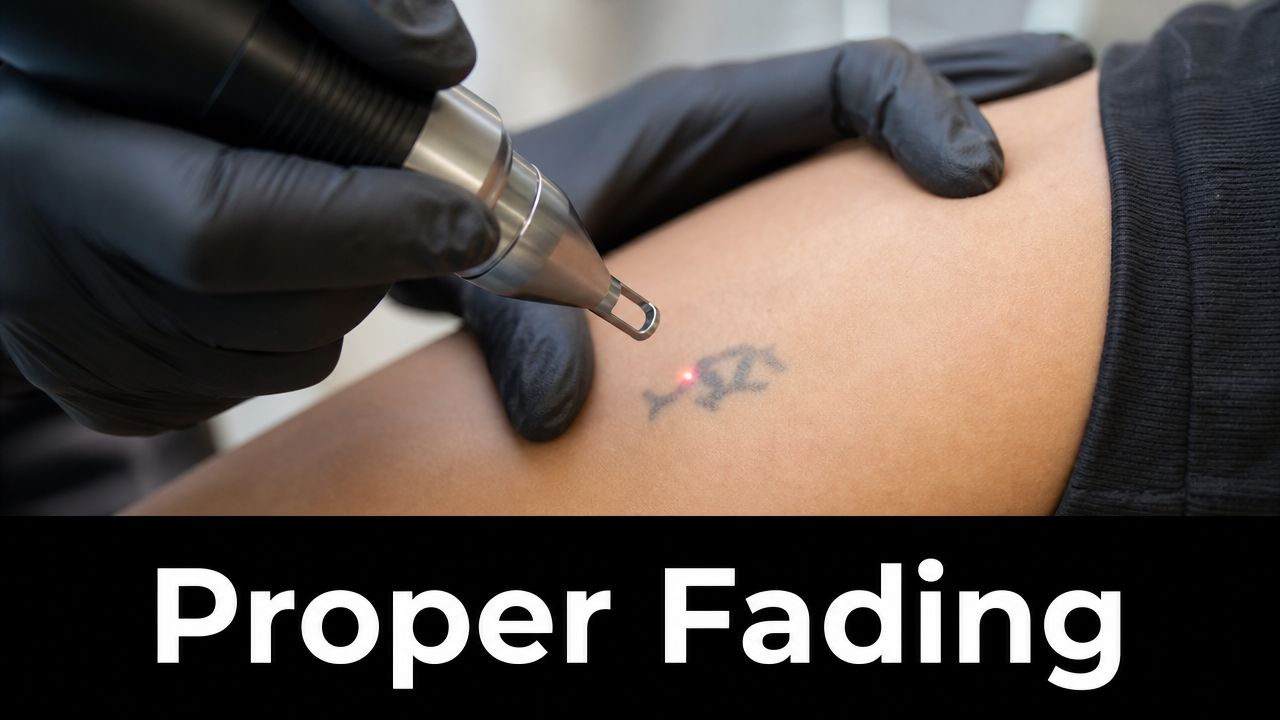
Why artists want even fading not damaged skin
A tattoo artist needs a workable canvas. That means skin with stable texture and predictable tone, plus an old tattoo that's been faded as evenly as possible. Creams tend to do the opposite. They can create patchy brightness, inflamed areas, shiny scar tissue, or uneven color changes that make design work harder.
Scarred skin also doesn't behave like untouched skin. Ink placement can become less predictable. Line quality and saturation can suffer. Even a talented artist is limited by the condition of the canvas.
Laser fading is different because the goal can be controlled reduction, not full removal. That gives the next artist more freedom. They may be able to use a wider range of shapes, shadows, and tones instead of having to build a heavy, dark cover-up just to hide what was underneath.
If your goal is a better cover-up, a more practical starting point is learning about fading a tattoo properly before a new design.
For cover-ups, "lighter" isn't enough. The skin also needs to stay healthy enough to accept a new tattoo well.
That distinction matters. Fading and damaging are not the same thing.
Frequently Asked Questions About Tattoo Removal
Can any cream at least lighten a tattoo a little bit
A cream may change the way the skin looks a little, especially if it causes peeling, irritation, or surface lightening. That isn't the same as removing tattoo ink. Any slight visual change is often uneven, temporary, or tied to skin injury. The risk involved is generally not worthwhile.
Are natural or herbal tattoo removal creams any safer
Not automatically. "Natural" doesn't mean safe for repeated use on tattooed skin, and it doesn't change the basic science problem. If a topical product can't reach the pigment in the deeper layer, a natural label won't make it effective. Plant-based ingredients can still irritate skin or trigger allergic reactions.
What is the safest first step to remove my tattoo
Book a consultation with a qualified tattoo removal specialist. A real assessment should look at your skin, the tattoo's colors and density, whether you want full removal or cover-up fading, and whether the skin has any existing irritation or scar tissue. That gives you a treatment plan based on reality instead of advertising.
If you're ready for a safer, clearer path forward, EradiTatt Tattoo Removal can help you understand your options for full removal or cover-up fading. Their team offers consultations, multiple Florida locations, and a straightforward treatment approach built around your skin, your tattoo, and your goal.