
You're probably here because you look at one tattoo and think the same thing a lot of Sarasota clients think first: “Can this come off, and what will it really look like along the way?”
That's the right question. The biggest mistake people make is expecting tattoo removal to behave like a quick cosmetic fix. It doesn't. Good laser removal is a process with visible milestones, real waiting periods, and trade-offs that depend on your ink, your skin, and where that tattoo sits on your body.
If you're researching tattoo removal results in Sarasota, the goal isn't to promise perfect erasure on a deadline. The goal is to give you a framework you can use before you commit. That means knowing what fading usually looks like, why some tattoos clear faster than others, and how to tell the difference between a realistic plan and a sales pitch. If you want a broader look at local providers before choosing a clinic, this guide to tattoo removal clinics in Sarasota is a useful starting point.
Table of Contents
- Considering Tattoo Removal in Sarasota
- What Realistic Tattoo Removal Results Look Like
- Your Removal Timeline How Many Sessions It Takes
- Key Factors That Determine Your Fading Speed
- Preparing for Success With Proper Aftercare
- Start Your Journey at EradiTatt Sarasota
Considering Tattoo Removal in Sarasota
Individuals don't typically start this process because they're curious. They start because the tattoo doesn't fit anymore. Sometimes it's the design. Sometimes it's the placement. Sometimes life changed and the ink didn't.
Laser removal gives you a modern option that's far more practical than older methods that can carry greater scarring potential. The important part is understanding how the laser works. It doesn't “wipe off” ink. It breaks pigment apart so your body can gradually clear it over time.
That's why realistic expectations matter so much. In Sarasota, the clients who feel most confident about their plan are usually the ones who understand from day one that removal is progressive. You don't judge the process by what happens in a few days. You judge it by how the tattoo changes across months of treatment and healing.
What a good consultation should answer
A useful consultation should make four things clear:
- Your goal: full removal and cover-up fading are different endpoints.
- Your ink profile: dark ink, bright colors, layered work, and dense packing behave differently.
- Your body location: circulation matters, and placement can change how fast fading shows up.
- Your timeline: removal works on a biological schedule, not a rushed one.
Good tattoo removal planning starts when the client stops asking, “How fast can you do it?” and starts asking, “What is my tattoo likely to do over time?”
That shift matters because it leads to safer treatment decisions and fewer surprises. If you understand the journey before session one, you're much less likely to get frustrated by normal plateaus or compare your tattoo to someone else's very different result.
What Realistic Tattoo Removal Results Look Like
Those seeking tattoo removal results in Sarasota usually want a simple before-and-after answer. Real life looks more like a sequence of changes than a single reveal.
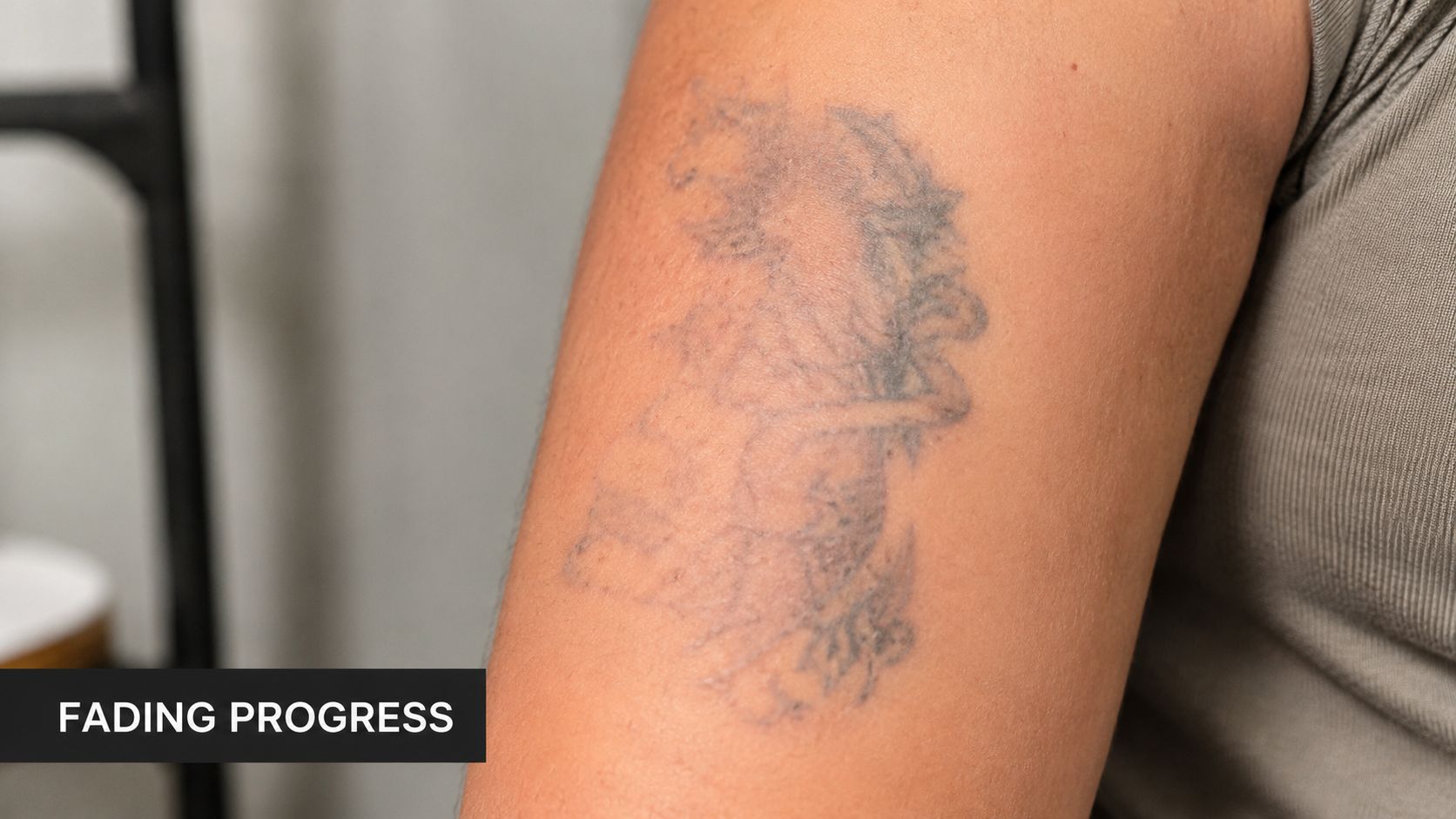
A tattoo often looks different in stages. Early on, you may notice softening around the sharpest edges, a slightly hazier appearance, or patchy fading where some pigment responds before the rest. Midway through treatment, many tattoos start to look visibly broken up rather than appearing lighter. Near the end, what remains is often the most stubborn pigment, which can make progress feel slower even though improvement is still happening.
If you want to compare those stages with real visual examples, take a look at these tattoo laser removal results.
What you usually notice first
The first visible changes are rarely dramatic. That's normal. The laser treatment starts the process, but the visible result develops as your body clears fragmented pigment.
A practical way to think about it is this:
- After an early session: the tattoo may still read clearly, but some lines can look less crisp.
- Around the middle of a plan: uneven fading often becomes obvious, especially in areas with lighter original saturation.
- Near the finish line: the remaining ink tends to be the most resistant part of the design.
Practical rule: fading is cumulative. A tattoo doesn't need to look dramatically different after one visit for the treatment to be working.
Color also changes what “good progress” looks like. According to guidance on Sarasota tattoo removal outcomes, black and dark-blue inks respond best, while green, yellow, and fluorescent colors are harder to remove. The same guidance notes that tattoos on the hands, feet, lower legs, and other areas with lower circulation tend to clear more slowly, so the same design may fade faster on the back than on the ankle.
Complete removal versus cover-up fading
Not everyone needs the same endpoint. That's where a lot of confusion starts.
If your goal is complete removal, the standard is as much clearance as your tattoo and skin can safely achieve. That usually means staying patient through the slower final phase, when leftover ink can be faint but stubborn.
If your goal is fading for a cover-up, you're looking for enough lightening to give a tattoo artist a workable base. In many cases, that means you don't need every trace gone. You need the original design reduced enough that new work won't fight with it.
Those are two successful outcomes, but they're not the same outcome. Knowing which one you want changes how you judge progress.
Your Removal Timeline How Many Sessions It Takes
The timeline is where expectations become real. Pico-laser tattoo removal commonly requires about 6 to 12 sessions, with treatments spaced at least 8 weeks apart, which means a full removal plan can easily extend across 12 to 24 months as the body clears shattered ink between visits, according to clinical guidance used in the market.
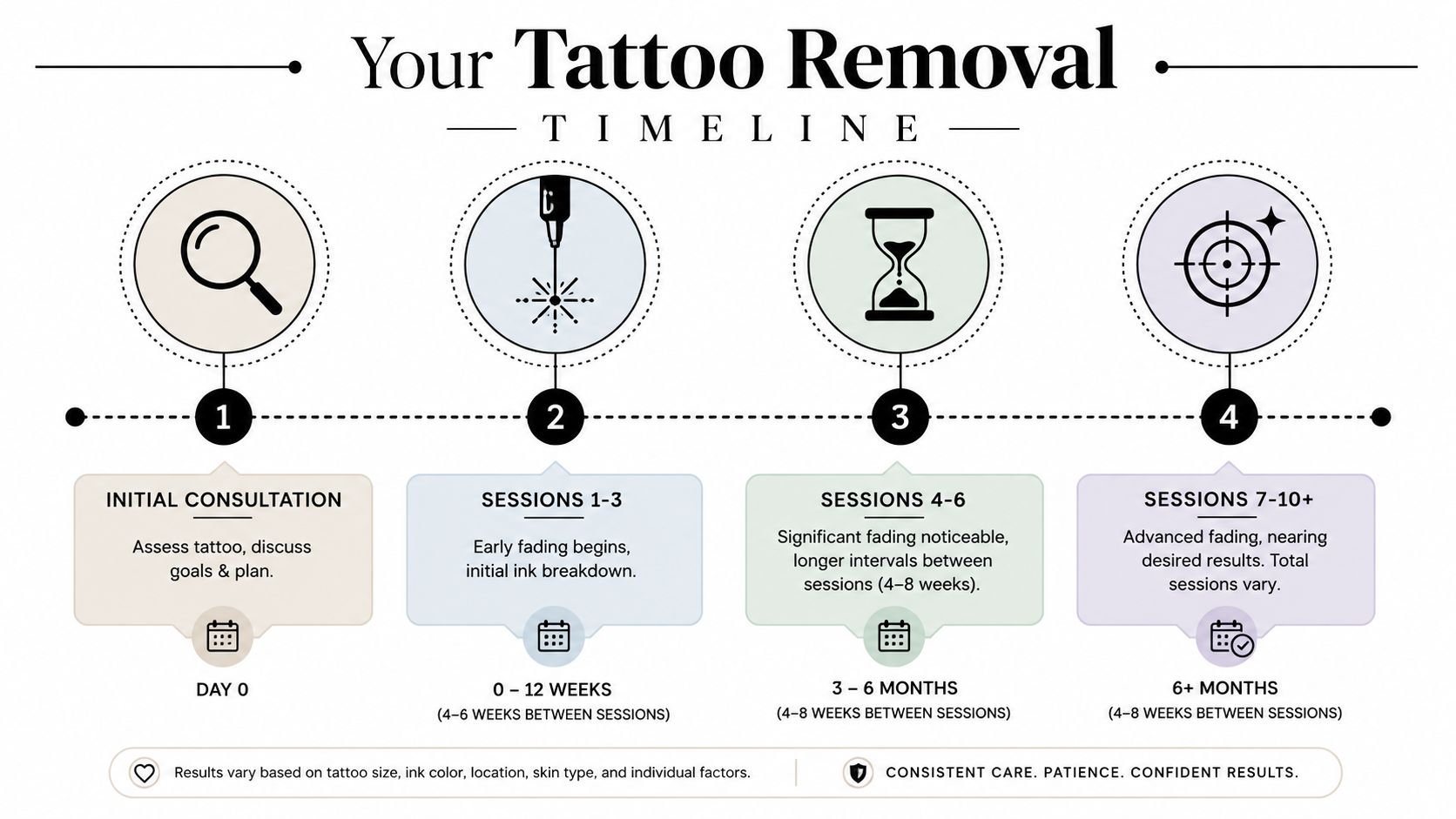
That number surprises people, but it makes sense once you understand the mechanism. The laser does the fragmentation. Your immune system does the clearing. Those are two separate steps, and only one of them happens in the treatment room.
Why the waiting period matters
The gap between sessions isn't dead time. It's active clearance time.
When laser energy breaks pigment into very small particles, your body needs time to process and remove them. Skin also needs time to calm down before the next session. If you push treatments too close together, you don't give either process enough room to work well.
That's why responsible scheduling tends to feel slower than clients expect at first. But slower and steadier usually means more predictable fading and less unnecessary irritation.
If a plan sounds fast but ignores healing time, it's usually not a better plan. It's just a more aggressive one.
A practical way to think about the timeline
Instead of asking how many weeks it takes, ask where you are in the arc.
Consultation and patch planning
During this stage, goals get clarified. Full removal, cover-up fading, difficult colors, and body placement all change the approach.Early sessions
The tattoo starts breaking apart visually. Changes may be subtle, but that doesn't mean nothing is happening.Middle sessions
This is often when clients feel encouraged because the tattoo no longer looks solid. The design starts to lose visual authority.Final sessions
Stubborn remnants become the focus. Progress can feel slower here because you're working on what resisted earlier treatments.
The biggest mindset shift is simple. Removal is measured in treatment cycles, not in one dramatic appointment.
Key Factors That Determine Your Fading Speed
People usually assume the biggest tattoo takes the longest to remove. That sounds logical, but it's not the best predictor.
A 2025 predictive model for black tattoo removal found that ink density had the strongest effect on session count, followed by location and age, while overall tattoo size was not a significant predictor. The study reported an average of 6 sessions, with a range of 2 to 20, and showed that denser tattoos often need more treatments regardless of area, as detailed in the peer-reviewed model on picosecond laser removal.
If you want a client-friendly breakdown of these variables, this post on factors that can affect tattoo removal progress expands on the same idea in practical terms.
The biggest predictor is often ink density
Ink density changes everything. A small tattoo with heavy saturation, layered passes, or packed black fill can be more stubborn than a larger tattoo that's older and already a bit faded.
That matters because many clients judge their timeline by surface area alone. But your skin isn't clearing square inches. It's clearing fragmented pigment load.
The next biggest factors are often easier to see once you know what to look for:
- Location on the body affects circulation and can influence how quickly fading becomes visible.
- Tattoo age matters because older work may already have natural fading that helps the process.
- Color profile changes response, especially when brighter or harder-to-target pigments are involved.
How different factors impact your tattoo removal
| Factor | Impact Level | Why It Matters |
|---|---|---|
| Ink density | High | Heavily packed pigment gives the body more fragmented ink to clear over time. |
| Body location | High | Areas with lower circulation often fade more slowly than better-perfused areas. |
| Tattoo age | Medium to high | Older tattoos may already be less saturated and easier to lighten. |
| Ink color | Medium to high | Some colors respond much more readily than others. |
| Skin response | Medium | Healing quality and inflammation control affect how smoothly treatment progresses. |
| Overall size | Lower than most people expect | Size alone doesn't predict session count as well as density, location, and age. |
Two tattoos can measure about the same and still behave completely differently in removal. Saturation often explains why.
This is why personalized planning matters more than generic promises. A technician should look at how the tattoo was built, not just how big it looks in a photo.
Preparing for Success With Proper Aftercare
Results don't depend only on the laser. They also depend on how you treat the skin between appointments.
The FDA explains that laser tattoo removal works by shattering pigment for the immune system to clear, and that the process requires multiple treatments spaced weeks apart so the skin can heal. The FDA also notes risks that can include temporary redness, swelling, blistering, and soreness, which you can review in its consumer guidance on tattoo removal options and results.
What to do before and after treatment
Think of aftercare as part of the treatment, not a separate chore.
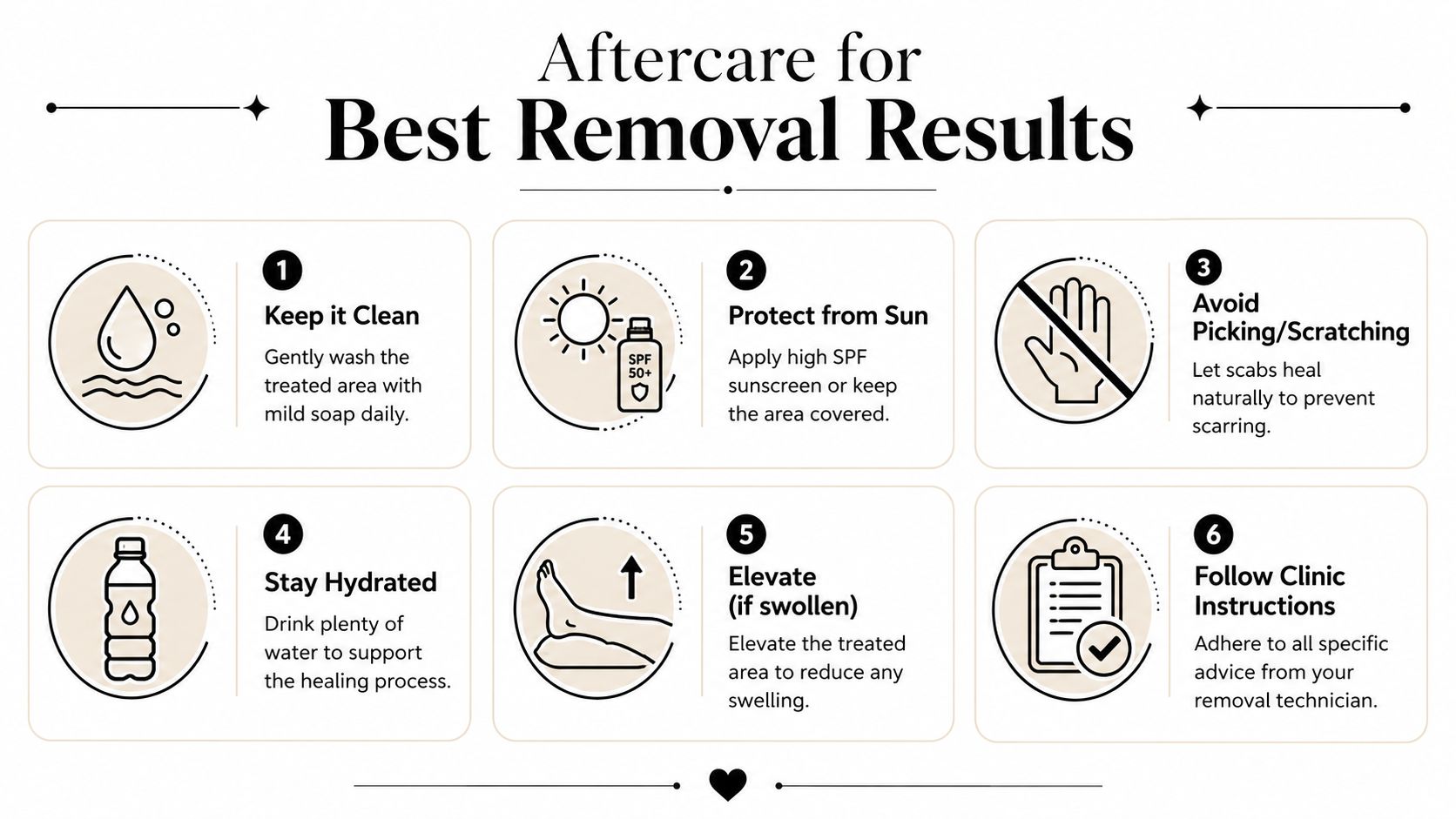
- Keep the area clean: Gentle washing helps protect healing skin without adding irritation.
- Protect it from sun: Tanned or sun-stressed skin is harder to treat well and harder to heal calmly.
- Leave blisters or scabs alone: Picking slows healing and raises the risk of texture changes.
- Follow the clinic plan exactly: Cooling, dressings, and timing instructions aren't random. They're there to protect the skin response.
- Support recovery habits: Hydration, rest, and avoiding extra friction on the area can help the treated skin settle more smoothly.
Some clients also like to read about scar-focused skin support after the healing phase. If that's relevant to you, this overview of the benefits of red light therapy for scars is a useful educational resource.
What normal healing can look like
A treated tattoo usually doesn't look “better” immediately. It often looks like skin that's been through a controlled procedure. Mild redness, swelling, tenderness, or blistering can be part of the normal early response.
That's one reason experienced clinics don't judge final progress too soon after a session. Fresh inflammation can temporarily distract from the fading that becomes clearer later.
Healing skin and clearing ink happen on different timelines. Don't mistake a temporary skin reaction for a poor removal result.
The best aftercare mindset is simple. Protect the skin, avoid interfering with healing, and let each session finish its work before the next one starts.
Start Your Journey at EradiTatt Sarasota
The first appointment should answer one question clearly: what does a realistic plan look like for your tattoo, not for someone else's?
At a consultation, the useful discussion points are your goal, the tattoo's density and color mix, where it sits on the body, and how aggressive or conservative the treatment approach should be. If a client wants fading for a cover-up, that changes the target. If the goal is maximum clearance, the plan needs to reflect patience and consistency.
Modern clinics in Sarasota use advanced systems like the PiQo4 laser, which fragments ink more efficiently than older nanosecond lasers and is designed for faster results with fewer treatments across a broader range of colors, including more difficult blues and greens, as described on the EradiTatt Bradenton and Sarasota location page. That technology matters because broader color coverage and more efficient fragmentation can make a real difference when a tattoo isn't just simple black linework.
For Sarasota-area clients, the appointment location is:
3825 E State Rd 64, Suite 200, Bradenton, FL 34208
Phone: (941) 866-6744
Appointments are by appointment only, which usually allows for a quieter, more focused visit. If you're comparing options, pay attention to whether the consultation gives you a personalized framework or just a generic session estimate. The right plan should make sense when you look at your tattoo and understand why it will behave the way it will.
If you're ready to talk through your tattoo, your goals, and what a realistic fading plan looks like, book a consultation with EradiTatt Tattoo Removal. A clear plan at the start makes the whole process easier to manage.