A complete CO2 laser treatment plan often costs $1,500 to over $5,000, even when the advertised price is only for one visit. The final amount depends heavily on the number of sessions required, the treatment intensity, the size of the area, and fees added outside the laser procedure itself.
You may be searching for “cost of CO2 laser treatment near me” after seeing several local prices that seem difficult to compare. One clinic may quote a modest fractional session, while another recommends a more aggressive ablative treatment and includes follow-up care in the estimate. Both prices may be reasonable, but they may describe very different procedures and recovery plans.
The practical question isn't only, “How much is one session?” It's, “What will I pay from consultation through recovery, and how many visits will I realistically need?” That distinction is especially important for tattoo removal, where treatment is commonly planned as a series rather than a one-time service.
Table of Contents
- Understanding the True Cost of CO2 Laser Treatment
- Fractional vs Full Ablative CO2 Laser Pricing
- Key Factors That Influence Your Treatment Quote
- Hidden Costs and Total Out-of-Pocket Expenses
- Essential Questions to Ask Your Provider
- How to Find a Reputable Clinic Near You
Understanding the True Cost of CO2 Laser Treatment
CO2 laser pricing isn't a fixed menu item. Providers generally build a quote around the treatment area, intensity, number of passes, session count, provider expertise, and local operating costs. A small targeted area may require less time and energy than a larger or more sensitive area, while a deeper treatment can demand more preparation, monitoring, and aftercare.
For tattoo removal, a useful historical benchmark is an average session fee of $697, cited in 2026 industry coverage of pricing. That same coverage notes that many patients need 5 to 8 sessions for satisfactory clearance, producing a typical treatment range of approximately $3,485 to $5,576 before consultation fees, numbing, or aftercare. These figures are discussed in the tattoo removal market pricing analysis.
Why the session quote can mislead
A one-session price only tells you what happens at one appointment. It doesn't tell you whether the treatment goal is complete removal, substantial fading, scar improvement, texture improvement, or another outcome that may require a different schedule.
Tattoo characteristics also affect planning. Size, ink density, body location, and the number of visits can change the total substantially. Another independent summary cited in the same market coverage reports a lower average of $463 per session and a common pattern of 7 to 10 sessions, which reinforces the point that local quotes aren't interchangeable.
| What the quote describes | Why it matters |
|---|---|
| One session | Useful for comparing appointment-level pricing |
| A recommended course | More helpful for budgeting the complete goal |
| A package price | May reduce the per-visit amount, but should be reviewed for terms and unused sessions |
| A treatment plus aftercare | Easier to compare with quotes that separate products and follow-up |
Location adds another layer. A clinic's rent, staffing, equipment maintenance, clinical protocols, and local demand all influence pricing. The lowest nearby quote may exclude services that another provider includes, so comparing the final treatment plan is more useful than comparing the largest number on an advertisement.
Practical rule: Ask every clinic to separate the price of the procedure from the estimated number of visits and all expected add-ons. That gives you a treatment budget instead of a headline number.
Fractional vs Full Ablative CO2 Laser Pricing
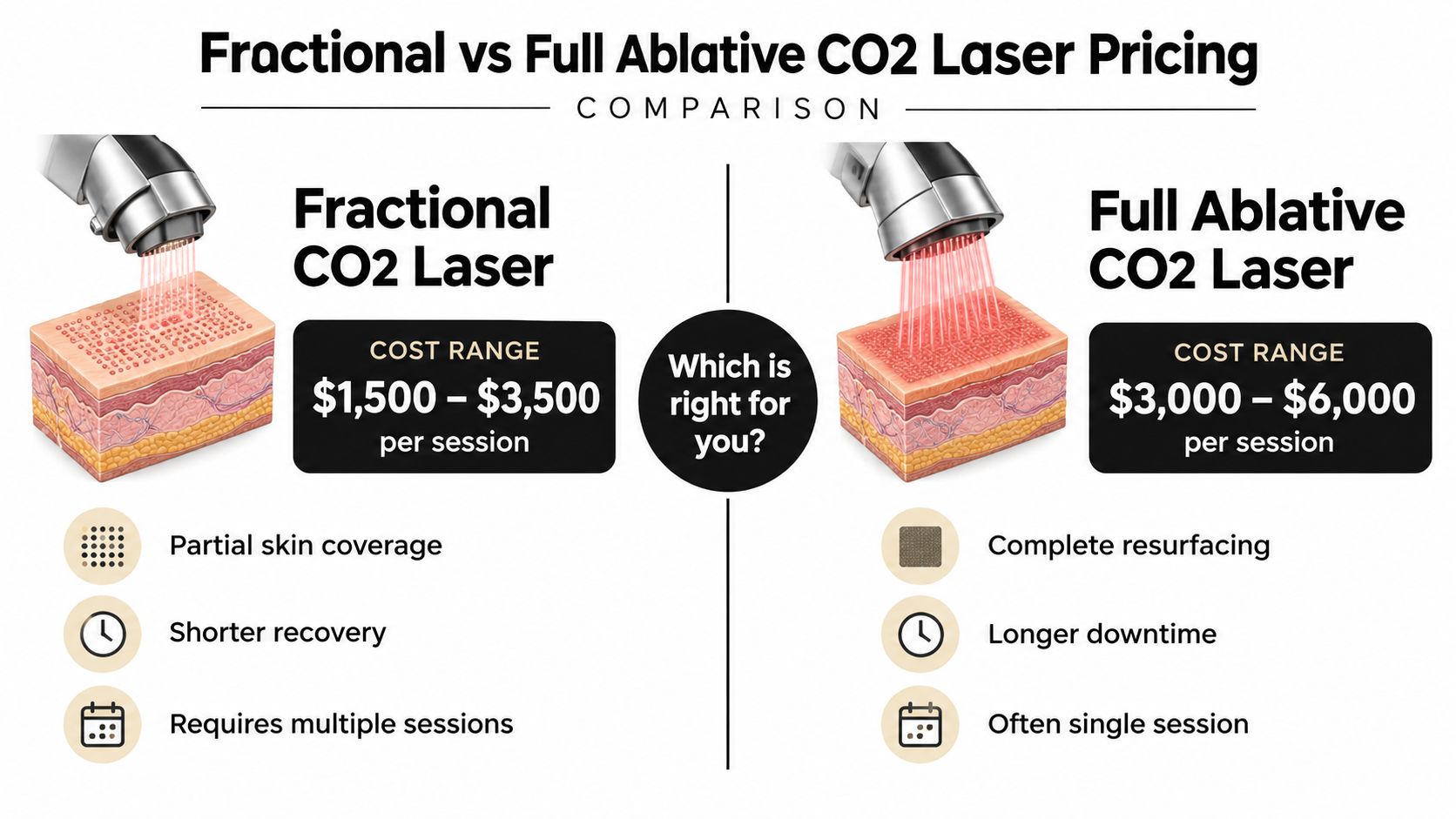
Fractional and fully ablative CO2 treatments use different approaches, so their quotes reflect different levels of coverage and intensity. Fractional CO2 treats microscopic columns or portions of the treatment area, leaving surrounding skin available to support healing. Fully ablative CO2 treats the entire selected surface, creating a deeper and more extensive resurfacing effect.
Fractional treatment usually has the lower upfront price, but it may require a series. Fully ablative treatment generally costs more per appointment because it involves deeper tissue vaporization, longer procedure time, and a more demanding recovery process. The right comparison isn't just “cheap versus expensive.” It's lower cost per session versus the expected total cost for the result you want.
Fractional treatment
Benchmark pricing commonly places fractional CO2 at approximately $1,500 to $3,500 per session, while fully ablative CO2 is often reported around $3,500 to $7,000 per session. These ranges come from clinical guidance on CO2 laser pricing and treatment intensity.
Fractional treatment can make sense when you want a more measured approach, have a recovery limit, or need treatment adjusted over several appointments. It can also be more practical when a provider needs to balance treatment depth with skin sensitivity and the size of the area involved.
However, a lower fractional quote doesn't automatically produce a lower total. If the treatment plan requires multiple visits, the combined professional fees and aftercare may approach or exceed the price of a single more aggressive treatment.
Fully ablative treatment
Fully ablative treatment removes the surface layer across the treated area rather than creating separated treatment zones. That broader coverage helps explain its higher price and longer downtime. It may be considered when the clinical goal calls for a more aggressive resurfacing approach, but it also demands careful patient selection, preparation, and follow-up.
Recovery estimates vary by treatment depth and individual healing. Recent pricing coverage describes fractional recovery as commonly around 5 to 14 days, compared with approximately 10 to 21 days for traditional full ablative treatment. Fractional treatment may cost 30% to 50% less per session than full ablative resurfacing, but the total course can change the calculation when two or more appointments are needed. Those comparisons are outlined in this fractional versus ablative CO2 cost guide.
Ask the provider to explain the expected result, estimated session count, recovery window, and total planned cost for each option. A transparent recommendation should connect the treatment intensity to your goal, not merely present the cheapest available session.
Key Factors That Influence Your Treatment Quote
A useful quote should explain why your treatment falls at a particular price point. If the estimate only names a device and a total, ask for a clearer breakdown.
Start with the treatment area
Larger areas require more passes, time, preparation, and aftercare planning. Sensitive locations may also require slower, more precise work. A small targeted area and a broad resurfacing session shouldn't be expected to carry the same fee, even when the clinic uses the same CO2 platform.
Treatment intensity matters just as much as surface area. Higher fluence or more passes can increase the technical demands of the appointment. The provider may also adjust the plan according to skin characteristics, the condition being treated, and the response expected from the chosen setting.
Consider the provider and local market
Experience, training, and the scope of the clinic's protocols can affect the quote. A provider who includes a detailed assessment, individualized settings, medical oversight, and structured follow-up may charge more than a facility offering a bare procedure fee. That difference should be evaluated as part of safety and service, not treated as an automatic surcharge.
Geography creates visible variation. One large pricing source reports an average of $3,078, with prices ranging from approximately $800 to $10,000 depending on complexity, area size, and number of passes. The same source reports Florida averages around $3,397, while Orlando was reported at approximately $1,594, illustrating why a local search can produce very different results. Review the CO2 laser treatment price data carefully, because averages don't predict an individual quote.
Before comparing clinics, write down:
- Area: Identify exactly what will be treated.
- Intensity: Ask whether the plan is fractional, fully ablative, light, moderate, or aggressive.
- Sessions: Request an estimated range rather than a promise of one appointment.
- Inclusions: Confirm whether numbing, facility use, aftercare, and follow-up are included.
- Credentials: Ask who performs the procedure and what training applies to the treatment.
For readers researching equipment economics separately, this guide to tattoo removal laser machine pricing can provide useful context. Device ownership alone, however, doesn't determine the price or quality of a patient's treatment.
Hidden Costs and Total Out-of-Pocket Expenses
The most common budgeting mistake is treating the procedure fee as the complete bill. A phone consultation may produce a number for the laser session, while the written estimate later adds preparation, facility, recovery, or follow-up charges.
Some pricing guides report consultation fees of $100 to $250 and post-treatment products costing approximately $130 to $430. Those figures, along with broader CO2 pricing variation, are discussed in this CO2 laser cost breakdown. They aren't universal charges, but they show why you should ask what the advertised price includes.
Build the budget in layers
Use this structure when reviewing an estimate:
- Assessment and consultation: Confirm whether the initial evaluation is free or charged, and whether the fee is applied to treatment.
- Procedure fee: Ask whether the price covers the full planned area, the stated intensity, and the expected number of passes.
- Comfort measures: Clarify whether topical numbing, anesthesia, or other preparation is included.
- Facility charges: Ask about room, medical supervision, supplies, or other facility-related fees.
- Aftercare: Find out whether cleansers, ointments, dressings, or other recovery products are supplied or purchased separately.
- Follow-up: Confirm how many postoperative checks are included and whether additional visits carry a charge.
- Additional sessions: Ask what happens if the result requires another treatment or a touch-up.
The simple calculation is:
Total out-of-pocket cost = consultation and preparation + procedure fees + required products and facility charges + follow-up visits + additional sessions.
Don't assume a package is automatically cheaper. A package may reduce the per-session price, but you should understand its expiration terms, transfer rules, refund policy, and whether the provider expects a different number of sessions than you do.
Ask for this in writing: “What is the estimated total for my goal, what is included, and which costs could be added later?”
That question changes the conversation from a promotional session price to a realistic financial plan. It also helps you compare providers fairly. A higher quote with aftercare and follow-up included may be closer to the final cost than a lower quote that covers only the laser itself. For additional perspective on why treatment costs can accumulate, review this explanation of why tattoo removal can be expensive.
Essential Questions to Ask Your Provider
A consultation should leave you with a clear treatment plan, not just a price. Bring written questions and take notes, especially if you're comparing several local clinics.
Questions about the procedure
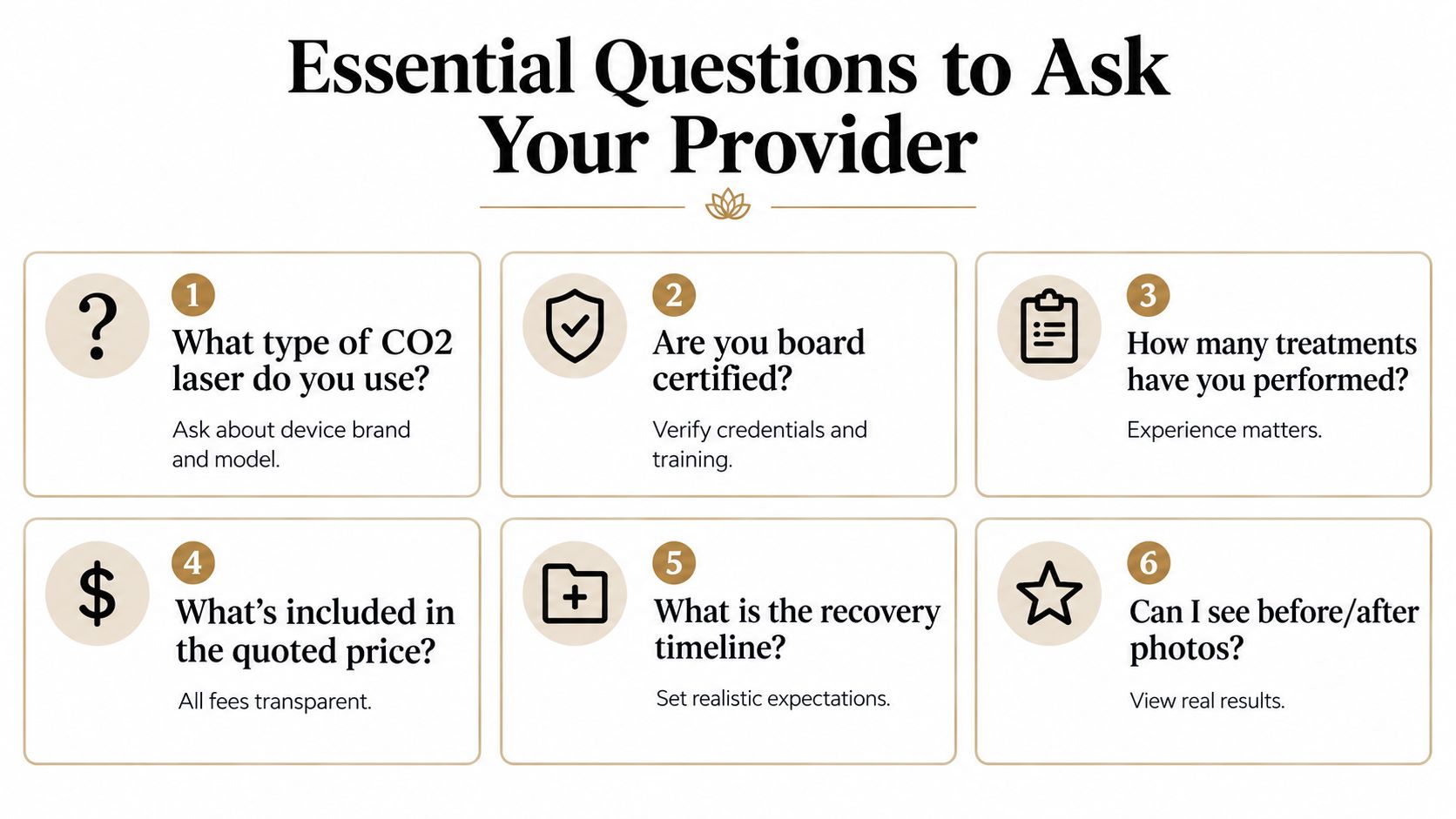
- What type of CO2 laser do you use? Ask for the device brand and model, then ask why that platform and setting suit your treatment goal.
- Who will perform the treatment? Confirm the provider's credentials, clinical role, laser-specific training, and experience with your skin concern.
- Is the treatment fractional or fully ablative? The answer affects intensity, expected recovery, price, and the possibility of repeat sessions.
- How many sessions do you expect me to need? Ask for a realistic range and what factors could increase or reduce it.
- What happens if I need another session? Find out whether additional visits are priced at the same rate and whether a package changes the terms.
Questions about the bill
- What exactly is included in the quoted price? Request a line-by-line explanation covering consultation, numbing, facility use, supplies, aftercare products, and follow-up.
- Are there fees that aren't included today? Ask directly about anesthesia, prescription products, recovery supplies, touch-ups, and unscheduled reviews.
- Do you offer a written estimate? A written plan makes it easier to compare like-for-like quotes and reduces confusion later.
- Can I see before-and-after photos from comparable cases? Look for patients with similar treatment areas, concerns, skin characteristics, and treatment intensity.
- What is the recovery timeline? Ask when you can return to work, exercise, sun exposure, and normal skincare, based on the planned settings.
- What safety and follow-up support do you provide? Confirm who to contact if healing doesn't follow the expected course and how follow-up appointments are handled.
A provider who answers plainly doesn't need to guarantee a specific result. Good communication means you'll understand the likely plan, the limits of the estimate, and the decisions that could change the final cost.
How to Find a Reputable Clinic Near You
Price comparison works only after you've confirmed that the clinics are offering comparable care. A low quote may reflect a smaller treatment area, lower intensity, fewer inclusions, or a different level of clinical support. A high quote isn't automatically superior either, so look for evidence that the price reflects appropriate expertise and transparent care.

Start with the consultation experience. Staff should ask about your goals, medical history, previous treatments, skin characteristics, recovery constraints, and budget. They should explain alternatives when a CO2 procedure isn't the most suitable route, rather than pushing the most expensive option.
A practical local screening process
- Verify credentials: Check the provider's professional status and laser training through appropriate official or professional sources.
- Review relevant results: Look for authentic before-and-after examples involving a similar concern and treatment area.
- Inspect the quote: Make sure the estimate identifies the area, treatment type, session expectations, and included services.
- Assess communication: Staff should answer questions directly and explain what would cause the price to change.
- Confirm follow-up: Ask who handles post-treatment concerns and how quickly patients can reach the clinic.
- Read reviews carefully: Look for repeated comments about consultation quality, punctuality, communication, and billing transparency, not only comments about dramatic results.
Clinics also communicate through advertising, so it can help to understand how medical marketing claims should be presented. This plastic surgery paid ads compliance guide offers useful context for evaluating whether promotional language is clear and responsible.
For Florida residents comparing local options, the CO2 laser treatment information for Tampa may help clarify what to ask during a consultation. The same standard applies anywhere: choose a provider who can explain the treatment, the expected course, the recovery requirements, and the complete price without pressure.
The best local decision isn't necessarily the lowest number. It's the clinic that gives you enough information to understand what you're buying, who will provide it, what support follows, and how the final bill could change.
EradiTatt Tattoo Removal offers consultations for people seeking complete tattoo removal or fading before a cover-up, with treatment plans based on the tattoo's size, ink characteristics, skin type, and expected session needs. Visit EradiTatt Tattoo Removal to request a consultation and discuss transparent pricing for a personalized plan.