
You're looking at a tattoo that once felt permanent, but now feels like a mistake. Maybe it's a name, a design that no longer fits your life, or ink that needs to fade before a cover-up. The question is simple: how effective is laser tattoo removal, really?
The honest answer isn't one universal percentage. Laser treatment can produce dramatic fading and, for some tattoos, near-complete clearance. Results depend on an equation that includes ink color, pigment depth, tattoo density, skin type, tattoo age, body location, technology, and your body's healing response. A black amateur tattoo may fade far more readily than a dense multicolor professional tattoo, even when both receive the same number of sessions.
Effectiveness also depends on your goal. Someone preparing a tattoo for a cover-up may need substantial fading, while someone pursuing the cleanest possible skin may need a much longer course. The laser starts the process, but the body completes it gradually.
Table of Contents
- Introduction to Laser Tattoo Removal Effectiveness
- How Laser Tattoo Removal Works on Ink and Skin
- Real Success Rates and How Many Sessions You Need
- Key Factors That Influence Your Removal Results
- What to Expect During the Treatment Timeline
- Common Misconceptions About Complete Removal
- Choosing Your Next Step Toward Clearer Skin
Introduction to Laser Tattoo Removal Effectiveness
You may enter a consultation wanting two answers: how much of the tattoo can fade, and how natural the skin will look afterward. A responsible provider cannot give every tattoo the same forecast. Ink color, skin type, tattoo age, pigment depth, density, body location, and laser technology all shape the treatment equation.
Effectiveness is better understood as a range:
- Light fading can soften an unwanted design.
- Substantial fading may provide a workable canvas for a cover-up.
- Near-complete clearance can leave only faint pigment or visible skin texture.
- Complete removal is possible for some tattoos, but no treatment can guarantee it in every case.
A large cohort study published in JAMA Dermatology reported that successful removal accumulated to 47.2% after 10 sessions and 74.8% after 15 sessions (JAMA Dermatology cohort study). These figures are not a prescription for every patient. They show why laser removal is usually a gradual course, with progress developing across appointments rather than appearing after one procedure.
Two tattoos of similar size can respond very differently. Older black ink with lighter density may fade more readily than a professionally applied, multicolored design with overlapping layers. Each pigment responds to laser energy in its own way, and dense ink gives the body more particles to clear. Tattoo age and skin type also affect how a provider chooses settings and evaluates safe progress.
Think of the result like clearing a crowded room. Removing a few objects may create enough space for a new arrangement, while emptying the entire room takes more time and effort. A cover-up often requires substantial fading, not perfectly clear skin. Someone seeking the cleanest possible result may need a longer course and may still see faint residual pigment or texture.
The practical answer: Laser tattoo removal is effective for many unwanted tattoos, but effectiveness is personal. The meaningful question is how your tattoo's color, age, density, skin type, and treatment technology combine to shape realistic fading.
Your consultation should define the endpoint first, then build a plan around repeated treatment, healing, and reassessment.
How Laser Tattoo Removal Works on Ink and Skin
Tattoo ink sits in the dermis, a deeper layer of skin than the surface cells that naturally shed. That permanence is why ordinary creams and surface exfoliation can't remove it. Laser treatment reaches the pigment with controlled pulses of light selected for the ink being treated.
The process works in stages:
- The laser targets pigment. Dark ink absorbs laser energy efficiently, while different colors require different wavelengths.
- The pulse fragments the ink. Picosecond and nanosecond systems deliver energy in extremely short bursts. The goal is to break larger pigment particles into smaller fragments.
- The body clears the fragments. Immune cells gradually transport and process the broken-down pigment.
- The skin heals and the tattoo lightens. The visible change develops between appointments, not only during the laser pulse.
- Additional sessions target remaining pigment. Each visit addresses ink that's still too large, too deep, or too resistant to clear.
A simple analogy helps. Think of a large piece of glass buried in soil. The laser doesn't pull the glass out in one motion. It shatters the piece into smaller fragments, and the body acts like a careful cleanup crew that removes those fragments over time. Some fragments are easier to clear than others, depending on their size, depth, color, and location.
Laser doesn't burn the tattoo away. It fragments ink so the body can gradually clear it.
That biology explains why rushing treatment can work against you. Your skin needs time to recover, and your immune system needs time to process the fragmented pigment. Treating too aggressively or too soon can increase irritation without giving the body enough opportunity to complete its part of the process.
For a straightforward explanation of the technology and treatment stages, see this complete guide to how tattoo removal works.
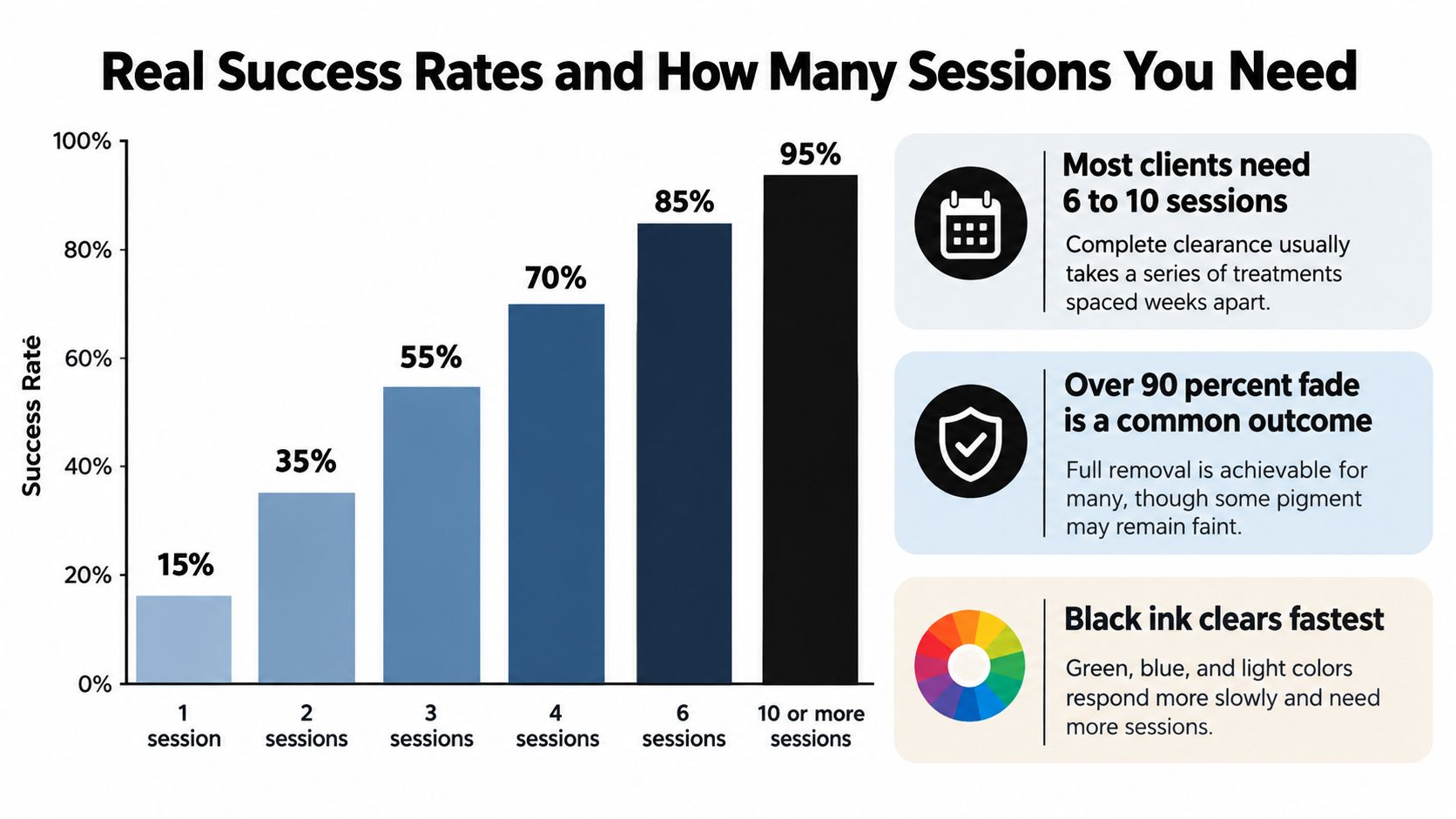
The chart can help visualize an important point, but its displayed figures shouldn't replace an individualized assessment. Published evidence shows that results vary widely by tattoo and technology. The laser makes the fragments smaller, but your body, skin, and ink determine how efficiently those fragments leave.
Real Success Rates and How Many Sessions You Need
A tattoo may fade quickly at first, then seem to stall. Early treatments often clear the pigment that responds most easily. Later visits address smaller or deeper remnants, so progress can become less dramatic even while the skin continues improving. Effectiveness is a personalized equation, shaped by ink color, skin type, tattoo age, layering, and the laser technology used.
A 2022 study in the Journal of the European Academy of Dermatology and Venereology found that about five treatments produced acceptable clearance for many tattoos. For black tattoos treated with picosecond lasers, 64% of cases achieved excellent clearance above 74%, compared with 55% using nanosecond lasers (2022 tattoo clearance study). When previously treated tattoos were excluded, almost complete clearance above 94% occurred in 37% of black tattoos treated with picosecond lasers and 23% treated with nanosecond lasers.
These results show why a single success percentage can mislead. Newer technology may improve clearance for some tattoos, yet near-total removal remains difficult to predict. A black, older tattoo may respond differently from a fresh, multicolored cover-up, even when both receive the same number of visits.
What the session milestones mean
A provider may discuss progress in stages rather than promise one fixed endpoint:
- Around five treatments: Many tattoos may reach acceptable clearance, although “acceptable” does not mean invisible.
- After 10 sessions: A JAMA Dermatology cohort recorded a cumulative successful-removal rate of 47.2%.
- After 15 sessions: The same cohort recorded a cumulative rate of 74.8% (JAMA Dermatology findings).
Those milestones describe outcomes across a group, not a guarantee for one person. A systematic review of picosecond laser studies found that 69% to 100% of tattoos reached more than 70% pigment clearance after 1 to 10 treatments (picosecond laser systematic review). The wide range reflects differences in tattoo design, pigment, skin, and study methods.
For a cover-up, substantial fading may be a more practical goal than completely clear skin. Removing enough pigment can make a new design easier to plan, even if faint traces remain. Your provider should estimate that range from the actual tattoo, not a universal session count. This guide explains how many laser tattoo removal sessions may be needed.
Prepaid packages also require simple record-keeping during a long course. A tool to manage prepaid session balances can help track appointments and remaining credits.

Key Factors That Influence Your Removal Results
Two people can receive the same number of treatments and see very different outcomes. The most influential differences usually involve pigment, tattoo construction, skin response, and treatment planning.
Ink color is often the clearest predictor. Black ink absorbs laser energy efficiently, which is why it generally responds best. An expert review reports black-ink clearance rates around 75% to 95%, while multicolored tattoos usually require multiple wavelengths and longer treatment courses to reach similar endpoints (review of tattoo-removal factors).
A practical comparison
| Factor | More Effective Scenario | Less Effective Scenario |
|---|---|---|
| Ink color | Black pigment that absorbs the selected wavelength efficiently | Multicolored ink requiring several wavelength approaches |
| Tattoo type | Amateur work with less densely packed pigment | Professional work with dense, deeply deposited ink |
| Tattoo age | Older or visibly faded ink | Newer, saturated pigment |
| Layering | A single tattoo layer | Cover-up ink layered over earlier pigment |
| Skin assessment | A treatment plan adjusted to your skin characteristics | Aggressive settings that ignore how skin may absorb laser energy |
| Technology | A laser and wavelength matched to the pigment | One wavelength used for every color |
| Body location | An area that responds consistently during healing | A location where clearance may progress more slowly |
The professional-versus-amateur distinction matters because tattoo artists typically deposit professional ink more consistently and densely. Amateur tattoos may contain less uniform pigment, which can make them more responsive, though no category guarantees a particular result.
Skin type doesn't make removal impossible, but it does influence how conservatively a provider must plan treatment. The laser needs to target ink while limiting unwanted absorption by the surrounding skin. That balance is especially important when pigmentary changes are a concern.
Tattoo age can help, but it isn't a shortcut. Older ink may already have softened, while a newer tattoo may contain dense pigment that requires more work. Body location, existing scarring, and layered designs can also change the pace.
Use this guide to factors that affect tattoo removal progress to prepare for a more useful consultation. Bring clear photos if you're asking about a tattoo from a distance, but expect the provider to make the final assessment in person.
What to Expect During the Treatment Timeline
If you are sitting in a consultation with a tattoo you want gone, the first discussion should focus on your goal, not on firing the laser immediately. The provider examines the tattoo's colors and ink density, checks the surrounding skin, and asks whether you want complete removal or cover-up fading. Those goals use the same basic technology but may require different treatment planning. Fading can leave enough of the old design for a new tattoo, while complete removal aims for the least visible pigment possible.
During a session, the laser may feel like brief snaps, heat, or sharp discomfort. The area can show temporary whitening, warmth, redness, swelling, tenderness, or blistering. These responses can look concerning, so the clinic should explain what normally settles during healing and which changes require a call.
The days after treatment
Healing often takes several days. Follow the written aftercare instructions, keep the area clean, and avoid picking at blisters or scabs. Protect the treated skin from unnecessary irritation and sun exposure, since healing skin can be more vulnerable to pigment changes.
Immediate appearance is a poor measure of effectiveness. The laser fragments ink, then the body gradually clears those particles between appointments. Clinical evidence indicates that black and blue tattoos often need about 4 to 8 sessions to reach at least 75% clearance, although individual outcomes vary (clinical evidence on Nd:YAG treatment counts).
Appointments are usually separated by weeks, giving the skin time to heal and the immune system time to remove fragmented pigment. Your provider should set the interval according to your skin and response, rather than following the calendar rigidly.
Photos can make slow progress easier to recognize. Photograph the tattoo before appointments under similar lighting, from the same angle, and compare images only after the skin has settled. Someone traveling between Orlando and Tampa, for example, could use this routine instead of judging fading from day to day.
A retrospective cohort reported an average of 5.09 treatments, while the Kirby-Desai scale predicted 9.9 treatments (retrospective cohort findings). That finding shows why prediction tools can support a consultation but cannot replace watching how your own tattoo responds.
Common Misconceptions About Complete Removal
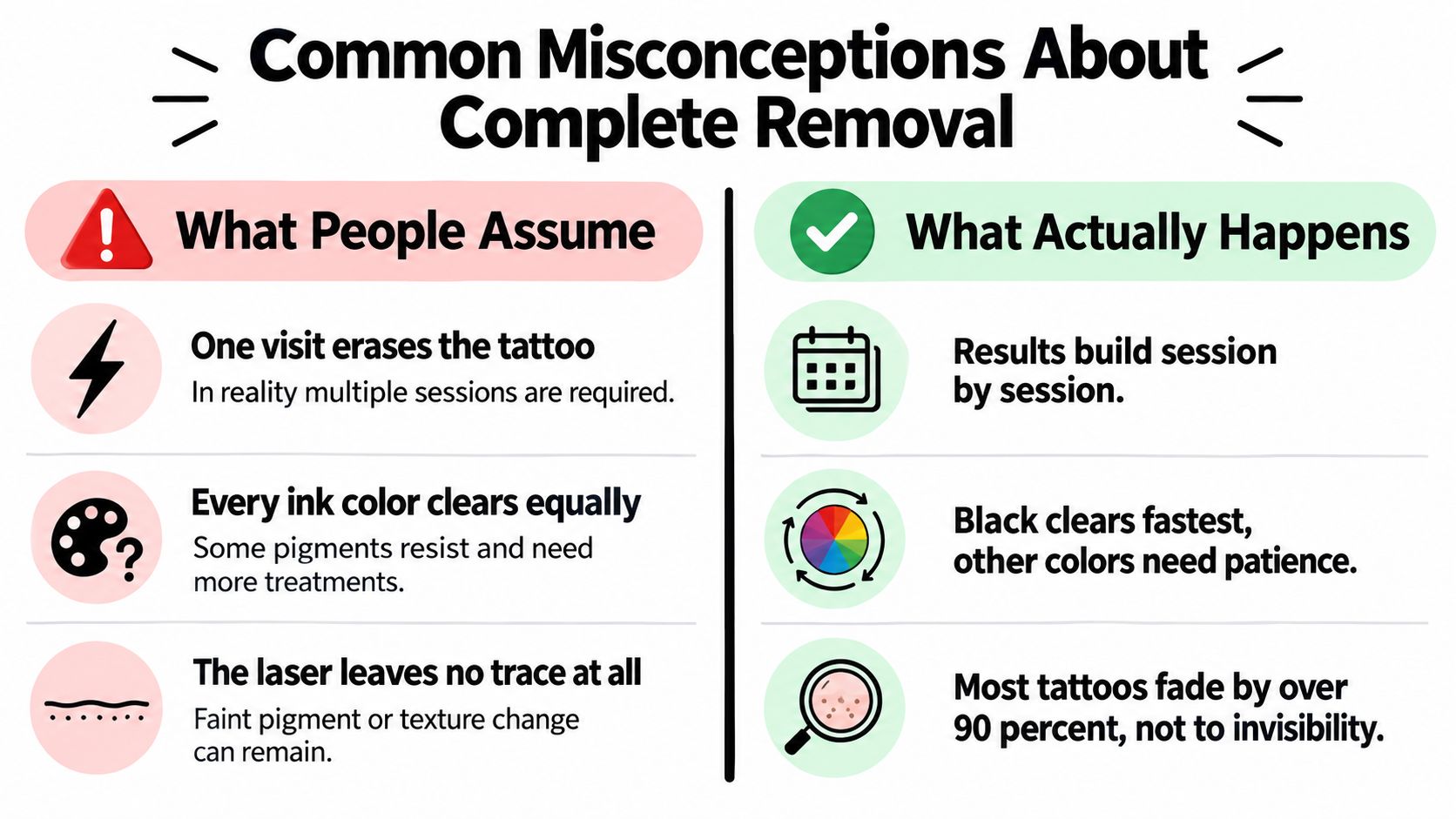
Myth one, one visit erases the tattoo
One treatment can start visible fading, but it rarely completes the job. Laser energy breaks down pigment in stages, and the body needs time to clear what the laser has fragmented. Expecting one visit to erase a tattoo can lead people to stop before the treatment has had a fair chance to work.
Myth two, every color clears equally
Black ink generally clears best, with one review reporting approximately 75% to 95% clearance for black tattoos (ink-color review). Multicolored tattoos usually need more wavelengths and longer treatment courses because each pigment responds differently.
Some colors can be more resistant, and a tattoo with several pigments may require a more complex plan than a simple black design. A provider should explain which colors are likely to respond well, which may require patience, and whether the goal is complete removal or practical fading.
Myth three, darker skin can't be treated
Skin tone doesn't automatically rule out laser removal. It does require careful assessment and settings that account for the way skin pigment may interact with laser energy. Ask how the provider evaluates your skin, what risks they discuss, and how they'll respond if pigmentary changes develop.
Myth four, the result is always scar-free and painless
Laser removal is not always comfortable, and temporary reactions such as blistering or pigmentary changes can occur. Broader complication literature describes pigmentary changes, residual ghost images, blistering, and less commonly scarring or texture changes. One prospective study cited adverse effects in 6.2% of patients, with hyperpigmentation the most common at 4.8% (complication review).
A review of picosecond treatment describes transient hypopigmentation and blistering as common adverse effects, while scarring and textural changes are described as rare (picosecond safety review). Existing scar tissue may also remain after the ink fades.

For many people, fading is the smarter endpoint. A cover-up artist may need the original tattoo softened rather than erased completely, which can reduce the time and treatment commitment. The right goal is the one that matches your next decision, not the most ambitious promise.
Choosing Your Next Step Toward Clearer Skin
Start by choosing the outcome you need. If you're planning a cover-up, ask how much fading your tattoo artist requires. If you want the tattoo removed for work, a wedding, enlistment, or personal confidence, discuss how close to your natural skin appearance you hope to get and what residual pigment or texture might remain.
The evidence supports realistic planning. One clinical review reports an average of 7 to 10 treatments, while a survey of 157 people who underwent tattoo removal found that 38% achieved complete removal (clinical review and patient survey). Those findings don't predict your personal result, but they make one point clear: complete clearance is possible, yet it shouldn't be treated as automatic.
Questions to bring to your consultation
- Goal: Do you recommend complete removal or fading for my intended next step?
- Pigment: Which ink colors are present, and how might each respond?
- Density: Does the tattoo appear professionally applied, layered, or scarred?
- Skin: What risks of pigment change apply to my skin?
- Technology: Which laser and wavelengths fit these pigments?
- Timeline: How will you decide when my skin is ready for the next session?
- Aftercare: What should I do if I develop blistering, scabbing, or unusual irritation?
If you're also researching general skin-care topics, keep them separate from tattoo-removal advice. Information about CBD for rosacea, psoriasis, eczema concerns different skin conditions and shouldn't replace a provider's instructions for treated tattoo skin.
For Central and West Florida residents, EradiTatt Tattoo Removal offers consultations across locations including Orlando, Bradenton/Sarasota, St. Petersburg, Palm Harbor, and Tampa. A consultation can help translate your tattoo's color, density, skin characteristics, and goal into a practical treatment plan.
Laser tattoo removal can be highly effective when expectations match the tattoo. Patience, wavelength-matched technology, appropriate spacing, and careful aftercare give the process the best foundation, whether you're pursuing clearer skin or preparing for a new design.
If you're ready to understand what your tattoo may realistically require, visit EradiTatt Tattoo Removal to schedule a consultation. Their team can assess your ink, discuss complete removal versus cover-up fading, and create a personalized plan for your skin and goals.
One Response