
Tattoo removal is a clinical process that uses targeted laser energy to break tattoo ink into tiny particles so the body's immune system can clear them away gradually over multiple sessions. A clinical reference reports that 11% of tattooed people have had or plan to undergo removal, 24% regret getting a tattoo, and more than 52,000 tattoo removal procedures were performed in the United States in 2018 (NCBI clinical reference).
But what is tattoo removal in practical terms, and why doesn't the tattoo disappear during the appointment? The laser only starts the process. Your body handles much of the clearing afterward, which is why the decision isn't whether a laser “works.” You also need to decide whether you want complete removal or fading for a cover-up, how much time your tattoo may require, and whether a clinic is adapting its plan to your skin and ink.
Table of Contents
- What Tattoo Removal Actually Means
- How Laser Tattoo Removal Works Step by Step
- Comparing the Main Tattoo Removal Methods
- How Many Sessions You Should Realistically Expect
- Skin Type, Ink Color, and What Changes the Outcome
- Full Removal or Fading for a Cover-Up
- Choosing a Clinic and Preparing for Your Consultation
- Key Takeaways Before You Book
What Tattoo Removal Actually Means
Tattoo removal is a multi-session medical-aesthetic treatment that breaks pigment trapped in the dermis into smaller particles. The dermis is the deeper skin layer where tattoo ink settles. After the laser fragments the ink, immune cells and lymphatic transport gradually carry those particles away during the weeks between appointments.
Why doesn't the tattoo vanish during treatment? The laser starts the fading process, while your body completes much of the clearing afterward. The visible change develops gradually as your immune system processes the fragmented pigment, so one appointment rarely represents the final result.
Your goal usually falls into one of two categories:
- Full removal: The aim is skin that looks as clear as possible, although complete clearance cannot be guaranteed.
- Cover-up fading: The aim is to lighten the existing design enough for a tattoo artist to place a new design over it.
People seek removal for many reasons, such as a former partner's name, changing career plans, or artwork that no longer fits their life. The decision is personal, but the treatment plan depends on practical details, including the ink, skin, tattoo location, and desired endpoint.
The three decisions that shape your plan
First, choose the method that suits the tattoo. For many tattoos, wavelength-specific laser treatment provides a controlled approach. Other methods may suit selected small tattoos or situations where laser treatment is not appropriate. A consultation should explain why a method fits your skin and ink rather than focusing only on the device name.
Next, plan for a process rather than one appointment. A predictive-model study reported an average of 6 sessions per tattoo, with a range from 2 to 20 sessions, depending on ink density, location, age, and design (laser removal history and evidence review). Your actual timeline may differ, particularly when the goal is complete removal instead of enough fading for a cover-up.
Finally, evaluate the clinic, not just its advertised equipment. The provider should assess your skin type, identify the ink colors, explain realistic outcomes, and give you clear aftercare instructions. Tattoo removal is measured in months, and sometimes longer, rather than in a single dramatic appointment.
How Laser Tattoo Removal Works Step by Step
Think of your tattoo as paint trapped beneath a glass window. The “window” represents your skin, while the pigment sits below the surface. A laser sends carefully selected light through the skin so the ink absorbs the energy without treating the entire area as though it were the target.
The appointment from mapping to fading
At consultation, a technician examines the tattoo's colors, density, age, location, and any texture or scarring. The treatment plan then matches wavelengths to the pigments. 1064 nm Nd:YAG is especially useful for black and dark pigments, while 532 nm is commonly used for red and orange ink (peer-reviewed wavelength study).
During treatment, the device delivers short pulses across the tattoo in carefully controlled spots. Those pulses create a photoacoustic effect, meaning the energy produces a rapid mechanical shock that fractures pigment rather than heating the skin. Q-switched systems generally operate in the nanosecond range, while picosecond systems use even shorter pulses at wavelengths such as 532, 755, and 1064 nm (mechanism review).
The immediate response can look surprising. The tattoo may develop a temporary white or frosted appearance, and the surrounding skin can become red, swollen, or tender. Many clients describe the pulses as quick snapping sensations, although comfort varies with location, ink density, and individual sensitivity.
The frosting isn't the ink leaving your body. It's a short-lived skin response created during treatment. Over the following days, the area may settle, crust, or blister, depending on the treatment and your skin. After healing, the tattoo often looks only modestly lighter at first. The larger change develops later, as immune cells and lymphatic pathways clear the fragmented particles.
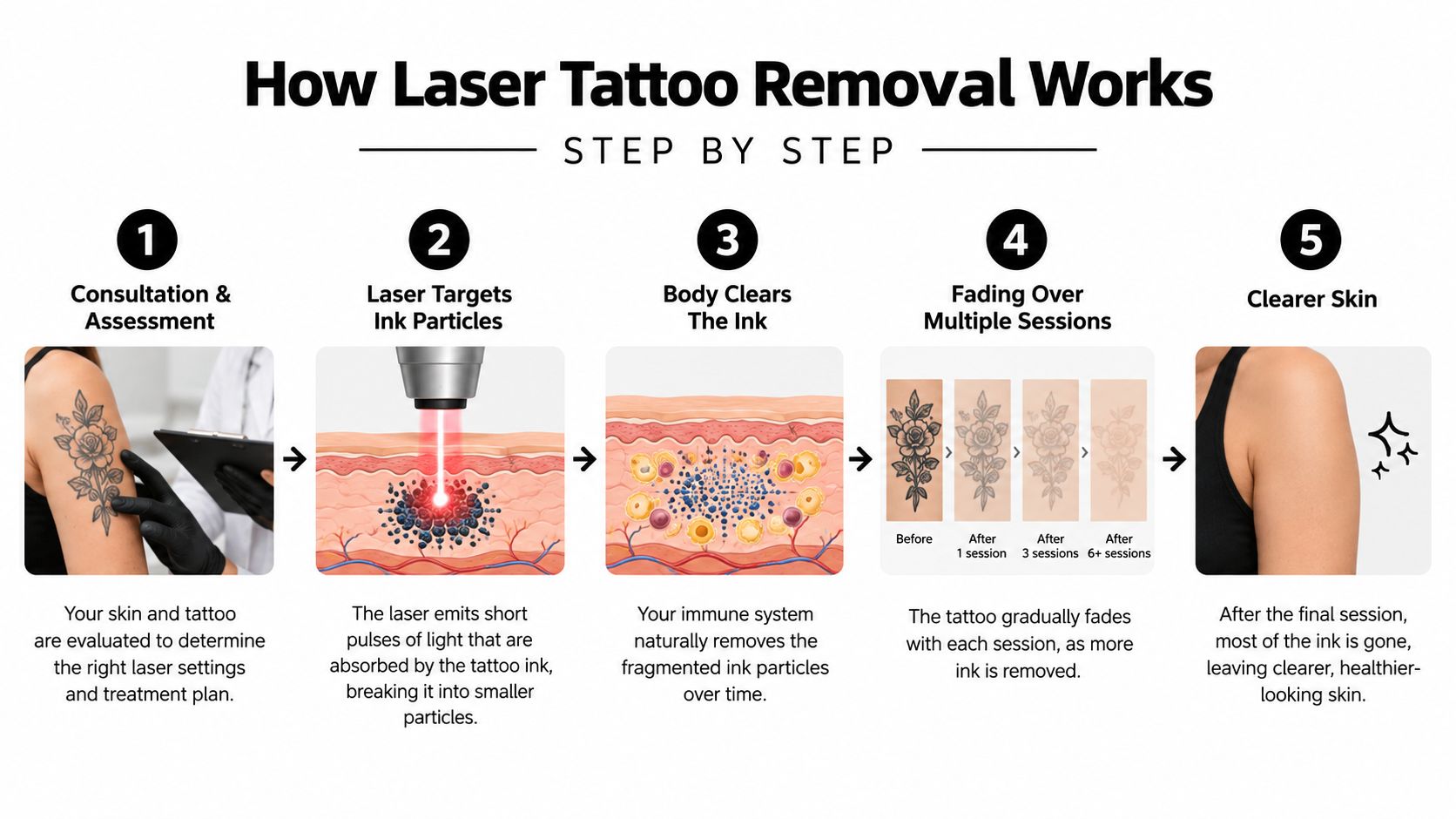
For a deeper explanation of device selection, treatment planning, and aftercare, review this laser tattoo removal guide. The central idea remains simple: the laser breaks the ink apart, and your body clears it over time.
Comparing the Main Tattoo Removal Methods
Laser treatment is the modern default because it can target pigment without removing the entire section of skin. Q-switched and picosecond systems use short energy pulses to fragment ink, and practitioners can select wavelengths for different colors and skin types. That makes laser treatment useful for many tattoo sizes and body locations, although it still carries risks such as pigment changes and incomplete clearance.
Q-switched lasers have a long clinical history. The QS ruby laser at 694 nm was the first commercially available Q-switched tattoo-removal laser in 1983, followed by QS Nd:YAG systems at 532 nm and 1064 nm, and the QS alexandrite laser at 755 nm (FDA device history). Picosecond systems deliver even shorter pulses and may be selected when the clinician believes their pulse profile suits the pigment and patient.
Surgical excision removes the tattooed skin and closes the wound with sutures. It may be considered for a very small tattoo in an area where the skin can be closed without excessive tension. The trade-off is direct and unavoidable: the tattoo is replaced by a surgical scar.
Dermabrasion mechanically abrades the skin to reach or disrupt pigment. It can involve substantial healing and has a less predictable cosmetic result than carefully targeted laser treatment. Some people consider it when laser treatment isn't financially viable, but the risk of textural change and scarring needs serious discussion.
Chemical or acid-based treatments attempt to damage or remove pigment through topical or injected chemicals. These methods can cause burns, infection, pigment changes, and scarring, especially when used outside regulated clinical care. They're not a safe shortcut because they don't use a laser.
Tattoo Removal Methods at a Glance
| Method | Best Candidate | Typical Commitment | Scarring Risk |
|---|---|---|---|
| Q-switched or picosecond laser | Most tattoos, when wavelength and skin type can be matched | Multiple appointments with healing between visits | Pigment changes and scarring are possible |
| Surgical excision | Very small tattoos in suitable low-tension areas | One procedure followed by wound healing | Surgical scar is expected |
| Dermabrasion | Selected cases where laser access or cost is a concern | Significant surface healing may be required | Textural change and scarring risk |
| Chemical or acid-based treatment | Generally not a preferred clinical option | Repeated irritation and prolonged healing may occur | Burn, pigment, and scarring risks can be substantial |
A qualified clinician may still discuss an alternative, but most trained clinics recommend laser first because it offers more selective pigment targeting and can be adjusted across treatment sessions.
How Many Sessions You Should Realistically Expect
How many appointments will your tattoo need? Treat any estimate as a range, not a promise. Clinical evidence shows that removal usually takes multiple treatments. A systematic review found that Nd:YAG lasers generally required 4 to 8 sessions to achieve at least 75% clearance for black and blue pigments, as reported in a clinical evidence review.
For practical planning, clinics often discuss 6 to 12 sessions for a typical tattoo. A small or already faded design may clear in 4 to 6, while dense, multicolored, or layered work can require 15 or more. A cover-up may take longer because newer ink can sit over an older design. An examination gives a more useful estimate than a general online range.
Appointments are commonly spaced about 6 to 8 weeks apart. The skin needs time to recover, while the immune system gradually processes the pigment fragments. Treating sooner does not make the body clear ink faster. It may add irritation before the previous response has settled.
Why one tattoo fades faster than another
| Tattoo Profile | Typical Sessions | Notes |
|---|---|---|
| Small, faded, single-color tattoo | 4 to 6 | Lower pigment density may allow a shorter course |
| Typical dark tattoo | 6 to 12 | The final estimate depends on depth, location, and saturation |
| Dense professional tattoo | 10 to 15 or more | Heavier ink application can require continued treatment |
| Layered or multicolored tattoo | 15 or more may be needed | Multiple colors and overlapping pigment complicate treatment |
The tattoo's size matters because surface area determines how much ink receives treatment. Ink depth matters as well. A heavily saturated line can contain more pigment than a lightly shaded section of equal size. With a cover-up, the technician may be treating several pigment layers rather than one.
Color affects the timeline too. Black and dark blue are generally easier to target, while green, red, and yellow are identified by the FDA as harder-to-remove colors (FDA laser device documentation). Location can influence progress because circulation and immune activity differ across body areas.
A practical decision follows from these ranges. If your goal is a cover-up, partial fading may require fewer appointments than full removal. If you want bare skin, plan for the longer end until a technician has seen how your tattoo responds.
Planning rule: Choose a realistic range, then plan your calendar and budget around the longer end until a technician has observed how your tattoo responds.
Skin Type, Ink Color, and What Changes the Outcome
Laser tattoo removal doesn't work identically on every person. The Fitzpatrick skin scale helps a clinician estimate how much natural melanin is present and how likely the skin is to absorb laser energy alongside the ink. Darker or recently tanned skin can carry a higher risk of hyperpigmentation, hypopigmentation, and other complications.
A complications review found that pigmentary changes are among the most common issues after tattoo removal, and that longer-lasting changes occur more often in darker or tanned skin. One cited study reported hypopigmentation in 8% and hyperpigmentation in 22% of patients with darker skin, while another prospective study observed adverse effects in 6.2% overall, with hyperpigmentation the most common at 4.8% (European Commission tattoo safety report).
Matching the wavelength to the person and pigment
Black ink absorbs 1064 nm efficiently, and dark blue often responds well to the same wavelength. Red and orange pigments are typically approached with 532 nm. The FDA states that 1064 nm can be used for black, brown, green, blue, and purple tattoos across Fitzpatrick skin types I to VI, while 532 nm is used for red, yellow, and orange tattoos in Fitzpatrick skin types I to III (FDA clearance documentation).
That doesn't mean every tattoo with a particular color receives the same setting. The practitioner may adjust fluence, pulse duration, spot size, and treatment spacing based on your skin and the tattoo's response. A conservative plan may take longer, but protecting the surrounding skin is more important than chasing rapid fading.
Greens, reds, and yellows are among the more difficult pigments, and fluorescent or unusual inks can behave unpredictably. Multicolor tattoos may require more than one wavelength across the treatment course.
Recent tanning changes the safety equation because the skin contains more active pigment. A responsible clinic may postpone treatment, perform a test spot, or use lower energy while the skin returns to its baseline. Read this guide to tattoo removal on dark skin before booking if you have a deeper skin tone or frequent sun exposure.
Full Removal or Fading for a Cover-Up
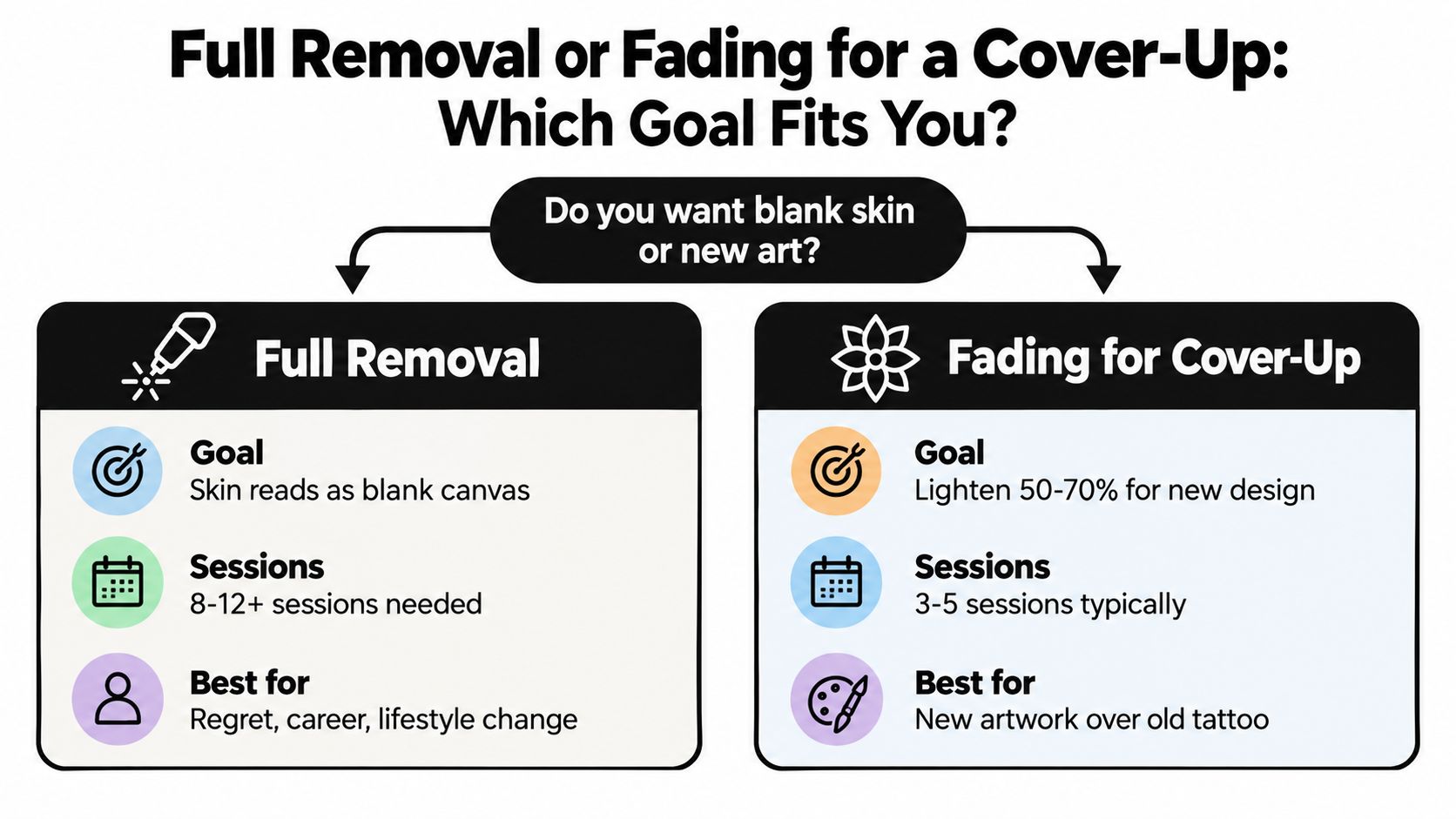
The right endpoint depends on what you want the tattoo to become. Full removal aims for skin that reads as blank to the eye. Fading aims to reduce enough of the old pigment to give a tattoo artist room to build a new design.
Fading often makes more sense when the old tattoo is an unwanted name, when heavy black saturation is blocking a better design, or when you're concerned about the time, cost, or risk involved in pursuing complete clearance. A cover-up artist can often use the remaining lighter shapes as part of a new composition, but the artist needs to assess the tattoo before laser treatment begins.
Choose fading when the new design is already clear
A consultation with the cover-up artist should come before you commit to a removal endpoint. The artist may want certain lines reduced more than others, or may recommend lightening a specific area rather than treating the entire tattoo. Selective removal can preserve portions of an existing design while opening space for new artwork.
The requested goal of lightening by 50% to 70% is commonly used in cover-up planning, but the amount needed depends on the new design, the remaining color, and the artist's technique. A tattooist working with dark geometric artwork may need a different canvas than one creating a heavily shaded floral piece.
Choose full removal when flexibility matters
Complete removal is usually the better path when you want the option of leaving the skin blank, when a visible tattoo affects professional presentation, or when no cover-up artist is willing to work over the existing piece. Multicolored tattoos can also be difficult to cover because several pigments may remain visible beneath the new design.
A practical rule is simple: if a cover-up artist you trust says the tattoo will be workable after 2 to 4 laser sessions, fading may be more sensible than pursuing complete clearance. Get that opinion first, and ask the artist to explain which areas need lightening.
You can also compare the decision in this tattoo removal versus cover-up guide. The best goal is the one that supports your next decision, not necessarily the one that promises the most dramatic treatment plan.
Choosing a Clinic and Preparing for Your Consultation
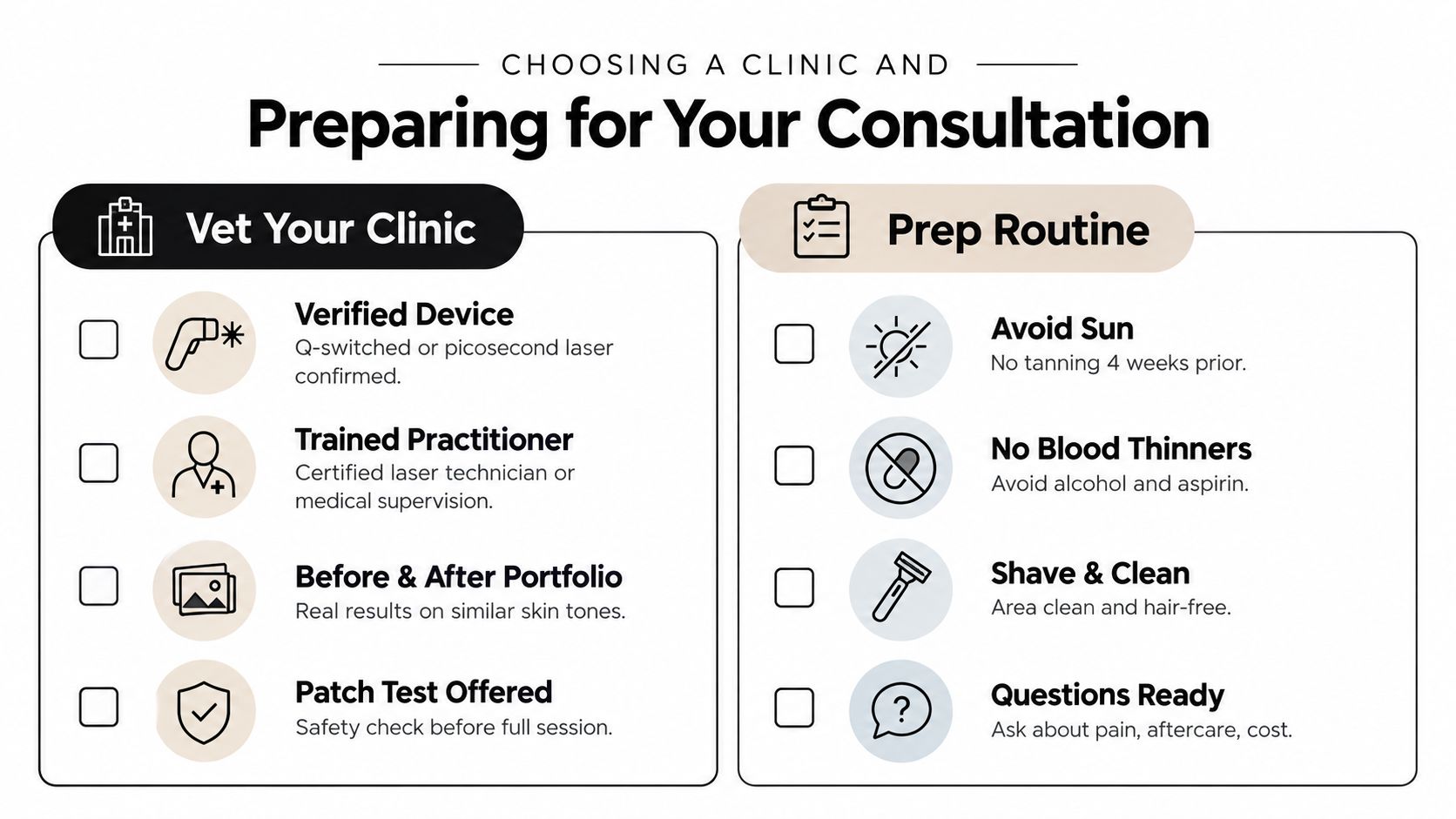
A clinic should earn your confidence before it earns your booking. Start by asking what device it uses, which wavelengths are available, who performs the treatment, and whether a medical professional supervises the service when appropriate. Q-switched and picosecond lasers are the main device categories to discuss, but the brand name alone doesn't tell you whether the treatment plan fits your tattoo.
Questions to ask before treatment
- Verify the wavelengths: Confirm that the clinic can address your ink colors with appropriate wavelengths rather than using one setting for every tattoo.
- Check practitioner training: Ask about laser certification, clinical experience, and supervision arrangements.
- Request comparable results: Look for before-and-after photos involving similar skin tones, colors, tattoo density, and body locations.
- Ask about a patch test: A test spot can help the practitioner assess how your skin responds before treating the full tattoo.
- Get transparent pricing: Ask for per-session pricing and a realistic treatment range without pressure to purchase a large package.
- Request written aftercare: You should leave knowing how to manage redness, swelling, blistering, crusting, and sun exposure.
The consultation should include a Fitzpatrick skin-type assessment, a close inspection of the tattoo, and an honest conversation about complete removal versus cover-up fading. The clinician should explain that lack of complete removal and disappointing results are recognized outcomes, and that reactions such as blistering, edema, crusting, redness, and pain can occur after treatment (clinical complications reference).
Prepare the treatment area
Avoid sun exposure and tanning before your appointment. The exact waiting period should follow the clinic's protocol and your current skin tone, because recently tanned skin may require postponement. Don't apply retinoids or strong exfoliants around the treatment area unless your clinician tells you otherwise, and arrive with the skin clean and free of products.
Eat beforehand, drink water, and tell the practitioner about medications, skin conditions, previous reactions, and any history of abnormal scarring. If numbing cream is part of the plan, ask whether you'll need someone else to drive you or whether the clinic has specific instructions for its use.
After treatment, follow the clinic's instructions rather than picking at blisters or crusts. Keep the area protected, use a cool compress if advised, and avoid heat and swimming during the early healing period. Your clinician should tell you exactly when normal activities can resume.

Key Takeaways Before You Book
What should you expect from tattoo removal once treatment begins? It is a medical-grade laser process, not a chemical eraser or instant reset. The laser breaks ink into smaller fragments, while your immune system clears those particles over time. Your skin's response, the ink, and the spacing between appointments all influence the result.
Q-switched and picosecond lasers target particular ink colors through specific wavelengths. Excision and dermabrasion have limited uses, but they remove or abrade skin and can leave scarring. Chemical methods add risk and are not a simple shortcut.
Use your consultation to clarify four decisions: how much fading you need, how your skin may respond, how long treatment may take, and whether the clinic's plan matches your goal.
- Expect a range: Session needs vary with tattoo size, ink density, color, location, age, and how your body clears pigment. A responsible estimate is a range, not a promise.
- Allow recovery time: Plan for multiple appointments spaced several weeks apart. Clearance can vary from one pigment and skin response to another, so the treatment plan may change as healing progresses.
- Respect skin differences: Skin tone, recent tanning, wavelength, and laser fluence affect both safety and pigment response. The safest settings may require a slower pace.
- Read the ink: Black and dark blue often respond more readily. Green, red, and yellow may require more careful wavelength selection and planning (FDA documentation on difficult pigments).
- Choose the endpoint: Full removal aims for the least visible pigment possible. Cover-up fading only needs enough clearance for new artwork to work, which can change the number and intensity of treatments.
- Judge the consultation: A credible provider examines your tattoo and skin, discusses risks, offers appropriate testing, explains aftercare, and avoids guaranteeing clearance.
Bring clear tattoo photos, decide whether you want blank skin or a cover-up, and ask how the clinic will adjust treatment as your skin heals.
EradiTatt Tattoo Removal offers consultations and personalized laser plans for complete removal or cover-up fading, based on skin type, tattoo size, color complexity, and your goals. Visit EradiTatt Tattoo Removal to explore Florida locations and arrange a consultation.
One Response