
Many small tattoos show visible fading in about 3 to 5 sessions, while complete removal commonly takes around 10 to 12 sessions, depending on the ink, depth, and how your skin responds. The more useful goal is to track steady fading and healthy healing, not to expect a compact design to disappear after one appointment.
You may be looking at a tiny wrist symbol before a wedding, a name you no longer want, or a small ankle tattoo that's become a problem at work. Because the design is small, it's natural to assume removal will be simple and fast. Often it is more manageable than removing a large tattoo, but the size alone doesn't determine the plan. Ink density, color, depth, skin type, and recovery between treatments matter just as much.
At EradiTatt's Florida clinics, a consultation turns those variables into a practical schedule. The team serves clients in Orlando, Bradenton/Sarasota, St. Petersburg, Palm Harbor, and Tampa, with plans built around the tattoo itself and the result you want, whether that's complete clearance or enough fading for a cover-up.
Table of Contents
- What Small Tattoo Removal Actually Looks Like
- How the Laser Tattoo Removal Process Works
- Session Count, Success Rates, and What Size Really Means
- Cost, Pricing Factors, and How to Compare Options
- Pain, Risks, and Aftercare You Can Actually Follow
- Complete Removal vs Fading for Cover-Ups
- Ink Color, Skin Type, and Laser Choice
- Next Steps and Scheduling at EradiTatt Florida Clinics
What Small Tattoo Removal Actually Looks Like
For a compact design, a realistic starting point is meaningful fading in about 3 to 5 sessions, while complete removal commonly takes around 10 to 12 sessions, according to published guidance on small tattoo treatment planning. Those figures are planning ranges, not promises. A lightly inked black outline may respond differently from a heavily saturated professional tattoo occupying the same small area.
The first step is an assessment, not a shot at a fixed session number. A practitioner looks at the tattoo's colors, density, depth, age, placement, any existing scarring, and your skin's pigmentation. The question isn't, “How many square inches is this?” It's, “How much pigment is concentrated in those square inches, and how safely can this skin be treated?”
A practical way to judge progress
After each session, the laser has already delivered its energy, but the visible result continues developing while your body clears fragmented pigment. Compare photographs taken under similar lighting rather than judging the area from memory. Look for softer edges, lighter fills, and gaps appearing in dense sections.
Keep these checkpoints in mind:
- After treatment: Expect the treated area to look irritated before it looks lighter.
- During recovery: Let the skin settle instead of judging the final result immediately.
- Before the next visit: Assess whether the tattoo has continued fading since the initial reaction.
- At consultation: Bring a clear timeline, including the date of your last tattoo session and any previous removal.
EradiTatt's laser tattoo removal images can help set realistic expectations about progressive change. For Florida clients, the most efficient path is to choose the convenient clinic location first, then build a schedule you can maintain consistently.
How the Laser Tattoo Removal Process Works
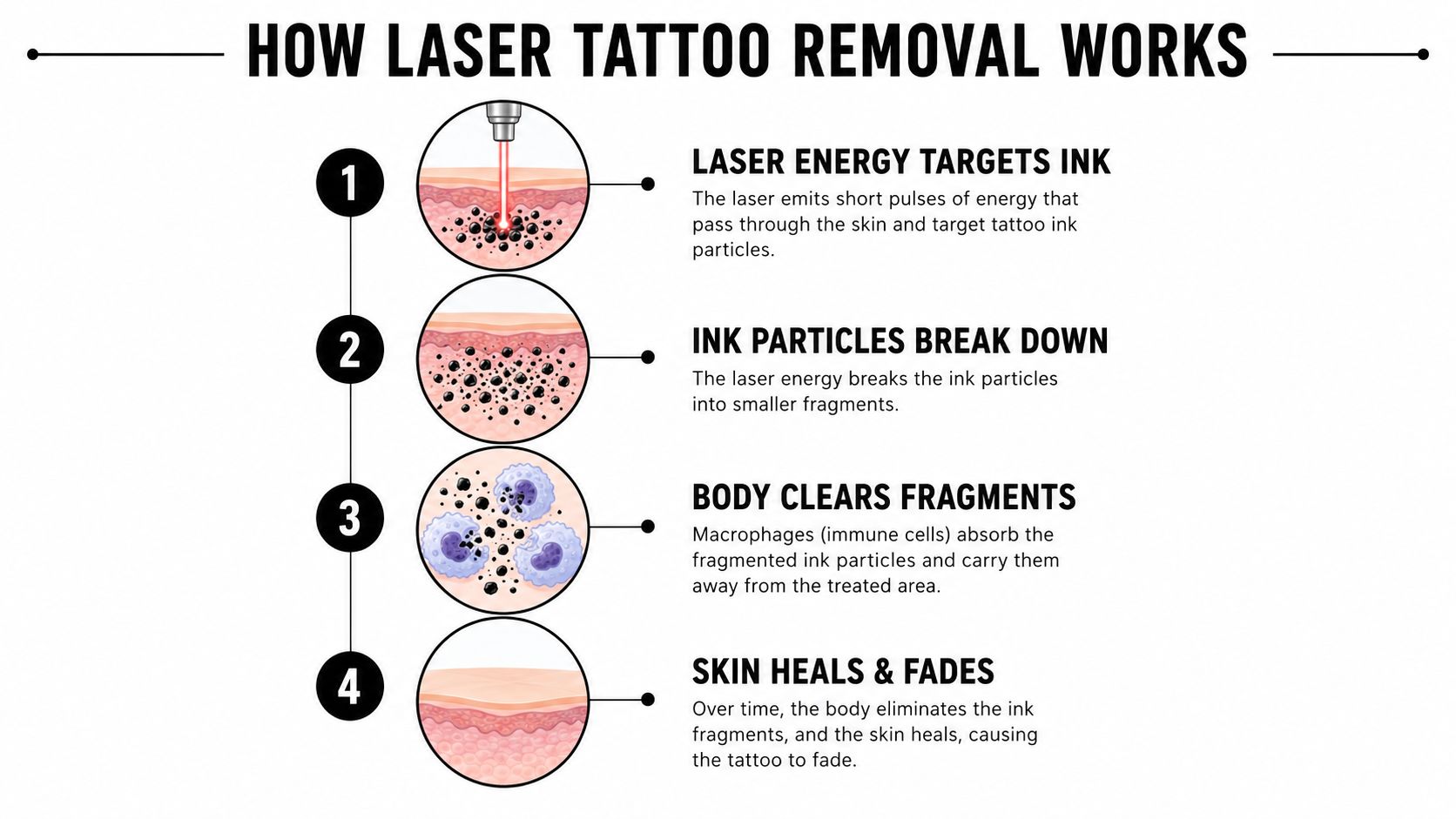
Laser tattoo removal uses short pulses of focused light. The selected wavelength is absorbed by tattoo pigment, causing the ink particles to break into smaller fragments while the surrounding skin receives carefully controlled exposure. Your immune system then clears those fragments gradually, so the laser starts the process, but your body completes much of the fading between visits.
What happens during an appointment
A typical workflow follows a controlled sequence:
- Assessment and preparation: The practitioner confirms the treatment area, reviews relevant skin considerations, and protects the eyes.
- Laser application: Pulses are delivered across the tattoo. Compact designs usually allow precise coverage, but precision doesn't mean the practitioner should use maximum energy automatically.
- Immediate skin response: Whitening, redness, swelling, or tenderness can occur as the skin reacts to the pulse.
- Recovery and clearance: The area heals while the body processes the fragmented pigment.
Some clinical protocols use multiple passes. The R20 method, for example, uses four laser passes in one session with a 20-minute wait between passes, allowing the immediate whitening to fade before the next pass, as described in this medical review of laser tattoo removal techniques. That approach isn't automatically appropriate for every tattoo or skin type. The practitioner has to decide whether additional passes offer a reasonable benefit without adding unnecessary irritation.
The interval between appointments matters just as much as the pulse itself. Treating too soon can interrupt healing and gives the body less opportunity to clear the pigment fragments already created. A steady plan is usually more productive than aggressive scheduling. EradiTatt's laser tattoo removal process guide provides additional practical context for the stages clients move through.
Session Count, Success Rates, and What Size Really Means
A small tattoo can fit easily into a treatment appointment and still require patience. A 2025 NIH-hosted predictive-model study reported an average of 6 sessions, with a range of 2 to 20, and found that tattoo size did not significantly determine session count. Ink density was the major driver of treatment burden. A compact, heavily saturated symbol may therefore resist treatment longer than a larger design drawn with a light outline. The full NIH-hosted predictive-model study provides the underlying analysis.
Measure the tattoo for coverage and pricing, then assess how much pigment sits in the skin. A solid black shape, a faded line drawing, and a cover-up do not share the same removal profile. Deeper pigment and pre-existing texture can also make the response harder to assess.
What the larger cohort tells us
Progress builds between appointments rather than appearing at one predictable visit. In a large JAMA Dermatology cohort, 47.2% of patients reached therapy success after 10 sessions, and 74.8% reached success after 15 sessions. The study also reported worse outcomes for tattoos larger than 30 cm², supporting the practical advantage of smaller designs while showing that size is only one factor.
| Planning question | What it tells you |
|---|---|
| Is the tattoo physically small? | Treatment can stay localized and may fit more easily into an appointment. |
| Is the ink dense? | A high pigment load can create a longer treatment burden than the footprint suggests. |
| What colors are present? | Different colors may require different wavelengths within the same design. |
| Is the goal fading or clearance? | The endpoint determines how long treatment continues. |
Spot size selection also matters. A compact tattoo may allow precise coverage, but the smallest available spot is not automatically the right choice. The practitioner must match spot size and energy to the ink density, location, and skin response, then adjust as the pigment lightens.
A sound consultation produces a treatment range and a decision framework, not an exact guarantee. Review fading between visits, confirm that the skin has returned to its usual appearance, and check whether remaining pigment is responding evenly. Fast-turnaround removal does not automatically improve the outcome. Healing time and pigment clearance still shape the plan.
Cost, Pricing Factors, and How to Compare Options
Small tattoo removal pricing usually depends on more than the tattoo's width and height. Clinics may consider the treatment area, ink colors, skin tone, device type, and the number of sessions likely to be required. Some providers charge per session, while others organize pricing around size categories or treatment packages.
A low per-session quote isn't necessarily the lower overall cost if the plan uses a device or wavelength that doesn't match your ink. Conversely, a higher session price may reflect more specialized equipment, practitioner experience, or a clearer treatment plan. The useful comparison is what's included, how the clinic evaluates your tattoo, and how transparently it explains the likely path.
Questions to ask before committing
Ask each clinic:
- What determines the price? Confirm whether the quote is based on size, color complexity, session time, or another method.
- Which laser will be used? The answer should connect the device and wavelength to your ink, not rely on a brand name alone.
- What happens if the tattoo needs more sessions? Clarify whether future visits are priced individually or covered under a defined package.
- How will progress be assessed? A clinic should be able to explain how it'll decide whether to continue, adjust, or pause treatment.
- What support is provided after treatment? Clear aftercare instructions help protect the skin and the investment you're making.
EradiTatt's guide to why tattoo removal can be expensive offers useful context for evaluating equipment, expertise, and the cumulative nature of treatment. Compare plans on predictability and clinical fit, not just the first number you hear.
Pain, Risks, and Aftercare You Can Actually Follow
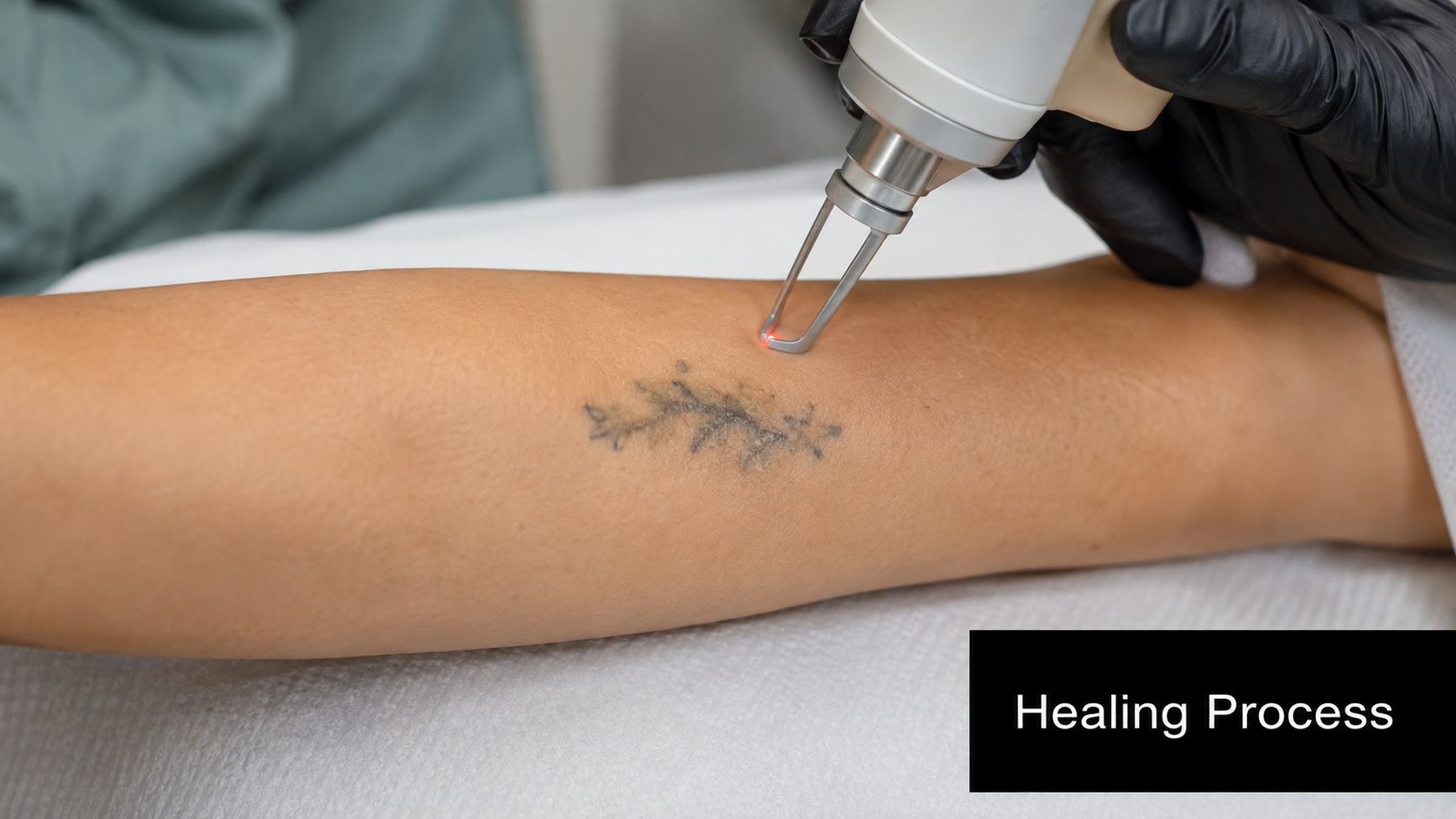
Laser treatment produces a sharp, hot snapping sensation. Many clients describe it as similar to a rubber-band snap, although sensitivity varies with placement, pigment density, and personal tolerance. Cooling and other comfort measures may be available, so discuss them before the appointment rather than waiting until the treatment begins.
The immediate response can include redness, swelling, tenderness, whitening, blistering, or crusting. These signs don't automatically indicate a complication, but they do mean the area needs protection while it heals. Pigment changes and scarring are possible risks, particularly when treatment settings or aftercare aren't appropriate for the individual skin.
Keep aftercare simple
Follow the clinic's instructions, including any dressing or topical product recommendations. The basic principles are consistent:
- Clean gently: Keep the area clean and avoid harsh scrubbing.
- Leave healing skin alone: Don't pick at blisters, scabs, or crusts.
- Reduce friction: Choose clothing that won't rub the treated area.
- Protect from sunlight: Healing skin is more vulnerable to unwanted pigmentation changes, so limit direct exposure and follow the clinic's sunscreen guidance once the skin has closed.
- Contact the clinic when unsure: Increasing pain, spreading redness, unusual drainage, or a reaction that concerns you deserves a professional check-in.
Practical rule: A smaller tattoo still needs complete aftercare. Its size reduces the treatment area, not the importance of protecting healing skin.
Don't schedule the next session because the tattoo is convenient to treat. The skin should be ready, and the practitioner should confirm that continued treatment is appropriate.
Complete Removal vs Fading for Cover-Ups
The correct endpoint depends on what you want to do next. Complete removal makes sense when you want the tattoo gone without replacing it, need the cleanest possible appearance, or don't want the old design influencing future choices. It requires patience because faint residual pigment can remain after the tattoo looks dramatically lighter.
Strategic fading may be enough when a tattoo artist plans to place a new design over the existing one. Fading reduces visual competition between the old and new artwork, giving the artist more flexibility with composition, contrast, and placement. The required amount of fading depends on the cover-up design, the original ink, and the artist's technique.
Make the decision with both professionals
Before starting treatment for a cover-up, show the existing tattoo to the artist who'll create the replacement. Ask what needs to disappear and what can remain. A dark, dense section may need more attention than a thin outline, even if both are part of the same small tattoo.
Wait until the treated skin has fully recovered before beginning a new tattoo. The removal practitioner can tell you when the area is ready, while the cover-up artist can judge whether the remaining pigment is acceptable. Rushing from laser treatment into new tattooing can compromise the skin and make the next design harder to execute.
For many clients, fading is a more efficient endpoint than pursuing a perfectly blank canvas. For others, stopping at partial lightening leaves too much uncertainty. Decide based on the next design, not on the assumption that every tattoo must follow the same removal path.
Ink Color, Skin Type, and Laser Choice
A compact black outline and a dense multicolor symbol need different treatment plans. Wavelength selection is central to laser tattoo removal for small tattoos. Black and dark blue generally respond best to 1064 nm light, while red, orange, and yellow respond to 532 nm. Green may require 650, 694, or 755 nm, depending on the pigment and the available system. The practitioner matches the wavelength to the ink while accounting for how the client's skin may absorb the energy.
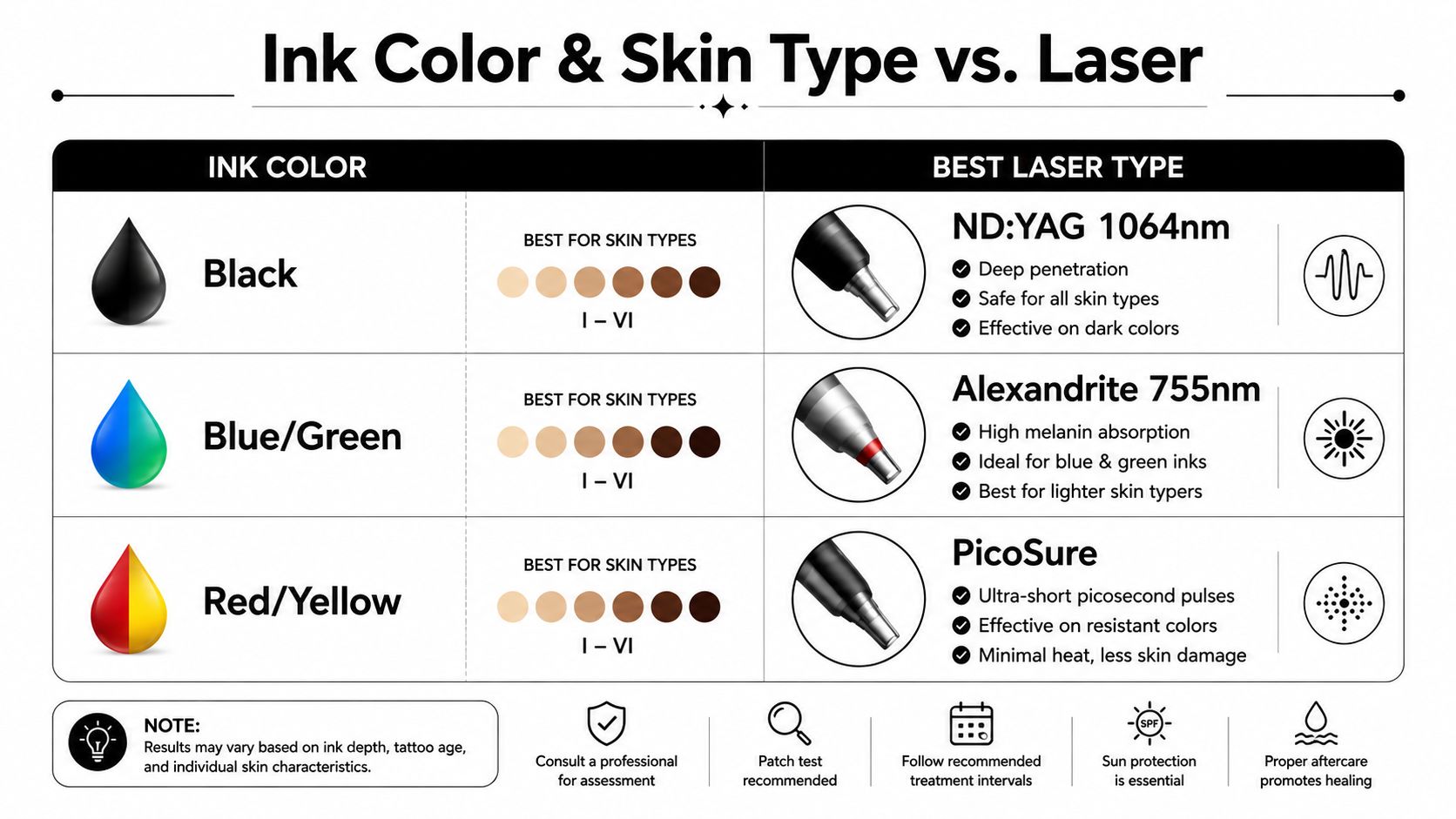
Skin type affects the safety margin, particularly when more melanin may interact with the laser. A careful clinic sets energy conservatively and evaluates the skin's response instead of applying identical settings to every client. Discuss your natural pigmentation, recent sun exposure, and any history of unusual healing before treatment.
Why spot size matters on compact designs
A larger spot size generally supports deeper penetration and can reduce epidermal injury. Very small 2 to 3 mm spots may scatter more photons and work less efficiently than 6 to 8 mm spots, according to technical guidance on laser spot size and tattoo pigment. A small tattoo still should not automatically receive the largest available spot. The spot must cover the pigment accurately while the practitioner balances coverage, depth, and protection of nearby skin.
The same source describes a porcine model in which a 2 mm spot at 1064 nm with 155 mJ produced a reported black-tattoo clearance rate of 76.46%. Because this was an animal model, it does not predict a guaranteed human result. It does show why energy delivery and spot selection matter when pigment is concentrated in a compact design.
Nanosecond Q-switched lasers remain widely used because tattoo ink granules commonly fall within the 30 to 300 nm range and have a thermal relaxation time under 10 nanoseconds. Picosecond systems may provide better results for some blue, green, and yellow pigments. A systematic review found that 69% to 100% of tattoos in human trials achieved more than 70% pigment clearance after 1 to 10 picosecond treatments, with outcomes varying by study and tattoo. The systematic review of picosecond laser tattoo-removal outcomes supports that finding, but it does not make rapid clearance predictable for every small tattoo.
Next Steps and Scheduling at EradiTatt Florida Clinics
A productive consultation starts with useful details. Bring the approximate date the tattoo was applied, information about any cover-up or previous removal, and your preferred endpoint. If you're preparing for a new tattoo, bring the cover-up artist's concept or explain which parts of the old design must be reduced.
EradiTatt Tattoo Removal provides laser tattoo removal consultations across Orlando, Bradenton/Sarasota, St. Petersburg, Palm Harbor, and Tampa. The team can evaluate the compact design, ink colors, skin type, and lifestyle timeline, then discuss whether a complete-removal or fading plan makes more sense. Scheduling at the location that fits your routine can help you maintain the recovery intervals your skin needs.
Build a plan you can sustain
Clients often focus on finding the fastest possible appointment. A better question is whether the schedule allows the skin to heal and the body to clear fragmented ink before the next session. Ask about appointment spacing, expected reactions, comfort options, photography for progress tracking, and what would cause the practitioner to delay treatment.
Clinics also need a clear local presence so prospective clients can find accurate location and booking information. If you're interested in how service businesses build that kind of visibility, this guide to dominate transactional searches offers useful background.

Call the EradiTatt team or contact the Florida clinic that's most convenient for a personalized assessment. You don't need to decide on a full course before the consultation, but you should leave with a clear understanding of your tattoo's likely response, treatment goal, and next appointment.
EradiTatt Tattoo Removal offers personalized laser treatment for small tattoos, whether you want complete removal or controlled fading for a cover-up. Visit EradiTatt Tattoo Removal to find a Florida location and book a consultation with the team.