
You've had the forearm tattoo for years, but it no longer fits your work, your taste, or the person you are now. The first instinct is often to place a new design directly over it. Sometimes that works. Other times, a few laser fading sessions create a much cleaner canvas and prevent the new piece from becoming larger, darker, and more restrictive than you wanted.
A successful tattoo cover up forearm project starts with an honest assessment, not a design picked from a gallery. Forearms are highly visible, long, and exposed to daylight, so placement, contrast, healing, and long-term readability all matter. The practical decision is usually between two tracks: direct cover-up or laser fading first.
Table of Contents
- When a Forearm Tattoo Becomes a Cover Up Project
- Assessing Your Existing Forearm Tattoo
- Direct Cover Up or Laser Fading First
- Preparing With Laser Fading Sessions
- Choosing a Cover Up Design That Conceals
- Finding the Right Artist for the Job
- Timeline Costs and Healing Expectations
When a Forearm Tattoo Becomes a Cover Up Project
A client may arrive with an old name, a band logo, dense lettering, or a piece that reflects an earlier chapter. They usually want the same thing, a fresh start without making the situation more complicated. The difficult question isn't whether a new tattoo can be placed over the old one. It's whether the desired new tattoo can work over the existing pigment.
Forearms make that decision more demanding than hidden placements. People see the area during handshakes, at work, in short sleeves, and in everyday conversation. A composition that looks acceptable in a photograph may feel unbalanced when it wraps around the arm or catches bright daylight. Employment policies can also make concealment relevant. Legal guidance notes that customer-facing employers may require a neat, professional image and may permit reasonable accommodations such as covering visible tattoos, even though blanket body-art bans should be avoided (employment guidance on visible tattoos).
The scale of the tattooed population helps explain why forearm revisions are common. Pew Research found that 32% of U.S. adults have at least one tattoo, including 22% with more than one. Among adults aged 18 to 29, the figure is 41%, and among adults aged 30 to 49, it is 46% (Pew Research Center). With more people carrying visible ink, changes in style, work, and personal preference naturally create more revision decisions.
The two-track decision
| Forearm Cover Up Quick Reference | Direct Cover Up | Laser Fading First |
|---|---|---|
| Best starting point | Small, aged, lighter, or low-saturation tattoo | Large, dark, saturated, or tightly lined tattoo |
| Main advantage | Shorter project and no laser preparation | More design freedom and less reliance on heavy darkness |
| Main trade-off | The new piece may need to be larger or darker | Adds treatment, healing time, and cost |
| Design flexibility | Limited by the darkest legacy areas | Lighter values and more open compositions become more realistic |
A direct cover-up is sensible when the old ink has already softened and the artist can place dark, textured elements over the most visible remnants. Fading first is smarter when the existing tattoo dominates the space or when your preferred replacement depends on lighter skin breaks.
For additional visual examples of how artists approach different arm placements, explore this guide to cover up tattoos for arms. The useful lesson is that the replacement design has to be planned around the existing tattoo, not merely placed on top of it.
Assessing Your Existing Forearm Tattoo
Before choosing a style, inspect the tattoo as material. The original subject may be emotionally important, but it doesn't determine cover-up difficulty. Ink saturation, line density, color, age, size, and placement matter more than whether the tattoo is a rose, script, symbol, or portrait.
Start with a clear photograph. Stand in even daylight without direct glare, keep the arm relaxed, and photograph the full forearm from several angles. Avoid filters and harsh overhead lighting, since both can hide texture and make faded ink appear lighter than it is.
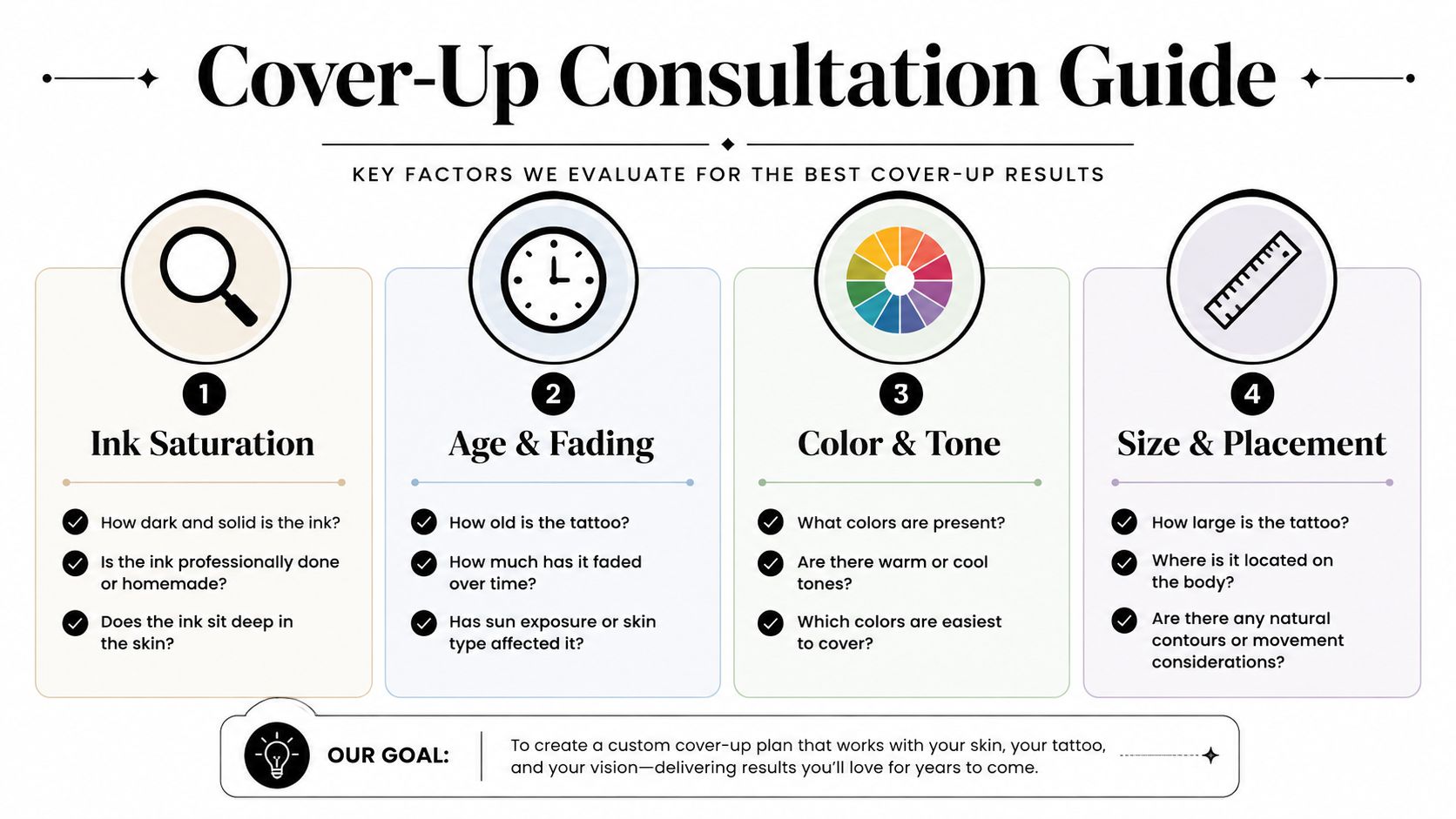
Four checks before a consultation
Age and fading: Older tattoos often lose some sharpness, but age alone doesn't make a piece easy to cover. Look for softened edges, broken lines, and lighter open areas. A relatively old tattoo can still be difficult if it contains dense black packing.
Line density: Trace the darkest zones with your eye. Tight lettering, overlapping outlines, and solid fills create a stronger visual structure that the new tattoo must interrupt. Mark those zones on a printed photograph or phone image so you can show an artist exactly where the problem areas are.
Color and tone: Black and deep saturated colors usually exert the most influence on the replacement design. Multicolor tattoos can be complicated because different pigments may fade unevenly. A new design might need to work around residual blue, green, red, or black rather than treating the old tattoo as one uniform layer.
Size and placement: Measure the tattoo and note whether it sits on the inner forearm, outer forearm, wrist side, or closer to the elbow. A piece that occupies most of the visible forearm leaves less room to create balance. A narrow tattoo may also require extension along the limb so the new composition doesn't look like an isolated patch.
A practical starting score
You can make a rough three-level assessment:
- Direct candidate: The tattoo is small or already light, has open skin between lines, and doesn't occupy a major focal area.
- Borderline: The tattoo has moderate darkness, some heavy outlines, or colors that may affect the new palette. A consultation and careful stencil placement are essential.
- Fading likely: The tattoo is heavily saturated, very dark, large, multicolored, or positioned where your desired focal point needs to be light.
This isn't a substitute for an in-person assessment. Skin tone, pigment depth, scarring, and previous touch-ups can change the recommendation. A photograph gives you a useful starting point, but a cover-up artist needs to see how the skin behaves and where the old structure remains strongest.
Direct Cover Up or Laser Fading First
A client may arrive with a dark forearm tattoo and a clear idea for a lighter replacement. The decision is not only whether a cover-up is possible. It is whether the existing pigment gives the new design enough room to work.
A direct cover-up suits an older tattoo that is small, faded, or unevenly distributed. The artist can place darker new elements over the strongest remnants and use foliage, textured realism, ornamental detail, or another design with varied values to break up the original lines. You should also be comfortable with a replacement that may be darker, denser, or larger than the first tattoo.
The direct option becomes restrictive when the old piece is large, solid, or heavily saturated. Black lettering beneath the lightest part of a portrait is a poor match. Dense lines under open skin areas can remain visible after healing, even when the fresh tattoo appears opaque in the studio.
Compare the trade-offs honestly
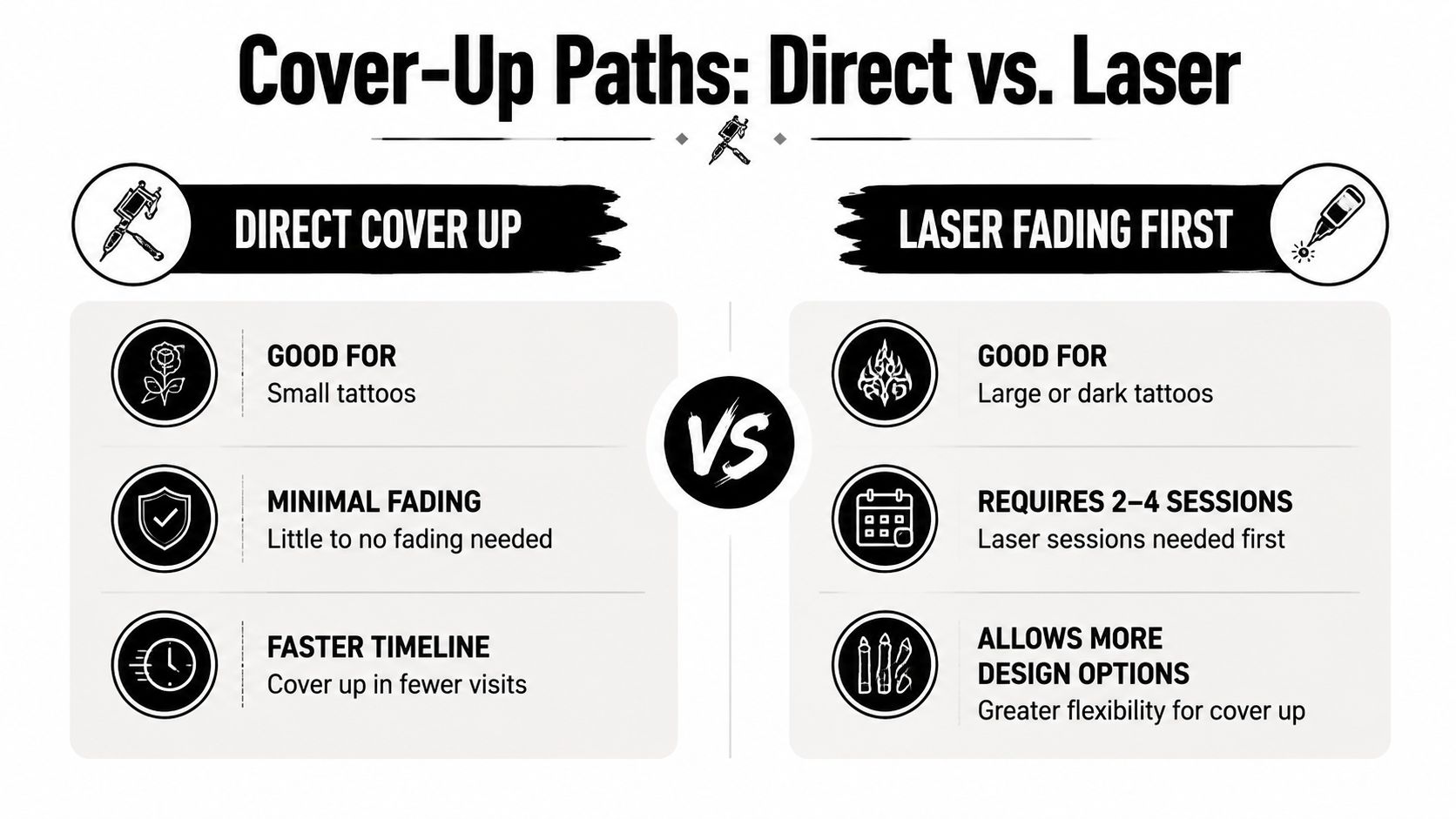
Direct cover-up usually fits when:
- The existing tattoo is small, faded, or spread unevenly.
- You accept a darker or busier replacement.
- The artist can position the darkest new elements over the darkest old areas.
- The composition can extend beyond the original boundaries without looking forced.
Laser fading first usually fits when:
- The old tattoo is solid black or strongly saturated.
- You want black-and-grey realism, lighter negative space, or softer color.
- Existing lines sit exactly where the new focal point needs to remain light.
- Several ink colors make a direct palette difficult.
- You prefer preparation time over a much heavier final design.
A peer-reviewed study reported that the original tattoo remained visible to some extent in 55.6% of cover-up tattoos and remained very visible in 38.9% (peer-reviewed cover-up tattoo study). The figures show why residual structure matters when the old design has not been weakened enough. They do not mean every cover-up needs removal. The artist must judge how much remaining pigment the intended composition can tolerate.
Decision rule: If the replacement needs light areas over the darkest legacy ink, fading first is usually the more responsible choice. If the new design can turn those zones into shadows, a direct cover-up may be practical.
Partial fading often offers the best compromise. Complete clearance is not always necessary. The stopping point is reached when the artist can build the intended composition without forcing every lighter area into a dark workaround.
Preparing With Laser Fading Sessions
Laser preparation works best when the removal practitioner and cover-up artist plan it together. The artist identifies which pigment must be weakened, while the practitioner understands that the target is partial fading for new tattoo work, not necessarily complete clearance.
Partial fading can reduce the visual weight of an old tattoo after several sessions, while complete removal usually requires a longer course (laser fading evidence). The response varies with ink colors, pigment depth, skin characteristics, treatment settings, and application technique. Your practitioner should assess those factors before recommending a session plan.
What the preparation stage involves
The practitioner examines and photographs the forearm, then marks the darkest or most restrictive areas. Treatment can produce temporary frosting and a mild sunburn-like sensation. During healing, the body gradually clears fragmented pigment. The tattoo may look unchanged immediately afterward, so wait for the skin to settle before judging the result.
Sessions need enough spacing for the skin to recover and for pigment clearance to occur. Your provider should set the interval according to your forearm's response rather than promise a fixed schedule. Do not tattoo over recently treated skin. The cover-up artist should inspect the area and confirm complete healing before applying new pigment.
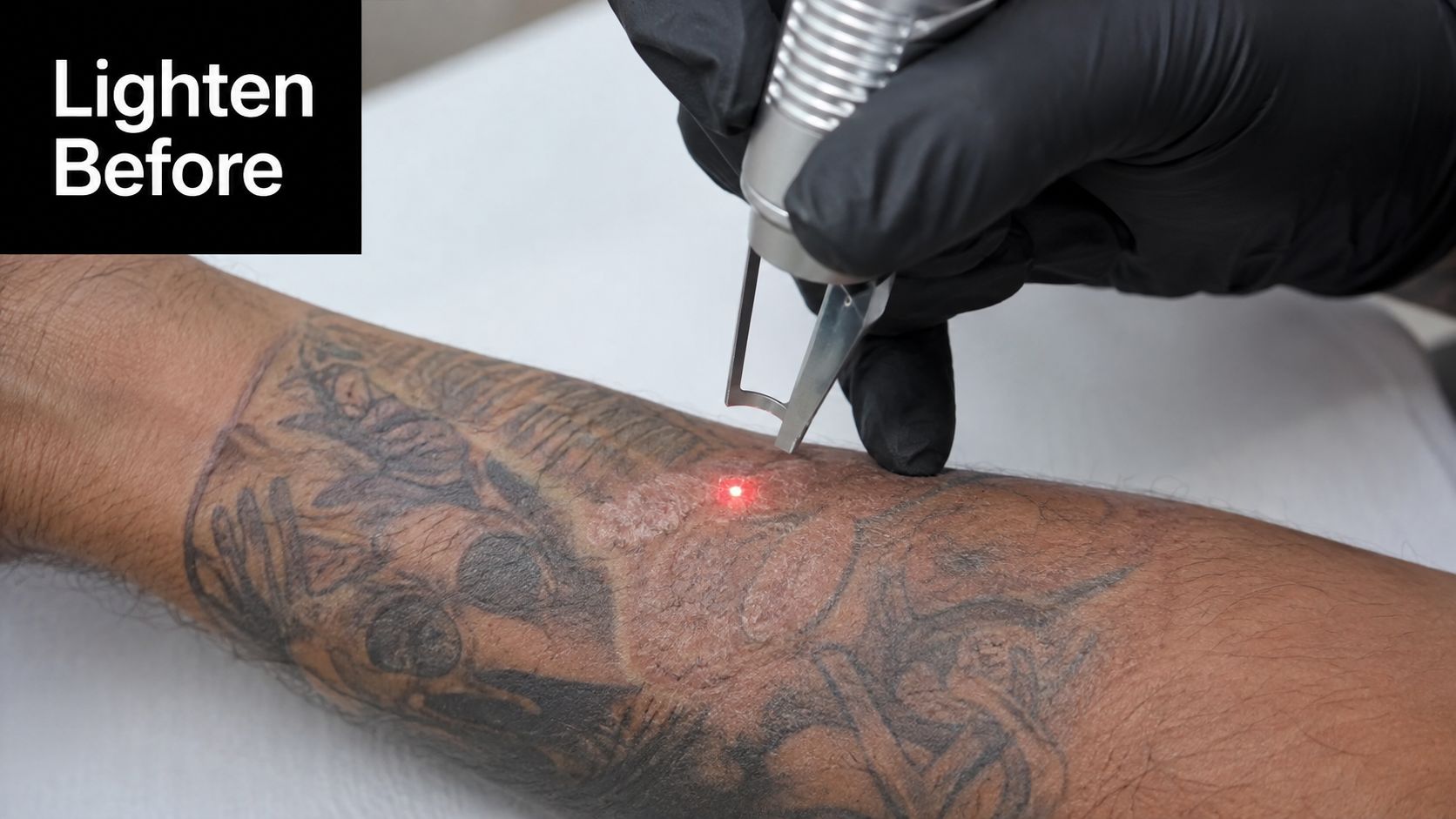
Color complexity also affects planning. Some colors respond less consistently than others, and multicolor tattoos can require a more cautious approach. Ask whether the proposed laser is appropriate for the pigments present, and understand that fading outcomes vary between tattoos.
Compare the trade-offs
Arrange a design review after the initial fading stage. If the old tattoo still dictates the focal point, continue only when further lightening would create a meaningful design option. Stopping after partial fading is reasonable when the artist can place the intended composition without forcing every light area into a dark workaround. For practical preparation guidance, read this guide to preparing for a tattoo cover-up.
Choosing a Cover Up Design That Conceals
A cover-up must solve a visual problem before it becomes a style choice. The design needs to interrupt the old lines, place sufficient dark value over the areas that require concealment, and remain intentional after the skin settles. Build the concept around the existing ink from the first consultation.
Size changes the design problem
Tattoo artist guidance from Think Tank Tattoo recommends making a cover-up roughly 2 to 3 times the size of the original so the composition can extend beyond the old boundaries (cover-up sizing guidance). Extra space gives the artist room to redirect attention instead of compressing the replacement into a dense patch. On a forearm, that space may extend toward the wrist or elbow, or wrap around the limb's natural curve.
Under-sizing leaves the original contours easy to detect. If the new design stops at the same edges, the artist has fewer options for distributing contrast and creating movement. Larger does not mean uncontrolled. It means the composition has enough room to conceal the old structure without forcing every area into solid black.
Value and color do the hiding
Pale colors rarely conceal solid black or saturated pigment on their own. Deep blues, purples, greens, and black usually offer more workable coverage, while pale yellows, pinks, and whites perform poorly over heavy dark ink (color strategy for cover-ups).
Start by mapping the darkest legacy areas. Black fills, dense shadows, textured scales, petals, feathers, smoke, and layered ornamental details can break up old lettering or symbols. The aim is controlled value placement, not maximum darkness across the entire forearm. Too much black creates a muddy result and removes the hierarchy that makes the new tattoo readable.
Follow the forearm's flow
The forearm's length suits designs that travel with the limb. Vertical florals, serpents, dragons, and black-and-grey compositions can use movement and overlapping elements to disguise the old structure. A design that twists or grows along the arm generally integrates better than a small emblem placed directly over the previous tattoo.
Sun exposure affects long-term contrast, so use appropriate protection after the tattoo has fully healed and follow the artist's aftercare instructions. For reference, Fountainhead New York tattoo artists show how subject choice, texture, and scale can shape cover-up concepts. You can also review these tattoo cover-up ideas before taking a shortlist to your consultation.
Finding the Right Artist for the Job
A general tattoo portfolio doesn't automatically prove cover-up skill. Look for healed forearm cover-ups, not only fresh photographs. Fresh ink can look more opaque than the settled result, so healed examples reveal whether the old tattoo remains readable and whether the new composition still has balance.
Portfolio checks that matter
- Forearm examples: Look for work on inner and outer forearms, including pieces that wrap or extend along the limb.
- Before-and-after evidence: The original tattoo should be visible enough to show what the artist had to solve.
- Faded-ink experience: A portfolio should include projects where laser lightening created a softer starting point.
- Dense compositions: Black-and-grey realism, textured nature work, and layered blackwork can demonstrate control over difficult legacy zones.
- Healed results: Ask how long after completion the photographs were taken.
Bring clear photographs and explain what you're willing to change. Ask whether the artist recommends a direct cover or fading first, how much larger the new piece should be, and where the darkest areas will sit. A serious consultation should address the old tattoo's line density and saturation before anyone promises a subject or price.
The artist should also discuss skin condition. Previous overworking, raised lines, or scar tissue can affect how pigment settles and how many sessions the cover-up needs. If you want a broader checklist for evaluating artists, use this guide to choosing a cover-up tattoo artist.
Red flag: An artist who guarantees a clean cover-up without seeing the tattoo, quotes a fixed price before assessing it, or dismisses fading for a clearly saturated piece is skipping the part that determines the result.
Timeline Costs and Healing Expectations
A complete project usually starts with a consultation, followed by either a direct tattoo appointment or a fading plan. If laser preparation is chosen, sessions are commonly spaced 6 to 8 weeks apart, and the new tattoo should wait until the treated skin has healed properly. A finished cover-up may then need 2 to 3 months of healing before you judge the settled color and concealment.
Costs depend on the tattoo's size, the artist's design time, the number of tattoo sessions, and whether laser preparation is required. Combining fading with a cover-up adds laser fees, but it can also prevent an unnecessarily large or dark replacement. Ask for separate estimates and clarify what each appointment includes.
Use this checklist:
- Photograph the tattoo in even light.
- Mark the darkest legacy zones.
- Decide whether you're open to going larger.
- Get the artist's direct-versus-fading recommendation.
- Follow laser and tattoo aftercare exactly.
- Protect the healed forearm from excessive UV exposure.
- Judge the result only after it has settled.
EradiTatt Tattoo Removal offers consultations and progressive laser treatment for complete removal or partial fading before a forearm cover-up. Visit EradiTatt Tattoo Removal to discuss your tattoo, treatment goals, and whether lightening first can give your artist more design freedom.