
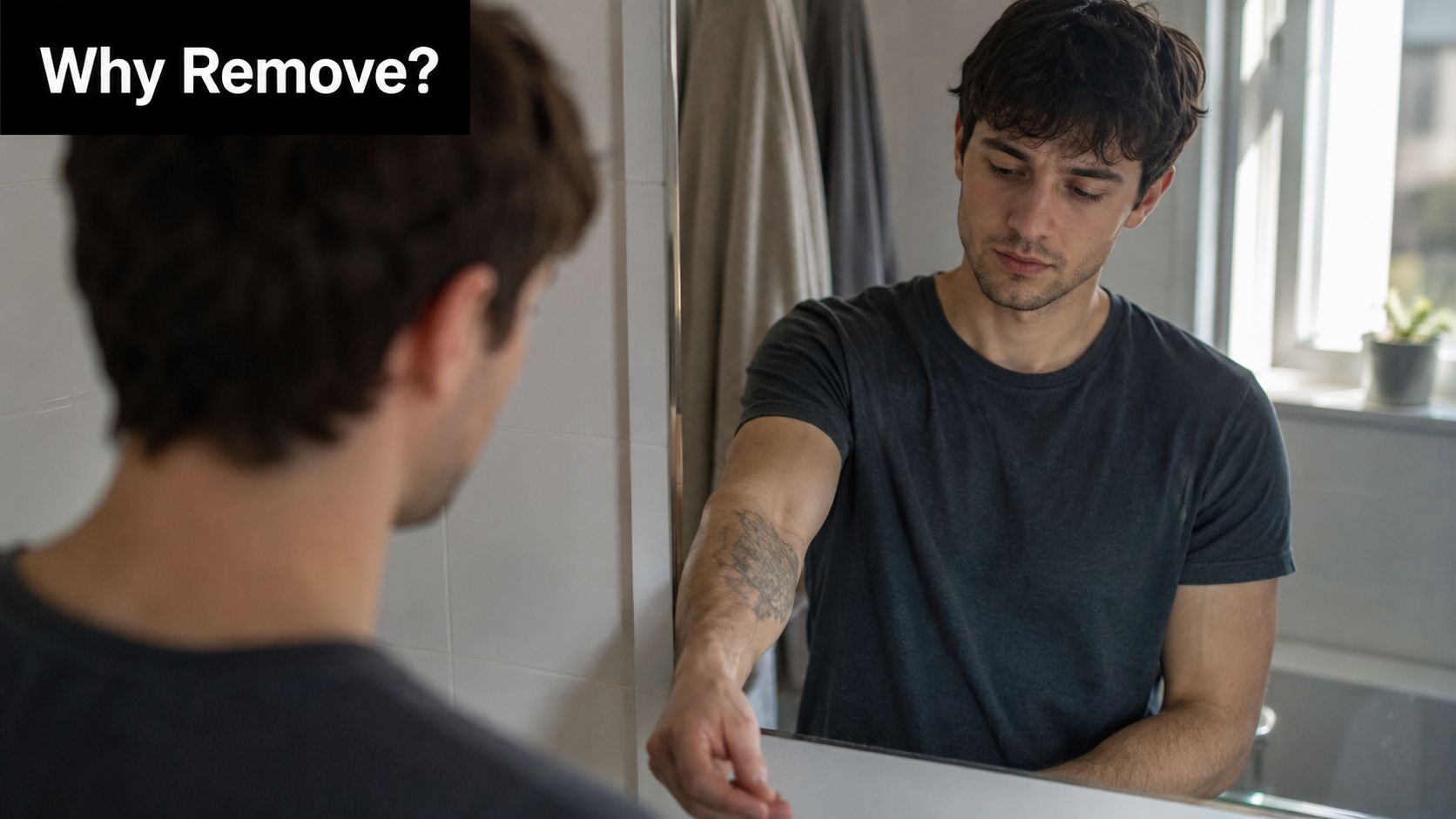
Standing in front of the mirror and wishing a tattoo would just disappear is a common kind of regret. Maybe the design no longer fits your work, your style, or the next chapter you're stepping into. Neo tattoo removal is the modern answer many people look for because it treats removal as a medical process, not a quick fix, and that matters when you want safe fading, cover-up prep, or a clean slate.
The tricky part is that tattoo removal is rarely instant. The ink has to be broken apart, your body has to clear it, and your skin has to recover between visits. That's why the smartest way to approach it is with clear expectations, a realistic timeline, and a basic understanding of what the laser is doing.
Table of Contents
- What Brings People to Neo Tattoo Removal
- How Neo Laser Tattoo Removal Works
- Neo Lasers Compared to Older Removal Methods
- What Happens During a Neo Removal Session
- Session Counts, Timelines, and Realistic Costs
- Candidacy, Risks, and Aftercare Essentials
- Getting Started With EradiTatt Across Florida
What Brings People to Neo Tattoo Removal
A lot of people start thinking about removal in very ordinary moments. You catch your reflection before work, before a wedding, or before a new job, and a tattoo that once felt right now feels off. That's usually when neo tattoo removal becomes more than a search term. It becomes a practical decision about how you want to show up in your daily life.
The reasons vary, but the pattern is familiar. Some people want full clearance, some want cover-up fading, and some just want a tattoo softened enough that it stops drawing attention. Others are trying to meet appearance rules for a career change, military service, or a professional role where visible ink feels risky.
Practical rule: if you're mainly after a better canvas for a cover-up, you may not need perfect clearance. Fading can be enough to open up more design options.
What people usually want to know first
The first question is almost always, “How long will this take?” That's fair, because removal is a commitment. The FDA says laser tattoo removal is the most common method used by health care professionals, treatments are spaced a few weeks apart, and it may take many sessions or still not fully remove a tattoo in every case. The Cleveland Clinic also notes that multiple visits are standard, and the body clears ink over time rather than all at once.
The second question is usually about outcomes. People want to know whether the tattoo can disappear, whether it can be lightened enough for a cover-up, and whether skin will look normal afterward. Those are honest questions, and they're better to ask up front than after the first session.
If you're sorting through those same concerns, the most useful mindset is simple. Treat the process like a project with stages, not a single appointment, and make your decision based on your actual goal, not on a promise of instant erasure.
How Neo Laser Tattoo Removal Works
A client often sees the same thing after a first session, a tattoo that looks a little washed out, then seems to keep softening over the next few weeks. That pattern makes sense once you know what the laser is doing. Short pulses of light break tattoo pigment into smaller particles, and the body clears those particles gradually through the lymphatic system Neo Tattoo Removal overview. The process depends on photomechanical fragmentation, which is a precise way of saying the ink is shattered into pieces small enough for the body to carry away.
That is why fading happens over time, not in the treatment room. The laser starts the breakup, but the cleanup belongs to the immune system. A tattoo may look lighter right after treatment, then continue to fade between visits as the body processes loosened pigment.
Why pulse duration and color matter
Pulse duration shapes how much energy reaches the ink versus the surrounding skin. Q-switched lasers fire in the nanosecond range and have long been a standard option, while picosecond systems use even shorter pulses that can break pigment with less heat spreading into nearby tissue review of laser physics. In plain terms, the shorter pulse gives the ink less time to absorb heat, so the treatment can be more selective.
Color changes the picture too. The FDA notes that black, blue, red, and green inks do not respond the same way, and some colors are harder to remove, which is one reason full clearance cannot be promised for every tattoo FDA tattoo removal guidance. A systematic review found that picosecond lasers performed especially well for blue, green, and yellow pigments systematic review.
That matters if you are looking at a cover-up, trying to clear a visible tattoo for a job, or dealing with a color mix that has resisted past fading. Modern neo technology is meant for that kind of real-world planning. It is a staged approach, not a single flash that erases everything at once, and a new technology tattoo removal overview can help readers understand how newer systems fit into that shift.
Plain-English takeaway: the laser breaks the ink, your body clears it, and the result appears gradually, not instantly.
Why some systems feel gentler
Shorter pulses can also reduce collateral damage to the skin around the tattoo. An observational split study found that both nanosecond and picosecond systems achieved acceptable clearance, but picosecond lasers caused less collateral skin damage than nanosecond lasers Wiley study. That difference matters when recovery time is part of the decision, especially for someone trying to keep visits spaced in a way that fits work, a cover-up plan, or simple day-to-day comfort.
For a broader look at how removal methods compare, a guide to removing unwanted tattoos can provide helpful background.
Neo Lasers Compared to Older Removal Methods
A tattoo removal plan can go in very different directions depending on the method you choose. Older approaches, including dermabrasion, salabrasion, surgical excision, and chemical peels, ask the skin to absorb more physical injury in exchange for fading ink. That is why the conversation usually shifts toward laser treatment, especially for people who want a clearer result without trading it for obvious surface change. If you want a readable overview of removal options, a guide to removing unwanted tattoos can be helpful background, and questions about home remedies often lead people to do tattoo removal creams work before they commit to a clinic visit.
Neo-style laser removal is the modern upgrade because it targets pigment below the skin surface instead of cutting the tattoo out or sanding the skin down. That difference matters in everyday situations, such as fading a cover-up candidate, clearing ink for work, or dealing with a piece that needs to look cleaner without leaving a rough texture behind. The goal is still gradual clearance, but the method gives the clinician more control over the surrounding skin.
| Method | Typical Sessions | Color Range | Scarring Risk | Recovery |
|---|---|---|---|---|
| Neo Laser Removal | Multiple staged visits | Broad, with modern systems better suited to stubborn colors | Lower than more aggressive surface methods, but not zero | Usually gradual, with temporary redness or soreness |
| Q-switched nanosecond lasers | Multiple staged visits | Established, effective for many inks | Low to moderate, depending on settings and skin type | Similar staged healing, often slower on resistant pigment |
| Dermabrasion | Usually one procedure or a few passes | Less selective for ink color | Higher because the skin surface is physically abraded | More intense healing and more visible aftercare |
| Salabrasion | One or a few treatments | Limited color selectivity | Higher due to surface injury | Longer surface healing |
| Surgical excision | Usually one procedure | All colors removed with the tissue | Leaves a linear scar | Healing depends on closure and size |
| Chemical peels | Repeated applications | Poor ink selectivity | Can be significant | Surface irritation and variable results |
The table makes the trade-off easier to see. Older methods can move faster in the sense that they act directly on the skin surface, but that speed comes with a higher chance of texture change, longer irritation, or a scar that becomes the new thing people notice. Laser systems usually ask for patience, yet they also give more room to protect the skin around the tattoo, which is part of why they fit better for people who care about appearance during recovery.
A newer short-pulse system can also fit colors that older technology handles less cleanly. That does not make every older method useless, but it does explain why modern clinics tend to favor laser-based plans over surface-damage approaches. For readers comparing options, the FDA overview of tattoo removal options and results is a useful reference point for how the main methods differ in practice.
What Happens During a Neo Removal Session
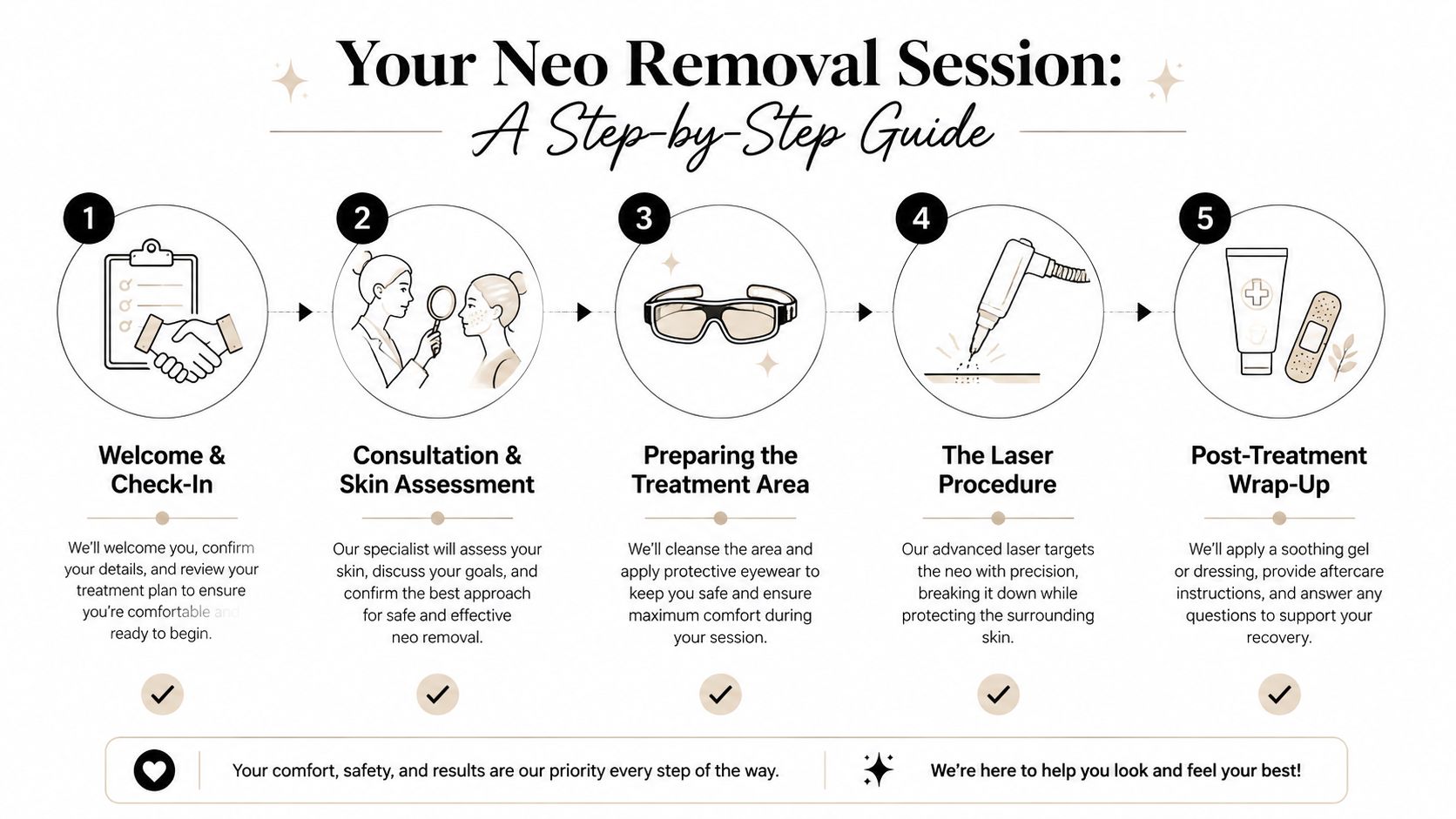
Your first visit usually starts with a check-in, a review of the tattoo, a discussion of medical history, and confirmation of whether the goal is full clearance or fading for a cover-up. If you want another plain-language walkthrough of the appointment flow, the guide on removing unwanted tattoos is useful context, but the core clinic experience is usually the same, careful and staged.
From skin check to test pulse
A clinician looks closely at the tattoo, because ink depth, color, and location influence how treatment is set up. Protective eyewear goes on before the laser fires. Many practices also use a test pulse, which helps confirm how your skin reacts before the full pass begins.
The sensation is often described as a quick snap against the skin. It's brief, and it comes in bursts rather than a steady burn. People with small tattoos may be in and out fairly quickly, while larger pieces take longer because the laser has to cover more surface area.
What your skin may look like right after
Right after treatment, redness and swelling are common, and a white or frosted look can appear briefly over the inked area. That frosting usually fades as the skin settles. At EradiTatt, the PiQo4 system is one example of the technology used in modern tattoo removal, which reflects how short-pulse systems are being used in real clinic settings.
The goal isn't to make the tattoo vanish in the chair. The goal is to start a controlled fading process your body can keep working on after you leave.
A short post-treatment wrap-up usually includes topical care instructions and a reminder not to rub, pick, or soak the area. If you want a separate first-visit walkthrough, the first laser tattoo removal session guide gives a helpful idea of what first-timers usually ask about.
Session Counts, Timelines, and Realistic Costs
Tattoo removal planning works best when you think in scenarios, not promises. A small black name tattoo is a very different project from a dense multicolor sleeve, and a faded amateur piece behaves differently than a professionally packed design. The FDA says treatments are usually spaced a few weeks apart, and a clinical review reports that 7 to 10 treatments are often needed with repeat sessions typically spaced about 8 weeks apart clinical review. Other clinical references say 4 to 15 treatments may be needed depending on age, color, quality, and placement NCBI Bookshelf.
Matching the tattoo to the likely timeline
| Tattoo Scenario | Estimated Sessions | Spacing Between Visits |
|---|---|---|
| Small black text or name | Often toward the lower end of a multi-session plan | About 6 to 8 weeks |
| Amateur ink with lighter density | Usually fewer sessions than dense professional work | About 6 to 8 weeks |
| Professional black linework | Commonly a moderate multi-session plan | About 6 to 8 weeks |
| Dense multicolor tattoo | Often on the longer side because colors respond differently | About 6 to 8 weeks |
| Cover-up fading goal | Usually fewer sessions than full clearance | About 6 to 8 weeks |
| Full removal goal | Usually the longest plan, especially for resistant colors | About 6 to 8 weeks |
The main reason not to rush is simple. The skin needs time to heal, and the body needs time to clear fragmented pigment. If sessions are packed too closely, the treatment plan can become less effective and more irritating.
What pricing usually signals
AP News reports that laser removal commonly takes 4 to 10 sessions and that session pricing can run from about $450 for small tattoos to $1,000 for larger ones AP News summary in the market report. That range helps people budget, but it also shows why vague teaser pricing can be misleading. A consultation is where the size, ink density, and plan are translated into something you can plan around.
If you want a rough self-check, ask whether your tattoo is small or large, black or multicolor, and whether your goal is fading or full removal. Those three answers usually tell you more than any generic “quick and easy” claim ever will.
Candidacy, Risks, and Aftercare Essentials
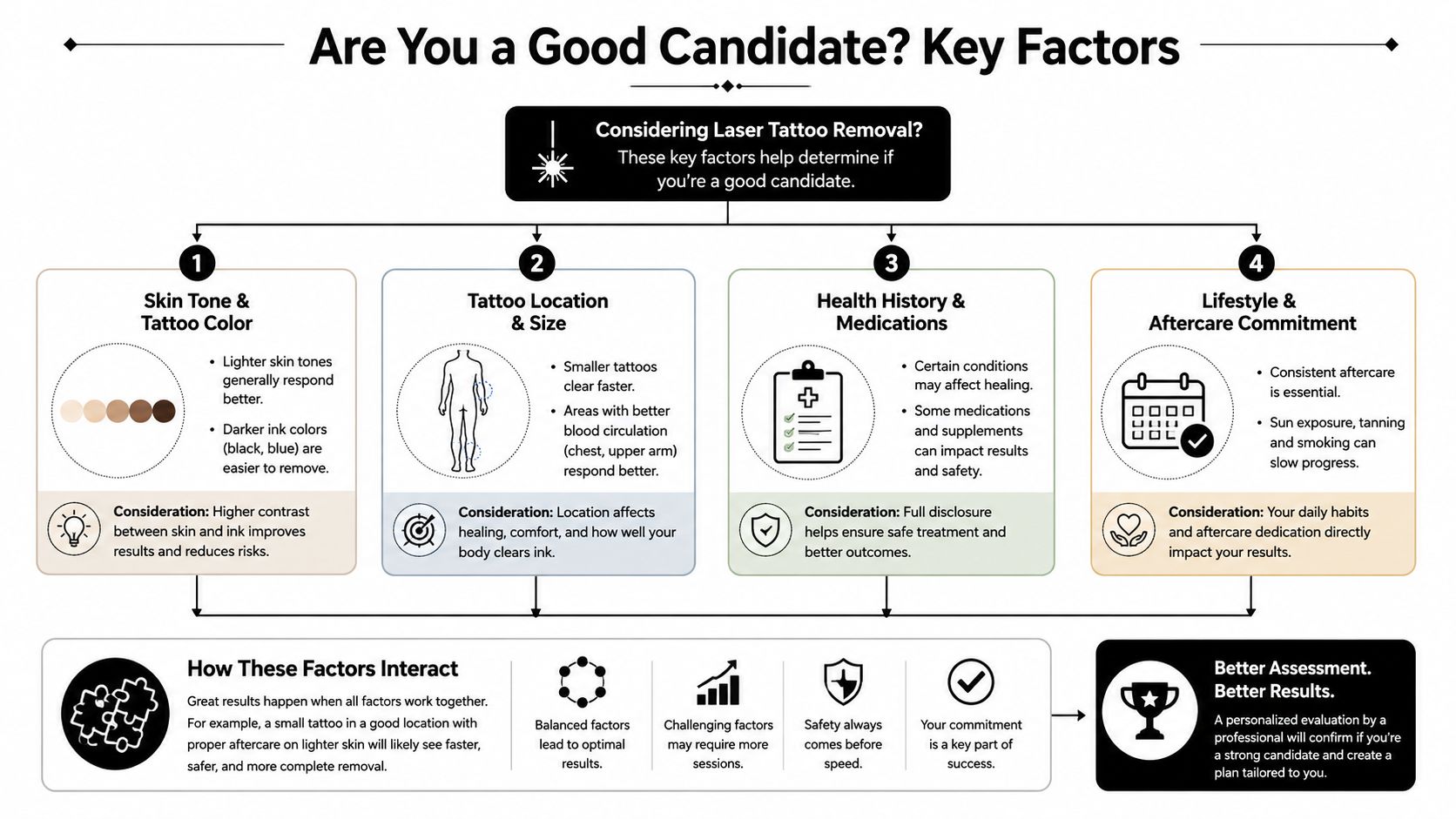
Good candidacy starts with a realistic goal. People with stable health, a tattoo they can keep out of the sun, and the patience for staged visits are often the easiest to plan for. People with darker or tan skin may still be candidates, but settings may need to be more cautious, because skin tone changes the risk profile and the way the laser is tuned.
What the risks actually mean in daily life
The Mayo Clinic says complete removal is difficult and that some scarring or skin color variation is likely to remain regardless of method Mayo Clinic. The FDA adds that laser removal can cause skin lighter than the surrounding area, plus scarring, infection, pinpoint bleeding, redness, or soreness FDA tattoo removal guidance. Those are the issues people worry about most, and they're worth naming clearly.
The best way to think about risk is to connect it to behavior. Picking at scabs, exposing the area to strong sun, or skipping instructions makes outcomes harder to predict. On the other hand, steady aftercare improves the odds that fading continues without avoidable irritation.
A simple aftercare routine
- Keep it out of direct sun: Freshly treated skin can react badly to UV exposure.
- Clean it gently: Use mild cleansing and avoid scrubbing the area.
- Skip soaking: No pools, baths, or long water exposure until the skin has settled.
- Leave blisters and scabs alone: Picking increases the chance of texture changes and delayed healing.
For readers who like a practical skin-care reference, Ella & Eden's pure vitamin E guide can be a useful way to think about topical products, but any product should fit the clinic's aftercare guidance rather than replace it.
Aftercare rule: protect the skin for a few days like it's healing from a sunburn, not like it's ready for a workout.
That mindset keeps the focus on healing first, fading second, and cosmetic appearance third. It's a simple order, but it matters.
Getting Started With EradiTatt Across Florida
For Central and West Florida readers, the next step is a consultation that turns guesses into a plan. That visit is where you get a candidacy review, a realistic timeline, and an estimate based on your specific tattoo, not a generic script. EradiTatt serves multiple Florida locations, so it's easier to match your schedule and your geography to the clinic you'll visit.
Orlando. 4700 Millenia Blvd, Suite 175, Orlando, FL 32839, call 844-327-4338 or 407-815-3816.
Bradenton/Sarasota. 11161 E State Road 70, Suite 110, Lakewood Ranch, FL 34202, call 844-327-4338 or 941-200-4297.
St. Petersburg. 1744 1st Avenue N, St. Petersburg, FL 33713, call 844-327-4338 or 727-258-4339.
Palm Harbor. 34899 US Highway 19 N, Suite 101, Palm Harbor, FL 34684, call 844-327-4338 or 727-900-2523.
Tampa. 4200 W Cypress Street, Suite 180, Tampa, FL 33607, call 844-327-4338 or 813-336-1500.
If you're comparing full removal with fading for a cover-up, bring a photo of the tattoo in natural light and be ready to talk about your goal. That makes the first conversation more useful and helps the clinic shape a plan around your skin, your ink, and your timeline.
If you're ready to start fading or fully erasing unwanted ink, EradiTatt Tattoo Removal can help you map out the process with a consultation, a realistic timeline, and a treatment plan built around your tattoo. Visit EradiTatt Tattoo Removal to find the Florida location that fits you and take the first step toward clearer skin.