
You may be looking at a green tattoo right now and wondering whether you waited too long, picked the hardest color, or got stuck with ink that won't fully clear. That concern is common. Green built its reputation for a reason. Older laser systems often struggled with it, and plenty of people were told that fading it would be slow, patchy, or incomplete.
That's no longer the full story. Modern green ink tattoo removal is much more precise than it used to be, but results still depend on one thing more than anything else: using the right wavelength and the right treatment strategy for the specific shade of green in your skin. The technology matters. The spacing between sessions matters. Your aftercare matters too.
What follows is a practical guide built around what changes outcomes, what slows them down, and what patients should know before starting.
Table of Contents
- Your Guide to Removing Green Tattoos
- Why Green Ink Is So Stubborn to Remove
- The Right Technology for Erasing Green Ink
- Your Green Tattoo Removal Journey Step by Step
- Timeline Results and Essential Aftercare
- Cost Considerations and Cover-Up Strategies
- Frequently Asked Questions About Green Tattoo Removal
Your Guide to Removing Green Tattoos
A client comes in with a green leaf, jewel tone, or bright emerald section that another clinic called “too hard” or “unlikely to clear.” That usually reflects the limits of older laser systems, not the reality of modern treatment. Green ink still takes planning, but with the right wavelength and pulse duration, it is highly treatable.
At EradiTatt, the first conversation is usually about the goal. Some clients want full removal. Others want enough fading to give their tattoo artist more room for a cover-up. Both are reasonable, and both depend on matching the treatment to the specific shade and composition of the green rather than treating it like generic color ink.
Green often needs more sessions than black because black absorbs a wider range of laser energy more readily. Clinical guidance from the Kirby-Desai scale overview published by StatPearls also reflects that darker, easier-to-target pigments tend to respond more efficiently than resistant colors. The key point is practical. Green is not “impossible.” Green is selective, and selective pigments respond best when the clinic has technology built for them.
That distinction matters. Older articles often repeat the myth that green is one of the hardest colors to remove without explaining why expectations changed. Picosecond platforms and color-specific wavelengths improved outcomes because they break pigment into smaller fragments and target shades that older systems often missed. That is why two clinics can give very different projections for the same tattoo.
If you want the treatment mechanics explained clearly before starting, this complete breakdown of how tattoo removal works for first-timers is a useful place to start.
A few points help set expectations early:
- Green is treatable with the right setup. The question is which laser and wavelength the clinic uses, not whether green can fade at all.
- Shade matters. Dark forest green, bright lime, teal-leaning green, and blended greens can respond differently.
- Session count is individual. Saturation, layering, location, skin tone, healing, and whether the tattoo was professionally applied all affect pace.
- Cover-up fading is often faster than full clearance. Reaching “light enough for new work” and reaching “fully removed” are different endpoints.
- Artist perspective matters too. For clients planning a redesign, reviewing student feedback on the masterclass can also help you understand how tattoo artists think about cover-up space, color balance, and workable fade levels.
The practical rule is simple. Green ink removal succeeds when the clinic treats it as a wavelength-matching problem and sets expectations around your actual pigment, not around outdated assumptions.
Why Green Ink Is So Stubborn to Remove
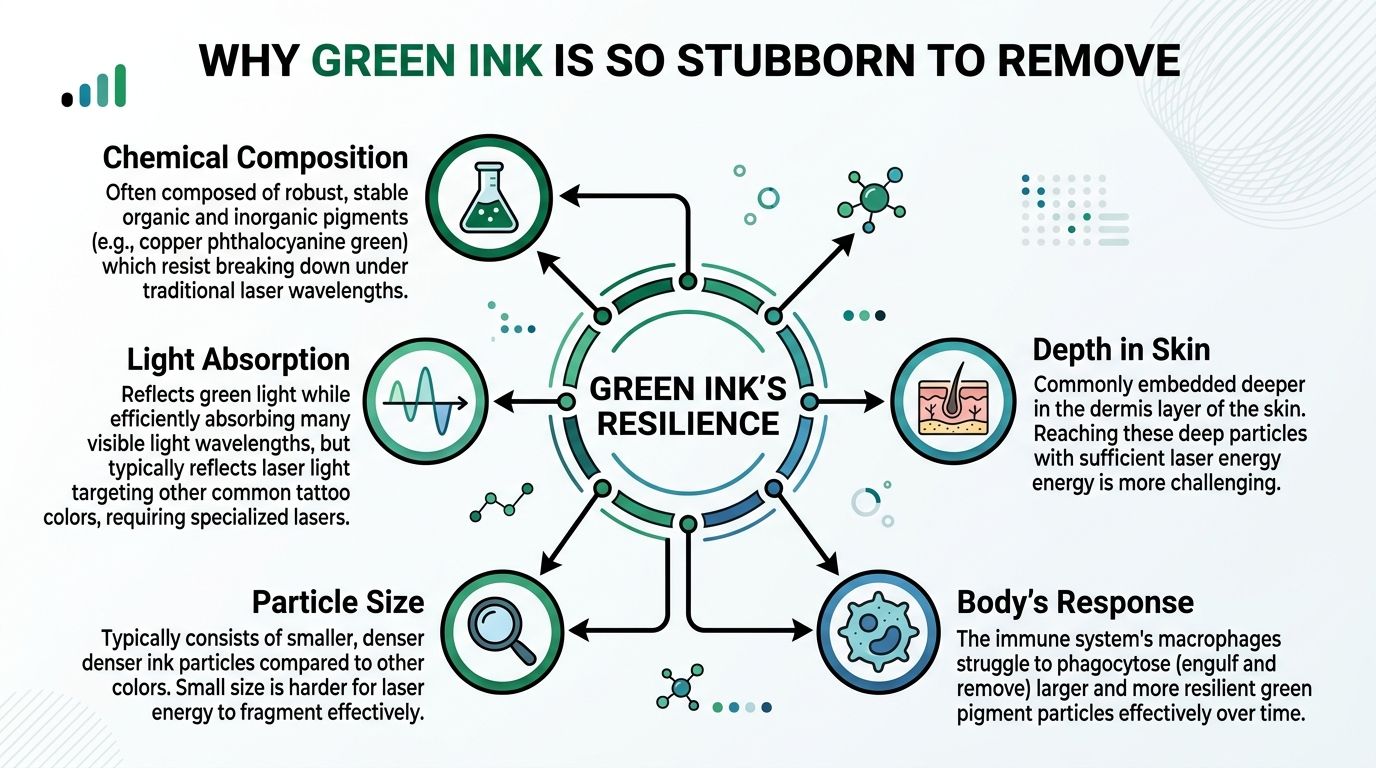
Green ink challenges laser removal for a simple reason. The pigment doesn't absorb light the way black ink does. Laser tattoo removal depends on matching a wavelength of light to the ink so the pigment can absorb that energy and fracture into smaller particles. When the match is poor, the treatment is weaker, slower, and less predictable.
Why black clears faster
Black ink is usually easier because it's carbon-based and absorbs a broader range of laser energy efficiently. Green pigment is more selective. It reflects some wavelengths and responds much better when the laser hits the part of the spectrum it can absorb.
That's why green often gets described as stubborn. The issue isn't that the body can't clear it. The issue is that the pigment has to be broken up properly first.
A few practical factors make green more difficult in real treatments:
- Pigment composition: Green formulas vary, and mixed pigments can behave unpredictably.
- Depth in the skin: If the ink sits deeper, the wavelength and delivery become more important.
- Particle density: Heavier saturation usually fades more slowly.
- Immune clearance: The laser starts the process, but the body finishes it over time.
Green isn't impossible to remove. It's just less forgiving when the wavelength is wrong.
Why the wavelength debate confuses people
Patients often hear a simplified version of the science: that one wavelength is the only real answer for green. That idea leaves out some important nuance. Coverage on this topic is often incomplete, especially when it ignores newer devices and different delivery methods.
One discussion of that gap notes a conflicting consensus around the “only effective” wavelength for green. Some sources frame 755 nm as the exclusive standard, while others report 90 to 98% clearance with 1064 nm diode or 785 nm Ruby diode approaches, challenging the one-wavelength myth in this review of green ink wavelength claims.
That's one reason people researching tattoo technique often spend time looking at visual training and critique from working artists and educators. Even outside removal, resources like student feedback on the masterclass can help people understand how much pigment choice, saturation, and placement affect long-term behavior in the skin.
The takeaway is practical. Green can be treated well, but broad statements like “any laser can do it” or “only one machine can do it” usually oversimplify what is occurring.
The Right Technology for Erasing Green Ink
Green tattoos are often the point where patients realize not all laser systems are built for the same job. A clinic can do solid work on black ink and still struggle with green if the device does not offer the right wavelength or if the settings are too generic for that pigment.
What the Right Laser Is Doing
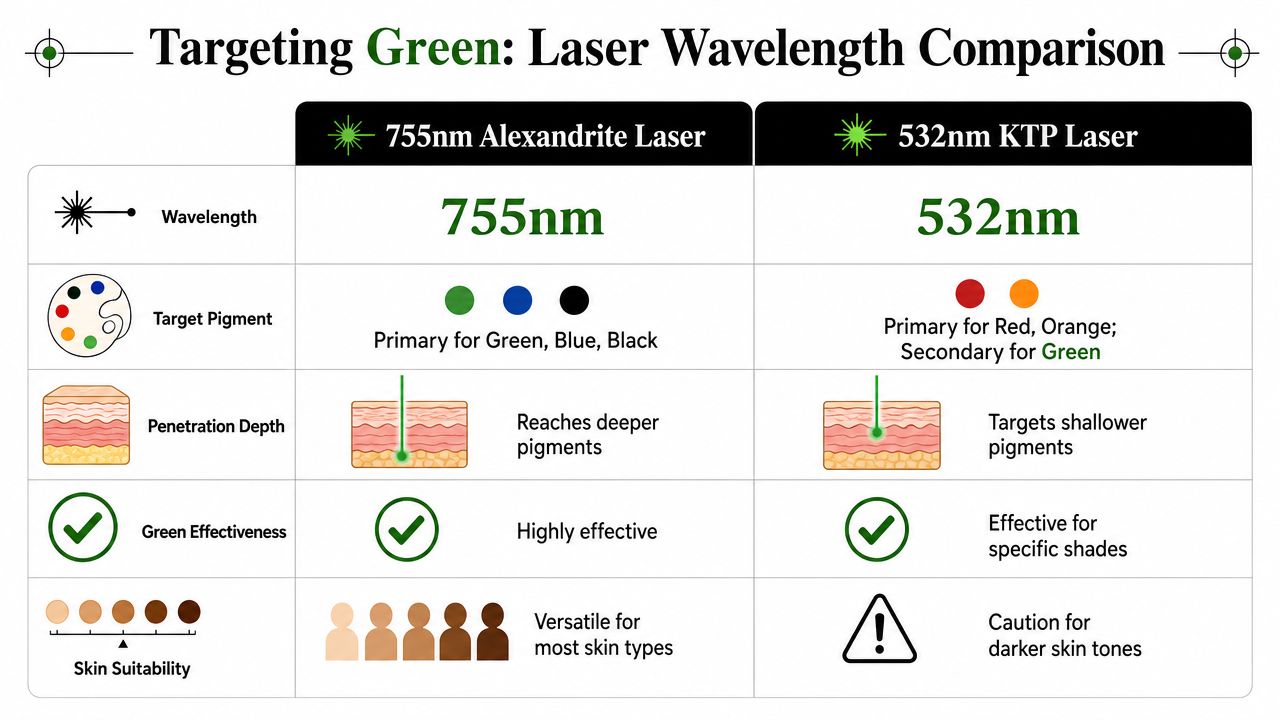
The first question is wavelength. Green ink responds best when the laser energy lands in a range that the pigment absorbs well. In practice, 755 nm Alexandrite has long been one of the key options for green because it targets this color range more directly than standard black-ink settings.
The second question is pulse duration. That matters more than many patients realize. Older nanosecond systems can treat green, but picosecond platforms deliver energy in much shorter pulses, which improves pigment fragmentation and often produces a cleaner response in resistant colors.
Both variables matter at the same time.
| Technology factor | Why it matters for green |
|---|---|
| Wavelength match | Green pigment has to absorb the laser energy well enough for treatment to be efficient. |
| Pulse duration | Shorter pulses create stronger photoacoustic disruption, which helps break ink into smaller particles. |
| Depth handling | Dense or deeply placed green can need different settings than a lighter, more superficial tattoo. |
This is the part many articles miss. Green was never “impossible” to remove. It was historically difficult when clinics tried to treat it with the wrong wavelength, older pulse technology, or a one-setting approach.
Why picosecond systems changed expectations
Picosecond technology changed green removal because it improved how energy is delivered, not because it turned every tattoo into an easy case. That distinction matters. Better fragmentation usually means better odds of steady fading, but tattoo density, ink blends, layering, and body placement still affect the pace.
Modern multi-wavelength platforms widened the treatment options for resistant colors. A device such as the PiQo4 laser system for multi-wavelength tattoo removal gives providers more flexibility when a tattoo contains green beside blue, black, or mixed tones. That flexibility matters because real tattoos are rarely one clean, uniform shade.
In clinic, the difference shows up in planning. Olive green may respond differently from bright emerald. A green that was packed heavily into scarred skin behaves differently from a lightly shaded green wash. Mixed pigments can also change the target. If yellow or blue is blended into the area, the provider may need to adjust strategy across sessions instead of repeating the same pass each time.
Good technology improves the odds. Experienced settings improve the execution.
When evaluating a clinic, ask specific questions:
- Which wavelength will you use for my shade of green?
- Is the system picosecond, nanosecond, or both?
- How do you treat green that is mixed with other colors?
- Do you change settings if one section is dense, layered, or slower to respond?
The right machine gives green ink a real treatment path. The right operator knows how to adjust that path when the tattoo does not respond evenly.
EradiTatt Tattoo Removal uses the PiQo4 Laser System because green tattoos often need more than a basic black-ink setup. That is especially useful for multi-color pieces and for cases where older assumptions about green have already led to slow or disappointing results.
Your Green Tattoo Removal Journey Step by Step
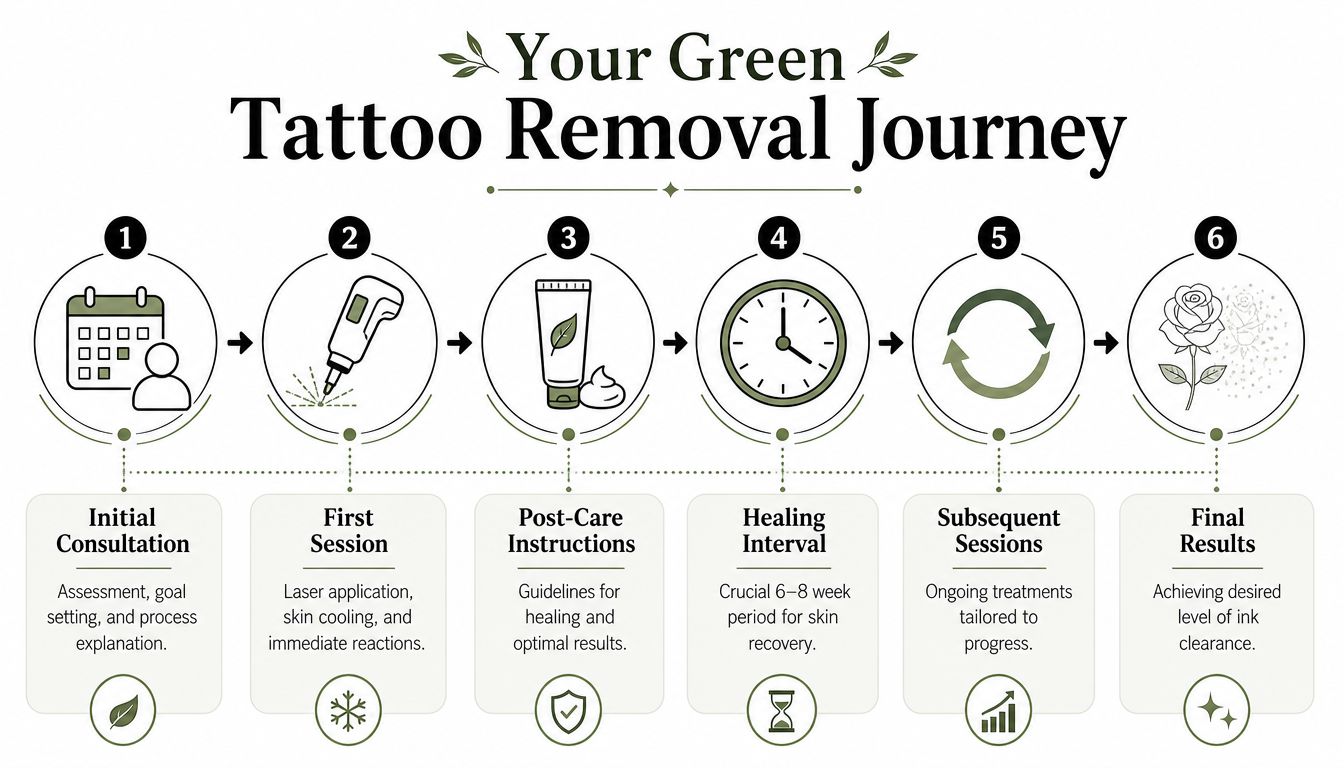
Starting treatment usually feels less intimidating once you know what the sequence looks like. The process is structured, not mysterious, and each appointment builds on the last.
Consultation and treatment planning
The first visit is about assessment. The provider looks at the shade of green, saturation level, tattoo age, body placement, skin tone, and whether the ink sits alone or next to other colors. A cover-up plan changes the target too. Fading for a tattoo artist is different from aiming for maximum clearance.
This is also where expectations get calibrated. Some tattoos respond in a very clean pattern. Others break unevenly at first, especially if the original artist packed the green heavily or layered it over older work.
A consultation often covers:
- Color mapping: Which parts are green only, and which parts are mixed.
- Treatment goal: Full removal or strategic lightening.
- Skin history: Reactions, sensitivity, pigment issues, and healing patterns.
- Patch-test logic: In some cases, testing a small area helps predict response and tolerance.
What treatment day feels like
The session itself is usually brief compared with the weeks of fading that follow. The skin is prepared, the treatment area is marked, and cooling measures may be used to improve comfort. During laser passes, many patients describe the sensation as sharp, hot snaps against the skin.
You may also notice immediate whitening or a frosted look on the tattoo. That short-term reaction is normal and often means the laser energy has interacted with the pigment and skin surface gases as expected.
Don't judge the result by what you see in the first hour. The real work happens during healing.
A typical appointment includes a few distinct phases:
Pre-treatment prep
The area is cleaned, photographed, and reviewed one more time so settings match the current condition of the tattoo.Laser application
The provider treats the green sections with settings chosen for that pigment and depth, adjusting cautiously if the skin response calls for it.Immediate cooling and dressing
Once the passes are done, the area is cooled and protected to reduce irritation.
What happens after you leave
Right after treatment, the area can feel hot, tight, or swollen. Redness is common. Some patients blister. Some don't. Both can fall within a normal healing response depending on the tattoo and how the skin reacts.
The key point is that the appointment doesn't remove the ink on the spot. It starts a biological cleanup process. Over the next several weeks, the body clears disrupted pigment gradually.
That's why consistency matters more than intensity. A provider who treats carefully and spaces appointments appropriately usually protects the skin better than one who chases dramatic same-day change.
Timeline Results and Essential Aftercare
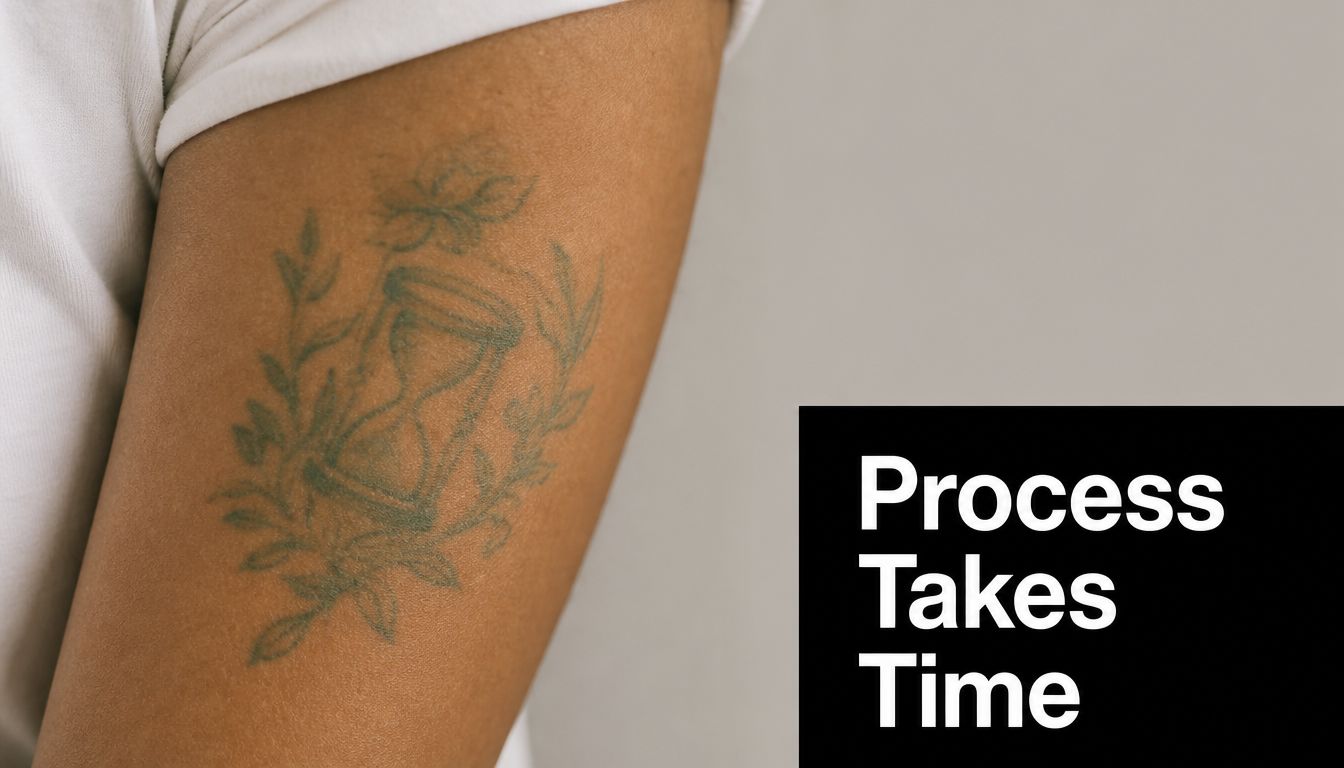
A common green tattoo removal scenario goes like this. After the first session, the tattoo still looks very similar once the initial frosting and redness settle. By the second or third, the green often starts to break unevenly. Some areas soften quickly. Other sections hold on longer because the pigment sits deeper, was packed more densely, or contains a blend that responds at a different pace.
What fading looks like over time
Green ink can respond well with the right wavelength and modern picosecond technology, but it still clears on a biological timeline. The laser does the fragmentation. Your body does the clearing. That is why visible change often arrives in stages rather than as a dramatic jump after every appointment.
In practice, progress usually looks like this:
- First few days: Redness, swelling, tenderness, and sometimes blistering or pinpoint crusting.
- Next couple of weeks: The surface calms down while the deeper healing response continues.
- Following several weeks: The green may look duller, less solid, or more broken apart.
- Before the next session: The area is reassessed based on skin recovery and pigment response, not impatience.
The spacing between sessions matters as much as the laser choice. Treating too soon can increase irritation without giving the body enough time to clear what was already disrupted. At EradiTatt, that timing is based on how the skin heals, how the pigment is changing, and whether the goal is full removal or controlled fading for a cover-up.
Some tattoos fade in a fairly predictable way. Others stall for a session, then improve again once the deeper pigment becomes more accessible. Green is no longer the impossible color it was once made out to be, but it still benefits from disciplined treatment intervals and realistic expectations.
Aftercare that protects your results
Good aftercare protects skin quality, reduces the chance of complications, and helps keep the project on schedule. Patients usually do best when they keep the routine simple and consistent.
For a closer look at why aftercare matters after laser tattoo removal, review the guidance before your first appointment.
Use this checklist:
- Keep it clean: Wash gently as directed. Do not scrub or exfoliate the area.
- Leave blisters alone: Blistering can be a normal response. Picking or popping raises the risk of irritation and scarring.
- Reduce friction: Loose clothing is usually better while the skin is tender.
- Avoid sun exposure: UV exposure can worsen inflammation and increase pigment changes in healing skin.
- Follow ointment and bandage instructions: More product does not speed healing.
- Report concerning symptoms: Increasing pain, spreading redness, drainage, or fever should be reviewed promptly.
Healing well is part of the treatment plan.
Temporary redness, swelling, tenderness, itching, and occasional blistering can all fall within a normal post-treatment response. What matters is the overall pattern. Skin that settles progressively over several days is different from skin that becomes more painful, more inflamed, or shows signs of infection. That distinction is one reason follow-up guidance matters, especially with green tattoos that often require multiple carefully spaced sessions.
Cost Considerations and Cover-Up Strategies
Green tattoo removal cost depends on the tattoo, not just the color. A small green accent in a multicolored piece is a different project from a dense, fully saturated green section packed into thick linework and shading. Session count, size, location, and whether the tattoo is layered all affect the total investment.
What affects the total price
The most important pricing variables are usually:
- Tattoo size: Larger areas take more treatment time.
- Ink density: Heavier pigment often needs more sessions.
- Color complexity: Mixed tattoos can require different strategies across different zones.
- Goal: Full removal and cover-up fading are not the same endpoint.
Because green can take a more customized wavelength approach, an in-person evaluation is the only reliable way to price the work accurately. That's especially true when the tattoo includes black, blue, yellow, or red beside the green.
Full removal or strategic fading
Not everyone needs a blank slate. In many cases, the smarter move is partial fading to help a tattoo artist build a cleaner cover-up. That approach can preserve time, skin quality, and budget when your real goal is new artwork rather than complete erasure.
A few decision points help:
| Your goal | Better strategy |
|---|---|
| You want the tattoo gone entirely | Aim for progressive full removal |
| You plan to rework the area with new art | Fade the darkest or busiest sections first |
| You only dislike one green element | Ask about selective treatment if the design allows it |
The right plan is the one that matches your endpoint. Some patients overcommit to full removal when fading would solve the problem faster. Others try to save money with minimal fading, then realize the cover-up artist still doesn't have enough room to work.
Frequently Asked Questions About Green Tattoo Removal
Does green tattoo removal hurt more than black ink removal
Pain varies more by body location, skin sensitivity, and treatment settings than by color alone. Green isn't automatically more painful. What patients usually notice is that stubborn areas may require careful repeat sessions, which makes the process feel longer overall.
Can one green area be removed without treating the whole tattoo
Sometimes, yes. Selective treatment can work when the green area is clearly separated from the rest of the design. It's less straightforward when pigments overlap, blend, or sit tightly against lines you want to preserve.
When can I get a cover-up
That depends on how much fading your tattoo artist needs and how your skin heals. The skin should be calm, intact, and fully recovered before new tattooing. If you're planning a cover-up, it helps to involve the future artist early so the removal target is clear.
Can green ink be fully removed
Often, yes. But “fully removed” doesn't look identical in every person or every tattoo. Some tattoos clear very cleanly. Others leave faint residual tone, textural change, or barely visible shadowing. The more realistic goal is this: get the tattoo as clear as your skin and pigment profile allow, without pushing treatment so aggressively that the skin pays for it.
If you're ready to talk through your tattoo, your options, and whether full removal or cover-up fading makes more sense, EradiTatt Tattoo Removal can help you plan the next step across its Florida locations with a consultation built around your skin, your ink, and your goal.