You're probably here because your forearm tattoo doesn't fit your life the way it used to. Maybe it's the name you stopped explaining a long time ago. Maybe it's a bold black piece that looked right at the time, but now it shows every time you shake hands, interview, or roll up your sleeves.
That's a common place to be. Forearm tattoos are highly visible, hard to ignore, and often tied to moments people have outgrown. The good news is that removal isn't about erasing your past. It's about giving yourself options, whether you want clear skin again or just enough fading for something new.
Table of Contents
- Considering a Change What to Know First
- How Laser Removal Works on Your Forearm
- Key Factors That Influence Your Removal Journey
- Full Removal vs Cover-Up Fading What Is Your Goal
- The Forearm Removal Timeline Pain and Healing
- Choosing Your Clinic and Understanding Costs
- Forearm Tattoo Removal FAQs
Considering a Change What to Know First
A forearm tattoo tends to become part of your public identity. You see it while driving. Other people see it when you reach for a coffee cup. That constant visibility changes how people feel about keeping it, especially when their job, style, or priorities shift.
Forearms and hands are the most frequently treated visible areas in tattoo removal, and people ages 18 to 39 make up about two-thirds of removal patients globally according to a global analysis of over 200,000 individuals. That tracks with what many clients feel in real life. A tattoo that felt personal at one stage can start feeling limiting later.
Some people come in wanting a clean slate before a career move. Others are getting married, joining the military, changing their image, or tired of answering questions about a design they no longer connect with. All of those reasons are valid.
Your reason doesn't have to sound dramatic to matter. “I'm just done with it” is enough.
Laser removal is usually the option people consider when they want the best balance of precision, skin preservation, and predictable fading over time. It's not instant, and it's not magic. But it is a controlled medical-aesthetic process that works with your body rather than scraping or cutting the tattoo out.
What makes the forearm different
The forearm has its own quirks. Skin thickness changes from the elbow side down toward the wrist. The area gets regular sun exposure. It also moves constantly, which matters during healing because friction from sleeves, workouts, watches, and desk contact can irritate treated skin.
That's why forearm tattoo removal works best when you approach it with a clear goal and realistic expectations. A small black script near the inner wrist can behave very differently from a dense outer-forearm piece with heavy shading.
The first decision isn't laser type
It's your goal.
Are you trying to remove the tattoo completely, or are you trying to lighten it enough for a better cover-up? That one answer affects your timeline, your aftercare mindset, and how aggressive a technician should be with each session.
How Laser Removal Works on Your Forearm
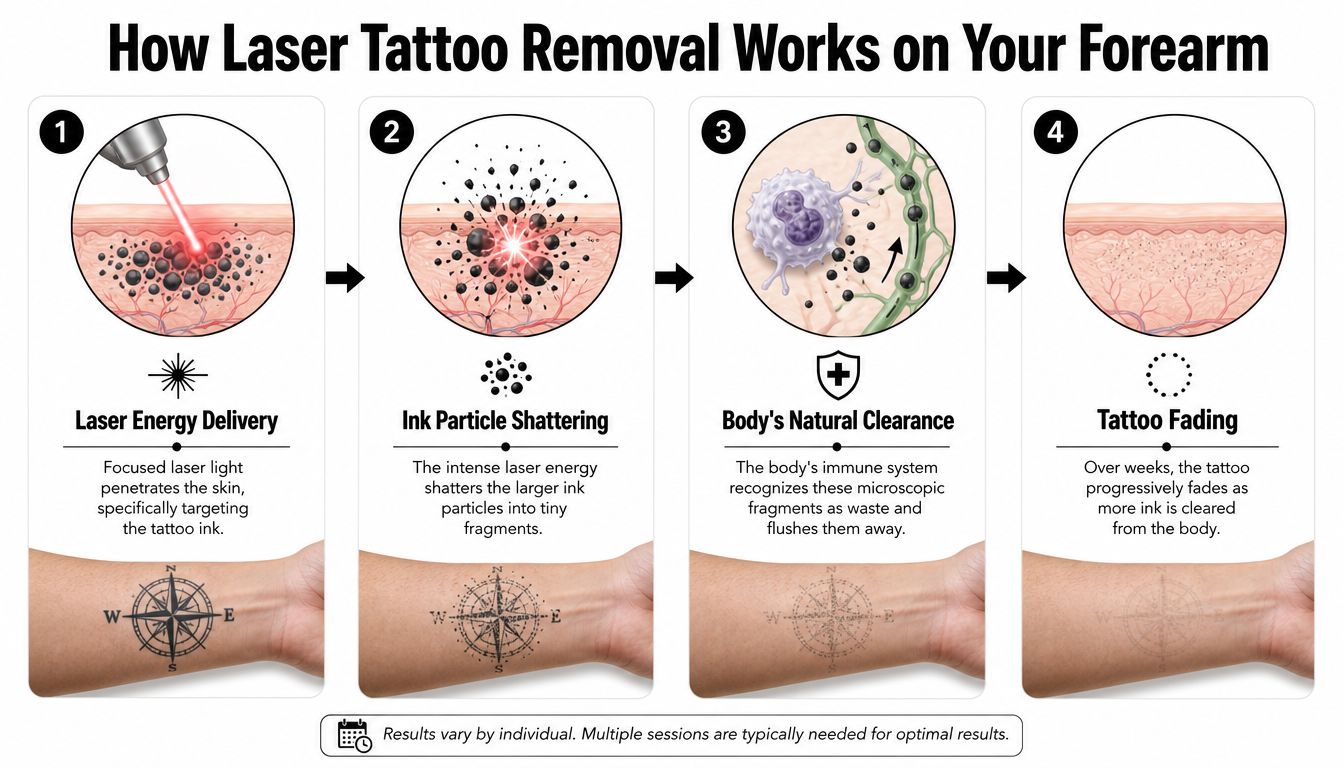
Laser tattoo removal doesn't “burn off” ink. It breaks the ink into much smaller fragments so your body can gradually clear them.
Think of the tattoo pigment like a pile of rocks buried in the skin. The laser acts like a precise удар of energy that cracks those rocks into pebbles and dust. Once the pieces are small enough, your immune system can carry them away over time. The laser starts the process. Your body finishes it.
Why the forearm needs a custom approach
The forearm isn't one uniform treatment zone. Skin near the wrist can be thinner and more reactive than skin higher up the arm. The outer forearm also tends to get more sun, which matters because recently tanned or irritated skin needs extra caution.
A good technician adjusts settings based on the specific part of the forearm being treated, not just the tattoo as a whole. That's one reason consultations matter so much. The same ink can respond differently depending on placement, saturation, and skin tone.
Practical rule: The forearm may look like one simple canvas, but treatment settings often change across that canvas.
How lasers target ink
Different wavelengths interact with different pigments. Black ink is usually the most responsive because it absorbs laser energy efficiently. That's useful on the forearm, where many tattoos are bold, visible, and heavily outlined.
For carbon-based black tattoos on fair skin, clearance with Q-switched ruby, alexandrite, or Nd:YAG lasers exceeds 90% with a low incidence of complications, while Q-switched Nd:YAG is preferred for darker skin to reduce risk and preserve efficacy according to the NCBI clinical overview of laser tattoo removal. In practice, that means skin tone and ink type both shape the safest machine choice.
If you want a deeper explanation of modern devices and why clinics may choose one platform over another, this guide to PiQo4 laser tattoo removal gives helpful background on current technology.
A typical forearm session follows a simple sequence:
- Assessment of the area. The technician checks ink color, density, skin tone, and recent sun exposure.
- Laser passes over the tattoo. Energy is delivered in controlled bursts.
- Immediate skin response. The area may whiten briefly, then look red or swollen.
- Recovery and fading phase. Your body clears fragmented pigment over the following weeks.
That last part is where people get impatient. Most visible fading happens after the appointment, not during it.
Key Factors That Influence Your Removal Journey
Two forearm tattoos can look similar at a glance and still follow very different removal paths. A technician isn't just looking at size. They're reading the tattoo like a map of decisions: what ink was used, how densely it was packed, how old it is, and how your skin is likely to respond.
Forearms are a major treatment area, and a large global analysis reported that forearms are the most frequently treated visible area, that people aged 18 to 39 account for about 66% of patients, and that black ink is the most commonly removed pigment worldwide. That matters because many clients seeking forearm tattoo removal are dealing with exactly the kind of visible black-ink work that clinics treat every day.
What a technician evaluates first
Some factors make removal more straightforward. Others slow it down.
- Ink color matters: Black usually responds better than lighter or more complex colors.
- Tattoo age changes behavior: Older tattoos may break down differently than newer, freshly packed work.
- Ink density is huge: Heavy shading and saturated linework usually take more effort than lighter designs.
- Skin tone affects settings: The laser has to target ink while protecting the surrounding skin.
- Placement on the forearm matters: Inner forearm, outer forearm, and wrist-adjacent skin don't always react the same way.
If you want a clinic-focused breakdown of what professionals look at during planning, these factors that can affect tattoo removal progress are worth reviewing.
Factors Affecting Forearm Tattoo Removal
| Factor | Easier to Remove | More Challenging to Remove |
|---|---|---|
| Ink color | Black or very dark pigment | Lighter or mixed colors |
| Tattoo age | Older tattoo with some natural fading | Newer tattoo with fresh, dense saturation |
| Ink density | Fine lines, light shading, less packed ink | Heavy fill, thick outlines, layered work |
| Skin tone | Skin that allows a wider range of settings safely | Skin that requires more conservative settings to avoid pigment changes |
| Location on forearm | Areas with calmer skin and less daily friction | Areas near the wrist or zones with more sun exposure and rubbing |
| End goal | Fading for a cover-up | Complete removal to a blank-skin result |
A consultation isn't just about saying “yes, this can be removed.” It's about estimating what will make your tattoo fast, slow, simple, or stubborn.
One common point of confusion is tattoo age. People often assume older always means easier. Sometimes that's true. But age only tells part of the story. An older tattoo with dense black packing can still take time, while a lighter design may respond faster.
The most accurate plans come from looking at the whole picture, not one variable in isolation.
Full Removal vs Cover-Up Fading What Is Your Goal
A forearm tattoo often reaches a decision point before the laser starts. You look down at your arm and ask a simple question with two very different answers. Do you want blank skin again, or do you want a better tattoo in the same place?
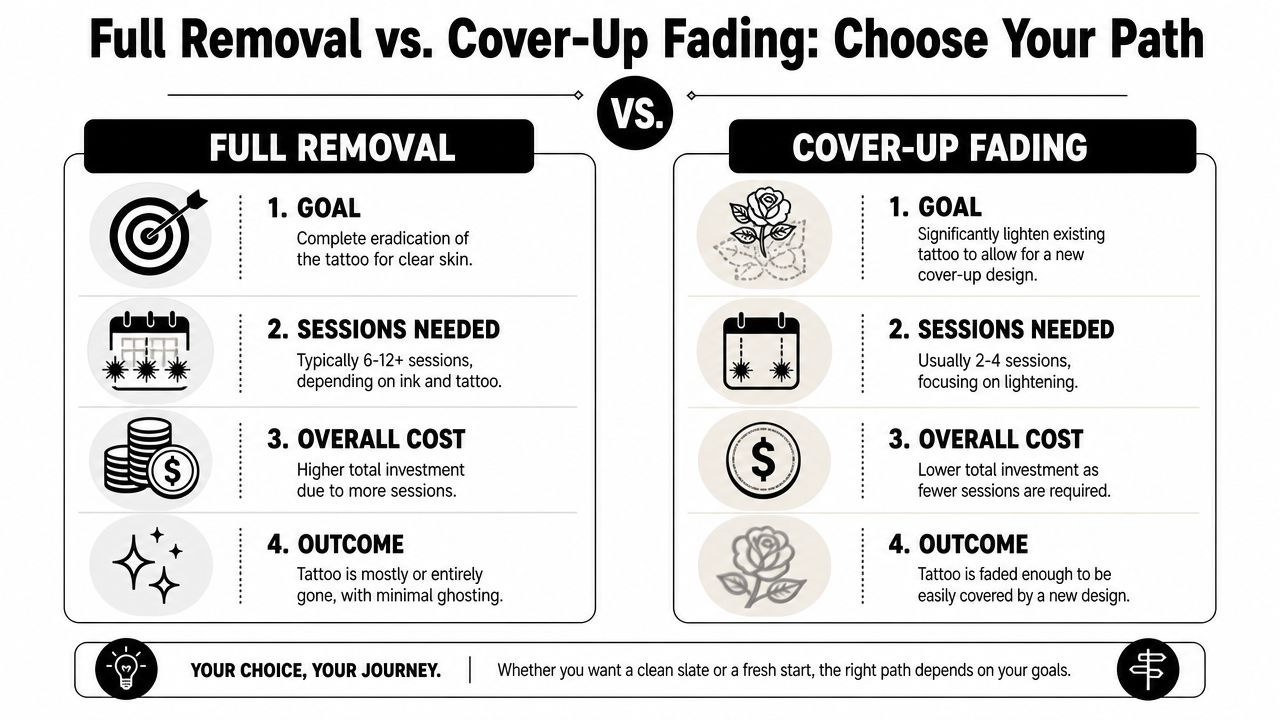
That choice shapes the whole plan. Full removal aims for the clearest result your skin can safely reach. Cover-up fading has a different finish line. The goal is to lighten the old design enough that a tattoo artist can work with it, instead of fighting through heavy outlines and dark fill.
On the forearm, that distinction is especially important because the area stays visible all the time. A partly faded tattoo may feel perfectly fine if you are preparing for new artwork. The same level of fading can feel unfinished if your real goal is no visible tattoo at all. The outer forearm also tends to draw more attention than many other body areas, so clients usually notice every stage of change more closely.
When full removal makes more sense
Full removal fits people who want the tattoo gone rather than redesigned. Some want a cleaner look for work. Some want to stop seeing a reminder tied to a past relationship, job, or phase of life. Some are tired of giving up forearm space to a piece they no longer enjoy.
The forearm can be a demanding place for this goal. Skin thickness can vary from the elbow side down toward the wrist, and the result may clear unevenly from one section to another before it evens out over time. That is normal. It is a bit like erasing a drawing from textured paper. Some parts lift faster, while others hold onto faint traces longer.
If your ideal outcome is clear skin, say that early. A technician can then plan settings, spacing, and progress checks around maximum safe clearance instead of stopping once the tattoo is only light enough to hide.
When fading for a cover-up is the better move
Fading works well for clients who still want tattooed skin, just not the current design. In that case, you are not chasing perfection. You are creating room. Less visible old ink gives the artist more freedom with shape, contrast, and lighter areas, which can help avoid a cover-up that becomes larger, darker, or heavier than you wanted.
This option is often practical on the forearm because placement is so public. Many clients want the old piece improved as soon as possible, not removed all the way over a longer stretch of time. If you're exploring design ideas before committing, it can help to look through expert cover up solutions so you understand how artists rebuild a visible arm piece after laser fading.
A quick test can help:
- Choose full removal if your target is skin that reads as tattoo-free.
- Choose cover-up fading if your target is better art, not blank skin.
- Choose a consultation first if you keep switching between those two outcomes.
That last group is common.
Clients sometimes start by saying they want complete removal, then realize they mainly want to get rid of the darkest parts and keep the area open for a new design. Others ask for a cover-up plan, then decide they do not want more ink on such a visible part of the body. Both are reasonable. The mistake is treating those goals as interchangeable, because they call for different expectations from the start.
The Forearm Removal Timeline Pain and Healing
You leave a forearm session, pull your sleeve down, and immediately wonder two things. What should this feel like tonight, and when will I see a difference? Those questions come up at almost every consultation because the forearm is hard to ignore. You see it when you type, drive, shower, and get dressed, so every stage feels more noticeable than it might on a less visible area.
The timeline also feels longer on the forearm for practical reasons. Different parts of the forearm can react a little differently, and the area deals with constant movement, sunlight, friction from sleeves, and contact with desks, gym equipment, and bag straps. Good results depend as much on healing between visits as on the laser itself.
What treatment day feels like
The sensation is usually brief and sharp. Many clients compare it to fast rubber-band snaps mixed with heat. On the inner forearm, where skin can be thinner and more sensitive, it may feel spicier. On the outer forearm, some clients find it easier to tolerate.
Right after treatment, the skin often turns white for a few minutes. That is a common laser response. Over the next several hours, redness, warmth, swelling, and a sunburn-like feeling are typical. Blistering, flaking, or small scabs can also happen during normal healing if the area is protected and left alone.
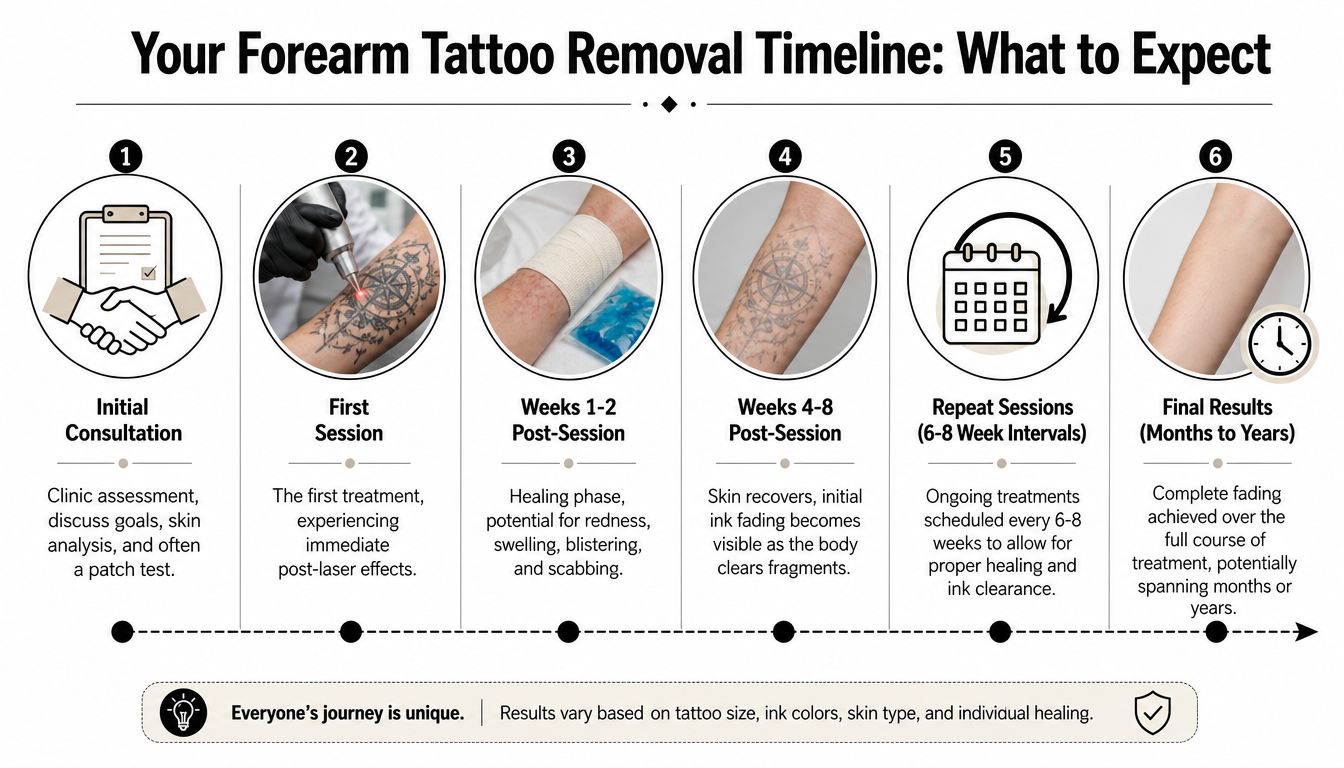
A standard appointment usually follows this sequence:
- Skin check and prep: Your technician checks for tanning, irritation, open skin, or anything else that could make treatment unsafe.
- Laser treatment: The tattoo is treated in controlled passes based on your ink, skin tone, and goal.
- Cooling and dressing: The area is cooled, then covered if needed.
- Home aftercare: You keep the forearm clean, dry, protected, and out of direct sun.
One forearm-specific tip helps more than clients expect. Reduce rubbing. Tight cuffs, watch bands, weightlifting grips, and absent-minded scratching can turn mild inflammation into a longer healing week.
Why the waiting between sessions is part of the treatment
Laser removal works like breaking a mural into tiny fragments, then waiting for your body to carry those fragments away. The laser does the shattering. Your immune system handles the cleanup. That cleanup takes time, which is why appointments are spaced out instead of stacked close together.
For many forearm tattoos, sessions are commonly scheduled about 6 to 8 weeks apart, and some cases need longer gaps depending on healing, skin response, and how quickly fading shows up, as noted earlier in the article. If you try to rush the schedule, you usually do not get faster clearance. You just give the skin less recovery time.
That slow pace can be frustrating on a visible area. It is still normal.
A newer tattoo can test your patience even more. Starting removal too soon is not always the fastest route overall. A clinic may advise waiting until the tattoo is fully settled in the skin before beginning, especially if the area still shows lingering sensitivity or raised texture.
A practical forearm healing timeline
The exact pace varies, but most clients find this general pattern helpful:
- First 24 hours: Heat, redness, swelling, and tenderness are common.
- Days 2 to 7: Blisters, dryness, itching, or light scabbing may appear.
- Weeks 2 to 4: The surface usually looks calmer, even though fading may still be subtle.
- Weeks 4 to 8 and beyond: More visible lightening can develop as the body continues clearing pigment.
The forearm can fool people here. Skin may look healed on the surface before it has fully settled underneath. That is one reason aftercare and timing matter so much.
How to make healing easier
Keep the plan simple and consistent.
- Clean gently: Use mild cleansing and avoid scrubbing.
- Do not pick: Flaking skin and blisters need time to resolve on their own.
- Protect from sun: Forearms catch incidental exposure during walks, driving, and outdoor errands.
- Limit friction: Loose sleeves are usually kinder than tight ones for the first few days.
- Ask when unsure: If the area looks unusually angry or painful, contact your clinic instead of self-treating.
If you are budgeting for multiple sessions, it helps to understand what drives pricing over time. This guide on why tattoo removal costs what it does breaks that down clearly. If you are comparing treatment budgets more broadly, some clients also find UK laser skin resurfacing prices useful for context on how clinics price visible skin procedures.
Pain is real, but it is usually brief. Healing takes longer. On the forearm, patience tends to be the skill that gets tested most, especially if you are deciding between complete removal and fading just enough for a cover-up.
Choosing Your Clinic and Understanding Costs
The clinic you choose affects your safety, your comfort, and how efficiently your tattoo is treated. On the forearm, that matters even more because the area is visible, active, and exposed to daily wear.
Start with questions, not pricing alone. The cheapest option can become the most expensive if poor technique creates skin problems or drags out the process.
What to ask before you book
Use this checklist when comparing clinics:
- What laser platforms do you use: Ask for the actual device names, not vague phrases like “advanced laser.”
- Who performs the treatment: You want trained staff who regularly work with different skin tones and visible placements.
- How do you assess skin type and ink density: A real plan should be personalized.
- What aftercare support do you provide: Good clinics don't disappear once the session ends.
- Can you explain why my forearm placement changes the approach: That answer tells you a lot about experience.
If you want background on pricing logic before your consultation, this article on why tattoo removal is so expensive helps explain what drives cost from one case to another.
Why technology changes the experience
Laser technology isn't just marketing language. It can change how much time and effort a removal plan requires. According to Westlake Dermatology's discussion of tattoo removal success factors, newer PicoSure lasers can reduce tattoo removal time by up to 75% compared with traditional Q-Switched lasers, which can require up to 20 sessions for complete removal.
That doesn't mean every forearm tattoo clears quickly. It means the machine matters, especially when the tattoo is dense, dark, or part of a larger visible piece.
You'll also notice that clinics don't usually post one flat price for “forearm tattoo removal.” That's normal. Costs vary based on tattoo size, saturation, color complexity, treatment goal, and number of sessions. Broad cosmetic pricing comparisons in adjacent categories, like these UK laser skin resurfacing prices, can be useful for understanding why laser-based treatments are usually quoted after an in-person assessment rather than with a generic menu price.
For Florida readers who want a local consultation, look for a clinic that offers easy scheduling, clear aftercare instructions, and locations that fit your routine. Convenience matters more than people think when sessions are spread over time.
Forearm Tattoo Removal FAQs
Can I work out after a forearm tattoo removal session
Light daily activity is usually easier than intense training right away. The issue isn't just movement. It's heat, sweating, friction, and pressure on fresh treated skin. If your workout involves gripping bars, resting your forearm on benches, or rubbing the area with sleeves or wraps, give the skin time to settle.
Will it scar
Laser tattoo removal doesn't automatically mean scarring, but poor aftercare raises the risk. Picking scabs, popping blisters, overexposing the area to sun, or treating skin that isn't ready can all create problems. The safest approach is simple: follow aftercare exactly and tell the clinic if healing looks off.
Don't judge the result during the first healing phase. Freshly treated skin often looks worse before it looks better.
What if my tattoo wraps around the whole forearm
Large wrap-around tattoos can still be treated, but the plan may be adjusted for comfort and skin response. Some clinics treat in sections so the skin isn't overworked all at once. That's especially helpful when the tattoo crosses areas with different sensitivity or density.
Can very new forearm tattoos be removed
They can be evaluated, but many people benefit from waiting until the skin is fully settled. Fresh tattoos often still have active healing and dense pigment presentation, which can make early removal less efficient.
Is fading uneven from session to session
Sometimes, yes. Lines, shading, and packed black areas don't always lift at the same speed. Uneven fading during the process doesn't automatically mean something is wrong. It often reflects how the tattoo was originally applied.
If you're ready to talk through your options, EradiTatt Tattoo Removal offers consultations for complete removal and cover-up fading across multiple Florida locations, including Orlando, Bradenton/Sarasota, St. Petersburg, Palm Harbor, and Tampa. If you want a practical next step, call 844-402-0500 and discuss your forearm tattoo, your skin type, and whether your goal is full removal or a cleaner base for new ink.