
Laser tattoo removal usually takes 1 to 2 years to complete, with treatments spaced 6 to 8 weeks apart. For many people, it's not a fast fix. It's a gradual process that depends just as much on healing time as it does on the laser itself.
If you're looking at a tattoo you no longer want and wondering whether this can be done before a job change, a wedding, enlistment, or just a fresh start, that question is completely normal. Individuals often first ask how many sessions they'll need. The better question is how long the full calendar process will take.
That's where a lot of tattoo removal guides fall short. They talk about session count, but they skip the waiting. The actual appointment is only one part of the process. The weeks between visits are where your body does the hard work of clearing shattered ink.
A realistic answer to Laser Tattoo Removal How Long Does It Take has to include both parts. The treatment session matters. The healing interval matters more.
Table of Contents
- Your Tattoo Removal Timeline Explained
- How Laser Tattoo Removal Works Session by Session
- Factors That Influence How Many Sessions You Will Need
- How Laser Technology Affects Removal Speed
- The Healing and Fading Process Between Treatments
- Your Tattoo Removal Questions Answered
Your Tattoo Removal Timeline Explained
When people book a consultation, they often expect the answer to be a number of sessions. What they really need is a calendar. A tattoo might need multiple treatments, but the full timeline is shaped by the recovery gap between them.
The complete laser tattoo removal process typically takes anywhere from 6 months to 2 years, because both the number of sessions and the waiting period matter. A commonly cited average is 8 to 10 sessions, with 6 to 8 weeks between treatments so the immune system can clear broken ink particles safely, as explained in this breakdown of tattoo removal sessions and wait time.
Why the waiting period matters
The laser doesn't lift ink out of the skin in one appointment. It breaks the ink into smaller pieces. After that, your body has to recognize those pieces as waste and carry them away over time.
That's why tattoo removal is measured in months and often years, not days. Even if the in-office treatment is short, the biological cleanup is slow.
Practical rule: If someone only talks about session count and ignores healing intervals, they're not giving you the full answer.
What a realistic timeline looks like
For some tattoos, the timeline falls toward the shorter end. These are often simpler tattoos with favorable traits such as darker ink, older age, or placement on an area with better circulation. Other tattoos take much longer because the body clears the fragments more slowly.
A simple way to think about your schedule is this:
- Treatment day: The laser targets the ink.
- Healing period: Your skin recovers and your immune system starts clearing the fragments.
- Visible fading: Changes continue between appointments, not just during them.
- Repeat cycle: The next session builds on what the last one started.
If you want an honest answer to laser tattoo removal how long does it take, the answer isn't just “several sessions.” It's a staged process with mandatory downtime between each visit.
How Laser Tattoo Removal Works Session by Session
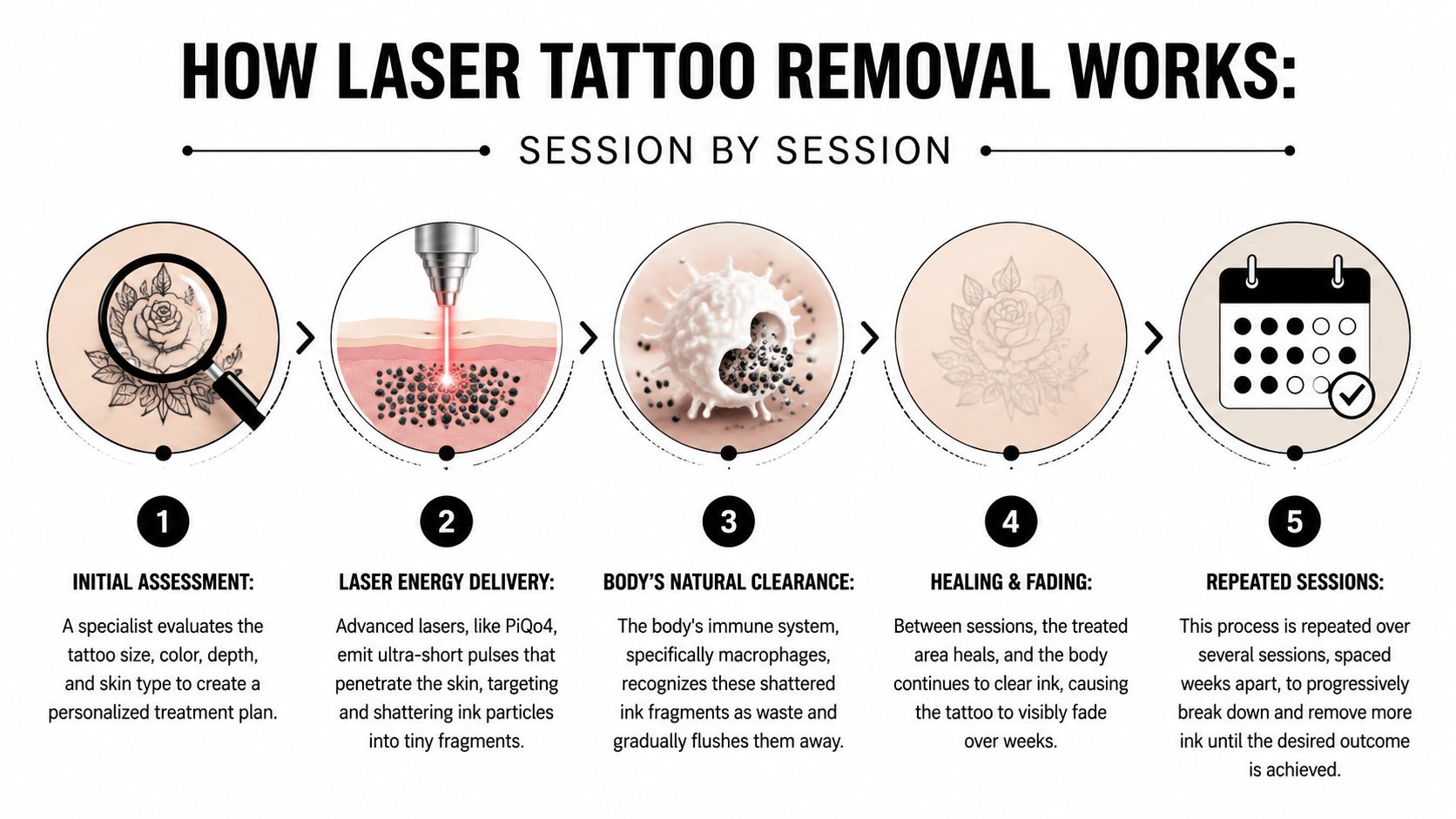
A tattoo stays visible because ink sits deep in the dermis in particles that are too large for the body to easily remove on its own. Laser treatment changes that. The job of the laser is to break those larger particles into much smaller fragments.
Consider this: Your immune system can carry away pebbles in a stream, but it can't move a boulder. The laser turns the boulder into pebbles.
What happens during each session
A specialist first looks at the tattoo's color, density, depth, and location. Those details shape the treatment plan because different tattoos respond differently.
Then the laser delivers very short pulses of energy into the tattooed skin. Modern PICO technology typically requires 5 to 12 sessions spaced 6 to 8 weeks apart for significant ink clearance, with a total treatment duration of 6 months to 2 years depending on ink density and location, according to this overview of how many sessions tattoo removal can take. If you want a beginner-friendly walkthrough of the process itself, this complete breakdown for first-timers explains the stages clearly.
Why one session never finishes the job
Each treatment only affects a portion of the remaining pigment. Some particles break apart more easily than others. Some are buried deeper. Some colors absorb laser energy better than others.
That's why fading tends to happen in layers. You may see one part of the tattoo lighten quickly while another section lags behind. That doesn't mean the treatment failed. It usually means different pigments and depths are responding at different speeds.
The laser starts the process. Your immune system finishes it.
Why the pause between sessions isn't optional
People often ask if they can come back sooner to get it over with. The reason technicians space sessions apart is simple. Skin needs time to settle, and the body needs time to clear what the laser just fragmented.
If you stack treatments too close together, you're not giving the previous session time to do its full work. In practical terms, that means more irritation, less efficient fading, and a process that can become harder to manage.
The most important part of the timeline often happens after you leave the clinic. The tattoo can keep softening and fading for weeks after a session, even though no laser is touching it during that time.
Factors That Influence How Many Sessions You Will Need
A better way to estimate tattoo removal is to ask two questions at once. How hard is this ink to break apart, and how quickly can your body carry those fragments away over the months between visits? Session count matters, but total calendar time comes from both parts working together.
That is why two tattoos of the same size can finish on very different schedules.
Ink color changes the pace
Different pigments respond to different wavelengths. Black usually clears fastest because it absorbs a broad range of laser energy well. Some colors, especially lighter tones, fluorescent inks, and mixed pigments, can be slower or remain partly visible.
Black ink tattoos on lighter skin treated with Q-switched ruby, alexandrite, or Nd:YAG lasers have a greater than 90% chance of complete clearance with a low complication rate, while red pigments treated with the frequency-doubled QS Nd:YAG often clear after an average of three treatments, according to the clinical review in NCBI Bookshelf on laser tattoo removal.
A multicolor tattoo often fades unevenly. One area may lighten quickly while another keeps hanging on. That uneven response can stretch the overall timeline because the last traces are often the slowest part.
Older tattoos often have a head start
An older tattoo has already been fading in the background for years. Sun exposure, skin turnover, and normal immune activity may have reduced how dense the pigment is before the first laser session even happens.
The Kirby-Desai scale overview from Removery includes tattoo age as one of the factors used to estimate treatment difficulty. In plain terms, older tattoos often start a few steps ahead of newer, heavily saturated work.
Location affects how long the calendar stretches
Placement influences more than discomfort. It often changes how fast fading shows up between appointments because circulation and lymphatic drainage are not equally strong everywhere on the body.
The Kirby-Desai prediction scale published in the Journal of Clinical and Aesthetic Dermatology assigns different scores to different body locations, with distal areas such as the lower leg, ankle, foot, wrist, and hand rated as harder to clear than the chest, back, or proximal upper extremity. The pattern matches what clinics see every day. Ink on hands and feet often takes longer on the calendar because each round of post-treatment clearing tends to be slower.
Professional ink usually takes longer
Professional tattoos are usually placed at a more consistent depth and packed with more pigment. Cover-ups add another layer of difficulty because there may be older ink underneath newer saturation.
The same NCBI clinical review notes that professional tattoos are significantly harder to remove than amateur ones and may require 15 to 20 sessions, while stubborn tattoos on extremities may need up to 25 sessions in some cases because slower circulation can limit how efficiently fragmented ink is cleared through the body.
That does not mean an amateur tattoo always disappears quickly. It means the starting amount and depth of pigment are often lower, which can shorten the overall process.
Skin tone affects treatment planning
Skin tone changes how a technician chooses settings, wavelength, and pacing. The goal is to target ink while leaving the surrounding skin as undisturbed as possible.
That can affect total time. A cautious treatment plan may use more gradual progress to lower the risk of unwanted pigment changes. From a client perspective, that can mean the process is still successful, but the timeline needs more patience.
| Factor | Easier to Remove (Fewer Sessions) | Harder to Remove (More Sessions) |
|---|---|---|
| How Different Factors Affect Your Removal Timeline | Older tattoos with some natural fading | Newer, saturated tattoos |
| Ink color | Black ink, and in some cases red with the right wavelength | Lighter or stubborn pigments |
| Tattoo location | Torso, upper arms | Hands, feet, lower legs |
| Ink density | Lighter, less saturated work | Dense professional tattoos, cover-up style layering |
| Skin considerations | Strong contrast between ink and skin can simplify targeting | More careful pacing may be needed when settings must be conservative |
For a practical summary of how age, color, placement, and ink density work together, this guide on factors that can affect tattoo removal progress lays them out clearly.
A tattoo's timeline follows biology. Pigment depth, color, placement, circulation, and skin response all shape how many treatments you need and how long the full calendar really becomes.
How Laser Technology Affects Removal Speed
The tool matters. Two clinics can treat the same tattoo with different laser systems and produce very different timelines.
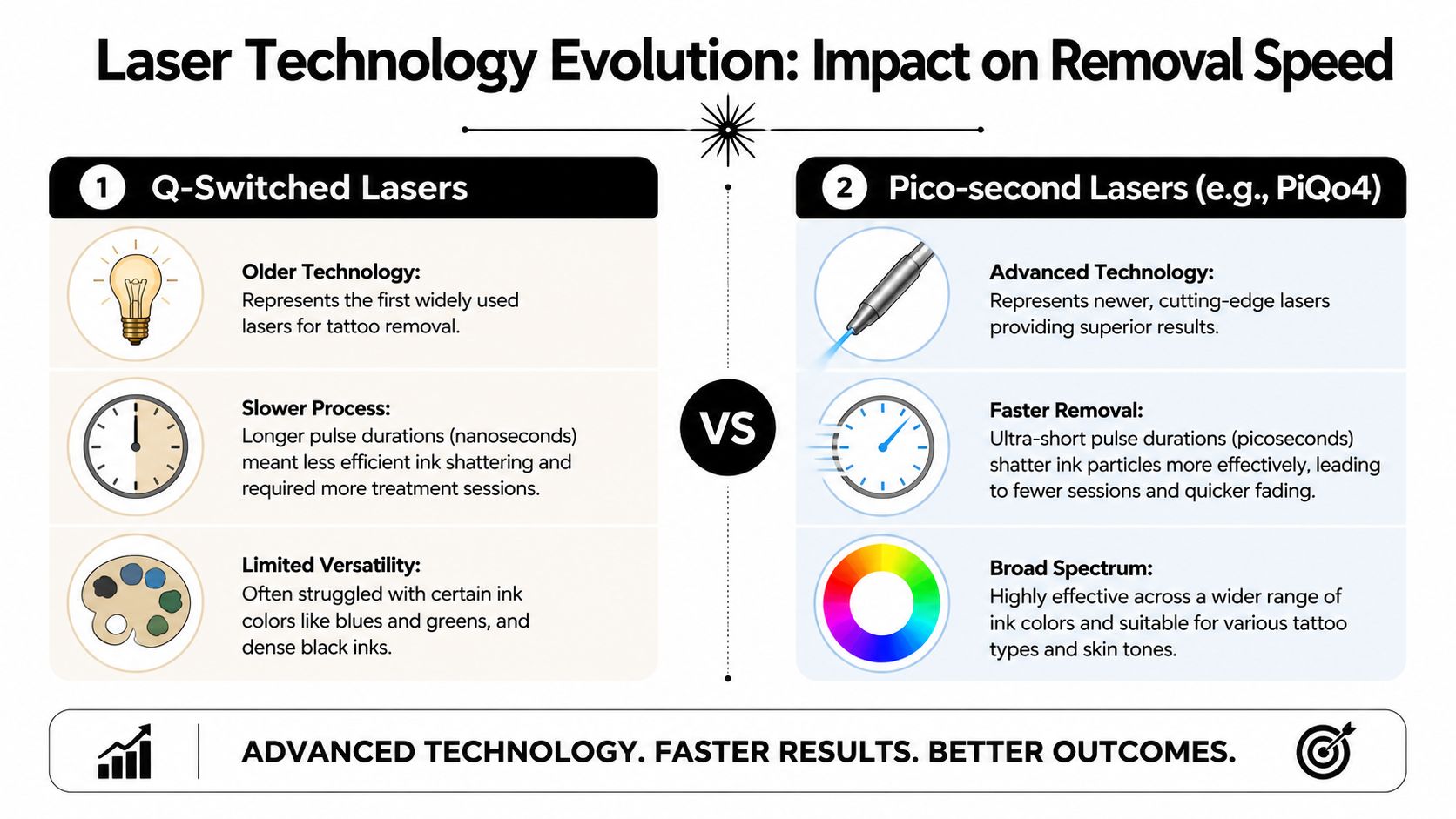
Older devices can remove tattoos, but they often do it less efficiently. Newer picosecond systems are designed to break pigment into finer fragments, which can make the body's cleanup job easier.
Older systems versus pico technology
Traditional Q-switched lasers work in nanoseconds. Picosecond systems work in even shorter pulses. That shorter pulse length changes how the ink breaks apart.
Newer pico-second laser technology such as PiQo4 removes tattoos up to 75% sooner than traditional Q-switched nanosecond lasers, which historically required up to 20 sessions for stubborn tattoos, according to this review of factors that determine tattoo removal success.
Why smaller fragments matter
Go back to the pebble analogy. If an older laser creates larger debris, the body still has more work to do. If a pico laser creates finer dust-like fragments, immune cells can often process that material more efficiently.
That doesn't mean every tattoo clears quickly. It means the technology can shorten the path for some clients by reducing how much resistant pigment remains after each treatment.
Some clinics use modern systems specifically to improve efficiency on stubborn colors and dense professional ink. For example, EradiTatt Tattoo Removal discusses newer tattoo removal technology in the context of treatment planning and expected progress.
Better technology doesn't cancel biology. It improves how effectively each session starts the fading process.
The Healing and Fading Process Between Treatments
The hardest part for many clients isn't the appointment. It's the waiting afterward. You leave the clinic, the tattoo still looks like a tattoo, and you wonder whether anything happened.
That feeling is normal. Laser tattoo removal is one of those treatments where progress often shows up gradually, not dramatically.
What the first days can feel like
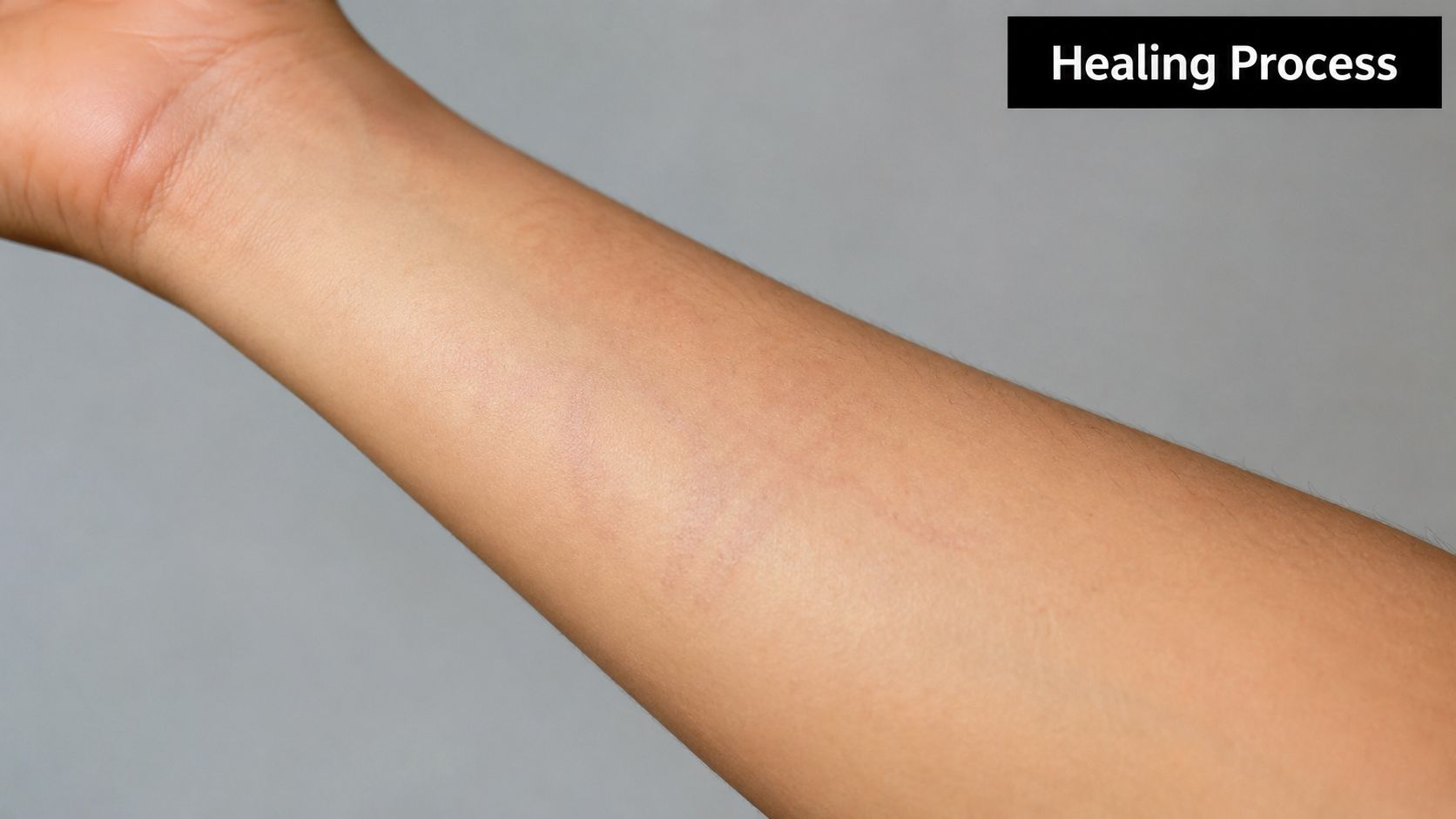
Right after treatment, the area may look frosted or chalky for a short time. Many people describe the skin afterward as feeling similar to a sunburn. Some also notice temporary swelling or mild blistering as the area reacts and starts healing.
Those early changes are only the beginning. The deeper work happens over the following weeks as the body processes the disrupted pigment.
A typical between-session rhythm often looks like this:
- Early phase: The skin feels irritated and looks freshly treated.
- Middle phase: Surface healing settles down.
- Later phase: The tattoo gradually softens, lightens, or breaks up unevenly as ink clears.
Why fading keeps happening after you leave
A lot of clients expect visible improvement right away. Sometimes they see it quickly. Sometimes they don't. That delay doesn't mean the session was wasted.
Real-world patient data found that 47% of tattoos required over three years for complete removal, with the common range falling between seven and ten sessions, often because treatments were spaced 8 to 12 weeks apart to support immune clearance, according to this real-world review of how long people actually wait between sessions.
That statistic matters because it accurately answers the question. The total time isn't only about how many times the laser fires. It's about how many healing cycles your tattoo needs.
Some tattoos fade in a smooth, steady way. Others stall, then suddenly lighten after a later session. Both patterns can be normal.
If you're planning removal for a deadline, give yourself more room than you think you'll need. Skin response, fading speed, and scheduling gaps can stretch the process beyond the ideal timeline on paper.
Your Tattoo Removal Questions Answered
Can I speed up the process
You can support the process, but you can't force your skin to heal faster than it safely can. Good aftercare, staying consistent with appointments, and giving your body time to recover all help. Trying to rush sessions too closely usually works against you.
A pilot study by Dr. Robert Burke found that 3-week intervals were feasible for many patients and could shorten overall treatment time by 63% compared with existing average treatment times, but the study group averaged only 3.5 treatments with 22 days between sessions and tattoos had not completely cleared by the end of the study, as reported in PM360's coverage of 3-week tattoo removal intervals. In most real-world settings, longer spacing still remains the standard approach.
What if I only want fading for a cover-up
That's often a shorter journey than full removal. If your goal is to lighten the tattoo enough for a new design, you may not need to chase every last trace of pigment.
This is a good conversation to have at consultation. A cover-up plan depends on how much opening the tattoo artist needs in the old design, not on achieving total clearance.
Does it hurt more each time
Not necessarily. Sensitivity can vary by body area, skin condition, and how much ink remains. Some people find early sessions sharper because the tattoo is dense. Others notice later sessions more because the skin has already been treated before.
What matters most is that settings are adjusted to the tattoo's progress and your skin's response. Treatment should be purposeful, not aggressive for the sake of speed.
If you're trying to figure out whether your tattoo is likely to take months or years, a personalized consultation is the clearest next step. An experienced technician can assess color, density, location, age, and your end goal, whether that's full removal or fading for a cover-up.
If you want a personalized estimate and a clear plan for your tattoo, book a consultation with EradiTatt Tattoo Removal. EradiTatt serves clients across Florida, including Orlando, Bradenton/Sarasota, St. Petersburg, Palm Harbor, and Tampa, and can help you map out a realistic timeline based on your tattoo, your skin, and whether you want complete removal or fading for a cover-up.