
Yes, you can fully remove a tattoo, and modern multi-wavelength systems can target over 9 of the most common ink colors, including difficult blues and greens. Complete removal is possible for most tattoos, but getting all the way to clear skin depends on the tattoo itself, your skin, your healing response, and the quality of the treatment plan.
If you're reading this, there's a good chance you're staring at a tattoo you don't want to keep living with. Maybe it no longer fits your life. Maybe it reminds you of a version of yourself you're done with. Maybe you don't hate tattoos at all, you just hate this one.
The biggest mistake people make is asking one simple question and expecting a simple answer. Can you fully remove a tattoo? Usually, yes. But "yes" doesn't mean instant, identical for everyone, or guaranteed in the same way for every color, placement, and skin type. The difference between full removal and significant fading often comes down to a handful of specific factors that can be assessed up front.
Table of Contents
- So Can a Tattoo Be Completely Erased
- How Laser Technology Makes Removal Possible
- The 7 Key Factors That Determine Full Removal Success
- Your Tattoo Removal Timeline From First Session to Final Results
- Minimizing Risks With Professional Aftercare
- Fading for a Cover-Up A Strategic Alternative
- Finding a Qualified Tattoo Removal Clinic in Florida
So Can a Tattoo Be Completely Erased
Yes, a tattoo can be completely erased. The better answer is yes, if the tattoo is a good candidate and the process is handled correctly.
That matters because not every tattoo behaves the same way under a laser. A lightly packed black script tattoo on the upper arm often has a very different path than a dense multicolor ankle piece, a layered cover-up, or a tattoo with scar tissue already in the skin. When people hear "it depends," they often think that means no one knows. In practice, it means the outcome is shaped by factors we can evaluate.
What full removal really means
When people ask whether they can fully remove a tattoo, they're usually asking one of two things:
- Will the ink disappear visually: In many cases, yes.
- Will the skin look exactly like nothing was ever there: Sometimes, but not always.
That's an important distinction. The laser removes pigment. It doesn't erase every possible sign that the skin was tattooed in the past. If the original tattoo left textural change or scar tissue, that can remain even after the ink is gone. If the skin develops temporary pigment changes during the process, those need time and careful management.
Practical rule: Judge success by whether the unwanted tattoo is no longer visible, not by the fantasy that every skin surface returns to a perfect pre-tattoo state overnight.
What moves the needle most
A realistic assessment starts with a few variables:
- Ink color: Some colors break down more easily than others.
- Tattoo location: Areas with better circulation tend to clear more efficiently.
- Ink density: Heavy saturation takes longer to break apart.
- Skin tone and skin response: Treatment settings must respect melanin and healing patterns.
- Age of the tattoo: Older tattoos often fade more readily.
- Scarring or cover-up layers: Extra complexity slows the process.
- Overall health: Your body does the clearing after the laser does the breakup.
If you want a straight answer, here it is. Consider tattoo removal in terms of a process of progressive clearing, not a one-session event. The tattoos most likely to reach full clearance are usually the ones with favorable color, placement, and ink load. The tattoos least likely to vanish completely are usually the ones with resistant color mixes, high saturation, layering, or pre-existing skin change.
How Laser Technology Makes Removal Possible
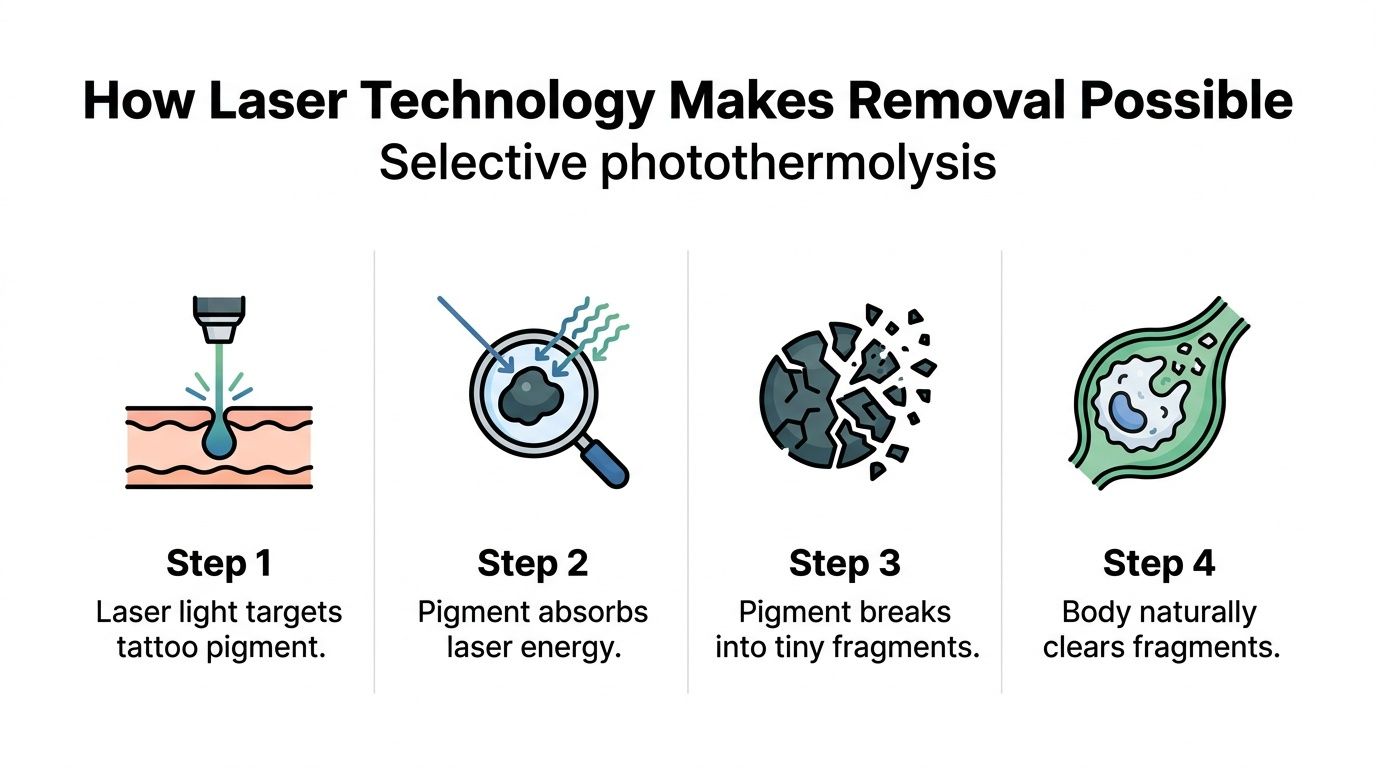
Laser tattoo removal works because the laser doesn't try to scrape ink out of the skin. It sends light into the pigment and breaks the pigment apart while aiming to leave surrounding skin as undisturbed as possible. That's the core idea behind selective photothermolysis.
The boulders and pebbles analogy
The easiest way to understand it is this. Tattoo ink starts out like a pile of buried boulders. Your body can't easily haul those boulders away on its own, so the tattoo stays visible. The laser acts like a very precise hammer. Each pulse hits the pigment and shatters those big boulders into much smaller pebbles.
Once the pieces are small enough, your body's cleanup system can start carrying them away over time. That's why removal is gradual. The fading you see after treatment isn't the laser magically making the tattoo disappear on the table. It's the result of the laser breaking pigment down, followed by your body clearing the fragments in the weeks after.
The laser does the breaking. Your body does the removing.
Why wavelength matters
Different ink colors absorb different wavelengths of light. That's why older single-wavelength devices often struggled with certain pigments. A tattoo isn't one target. It's a mix of targets, and each one responds differently.
Advanced multi-wavelength laser systems, like the PiQo4 used by EradiTatt, can effectively target over 9 of the most common ink colors, including notoriously difficult blues and greens, leading to significantly higher clearance rates than single-wavelength lasers, according to Candela's PiQo4 technology overview.
That doesn't mean every color vanishes equally fast. It means modern technology can address a much wider range of tattoo pigments than older systems could.
What a session actually does
A treatment session creates a controlled reaction in the ink and skin. The treatment isn't about brute force. Good removal is about matching the right settings to the tattoo, then letting healing happen before the next pass.
If you want a broader look at where laser systems have improved, this overview of new tattoo removal technology is a useful starting point.
A good clinic doesn't chase dramatic short-term reactions. It aims for repeatable progress, because the safest path to high clearance is steady fragmentation and steady healing.
The 7 Key Factors That Determine Full Removal Success
Two people can have tattoos that look similar from across the room and have very different removal outcomes. That's why "can you fully remove a tattoo" should really be followed by "what kind of tattoo are we talking about?"
Impact of factors on tattoo removal difficulty
| Factor | Easier to Remove | More Difficult to Remove |
|---|---|---|
| Ink color | Dark inks that absorb laser energy readily | Mixed or resistant colors |
| Tattoo age | Older, naturally faded tattoos | Fresh, crisp, highly saturated tattoos |
| Body location | Areas with stronger circulation | Farther-from-core areas with slower clearing |
| Ink density | Fine line or lighter packing | Dense fills and heavy saturation |
| Skin tone | Skin that allows broader settings safely | Skin that requires more conservative treatment |
| Scarring | Smooth skin with minimal texture change | Raised, fibrotic, or previously scarred areas |
| Layering and health | Single-pass tattoo with solid healing capacity | Cover-ups, reworked tattoos, or slower healing patterns |
Color is often the first make-or-break variable
Black usually responds well because it absorbs laser energy efficiently. That doesn't mean every black tattoo is easy. A dense black tribal piece still asks a lot more of the process than delicate black lettering.
Turquoise, bright blends, and unusual mixes can be more stubborn. So can tattoos where the artist layered several colors into the same area. Even with better modern systems, resistant pigments tend to separate more slowly and less evenly than straightforward dark ink.
Placement changes the pace
Location matters more than is often realized. A tattoo on the shoulder or upper arm often behaves differently than one on the ankle, hand, or foot. The farther you get from the body's central circulation, the more gradual the cleanup tends to be.
A black ankle tattoo can be tougher than a black shoulder tattoo for that reason alone. Same color. Same basic style. Different biology.
Dense packing versus light packing
Some tattoos are built like watercolor. Others are built like a wall. The more ink the skin is holding, the more fragmentation and clearance has to happen before the tattoo disappears from view.
You can usually spot this in:
- Professional saturation: Crisp fills and heavy color packing often take more work.
- Multiple passes from the original artist: Reworked areas may contain more pigment than they appear to.
- Cover-up sections: Darker zones often hide more than one layer of ink.
For a closer look at variables that can change progress, factors that affect tattoo removal progress lines up with what we see clinically every day.
Skin tone affects settings, not candidacy
People sometimes hear that skin tone matters and assume that means they aren't a candidate. That's not the right takeaway. Skin tone affects how treatment is performed, especially how conservatively settings are chosen to protect melanin-rich skin.
That changes pace, not possibility. The goal is to remove ink while minimizing unwanted pigment changes in the surrounding skin. In experienced hands, that usually means a more deliberate treatment rhythm, not giving up on clearance.
The right question isn't "Can my skin be treated?" It's "Will the clinic treat my skin with the right level of caution?"
Scarring and overall health matter more than people think
If the original tattoo left raised lines, shiny areas, or uneven texture, the laser can remove the pigment in that tissue, but it won't necessarily remove the texture itself. That can create the impression of a tattoo "shadow" even when most of the visible ink is gone.
Your healing response matters too. The body is the cleanup crew. People who recover predictably, protect the area, and follow instructions tend to move through the process more smoothly than people who expose the area to friction, sun, and repeated irritation.
Your Tattoo Removal Timeline From First Session to Final Results
Most tattoos don't disappear in one dramatic leap. They fade in stages, and the weeks between treatments matter as much as the appointment itself.
The first visit and the first treatment
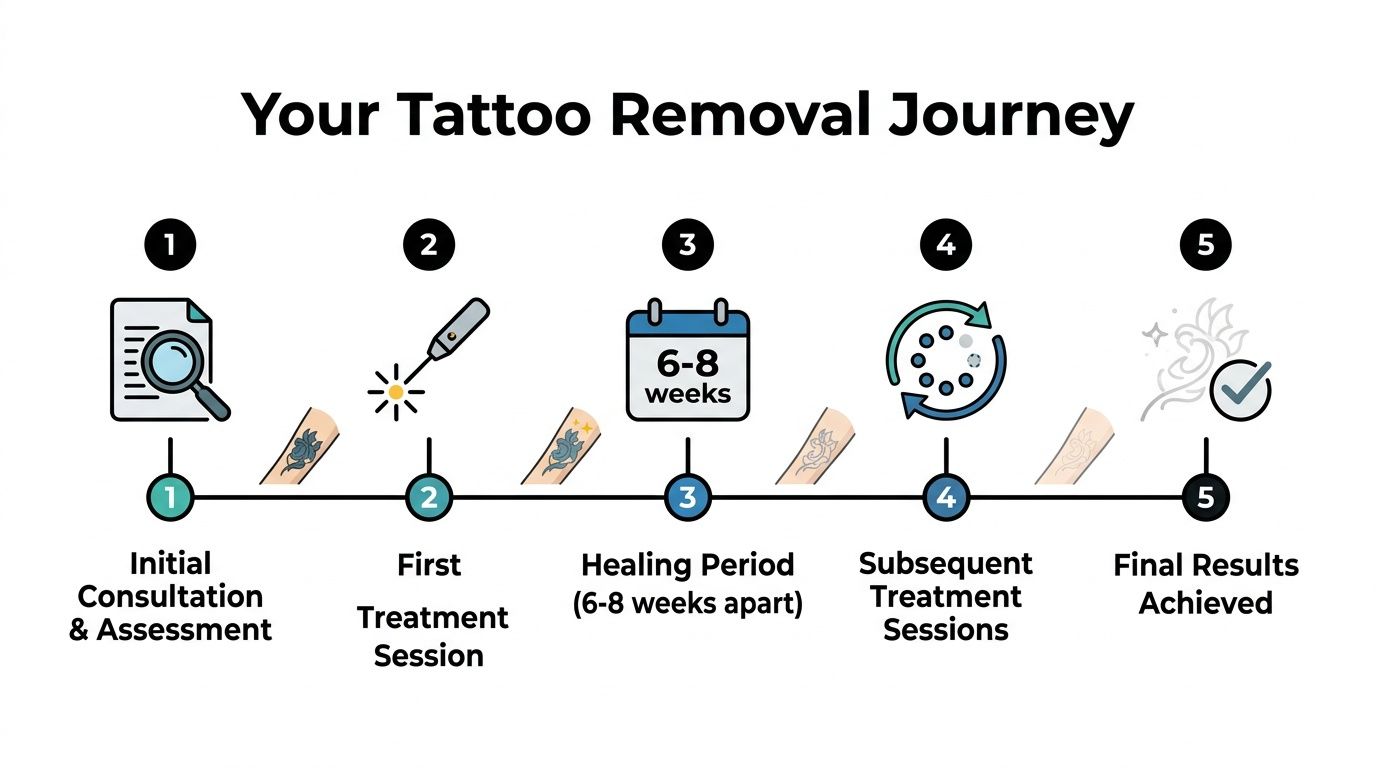
The process starts with an assessment. The practitioner looks at color, saturation, location, layering, skin tone, and whether the tattoo appears scarred or texturally changed. That consult should end with a realistic plan, not a promise that everything will be gone on a fixed date.
During treatment, the laser delivers quick pulses into the tattooed area. Right after, it's common to see temporary whitening, redness, warmth, and swelling. None of that means the tattoo is gone. It means the skin and pigment have reacted as expected.
Why spacing matters
Sessions are typically spaced 6 to 8 weeks apart because your body needs time to process the fragmented pigment and your skin needs time to recover. For practical insight into how long the full process can take, this guide on how long tattoo removal takes gives a useful overview.
Treating too close together usually doesn't speed results. It often just stacks irritation on top of healing tissue. Think of each appointment as setting the next phase in motion, then stepping back so the body can do its work.
What fading looks like over time
The pattern is rarely perfectly linear. Some sessions create dramatic visible change. Others look subtle for a while and then seem to "catch up" later. That's normal.
A typical experience often looks like this:
- Early treatments: The tattoo may look slightly patchy or softer around the edges.
- Middle phase: More sections begin to break apart unevenly, especially in mixed-color pieces.
- Late phase: Residual pockets, faint haze, or stubborn fragments become the main focus.
- End point: The remaining question becomes whether you're aiming for complete clearance or whether you've already reached enough fading for your goal.
Patients do best when they expect progress, not instant perfection.
What people get wrong about the timeline
The biggest misunderstanding is assuming the appointment creates the result. It doesn't. The appointment starts the result. The visible clearing shows up later, after inflammation settles and the body starts moving out pigment fragments.
Another common mistake is tying self-worth to speed. Some tattoos fade fast. Others negotiate. If your tattoo is dense, layered, or on a slower-clearing part of the body, the timeline reflects the tattoo's complexity, not failure.
Minimizing Risks With Professional Aftercare
Good treatment can be undermined by poor aftercare. That's not said to scare you. It's said because the skin needs support after each session, and the best cosmetic outcome depends on respecting the healing window.
What can happen after treatment
Common short-term reactions include redness, swelling, tenderness, blistering, scabbing, and temporary pigment change. Hyperpigmentation and hypopigmentation are the ones people worry about most because they affect how the skin tone looks during recovery.
These risks don't mean laser tattoo removal is unsafe. They mean the treatment has to be performed responsibly, and healing has to be managed responsibly too. A careful clinic reduces avoidable risk through settings, cooling, spacing, and clear instructions. The patient reduces avoidable risk by following those instructions.
What aftercare should look like in real life
Aftercare isn't complicated, but it does require discipline.
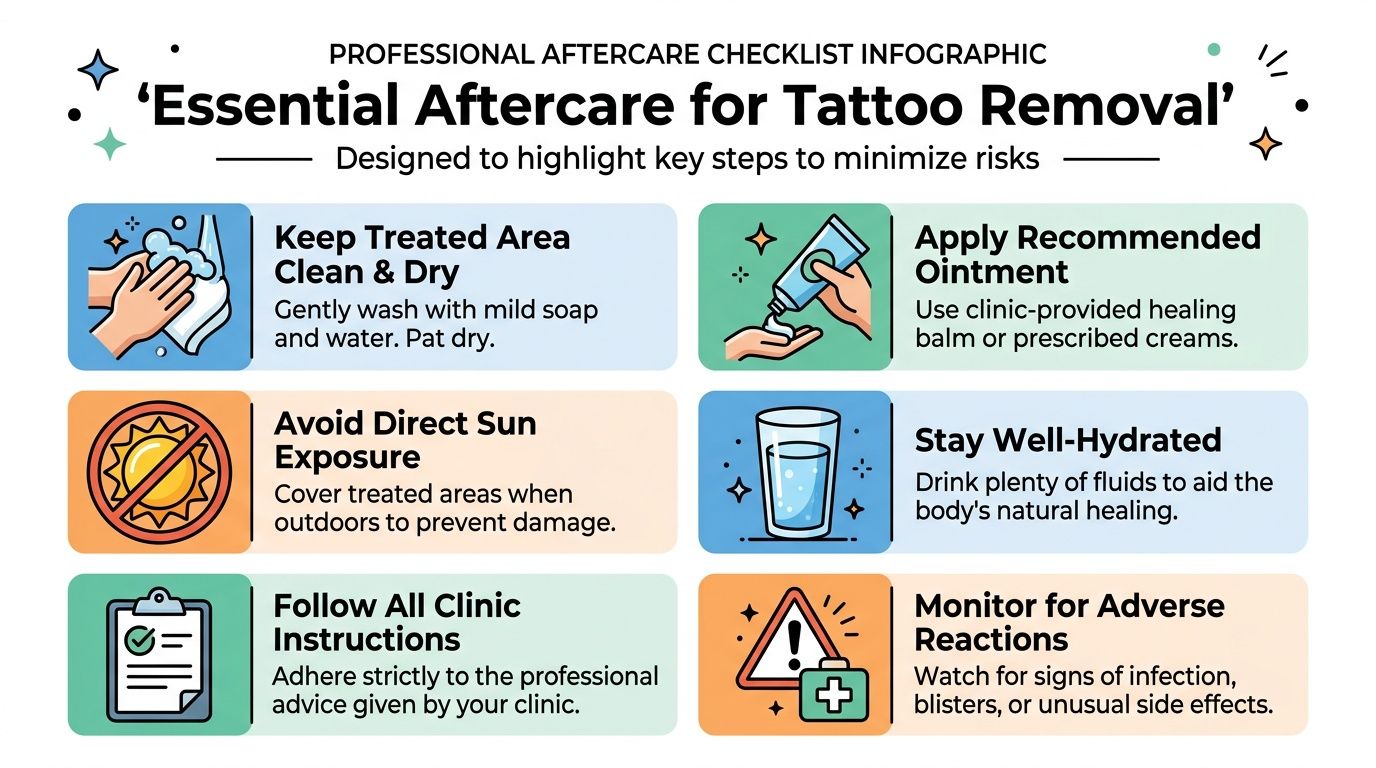
- Keep it clean: Wash gently as instructed and don't scrub the treated area.
- Protect the skin barrier: Use only the ointment or healing product your clinic recommends.
- Leave blisters and scabs alone: Picking turns a temporary healing response into unnecessary trauma.
- Reduce friction: Tight clothing, gym abrasion, and repeated rubbing slow recovery.
- Hydrate and recover: Healthy healing supports the body's cleanup work.
Sun exposure is where people sabotage results
Freshly treated skin and direct sun don't mix well. If the treated area darkens after exposure, recovery gets more complicated and the risk of lingering discoloration goes up. That's one reason consistent sun protection matters so much during the removal process.
If pigment unevenness is already a concern, this resource on combatting dark spots with SPF is worth reading because it explains how sunscreen fits into protecting vulnerable skin from getting darker while it heals.
Aftercare warning: Don't judge the skin in the first few days. Judge it by how well you protect it through the full healing cycle.
When to contact your clinic
You shouldn't be left guessing. Reach out if swelling seems excessive, discomfort escalates instead of easing, or the area looks unusual in a way that wasn't explained during your visit.
A strong clinic gives written aftercare, explains what normal healing looks like, and makes it easy to ask questions. That support isn't a bonus. It's part of safe removal.
Fading for a Cover-Up A Strategic Alternative
Full removal isn't the right goal for everyone. Sometimes the smarter move is strategic fading.
If you still want a tattoo in that area, complete clearance may be unnecessary. A cover-up artist doesn't need perfectly blank skin. They need less visual interference from the old design. When the original tattoo is faded down enough, the artist has more freedom with line work, color choice, placement, and negative space.
Full removal versus fading
The difference is the finish line.
- Full removal: You're trying to eliminate visible tattoo pigment as completely as possible.
- Fading for a cover-up: You're trying to reduce the old tattoo enough that new work can sit cleanly over it.
That second goal can save time, reduce total treatment burden, and open up better design options. It also prevents a common mistake, which is over-treating a tattoo that only needed to be lightened.
When fading makes more sense
Fading is often a strong option when:
- You still like tattoos: You want a new design, not bare skin.
- The existing piece is too dark to cover well: Lightening gives your artist room to work.
- You don't need every trace gone: You just need the old image to stop dominating the area.
This isn't "settling" because full removal didn't work. It's choosing the right objective from the start. In many cases, a partially faded tattoo is the most efficient path to the look you want.
Finding a Qualified Tattoo Removal Clinic in Florida
A clinic should be able to explain why your tattoo is a good candidate, a hard candidate, or something in between. If the consultation sounds like a sales pitch instead of a clinical assessment, keep looking.
What to check before you book
Start with the equipment. Multi-wavelength capability matters because tattoos aren't monochrome in how they respond. If a provider can't explain how the system addresses different ink colors, that's a problem.
Then look at experience and process:
- Consultation quality: They should assess color, placement, density, skin tone, and texture.
- Treatment planning: They should talk about goals, including full removal versus fading.
- Risk discussion: They should explain side effects and aftercare clearly.
- Pricing transparency: You should understand how sessions are billed before treatment starts.
Why local access matters
Tattoo removal is not a one-visit service. Convenience matters because you'll be returning over time. For Florida patients, a provider with multiple locations can make it easier to stay consistent with treatment and follow-up.

EradiTatt Tattoo Removal offers laser tattoo removal consultations in Florida locations including Tampa, Orlando, St. Petersburg, Bradenton/Sarasota, and Palm Harbor, with scheduling available through a central phone line.
Questions worth asking in the consult
Bring direct questions and listen for direct answers.
- What makes my tattoo easier or harder to fully remove?
- Am I a better candidate for total clearance or cover-up fading?
- What signs of pre-existing scarring do you see, if any?
- How will you adjust treatment for my skin tone and tattoo colors?
- What should I expect the area to look like as it heals?
A qualified clinic won't promise magic. It will give you a realistic map.
If you're ready to find out whether your tattoo is a good candidate for full removal or better suited for strategic fading, schedule a consultation with EradiTatt Tattoo Removal. A proper assessment can tell you what matters most for your tattoo, your skin, and your end goal.